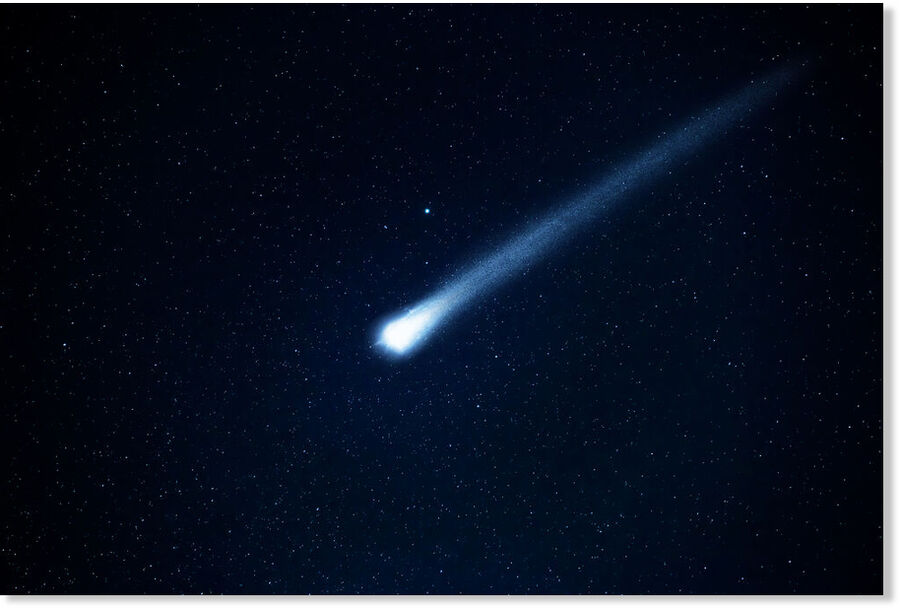
Fireballs
For weeks, there's been hardly anything reported in Florida to the American Meteor Society, but suddenly at 9 p.m. it had a flurry of sightings.
The reports largely covered a triangle from Naples through Sanibel and Sarasota to Tampa Bay and across the I-4 corridor through Polk County to Leesburg, Sanford and DeLand.
Experts have ruled out both the Comet NEOWISE, which was supposed to be potentially seen later this week, and the upcoming Perseids.
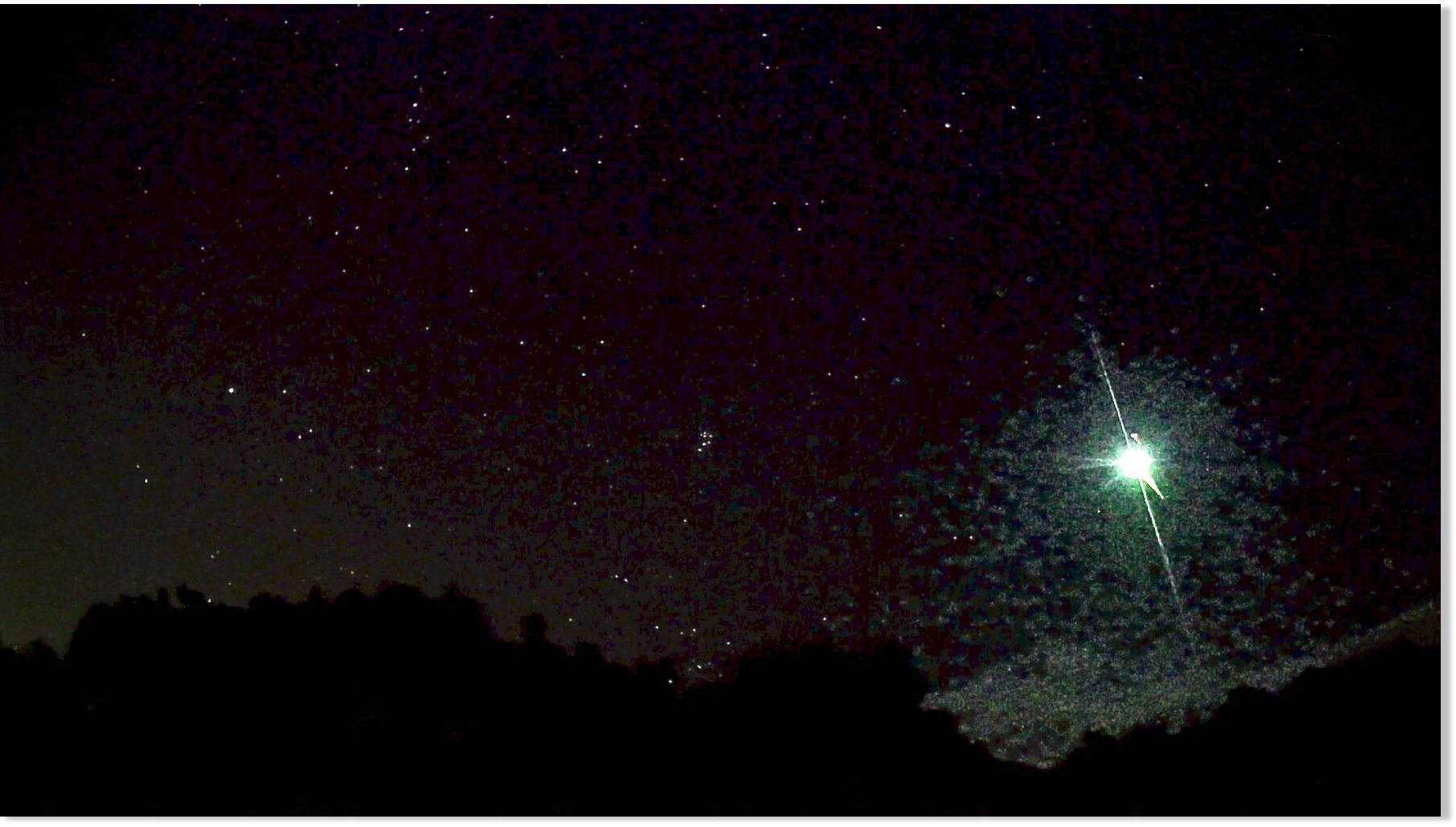
Pictures captured on the Central Coast show a ball of light burning with a green tinge.
Others filmed the event streaking through sky over the Sydney CBD.
Social media was alight with Sydneysiders sharing pictures and videos of the meteor.
"Did anyone just see a meteor or something go down over Sydney just now?" one person asked.
"Looked like a fireball. Looked green to me."
The unbelievable amount of precipitation during the past months can be explained with the increasing amount of charged particles in upper layers of the atmosphere.
When meteors and meteorites pass through our lower atmosphere, or when our planet goes trough a comet dust stream, charged particles accumulate between the ionosphere and the surface of the earth causing storms to intensify, clouds to grow and more rain to fall. Wildfires and volcanic eruptions, for example, also contribute to this accumulation of particles.
At the same time, rain can conduct the accumulated electrical charge of the ionosphere to the ground, which increases the occurrence of other electrical phenomena, as tornadoes, hurricanes and plasma formations.
The accumulation of charged aerosols and increasingly colder temperatures in upper layers of the atmosphere - caused by the current solar minimum - can also be responsible of the increasing amount of hail and unseasonable snow around the world.
Charged particles influence weather much more than has been appreciated.
Heavy rain and raging floods took the life of hundreds and affected millions in south China, and destroyed 1,470 houses and 3 bridges in Gorontalo Province, Indonesia. Heavy floods also hit Assam, India leaving 16 dead and over 253,000 affected.
While Romania got its second coldest day in June, Montana got more than 1 foot of snow and southeast Wyoming got 6 inches... just at the beginning of summer.
Siberia got a share of extreme weather this month, from tornadoes to floods and extreme temperature swings.
A 7.5-magnitude earthquake rattled large swaths of southern and central Mexico, killing at least five people. No major damage was reported.
Locusts continued to ravage Africa, India, Brazil, Argentina and the Middle East, with no sign that they'll be gone soon.
All that and more in our SOTT Earth Changes Summary for June 2020:
The event was recorded in the framework of the SMART project, which is being conducted by the Southwestern Europe Meteor Network (SWEMN). The event was spotted from the meteor-observing stations located at Sevilla, Calar Alto (Almería), La Sagra (Granada) and Sierra Nevada (Granada).
Fire and police officials checked around looking for a source of the sound early in the morning and could not locate anything that might be the source, an Aspen Police and Fire Department official said Friday morning. They thought it might have been a transformer of some kind because it was louder than a gunshot.
A Holy Cross Energy spokesperson said they were not aware of any transformer damage or a disruption of service Friday morning in the Aspen area.
Many people reported hearing the loud sound echoing in the upper valley. Police and fire officials said it was not the Smuggler Mine cannon that is shot off on Fourth of July at 6 a.m. each year by the owners.

A huge fireball crosses the sky above the Kanto region at around 2:32 a.m. on July 2. (Captured from a video taken by Kagaya)
Social media came alive after the 2:30 a.m. sightings, with many people saying they heard a large bang. Some said they mistook the sound for noise made by neighbors.
"I thought a person living (in the condo) above knocked down a shelf," wrote one Twitter user, while another said, "I thought my child sleeping on the second floor fell out of bed."
Others witnessed the sky suddenly light up.

An illustration of how a meteorite struck Earth 4 billion years ago.
Living organisms are said to have emerged on Earth 4 billion years ago. A large number of meteorites are believed to have bombarded the planet 200 million years before and after the birth of life.
"Materials needed for the start of life may have been generated over long periods, offering a chance for life to appear," said Yoshihiro Furukawa, an associate professor of geochemistry at Tohoku University.
Furukawa and his colleagues primarily from the university put carbon dioxide, nitrogen, water and iron in a container to reproduce conditions of primordial times. The vessel was then struck with a piece of metal to simulate the impact from a meteorite.
The meteoroid stream is unusual in that its orbit is nearly exactly perpendicular to the plane of the planets, having an inclination of 90.2 +/- 1.0 degrees. The shower has received the name "chi Phoenicids" and has been added as number 1036 to the list of meteor shower names maintained by the International Astronomical Union. A telegram announcing the discovery (CBET 4798) was issued today.
Paul M Smith was recording storms over Kansas when he captured the likely bolide (meteor brighter than the planet Venus) illuminating the night sky.
According to locals, an explosive sound was heard when the object fell from the sky. The fall and the sound resulted in panic in the area.
The object was emitting heat even three hours after it crashed leading many to believe it may explode. As a result, the administration advised locals to stay away. After it cooled down, it was put in a jar. According to the police, the object will be investigated by experts.
"There was a massive sound in the morning when the object fell from the sky -- it was as if an airplane had crashed. However, no one could spot what had fallen. It was only after sometime that the object was noticed in a one-foot-deep pit in the ground. It had fallen about 100 metres from my house. We immediately informed local authorities," says Ajmal Devasi, a local.
Mangal Singh, Information Bureau Inspector, Jalore district, said, "After we received information about the unidentified object, department officials reached the spot. The unidentified object was found to be three kilometers heavy and was very hot. Investigation is underway."


Comment: In February this year a meteorite hit a factory compound in Alwar, Rajasthan, India reportedly causing a 20-feet deep crater.
Other reported meteor impacts so far this year include: