Storms
S


Bizarro Earth

81 U.S. Midwest tornadoes highly unusual for November

Tornadoes
© Good Morning America
After one of the quietest U.S. tornado seasons in 40 years, Sunday was nature's comeback, with a total of 81 tornado reports in Illinois, Kentucky, Missouri, Indiana and Ohio.

Illinois was the hardest hit, with 43 tornadoes, followed by 23 in Indiana, 13 in Kentucky, one in Missouri and one in Ohio.

According to the National Weather Service's preliminary ratings, New Minden, Ill., in the southern part of the state, was in the swirl of an EF4 tornado, with winds of at least 166 mph. In Washington, Ill., the tornado, also an EF4, packed even more force, with winds from 170 to 190 mph.

According to the climatology of U.S. tornadoes in the Midwest, twisters of such force were unusual for this time of year. In the lower 48 states, the peak of severe weather and tornadoes usually occurs in April and May; November is known as the second peak for severe weather.

Cloud Lightning

28 die in Vietnam floods, 9 missing - 80,000 displaced

Image
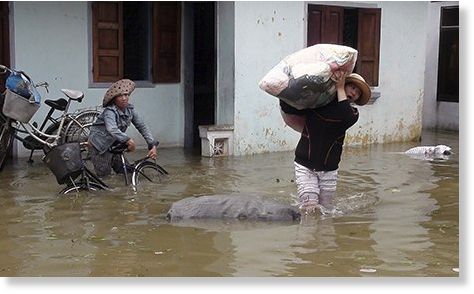
© Vietnam News Agency/AFP/Getty ImagesResidents move their belongings from a flooded house in Qui Nhon city, central Vietnam.
Flooding in Vietnam has killed at least 28 people since Friday, with nine others missing and nearly 80,000 displaced, state media and government reports said, after a tropical depression dumped heavy rains across central regions of the country.

In Quang Ngai province, where nine were killed and four people are missing, flood waters rose above a previous peak measured in 1999, submerging many houses, the official Thanh Nien (Young People) newspaper reported on Sunday.

Flood waters rose quickly after 15 hydro power plants in the central region opened their sluice gates to release water in reservoir protection, the newspaper reported.

Around 100,000 houses were submerged and nearly 80,000 people have been evacuated, the government-run committee on floods and storm protection said in a report. Roads have been closed due to floods and some national train services canceled.

Binoculars

Video: Extreme weather, fireballs and UFOs of November, 2013

As the title indicates, so far this month, we've seen more extreme weather, more sinkholes, a volcano erupting that had been dormant for 400 years, more fireballs, UFOs and strange 'sky' sounds. They're all definitely signs of the times!


Cloud Lightning

NOAA images show wind farms distort weather radar data, affecting their primary mission of forecasting and safety

"Chaotic wind velocities associated with the rotating turbine blades triggers the doppler radar mesocyclone detection algorithm"

Note: this essay was written by the National Weather Service Forecast Office in Burlington, Vermont and tipped to me by a reader. Vermont's wind farm acreage pales in comparison to places like the Texas and Oklahoma, where there are literally thousands of acres of wind farms right in the middle of tornado alley. I've been there and seen them firsthand.
wind farm doppler
Certified Consulting Meteorologist Mike Smith writes:

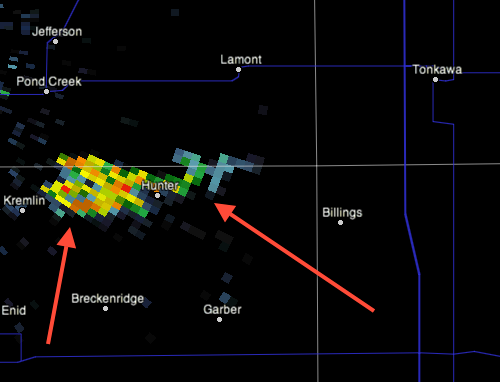
"While driving to Norman, OK recently I saw the newest "wind farm" to the west of Interstate 35 southwest of Tonkawa. Wind farms show up as bright ground clutter on weather radars and here it is."
One has to wonder just how much trouble wind farms are causing the nation's doppler radar warning system. It looks like a classic case of the law of unintended consequences at work. - Anthony


National Weather Service WSR-88D Radar and Wind Farm Impacts


Introduction

The most valuable tool used by the National Weather Service (NWS) to detect precipitation is the radar. Radar stands for Radio, Detection, and Ranging, and has been used to detect precipitation since the 1940′s, with most of the technology coming from the military.

Family

'Two out of five corpses are children' says survivor of Philippines typhoon Haiyan

Image
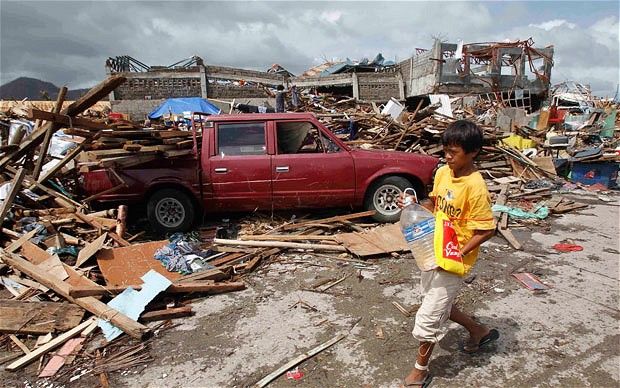
© REUTERS/Romeo RanocoTacloban City, where two out of five killed by Typhoon Haiyan were children, according to aid worker
Survivor of what may be the strongest storm ever to make landfall tells of terrible destruction in Tacloban City

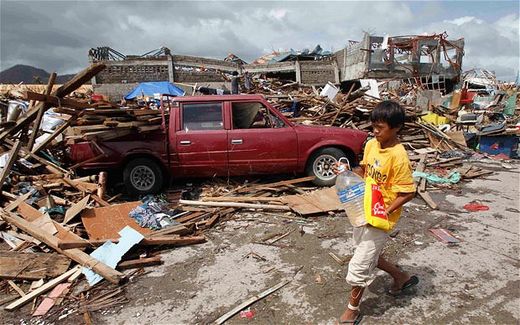
Only when Lynette Lim started to walk into Tacloban City, a few hours after 'Super' Typhoon Haiyan wreaked unimaginable devastation across the Philippines, did she realise how lucky she herself had been to survive the storm.

"Everything was just flattened," said Miss Lim, the Asia communications manager for Save the Children, who arrived in Tacloban with a group of aid workers assessing the potential need for help just 24 hours before Haiyan smashed into the city on Friday.

"The water was knee high and there were bodies floating in the streets. I saw several dead children. I'd say two out of every five corpses I saw were kids. Most of the houses were wooden and they were completely destroyed.

"There were trees and electrical poles strewn across the road and corrugated iron roofing that had been ripped off houses."

Making her way through the villages south of Tacloban, she discovered the full extent of the horrific damage caused by winds that came close to 200mph, and storm surges that sent waves as high as the second storey of houses crashing ashore.

"Everywhere we went, people told us between 10 and 50 people had been killed in their communities," said Miss Lim. "Most of the families who had decided to evacuate ahead of the storm left one member behind to guard their homes and possessions. Unfortunately, most of them died."

Bizarro Earth

Deadly, rare tropical cyclone hits Somalia

Tropical Cyclone
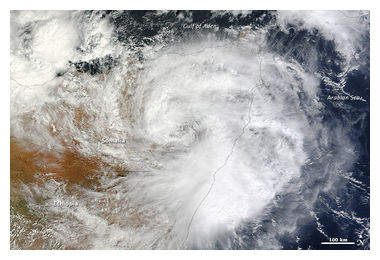
© NASA image courtesy Jeff Schmaltz, LANCE/EOSDIS MODIS Rapid Response Team at NASA GSFCA slow-moving tropical cyclone destroyed hundreds of homes and farms in Somalia.

A slow-moving tropical storm pounded the Somalia coast this weekend, a rare hit for the war-torn country that killed more than 100 people and devastated coastal communities.

The unnamed tropical storm made landfall on Sunday (Nov. 10) north of Eyl in the Puntland state, a semiautonomous region that typically receives less than 10 inches (25 centimeters) of rain every year.

The storm, designated Tropical Cyclone 03A, was forecast to dump a year's worth of rain on Puntland this week and hit the shore with winds of 46 mph (74 km/h).

Weak storms such as Cyclone 3A can wreak havoc along the arid African coast because they trigger flash floods, said Amato Evan, an atmospheric scientist at the Scripps Institution of Oceanography at UC San Diego.

"Even a very weak storm can cause huge damage and loss of life in this area," Evan told LiveScience. "In an area that doesn't receive a lot of rainfall in general, a storm that moves very, very slowly and dumps a lot of rain in one place for a long time can be particularly deadly."

Ice Cube

'January temperatures' in November? First snows hit East Coast as arctic blast sweeps across the U.S.

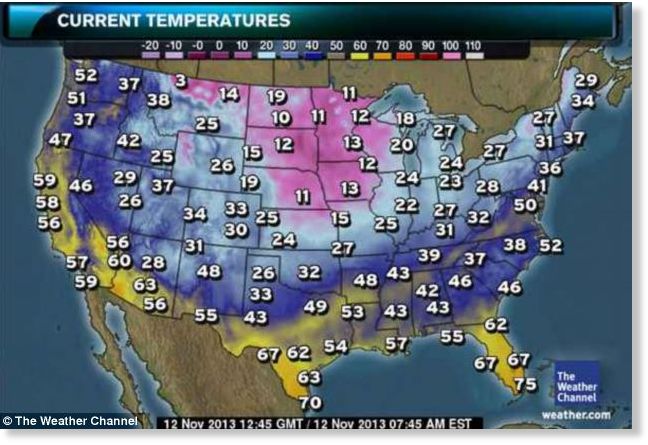
A biting arctic blast rattled from the Midwest to the Northeast this morning, sending temperatures plummeting and blanketing some areas with snow and sleet. Parts of New York, Chicago and New England, among others, are seeing the first snows of the season while nearly a third of the country can expect temperatures 10 to 20 degrees below normal for this time of the year, meteorologists warned.

Temperatures in the Great Plains and Upper Midwest dropped as low as single digits on Tuesday morning, while Texas and mid-Atlantic states saw temperatures in the 20s, NBC reported.

In Chicago on Monday, the National Weather service recorded 0.4 inches of snow - the first of the season and a week ahead of schedule - and today, the temperature is expected to reach 24 degrees, which is 11 below normal for the date. And the Weather Service reported that even the Southeast can expect surprisingly low temperatures in the teens.
Image
Low temperatures: Nearly a third of the country is experiencing temperatures between 10 and 20 degrees lower than normal for this time of year. This map shows the temperatures this morning
Additional images

People

Typhoon Haiyan overshadows UN climate change talks in Poland

Philippine delegate weeps at UN climate conference
© UnknownPhilippine delegate weeps at UN climate conference
The devastation caused by Typhoon Haiyan cast a gloom over UN climate talks Monday as the envoy from the Philippines broke down in tears and announced he would fast until a "meaningful outcome is in sight."

Naderev "Yeb" Sano's emotional appeal was met with a standing ovation at the start of two-week talks in Warsaw where more than 190 countries will try to lay the groundwork for a new pact to fight global warming.

UN climate chief Christiana Figueres also made reference to the "devastating impact" of the typhoon in her opening speech, and urged delegates to "go that extra mile" in their negotiations.

Scientists say single weather events cannot conclusively be linked to global warming. Also, the link between man-made warming and hurricane activity is unclear, though rising sea levels are expected to make low-lying nations more vulnerable to storm surges.

Nevertheless, extreme weather such as hurricanes often prompt calls for urgency at the UN talks.

Comment: What happened in the Philippines as a result of the recent typhoon is tragic. It is therefore also important to direct the focus where it belongs and not use this loss of life to propagate false ideas about climate change.

Warming has occurred, also on some of our neigbouring planets such as Mars, but that warming has stopped here on planet Earth and it looks more like a global cooling is on the cards as the activity on the sun is getting eerily quiet.

As for the Philippines, the lack of sufficient infrastructure has more to do with the extent of the damage seen than global warming, and that lack of sufficient infrastructure is in no small amount due to the in all but name colonial exploitation of the Philippines by the ponerological elite of the world.

Rising global temperatures on Mars melt hints at solar-system-wide, not human, cause for warming
German scientists: Solar cycle 24 points to Dalton or Maunder-like minimum, boding ill for a climate cooling
Shock Doctrine in action: Anglo-Saxon elites send warships, destroyers and special forces to 'protect' crisis-hit Philippines


Arrow Down

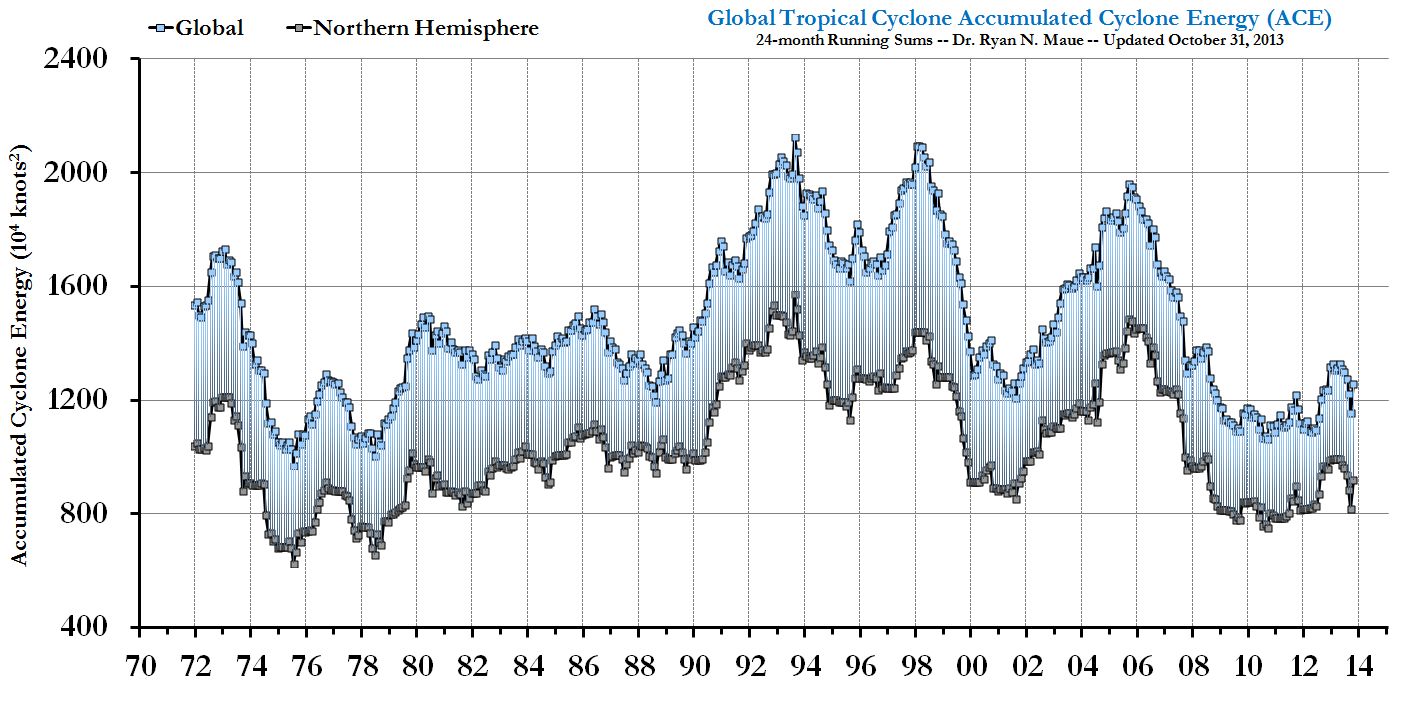
Accumulated Cyclone Energy of all cyclones below normal

It is phenomenal. Climate campaigners like [John] Vidal in Guardian keeps arguing that the terrible typhoon Haiyan shows we need to do more about global warming.

Yet, even *after* Haiyan, the Accumulated Cyclone Energy of all cyclones in the Western North Pacific is below normal (99%, http://models.weatherbell.com/tropical.php). The global ACE is at 74%.

As you can see in the graph below (updated Nov 10), both Northern Hemisphere ACE and global ACE are at the lowest since the 1970s.
Global running ACE
© Weatherbell.com

Comment: It is also worth pointing out that there has been no warming for the last 15+ years and that it looks more likely that we are entering a cooling climate if not a full blown ice age.


Vader

Shock Doctrine in action: Anglo-Saxon elites send warships, destroyers and special forces to 'protect' crisis-hit Philippines

HMS Daring and USS George Washington lead military push to help relief effort with drinking water and air support
Image
Britain and the US are sending warships to help relief efforts in the Philippines after typhoon Haiyan left thousands dead.

The Philippine government raised the official death toll to 1,744 on Tuesday, but the figure is expected to climb drastically, with authorities estimating that the storm killed 10,000 or more across a vast region of the country, and displaced about 660,000 others.

David Cameron said HMS Daring, which carries equipment to make drinking water from seawater, would provide humanitarian assistance and flights from its onboard helicopter. At least one Boeing C-17 military transport aircraft would be allocated to move humanitarian aid to areas that are most in need and hardest to reach, the prime minister said.

"HMS Daring, currently deployed near Singapore, will shortly be heading at full speed towards the disaster zone with further support from an RAF C-17 which will be a powerful help to the relief operation," Cameron told a dinner attended by business leaders in London.

Comment: The US.-UK regime has some nerve posturing as the Philippines' saviour. Having colonized and indirectly (and sometimes very directly) militarily occupied the country for over 100 years, the Anglo-Saxon elites are substantially to blame for Philippines never developing adequate infrastructure to cope with typhoons and everything else Nature throws at it.