Animals
S


Frog

Australia: Crocodiles wiped out by invasion of the toxic toads

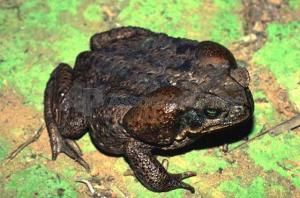
Cane Toad
© APThe cane toad is famed for its indestructibility

In a contest between a toad and a crocodile, it seems obvious the croc will win. Not, though, if its adversary is a cane toad - the poisonous pests laying waste to Australian wildlife.

Researchers have found that, in some waterways in the Northern Territory, numbers of freshwater crocodiles have more than halved over the past two years. The reason is cane toads, which are fatal when eaten.

Cow Skull

Irish tests find dioxins in cattle

Irish government officials say tests have confirmed illegally high levels of dioxin chemicals in cattle that ate the same oil-tainted food that has already devastated Ireland's pork industry.

The government scheduled a news conference Tuesday to confirm the positive dioxin findings in 38 cattle farms.

Butterfly

Caterpillar invasion so bad Yandaran residents can't stand still

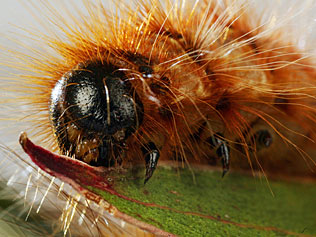
Caterpillars
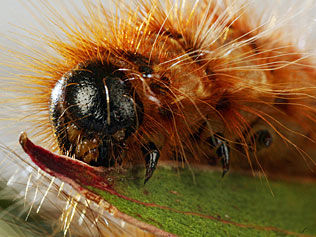
© news.com.auCreep ... a caterpillar plague has hit a small town, and it's so bad people can't stand still for fear of being covered in the crawlies.

Millions of hairy caterpillars are making life an itchy misery for residents of a small town north of Bundaberg in Queensland.
The as yet unidentified sub-species of the "processionary" caterpillar has been steadily multiplying since the start of the year to the point where residents of Yandaran cannot stand still without being covered in the creepy crawlies.

"It's like something is out of whack somewhere in the environment for them to be like this, munching through everything," said resident Dallas Boothey, who wears a protective suit to shield herself from the caterpillar's itchy little hairs.

"During winter it wasn't too bad but they've come back with a vengeance," she said

"They can travel up to a kilometre in the air and they create a very itchy allergic reaction in some people, including me.

"I get itchy red welts and a tightness of the chest. That's why I wear the suit which is really hot in summer. At the moment it's like living in a horror movie that never ends."

Better Earth

Deadly vanilla fungus hits Madagascar

An incurable crop disease has spread widely in Madagascar's vanilla-producing region, government scientists said Monday. The scientists' initial assessment released Monday said the world's main vanilla exporter needs to radically change farming methods to fight the disease, carried by an underground fungus.

Most of Madagascar's vanilla is exported to the United States, where it is used in candy, soft drinks and ice cream.

Fish

California's Deep Sea Secrets: New Species Found, Human Impact Revealed

whale shark
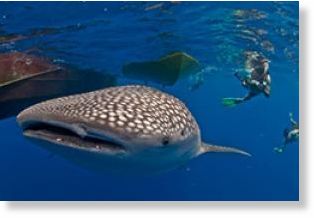
© University of California - San DiegoA whale shark photographed by Octavio Aburto-Oropeza during 2008 expedition to Gulf of California aboard DeepSee submersible.
Scientists from Scripps Institution of Oceanography at UC San Diego returning from research expeditions in Mexico have captured unprecedented details of vibrant sea life and ecosystems in the Gulf of California, including documentations of new species and marine animals previously never seen alive.

Yet the expeditions, which included surveys at unexplored depths, have revealed disturbing declines in sea-life populations and evidence that human impacts have stretched down deeply in the gulf.

In one expedition, researchers Exequiel Ezcurra (adjunct professor at Scripps Oceanography and former provost of the San Diego Natural History Museum), Brad Erisman (Scripps postdoctoral researcher) and Octavio Aburto-Oropeza (graduate student researcher) traveled on a three-person submarine to explore marine life in the Gulf of California's deep-sea reefs and around undersea mountains called seamounts.

Butterfly

Harbour seals' decline 'alarming'

Harbour seals, or common seals, are familiar faces along coastlines across
seal
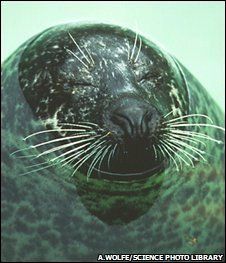
Drowning, not waving - harbour seal numbers have halved in some areas
the northern hemisphere.


But they are now vanishing in the UK at an alarming rate, warn scientists from St Andrews University.

Numbers have halved in the hardest hit area, the Orkney Islands, since 2001 - falling almost 10% each year.

Better Earth

Glimmer of hope for rare monkey

A new sub-population of a Critically Endangered species of monkey has been recorded in north-western Vietnam.

Biologists from Fauna and Flora International said they had found up to 20 Tonkin snub-nosed monkeys in a remote forest.

The team said the new group offered a ray of hope because it included three infants, suggesting that the monkeys were breeding and increasing in number.

Frog

Mystery of crocs' mass die-off

Gharial
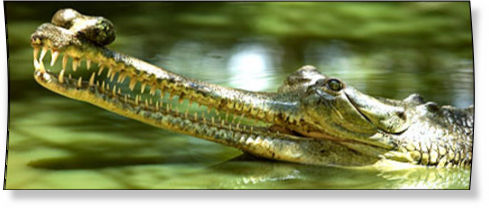
© UnknownSome gharials may be feeding on fish that have large toxic loads
Measuring up to 6m long, with elongated narrow snouts, gharials are one of the world's most distinctive-looking crocodilians.

Just 100 years ago, these fish-eating reptiles were prevalent throughout the Indian subcontinent; but by 2007, there were just 200 breeding adults found in only a handful of rivers in India and Nepal.

Last winter, this already critically endangered species was dealt another cruel blow. Over the space of just five months, more than 100 of the creatures washed up dead on the banks of India's Chambal river - and nobody knew why.

For the past year, herpetologist Rom Whitaker, who runs the Madras Crocodile Bank, has been followed by a BBC Natural World team as he attempted to solve this mystery.

Better Earth

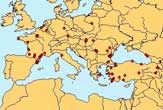
Super-Ant Taking Over Europe

An ant species that originated in the Black Sea region has invaded more than 100 areas across Europe and is moving north. Scientists say if it is not stopped, it will reach northern Germany, Scandinavia and Britain and could invade the whole world.
Live Science Ants
© Credit: Centre for Social Evolution (CSE) at the University of CopenhagenRed dots show where Lasius neglectus has been found.

Info

US: Plague spurs prairie dog die-off in grasslands

Colorado Springs - An outbreak of the plague is killing off the black-tailed prairie dogs on the Comanche National Grassland in southeast Colorado, in a dramatic die-off that has raised concerns for the future of the species in one of its richest habitats.

The U.S. Forest Service, which runs the 443,750-acre grassland, said Monday that prairie dog colonies decreased from 16,000 acres in 2005 to just 3,607 this year. The plague occurs regularly among prairie dogs throughout their range, spreads quickly through colonies, and can infect pets and humans that come into contact with them, the agency said.

The news comes at a time of scrutiny on the small, plains rodent. The U.S. Fish and Wildlife Service is expected to determine, possibly as soon as today, whether the prairie dog should be protected under the Endangered Species Act.