Animals
S


Better Earth

Sea otter diets affect disease exposure

Davis, California - The U.S. Geological Survey says central California sea otters risk higher exposure to disease-causing parasites due to the food they eat and where they feed.

Researchers said sea otters that eat small marine snails are at a higher risk of exposure to Toxoplasma gondii, a potentially deadly protozoal pathogen, than animals that feed exclusively on other prey. Sea otters living along the coast near San Simeon and Cambria are more at risk than sea otters outside that area.

"Recovery of the sea otter in California has been especially sluggish at the center portion of its range, where sea otter densities are highest and where most of the reproduction occurs," said Tim Tinker, co-leader of the study led by the USGS and the University of California-Davis. "Where food resources are limited, individual sea otters tend to become diet specialists, and the specific skills used to secure food are passed on from mother to pup."

Frog

Appetite for frogs' legs harming wild populations

frog legs
© Andrew McConnell/Robert Harding Picture Library Ltd/AlamyGastronomic demand may be depleting regional populations of many frogs to the point of no return.

Are frogs being eaten to extinction? We're used to hearing about how disease, climate change, and habitat degradation are endangering amphibians, but conservationists are warning that frogs could be going the same way as the cod. Gastronomic demand, they report, is depleting regional populations to the point of no return.

David Bickford of the National University of Singapore and colleagues have called for more regulation and monitoring in the global frog meat market in order to avoid species being "eaten to extinction".

Statistics on imports and exports of frog legs are sparse as few countries keep track of the amount of meat harvested and consumed domestically.

According to UN figures, global trade has increased in the past 20 years. France - not surprisingly - and the US are the two largest importers; with France importing between 2500 and 4000 tonnes of frog meat each year since 1995.

Info

Army worms decimate crops in north-central Liberia

Monrovia - Swarms of army worms have attacked crops in a food-producing district of Liberia, forcing the West African state to declare a state of emergency in the area at the weekend, the Ministry of Agriculture said on Monday.

Army worms, which can grow to around 5 centimetres (two inches) in length, are moth caterpillars and when present in large numbers can destroy swathes of vegetation and crops.

"We are calling for international assistance to combat these insects. They have affected over 19 villages in Bong county," Agriculture Minister Christopher Toe told Reuters.

Question

US: Mystery of sick pelicans still puzzling experts

Los Angeles - A mysterious illness afflicting California brown pelicans continues to take its toll.

The Northern California-based International Bird Rescue Research Center said Thursday it had counted 460 sick or dead birds so far, up from 265 last week. The birds were found along the West Coast from Baja California in Mexico to Oregon.

Better Earth

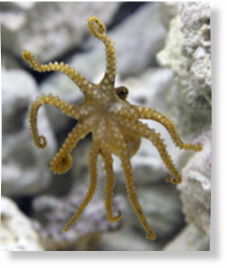
Japan: Nine-limbed octopus gives aquarium a leg up

Nine-arm octopus
© Mainichi (file photo)The nine-armed octopus is pictured in Susami, Wakayama Prefecture in this Dec. 25, 2008
Susami, An octopus found off the coast of Susami is attracting attention for an unusual reason -- its nine arms.

The blue-ringed octopus, found by a researcher from the Susami Crustacean Aquarium, is on display.

"Octopus arms grow back if they are cut off, and it's possible that the ninth arm grew out of a wound or from some other stimulus," said aquarium head Takuya Mori.

Question

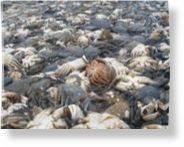
UK: Crab riddle on Thanet beaches

Velvet crabs
© UnknownVelvet swimming crabs
Mysterious circumstances surround the beaching of thousands upon thousands of crabs on the isles beaches.

Last week the bodies of velvet swimming crabs were washed up on shores all around the Thanet coast but no definitive reason can be found.

Some think the sudden death of the velvet swimming crabs could be due to the cold weather.

Tony Child of the Thanet Coast project said: "It does seem to be linked to the weather, as it's been particularly cold.

It is something which happened three or four years ago. It's very strange."

However, he added that some crabs have been taken away to test for disease and "it was odd that no other species had been affected" by the cold.

Crab numbers had just started to recover from the last wave of deaths.

Cloud Lightning

US: Mysterious bird deaths solved?

A rash of brown pelican deaths and illnesses was probably caused by a severe mid-December storm in the Pacific Northwest, state wildlife officials believe.

An estimated 400 birds turned up dead, injured or sick along the California coast beginning about Dec. 19. The episode has largely faded, state officials said.

"It doesn't appear severe (poisoning) or disease appears to be doing this. It appears to be more weather-injury and nutrition-related," said David Jessup, senior wildlife veterinarian for the California Department of Fish and Game.

Magnify

US: Why are the western white pines dying?

Everett, Washington - Sharon Collman's quest for answers started at her childhood home.

There, in Shoreline, 60 years ago, her mother planted a tiny Western white pine sapling that would grow strong and sure until a few years ago, when it inexplicably began to die.

Collman, an extension educator and entomologist, knows a few things about trees. A healthy, well-cared-for tree in her mother's front yard should live at least 200 years.

She didn't know it then, but she had stumbled on a problem that has the potential to devastate certain species of pines across Western Washington. It's already killing Western white pines from Mill Creek to Seattle.

Question

Mystery of the British penguins that are marching towards oblivion

An endangered species of penguin is mysteriously disappearing from a remote British island in the South Atlantic at a rate of 100 birds every day. About two million northern rockhopper penguins have vanished from Tristan da Cunha and Gough Island, part of the British overseas territory of St Helena, in half a century.

The once huge penguin populations on the islands have dwindled so dramatically that they are now threatened with extinction, and the British Government was accused yesterday of contributing to the decline.

Bug

Mysterious pelican deaths worry California biologists By Lisa M. Krieger

In a troubling wildlife mystery, California brown pelicans are turning up sick or dead in suburban ponds, driveways and backyards - far from their ocean home.

Two of the elegant birds, emaciated and disoriented, were found in San Jose last week. Another was rescued from Searsville Dam at Stanford University's Jasper Ridge Preserve. Others have been reported at such unlikely locations as Belmont, San Bruno, Brisbane and Burlingame. One fell out of a tree in Oakland. Two were found in a San Francisco dumpster; another stopped traffic on the Golden Gate Bridge.

"Normally, they're on piers and places where they can find fish,'' said Rebecca Ryan of the Peninsula Humane Society in San Mateo, which has stabilized several sick birds. "Now they are appearing in really unusual places.''