Comets


Fireball

Impact over Northern Ireland: Hoax or government cover-up?

Kinawley, Northern Ireland
© Unknown
On February 13th, 2001, a strange airplane crash was observed in the Southwest corner of Northern Ireland, less than a mile away from the border with the Republic of Ireland. There was no airplane, but despite credible witnesses of what may have been an impact event, the story was quickly squashed as a genuine mistake, and then as a hoax. The manner in which this story was squashed with slashing diminutives begs the question: If this is indeed a cover-up, then why?
BBC News, February 13, 2001
Aircraft crashes on mountain

Police in Northern Ireland are investigating reports that a light aircraft has crashed in County Fermanagh.

It is understood that a plane came down at Benaughlin Mountain near Kinawley shortly after 1800 GMT.

It is believed helicopters are being used in the rescue effort.
One day later the same site had the following report:
Tuesday, 13 February, 2001, 20:56 GMT, BBC News
Mystery surrounds 'plane crash' reports

Mystery surrounds the source of flames and smoke in the sky over County Fermanagh which has sparked a major search operation.

farm house
© Unknown
About 12 people described seeing flames and smoke on the side of the Benaughlin Mountain, near Kinawley, on Tuesday night.

Paul McCaffrey, who raised the alarm with a friend, is convinced he saw something in the sky with smoke billowing from it.

"I saw a dot at the front and a black trail of smoke leading down at an angle towards the mountain," he said.

A British Army helicopter using heat sensitive equipment also flew over the area.

But following more than three hours of extensive searches, nothing was found.

Comment: The author seemed to be having something of a prophetic moment. In the fifteen years that have passed since this article was written, the number of fireballs and meteorites has continuously increased at an exponential rate. It's only a matter of time before one does a serious amount of damage that can't be covered up or explained away.

We wait and watch.


Comet 2

New comet discovered: C/2016 K1 (LINEAR)

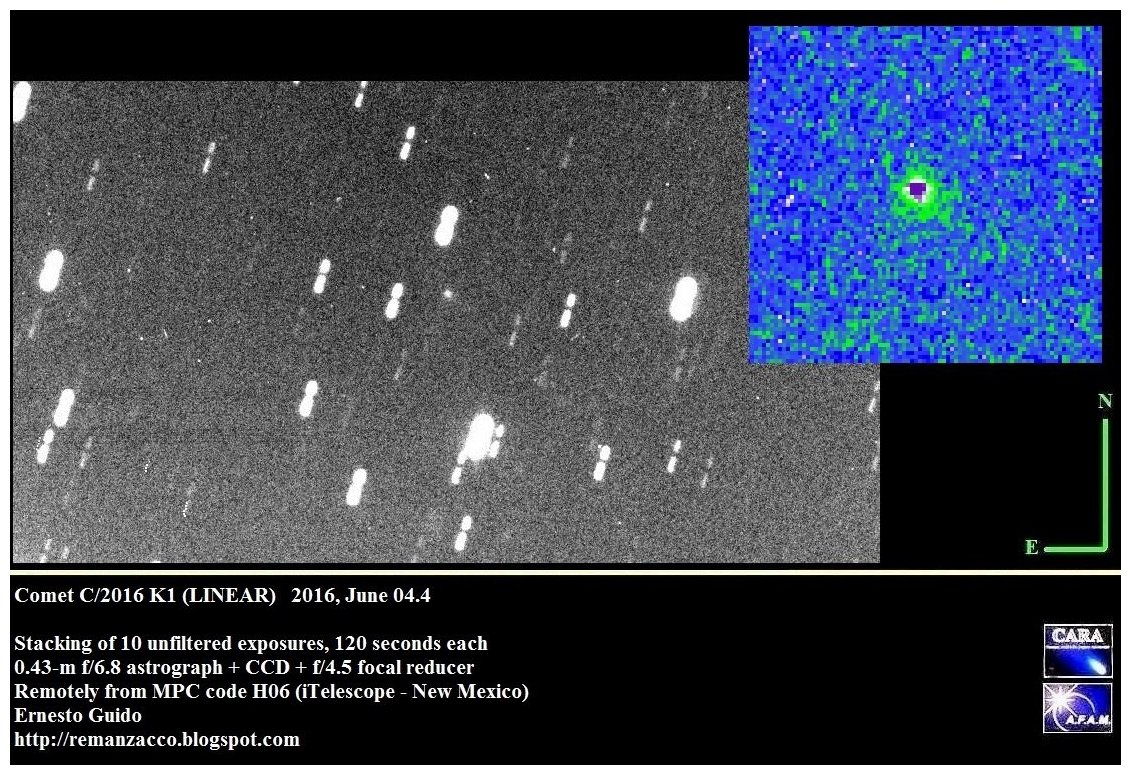
CBET nr. 4282, issued on 2016, June 05, announces the discovery of an apparently asteroidal object (magnitude ~18.5) found on CCD images taken on May 31 with the 3.5-m f/1 Space Surveillance Telescope on Atom Peak in the White Sands Missile Range, NM, USA, in the course of the LINEAR survey. This object has been found to cometary appearance by CCD astrometrists elsewhere after it was posted on the Minor Planet Center's NEOCP webpage. The new comet has been designated C/2016 K1 (LINEAR).

We performed follow-up measurements of this object, while it was still on the neocp. Stacking of 10 unfiltered exposures, 120 seconds each, obtained remotely on 2016, June 04.4 from H06 (iTelescope network - New Mexico) through a 0.43-m f/6.8 astrograph + CCD + f/4.5 focal reducer, shows that this object is a comet with a compact coma nearly 8 arcsec in diameter elongated toward PA 225.

Our confirmation image (click on it for a bigger version)
C/2016 K1 (LINEAR)
© Remanzacco Blogspot
M.P.E.C. 2016-L34 assigns the following preliminary parabolic orbital elements to comet C/2016 K1: T 2016 July 14.36; e= 1.0; Peri. = 18.66; q = 2.29; Incl.= 90.94

Fireball 5

Loud bang over New Zealand town remains a mystery

Palmerston North
© Leilani Hatch/Manawatu StandardPalmerston North's "big bang" has police and Fire Service puzzled.
The source of a loud echoing bang has the Palmerston North police and fire service baffled. A "deep resounding bang" was heard at about 10pm on Thursday, near Kelvin Grove. A police spokesperson said police attended the callout but they were not able to locate its source.

"It was a definitely a loud deep bang - nothing like a gun shot bang, which is quick and high pitch.

Palmerston North Astronomical Society member Noel Munford said the noise could have been a sonic boom created from a fire ball.

But he said if it was a fire ball, then there would have been reports of people seeing a "bright light", burning space junk, shooting across the sky. Gail Lucinsky said she heard the explosive sound from the bottom of Pahiatua Track.

"It was so loud that I jumped out of my skin thinking that one of my parents had fallen heavily and hit the wall in the room behind me."

She said she went outside to look for a source but could not find anything.

"A transformer exploding was suggested as a likely cause, but we couldn't see any part of Palmy in darkness, so it remained a mystery," she said.

Sofia Butler said she heard the explosion sound "very loud and clear" from Lombard St.

"I also heard lots of teens roaming around the streets which at the time I thought may be responsible for that big bang. I haven't heard anything like it to be fair."

Fireball

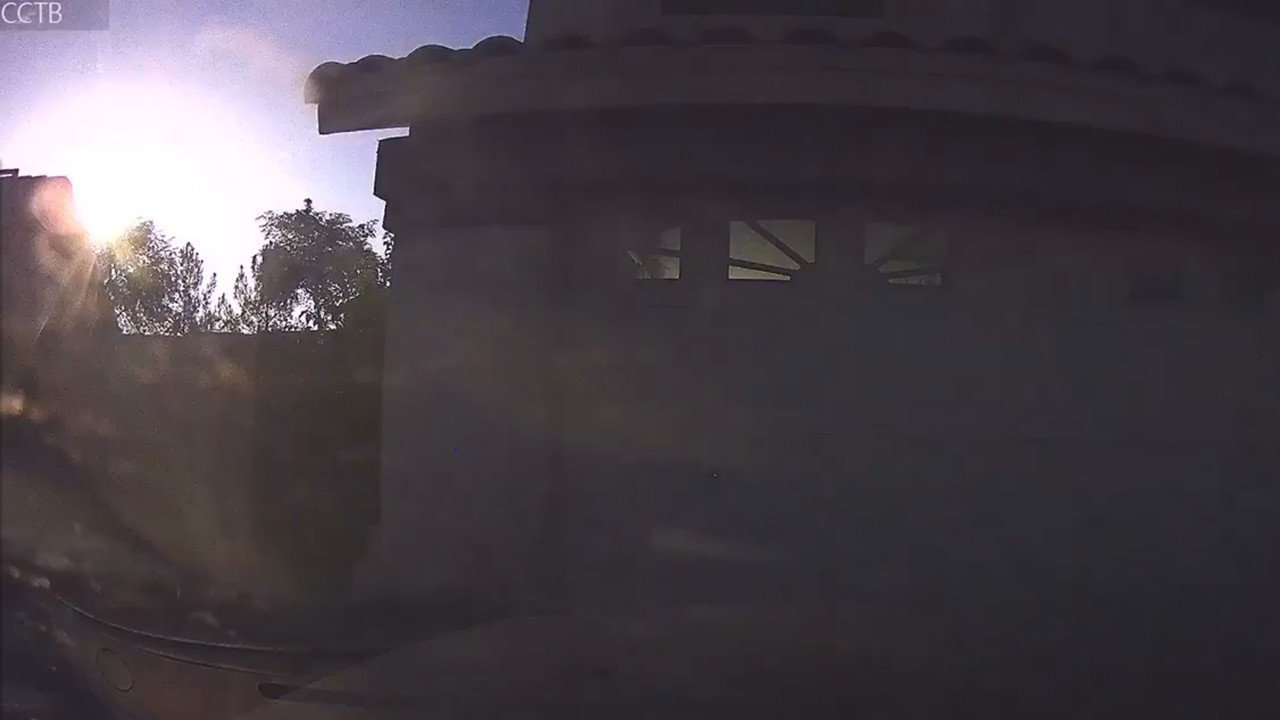
Huge fireball lights up night sky over Phoenix, Arizona - Residents stunned as meteor explodes, shaking homes

phoenix airzona meteor dashcam screenshot 2 Jun 2016
No, that's not the sun

Comment: In terms of size, this doesn't seem to have been 'a small meteor' - it sounds more like it was a comet fragment!

Will we be seeing another Chelyabinsk type event in the not too distant future?


A meteor flared across the sky over Phoenix, Arizona Thursday morning, reportedly waking many residents from their slumber with the sound of a loud bang as it passed.

Locals took to social media to question what the noise was, as others confirmed it was a meteor streaking through the sky.

Comment: Notice the recent uptick in meteor fireball events, as well as the increase in lightning deaths, volcanic eruptions, and extreme weather.


Comet

Comets & Asteroids - Summary for May 2016

During the month of May 2016, 2 new comets were discovered and cometary activity was detected for 1 previously discovered object (earlier designated as an asteroid).

NASA's Hubble Space Telescope imaged comet 252P/LINEAR just after it swept by Earth on March 21, 2016 while the Subaru Telescope serendipitously captured high-resolution images of comet 67P/Churyumov-Gerasimenko. Moreover a non-gravitational acceleration has been detected influencing the motion of minor planet (85990) (see below for more about these news). "Current comet magnitudes" & "Daily updated asteroid flybys" pages are available at the top of this blog (or just click on the underline text here).

The dates below refer to the date of issuance of CBET (Central Bureau Electronic Telegram) which reported the official news & designations.

Comet Discoveries

May 09 Discovery of P/2016 J1 (PANSTARRS)*
May 09 Discovery of C/2016 J2 (DENNEAU)
P/2016 J1 (PanSTARRS)
© Michael JagerP/2016 J1 (PanSTARRS)
* According to the discovery CBET, follow-up images obtained at the 3.6-m Canada-France-Hawaii Telescope atop Mauna Kea on May 6.43 showed a second comet in the field. "The two components are moving at nearly identical rates in nearly identical directions (both about 0".6/minute in p.a. about 314 deg).

The brighter component (designated component A) displays a clear and quite thin tail about 10" long in p.a. 250 deg in the May 6.43 images. The fainter object (designated component B) also displays a clear but broader tail of similar length, oriented toward p.a. about 210 deg". The available astrometry for both components and ephemerides appear on MPEC 2016-J90

Meteor

Tsunamis created by enormous meteor impacts may have resurfaced ancient Martian ocean

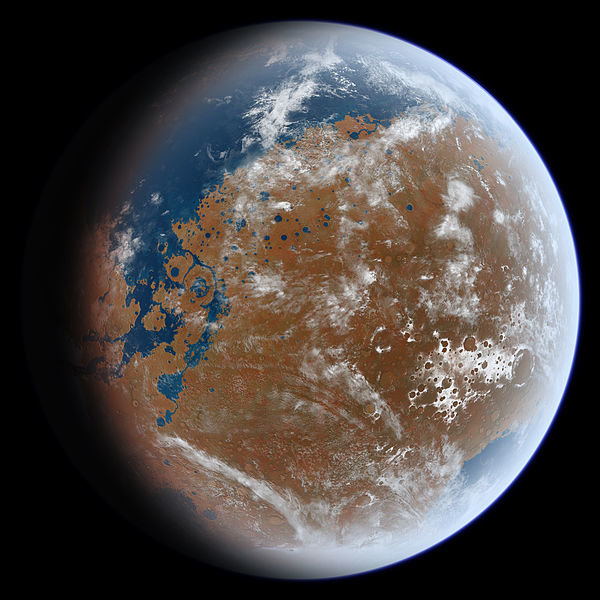
ancient mars
© IttizConcept art of ancient Mars with ocean
Scientists have long suspected that billions of years ago, Mars hosted a large ocean that engulfed the planet's northern lowlands. But one of the major sticking points with this theory is the lack of clear shoreline formations to indicate where ancient Martian seas might have met the coast.

Now, a team led by Alexis Palmero Rodriguez, a planetary scientist based at the Planetary Science Institute in Tucson, Arizona, has proposed an utterly epic answer to this waterfront enigma—ancient Martian tsunamis created by catastrophic meteor impacts.

In a study published Thursday in Scientific Reports, Rodriguez and his colleagues share evidence that two tsunami events may have raged across Mars some 3.4 billion years ago, during the Late Hesperian epoch in Martian history.

By conducting extensive geomorphic and thermal image analysis of Chryse Planitia and Arabia Terra—two regions that are thought to have been adjacent to this bygone shoreline—the team was able to pick out what may be the geological fallout of massive waves that pounded away clear coastal distinctions on the young planet.

Comment:


Info

Evidence of ancient giant asteroid impact event discovered in Australia

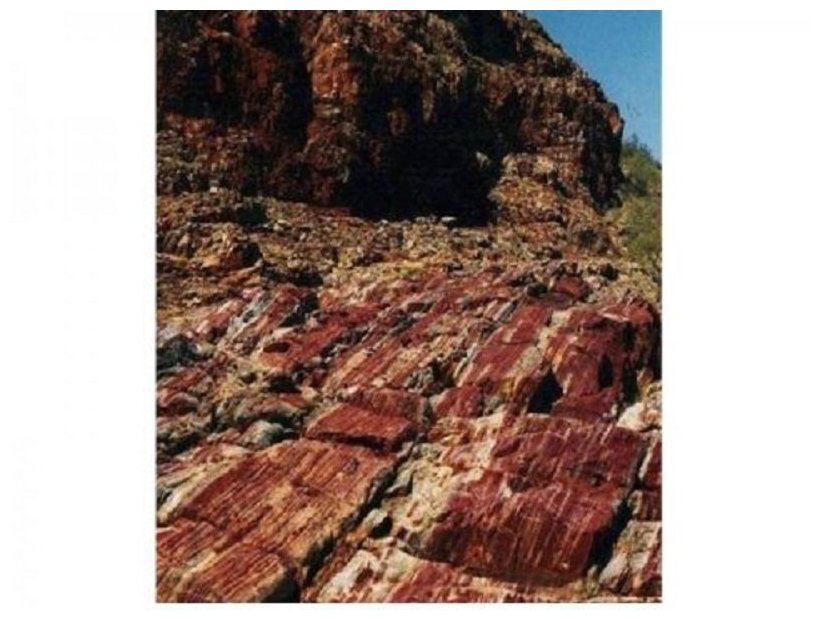
Marble Bar sediments
© A. GliksonMarble Bar sediments, a microcrystalline silicone-rich chert.
Scientists have found evidence of a huge asteroid that struck the Earth early in its life with an impact larger than anything humans have experienced.


Tiny glass beads called spherules, found in north-western Australia were formed from vaporised material from the asteroid impact, said Dr Andrew Glikson from The Australian National University (ANU).

"The impact would have triggered earthquakes orders of magnitude greater than terrestrial earthquakes, it would have caused huge tsunamis and would have made cliffs crumble," said Dr Glikson, from the ANU Planetary Institute.

"Material from the impact would have spread worldwide. These spherules were found in sea floor sediments that date from 3.46 billion years ago."

The asteroid is the second oldest known to have hit the Earth and one of the largest.

Dr Glikson said the asteroid would have been 20 to 30 kilometres across and would have created a crater hundreds of kilometres wide.

About 3.8 to 3.9 billion years ago the moon was struck by numerous asteroids, which formed the craters, called mare, that are still visible from Earth

"Exactly where this asteroid struck the earth remains a mystery," Dr Glikson said.

"Any craters from this time on Earth's surface have been obliterated by volcanic activity and tectonic movements."

Comment: Our world has fallen victim to comets, fireballs, asteroids and meteorites on a continual basis for all of its existence.

For an in-depth look at how these extraterrestrial insults have affected our civilisations - ancient and not so ancient - head to our Comets and Catastrophes section for a number of articles on the topic. You can also visit our Red Pill Press store to pick up a copy of Laura Knight-Jadczyk's book, Comets and the Horns of Moses to get an understanding of how the evidence of these events gave birth to mythology and how certain schools of philosophical thought were either suppressed or promoted in order to cover up the truth of a human cosmic connection in order for the psychopaths who rule our world to continue to do so without blowback from the masses.


Comet 2

Comets & Asteroids - Summary for April 2016

During the month of April 2016, 2 new comets were discovered and cometary activity was detected for 1 previously discovered object (earlier designated as an asteroid). NASA's Hubble Space Telescope spotted a small, dark moon orbiting Makemake, the second brightest icy dwarf planet — after Pluto — in the Kuiper Belt. Pioneer comet observer Elizabeth (Pat) Roemer died on April 09.

Moreover the discovery of the binary nature of asteroid (5674) Wolff and the images of a new satellite of asteroid (130) Elektra have been reported (see below for more about these news).

"Current comet magnitudes" & "Daily updated asteroid flybys" pages are available at the top of this blog (or just click on the underline text here).

The dates below refer to the date of issuance of CBET (Central Bureau Electronic Telegram) which reported the official news & designations.

Comet Discoveries

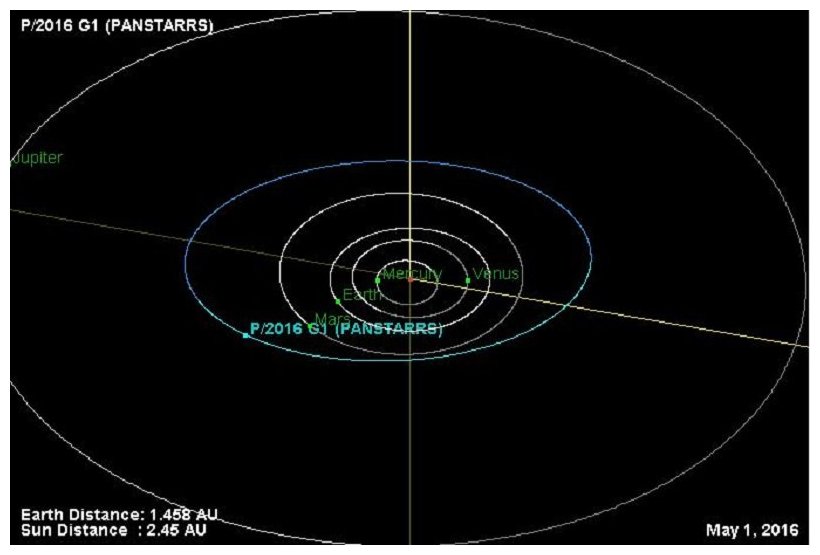
Apr 05 Discovery of P/2016 G1 (PANSTARRS)
Apr 08 Discovery of P/2015 HG_16 (PANSTARRS)*

*G. V. Williams, Minor Planet Center, noted that the 2016 April 3 observations of this comet appeared to belong to a supposedly asteroidal object found a year ago by Pan-STARRS1 on 2015 Apr. 20, 21, and 24 (and then given the minor-planet designation 2015 HG_16 on MPS 603395 and 603396)
Comet P/2016 G1 PanSTARRS
© JPL NASA
Cometary activity detected

Apr 24 Cometary activity detected in 2015 WZ = C/2015 WZ (PANSTARRS)

Comet 2

Rocky comet from Oort Cloud may provide clues about origin our Solar System

C/2014 S3 (PANSTARRS)
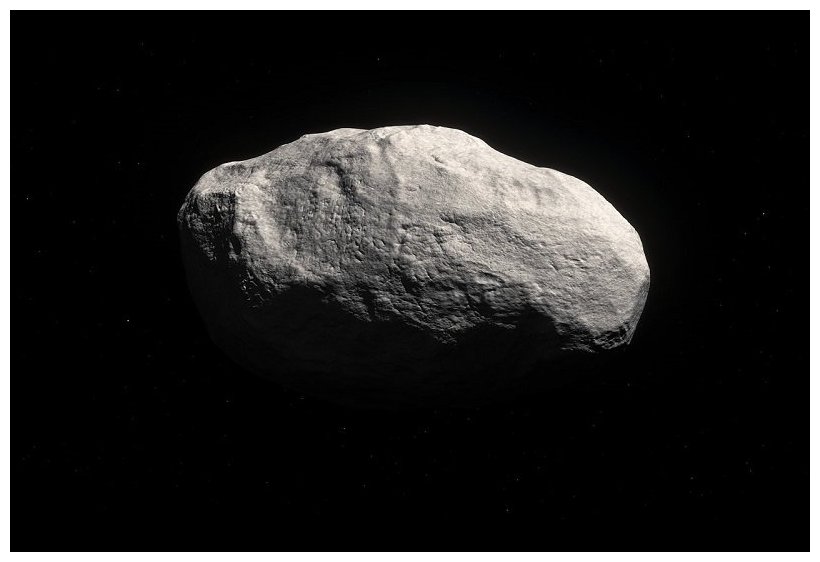
© ESO/M. Kornmesser Artist's impression of the unique object C/2014 S3 (PANSTARRS). Observations with ESO's Very Large Telescope, and the Canada France Hawai`i Telescope, show that this is the first object to be discovered that is on a long-period cometary orbit, but that has the characteristics of a pristine inner Solar System asteroid. It may provide important clues about how the Solar System formed.Because the object has spent most of its life away from the inner Solar System it suffered very few collisions, and its surface displays few or no craters. As it formed in the same region as the Earth did, it is mostly rocky, and therefore has only very limited cometary activity.
In a paper to be published today in the journal Science Advances, lead author Karen Meech of the University of Hawai'i's Institute for Astronomy and her colleagues conclude that C/2014 S3 (PANSTARRS) formed in the inner Solar System at the same time as the Earth itself, but was ejected at a very early stage.

Their observations indicate that it is an ancient rocky body, rather than a contemporary asteroid that strayed out. As such, it is one of the potential building blocks of the rocky planets, such as the Earth, that was expelled from the inner Solar System and preserved in the deep freeze of the Oort Cloud for billions of years.

Karen Meech explains the unexpected observation: "We already knew of many asteroids, but they have all been baked by billions of years near the Sun. This one is the first uncooked asteroid we could observe: it has been preserved in the best freezer there is."

C/2014 S3 (PANSTARRS) was originally identified by the Pan-STARRS1 telescope as a weakly active comet a little over twice as far from the Sun as the Earth. Its current long orbital period (around 860 years) suggests that its source is in the Oort Cloud, and it was nudged comparatively recently into an orbit that brings it closer to the Sun.

Fireball

72 new asteroids discovered near Earth, says NASA

Asteroid's Near Earth
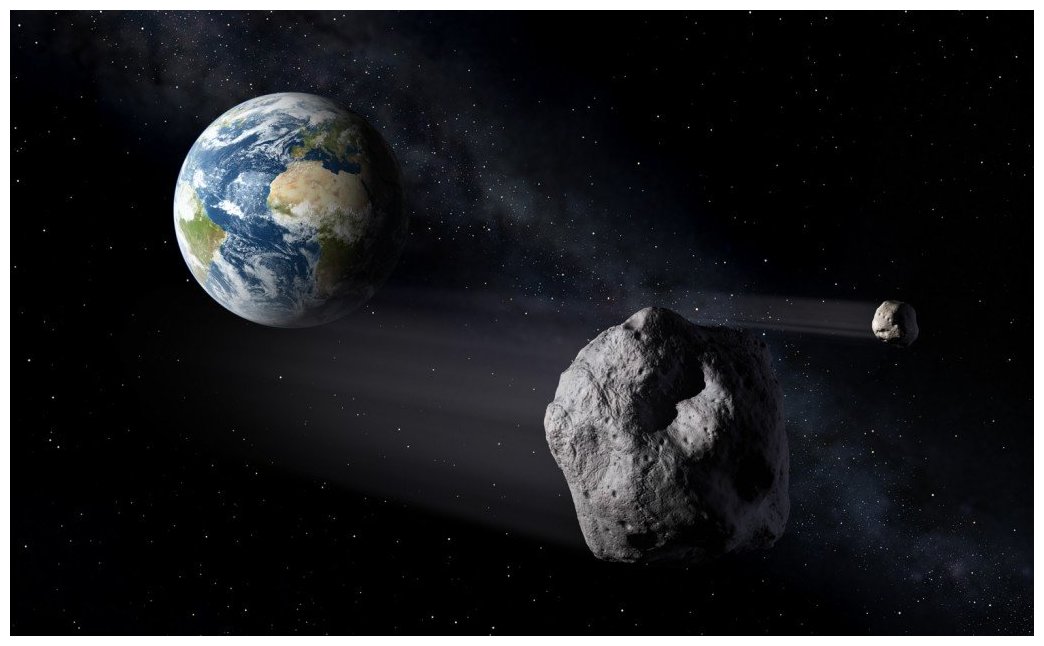
© ESAArtist's impression of a Near-Earth Asteroid passing by Earth.
Of the more than 600,000 known asteroids in our Solar System, almost 10 000 are known as Near-Earth Objects (NEOs). These are asteroids or comets whose orbits bring them close to Earth's, and which could potentially collide with us at some point in the future. As such, monitoring these objects is a vital part of NASA's ongoing efforts in space. One such mission is NASA's Near-Earth Object Wide-field Survey Explorer (NEOWISE), which has been active since December 2013.

And now, after two years of study, the information gathered by the mission is being released to the public. This included, most recently, NEOWISE's second year of survey data, which accounted for 72 previously unknown objects that orbit near to our planet. Of these, eight were classified as potentially hazardous asteroids (PHAs), based on their size and how closely their orbits approach Earth.

Originally launched back in 2009 as the Wide-field Survey Explorer (WISE), the spacecraft relied on its infrared telescope to look for previously undetected star clusters and main belt asteroids. In February of 2011, the mission ended and the spacecraft was put into hibernation. As of December 2013, it was reactivated for the purpose of surveying Near-Earth Objects (i.e. comets and asteroids) for the remainder of its service life.