Comets


Fireball 5

Asteroid 2016 RB1 to flyby Earth at 0.1 Lunar Distance on September 7

The asteroid 2016 RB1 was discovered (at ~ magnitude +19) on 2016, September 05 by Mt. Lemmon Survey (MPC code G96) with a 1.5-m reflector + 10K CCD.

Asteroid 2016 RB1 has an estimated size of 7.3 m - 16 m (based on the object's absolute magnitude H=27.8) and it will have a close approach with Earth at about 0.1 LD (Lunar Distances = ~384,000 kilometers) or 0.0003 AU (1 AU = ~150 million kilometers) on 2016, September 7 at 17:20UT and it will reach a peak magnitude of about +12.3. Radio astronomers will try to observe it as 2016 RB1 could be a really strong radar target during its close approach.

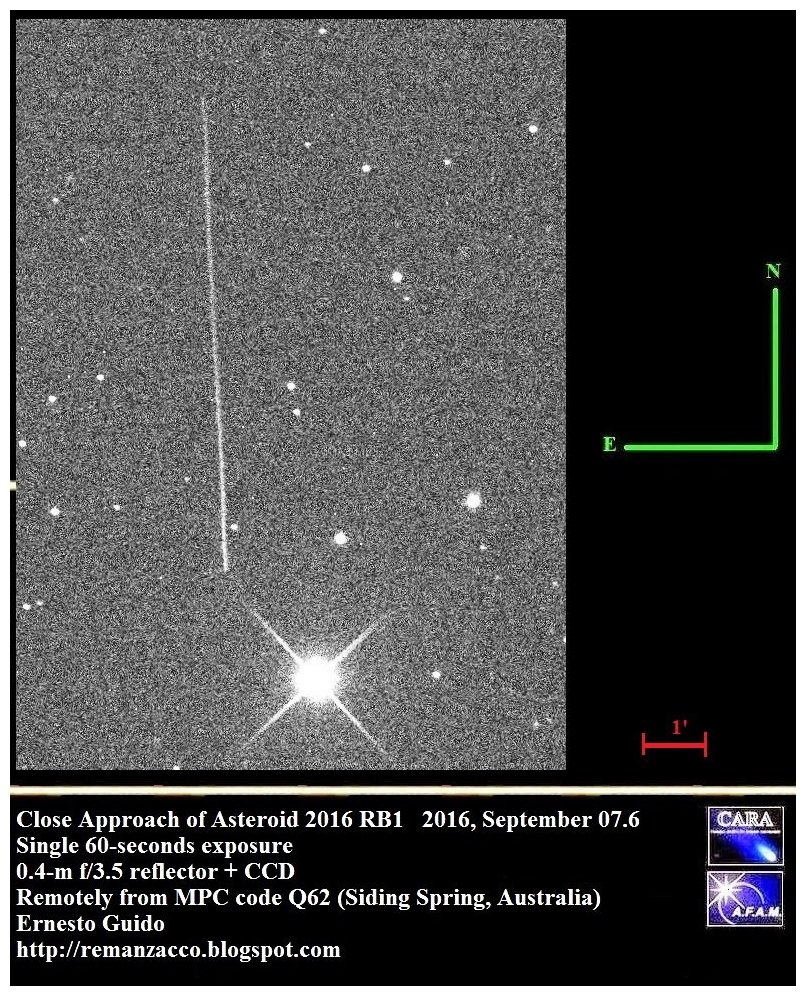
I performed some follow-up measurements of this object on 2016, September 07.6, remotely from the Q62 iTelescope network (Siding Spring, Australia) through a 0.4-m f/3.5 reflector + CCD. Below you can see our image taken with the asteroid at about magnitude +13 and moving at ~ 503 "/min. At the moment of its close approach on Sep 07, around 17UT, 2016 RB1 will move at ~ 2716 "/min (or about 45.2 deg/hour). The asteroid is trailed in the image due to its fast speed. Click on the image below to see a bigger version. (North is up, East is to the left).
Asteroid 2016 RB1
© Remanzacco Blogspot

Fireball 2

Man says meteorite hit lone pear on tree in Massachusetts

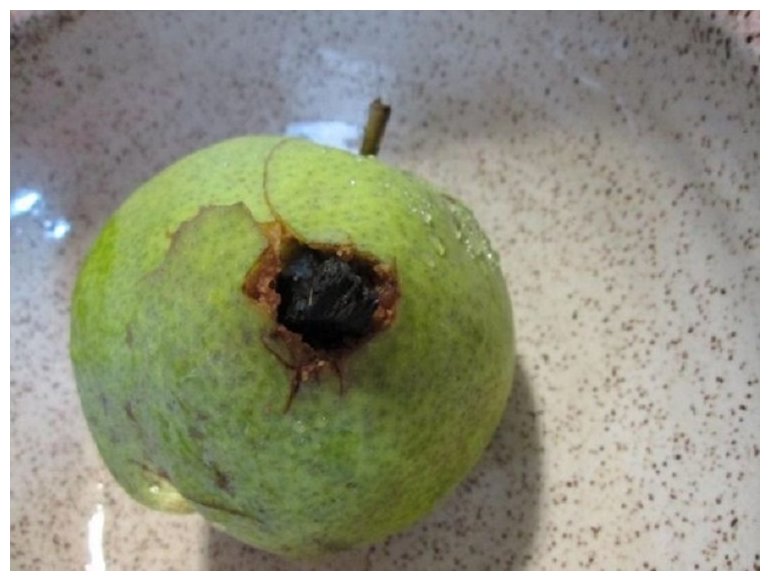
Meteorite in Pear
© Metrowest Daily News
Framingham - First a late hard freeze robbed Steven Lovewell's Asian pear tree of most of its blossoms. Then the summer drought wiped out all but one lonely pear ripening on his tree. The final blow came swiftly and loudly - from a meteorite.

Lovewell, who lives on Grant Street, said he was awakened by a loud whooshing noise about 3 a.m. Tuesday. Later that morning he found his one Asian pear fruit on the ground with what he believes is a meteorite embedded in its flesh. The dark rocky object, about the size of a peach pit, protruded about halfway from the fruit.

Lovewell said he has been interested in astronomy and rocket science since he was a kid. He plans to reach out to the McAuliffe Center at Framingham State University to try and confirm his belief that his last Asian pear was knocked from the tree by an extraterrestrial object. In the meantime, the pear and meteorite are chilling in his freezer for safe keeping.

Comet 2

Giant comets pose a much greater hazard to life than asteroids

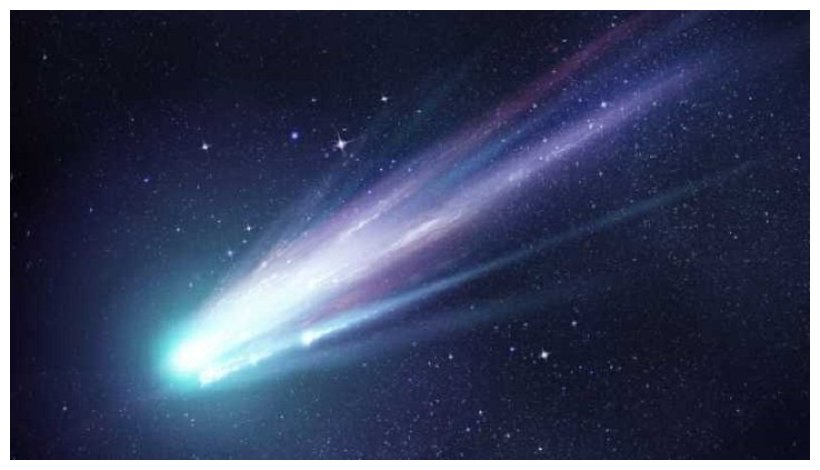
Giant Comet
© The Daily Galaxy
A decade ago, Stephen Hawking warned that one of the major factors in the possible scarcity of intelligent life in our galaxy is the high probability of an asteroid or comet colliding with inhabited planets. This past December, a team of astronomers from Armagh Observatory and the University of Buckingham reported that the discovery of hundreds of giant comets in the outer planetary system over the last two decades means that these objects pose a much greater hazard to life than asteroids.

Giant comets, termed centaurs, move on unstable orbits crossing the paths of the massive outer planets Jupiter, Saturn, Uranus and Neptune. The planetary gravitational fields can occasionally deflect these objects in towards the Earth. Centaurs are typically 50 to 100 kilometer across, or larger, and a single such body contains more mass than the entire population of Earth-crossing asteroids found to date.

Because they are so distant from the Earth, Centaurs appear as pinpricks of light in even the largest telescopes. Saturn's 200-km moon Phoebe, depicted in this image, seems likely to be a Centaur that was captured by that planet's gravity at some time in the past. Until spacecraft are sent to visit other Centaurs, our best idea of what they look like comes from images like this one, obtained by the Cassini space probe orbiting Saturn. NASA's New Horizons spacecraft, having flown past Pluto six months ago, has been targeted to conduct an approach to a 45-km wide trans-Neptunian object at the end of 2018.

Calculations of the rate at which centaurs enter the inner solar system indicate that one will be deflected onto a path crossing the Earth's orbit about once every 40,000 to 100,000 years. Whilst in near-Earth space they are expected to disintegrate into dust and larger fragments, flooding the inner solar system with cometary debris and making impacts on our planet inevitable.

Known severe upsets of the terrestrial environment and interruptions in the progress of ancient civilisations, together with our growing knowledge of interplanetary matter in near-Earth space, indicate the arrival of a centaur around 30,000 years ago. This giant comet would have strewn the inner planetary system with debris ranging in size from dust all the way up to lumps several kilometres across.

Specific episodes of environmental upheaval around 10,800 BCE and 2,300 BCE, identified by geologists and palaeontologists, are also consistent with this new understanding of cometary populations. Some of the greatest mass extinctions in the distant past, for example the death of the dinosaurs 65 million years ago, may similarly be associated with this giant comet hypothesis.

Fireball 2

Mysterious bangs possibly caused by meteor over South Island, New Zealand

Fireball - stock image
Stock image
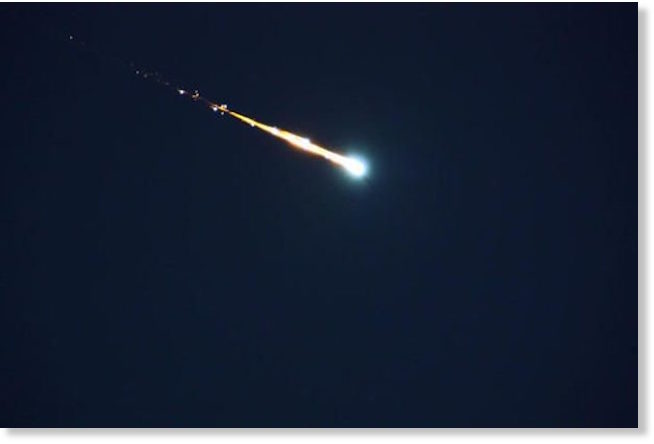
An astronomer says a loud bang heard in Rolleston and a red streak seen in the sky over Whanganui at the same time were possibly from a meteorite entering Earth's atmosphere. Retired astronomer Peter Cottrell said it was possible the red streak and loud explosions late Saturday could be from a meteorite or space junk.

"It's possible to get a sonic boom from something coming through the atmosphere at high speed.

"It's a sonic boom because it is travelling faster than the speed of sound."

The red flash seen in Whanganui could have been the meteorite burning up in the atmosphere.

"As soon as it hits the atmosphere there's a lot of friction and friction creates heat and heat creates light as well."

Security guard Nick O'Leary, who was on duty at Whanganui Hospital, said he saw a red streak for a split second just after 11.30pm.

At the same time several residents in the town of Rolleston, Canterbury, reported loud explosions in the area.

Police were unable to identify the source.

Cottrell said the loud bang, or sonic boom, heard in Rolleston would have followed the sighting in Whanganui, Cottrell said.

If it had not burned up completely, finding the meteorite would be challenging. It could be as small as the size of a pebble, but would be dense and heavy.

Cottrell said it was fairly common for meteorites to enter Earth's atmosphere.

Fireball

Fireball seen across Pacific Northwest

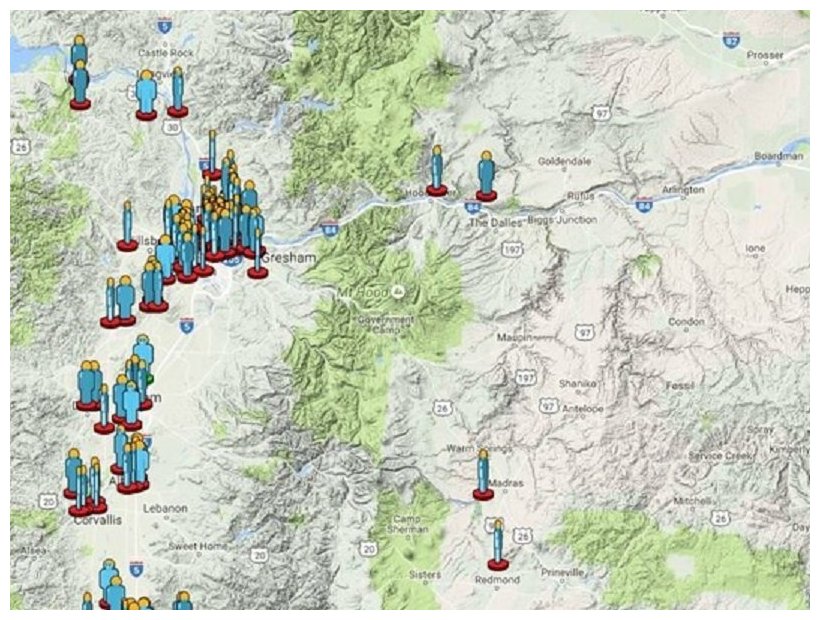
Screenshot of AMS map
© Screenshot of AMS mapMap of where the fireball was reported seen.
Portland, Oregon - Many people throughout the Pacific Northwest reported seeing a "fireball" blazing through the sky at around midnight Friday.

According to the American Meteor Society, more than 130 people reported seeing the light shoot across the sky. It was reported seen as far south as Grants Pass and as far north as Port Angeles, Washington. Most of the reports came from the Willamette Valley.

Videos and photos of the fireball were posted on social media.

Fireball

Astronomers discover asteroid twice the size of Chelyabinsk bolide... a few hours before it narrowly missed Earth

Asteroid
© Getty
On Saturday, astronomers discovered a new asteroid, just a few hours before it almost hit us.

The asteroid is called 2016 QA2, and it missed the Earth by less than a quarter of the distance to the moon. That puts it about three times as far away from Earth as our farthest satellites. And we never saw it coming.

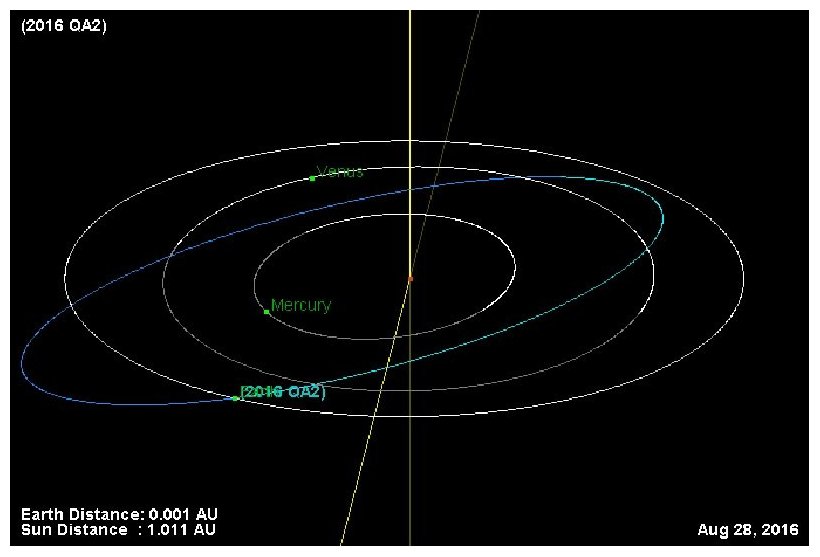
So how did 2016 QA2 sneak up on us like that? For this particular asteroid, the answer seems to be that it has a very peculiar orbit. It's highly elliptical, which means it can usually be found hanging out by either Mars or Venus, but rarely ends up near Earth.

But another, more worrying reason is that there aren't a lot of people looking for potentially dangerous asteroids. While Congress has tasked NASA with finding 90 percent of asteroids 450 feet or larger by 2020, the agency is nowhere close to that goal. Funding for asteroid detection is very low, and most telescopes that could detect asteroids of this size won't come online for a few more years.


Comment: So, the technology is lagging, the funding is lacking, and the politicians are too busy feathering their nests.


Comment: Our other report about this estimates that this object was at least twice the size of the Chelyabinsk asteroid.


Fireball

Asteroid zooms past Earth hours after discovery

Asteroid 2016 QA2 was twice as big as the space rock that entered over Russia in 2013, breaking windows in 6 Russian cities. It passed safely Saturday night

The calculated orbit of 2016 QA2.
© JPL Small Body Database/Sciencythoughts BlogspotThe calculated orbit of 2016 QA2.
An asteroid safely passed by our planet on Saturday night - August 27-28, 2016 - just hours after being detected. Astronomers have labeled the space rock as asteroid 2016 QA2. The rocks is estimated to be at least twice as big as the Chelyabinsk meteor that penetrated the atmosphere over Russia in February, 2013.

According to the Minor Planet Center, closest approach to Earth occurred August 28 at 01:24 UTC (9:24 p.m. EST on August 27; translate to your time zone). The asteroid has an estimated size of 111.5 feet (34 meters), although its exact dimension can range between 52-171 feet (16 to 52 meters).

The speeding space rock came considerably closer than the moon, as it passed at just 0.22 the Earth-moon distance. That's about 52,580 miles (84,619 km) away. For comparison, the moon is located at some 239,000 miles (384,633 km) from Earth.

Asteroid 2016 QA2 was first seen by the SONEAR Observatory at Oliveira, Brazil.

Fireball 4

Meteorite lands in Leeds garden

Meteorite
© Yorkshire Evening Post
Is it an astronomical gift or something much more mundane? David Stevenson is not sure, but he does know that a glowing hot rock appeared in his Leeds garden, apparently leaving a burning 'impact' site in its wake.

The 46-year-old was at home in Bramley with a friend when in the early hours of the morning he walked outside to the smell of burning. He found a circular area of grass on his lawn, about a metre wide, that was smouldering away and giving off wisps of smoke.

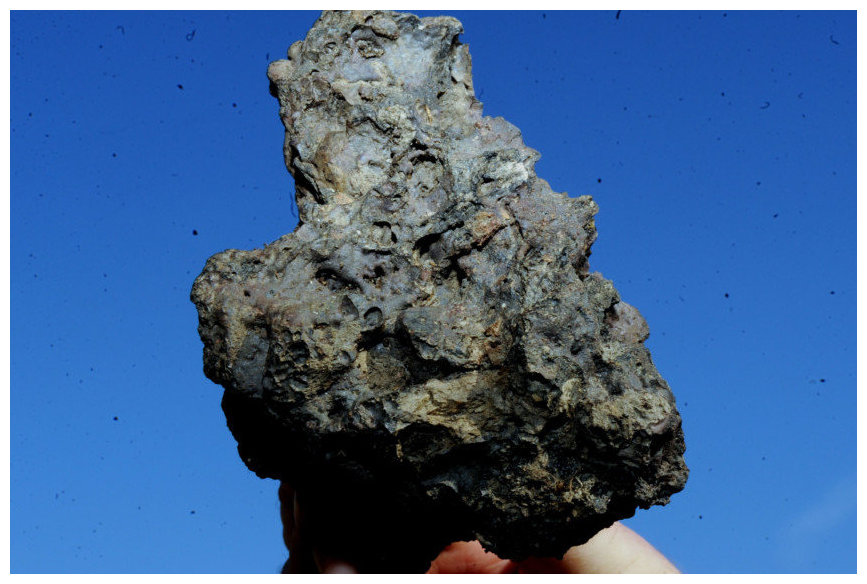
He retired to bed baffled but it was only upon closer inspection in the light of day that he discovered a weighty rock, roughly the size of two tennis balls near to the area of parched ground.

Having dismissed any prank or mischief, Mr Stevenson believes the rock may be a fragment of meteorite that has been sent crashing onto his garden lawn from outer space. His own tests have found it to be magnetic and it was initially giving off enough heat to light a cigarette.

Newspaper

Error or Toddler profiling?: Secretive CA gang database includes 42 babies

US Gang arrest
© Lucy Nicholson / Reuters
An explosive state audit of a secretive California gang database used by law enforcement showed 42 profiles were for 1-year-old children, half of whom apparently confessed to being in gangs. The database, paid for by taxpayers, is rife with other errors.

Of those profiles for 1-year-old children, 28 were entered for "admitting to being gang members," according to State Auditor Elaine Howle in a statement issued with the report The CalGang Criminal Intelligence System on Friday.

Comet 2

Comets & Asteroids - Summary for July 2016

During the month of July 2016, 1 new comet has been discovered and there were 4 comet recoveries. An international team of astronomers discovered a new dwarf planet (designated 2015 RR245) orbiting in the disk of small icy worlds beyond Neptune. The Team Radar at Arecibo observed the Near-Earth asteroid (154244) 2002 KL6. "Current comet magnitudes" & "Daily updated asteroid flybys" pages are available at the top of this blog (or just click on the underline text here).

The dates below refer to the date of issuance of CBET (Central Bureau Electronic Telegram) which reported the official news & designations.

Comet Discoveries

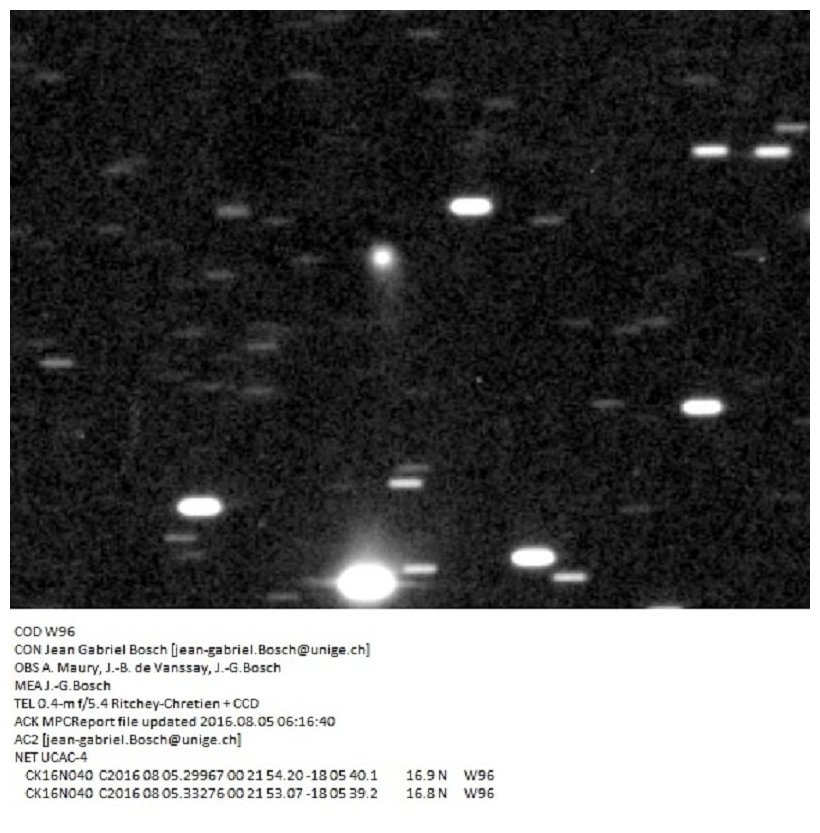
July 18 Discovery of C/2016 N4 (MASTER)
C/2016 N4 ( MASTER )
© Jean-Gabriel BoschComet C/2016 N4 (MASTER).
Comet Recoveries

July 04 Recovery of P/2009 K1 (GIBBS) as P/2016 M2
July 04 Recovery of P/2008 J3 (McNAUGHT) as P/2016 N1
July 06 Recovery of P/2008 T1 (BOATTINI) as P/2016 N2
July 18 Recovery of P/2007 R3 (GIBBS) as P/2016 N3