Comets


Comet 2

Sott Exclusive: Nemesis, not 'Nibiru' - Clarifying mainstream reports about 'a large ninth planet' that periodically sends comets our way

comet earth
There are historical records of comets taking up the whole night sky...
A number of tabloids recently revived an astronomical theory about a large 'ninth planet' orbiting the outer reaches of the solar system and periodically crashing through a comet field - in this case, the Kuiper Belt - to send 'icy' space rocks our way. What makes the story remarkable for us is not the intriguing nature of the information it conveys - Sott.net has been covering a more well-founded variant of this theory for many years - but that even Rupert Murdoch's slimy British publication, The Sun, which thankfully bears no relation whatsoever to Sol, ran with it (albeit in super-dumbed-down form).

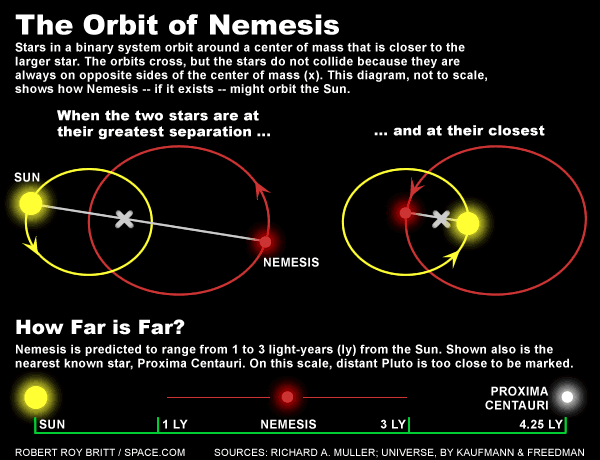
This is not the first time astronomers have suggested that something periodically disturbs comets situated somewhere on the outer rim of our solar system, sending some (or many, depending on your perspective) of them our way. 'Planet X' a.k.a. 'Nibiru' would be far too small to account for the effects attributed to it. Rather than speculating about 'a ninth planet', other astronomers have posited that such a space body is more likely to be a second sun - albeit a smaller, dark, 'dwarf' one. Its orbit would be so big that it would take it half-way to the nearest star. The theory goes that it disturbs comets in the Oort Cloud - which is basically an extension of the Kuiper Belt - as it 're-enters' the solar system.

nemesis
Nemesis, not such 'pseudo-science quackery' after all
The History Channel's The Universe TV series aired this episode - 'Nemesis: The Sun's Evil Twin' - back in 2011:


Comet 2

Comets & Asteroids - Summary for March 2016

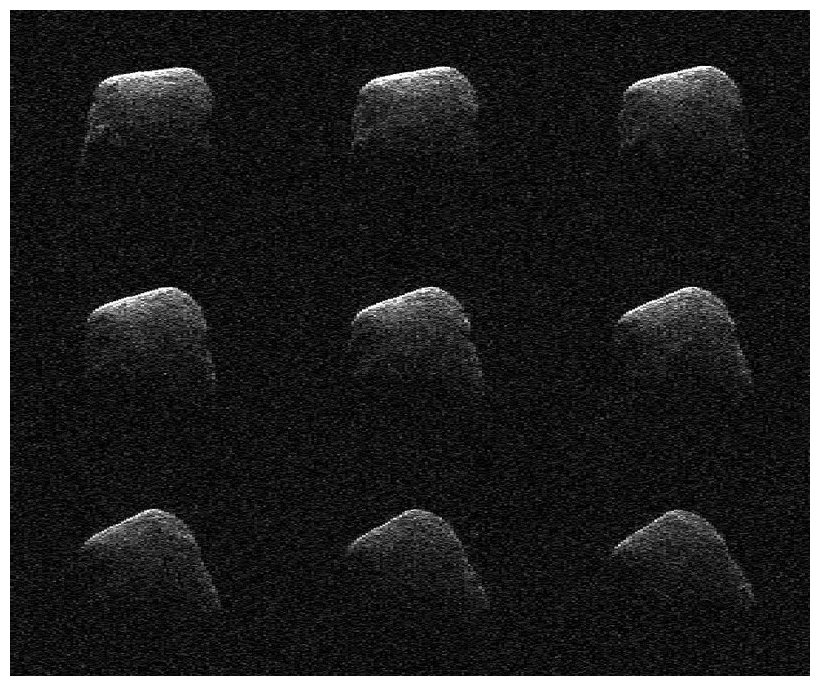
During the month of March 2016, 3 new comets were discovered. On March 17, 2016 a new impact flash on Jupiter has been captured by amateur astronomers. Moreover, delay-doppler images of asteroid 2016 DV1 (on March 03, 2016) and of comet P/2016 BA14 (on March 22, 2016) have been obtained by Goldstone Solar System Radar.(see below for more about these news). "Current comet magnitudes" & "Daily updated asteroid flybys" pages are available at the top of this blog (or just click on the underline text here).
The dates below refer to the date of issuance of CBET (Central Bureau Electronic Telegram) which reported the official news & designations.
Comet P/2016 BA14
© NASA/JPL-Caltech/GSSRRadar images of comet P/2016 BA14.
Comet Discoveries

Mar 11 Discovery of C/2016 E1 (PANSTARRS)
Mar 16 P/2015 B4 (LEMMON-PANSTARRS)
Mar 16 C/2016 E2 (KOWALSKI)

Scientists using the Goldstone Solar System Radar in California's Mojave Desert observed comet P/2016 BA14 during its historic flyby. Close approach of March 22, 2016 by P/2016 BA14 has been the third closest on record and the closest flyby of a comet in 246 years (for more info about P/2016 BA14 see our previous post). Radar images from the flyby indicate that the comet is about 1 kilometer in diameter. Moreover data collected by V. Reddy using the NASA Infrared Telescope Facility (IRTF) on Mauna Kea, Hawaii indicate that the comet reflects less than 3 percent of the sunlight that falls on its surface.

Jupiter

Update: Was Jupiter slammed by another comet... or was it something else?

Jupiter Impact
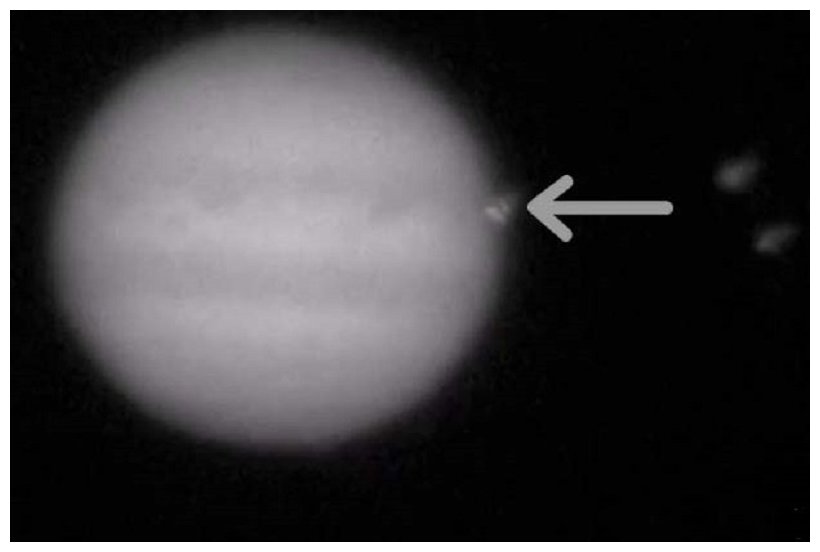
© John McKeon The flash from a new impact on Jupiter (arrow) is seen in this still from a video taken through a telescope by amateur astronomer John McKeon of Swords, Ireland on March 17, 2016.
Take that, Jupiter! The largest planet in the solar system just got whacked by an asteroid or a comet, and some intrepid stargazers have captured the planet's latest collision on camera.

Amateur astronomer John McKeon was observing the king of planets by telescope from Swords, Ireland, on March 17 when he captured this stunning time-lapse video of something hitting Jupiter. McKeon was recording the transit of Jupiter's moons Io and Ganymede with an 11-inch Schmidt-Cassegrain telescope and his ASI120mm camera when something struck Jupiter, and he struck cosmic pay dirt.

"The original purpose of the imaging session was to get this time-lapse, with a happy coincidence of the impact in the second, last capture of the night," McKeon wrote in a YouTube video description.

While it's still too early to know exact details on the Jupiter crash, NASA asteroid expert Paul Chodas, who heads the agency's Center for Near-Earth Object Studies at the Jet Propulsion Laboratory in Pasadena, California, said there's greater chance that an asteroid, not comet, is the culprit.

"It's more likely to be an asteroid simply because there are more of them," Chodas told Space.com by phone.

It's not yet clear what hit Jupiter, but the impact was also captured by at least one other amateur astronomer — Gerrit Kernbauer of Mödling, Austria — according to Bad Astronomy's Phil Plait, who posted Kernbauer's YouTube video of the impact. According to Plait, the impact occurred at 00:18 GMT, or just after midnight, on March 17.

Comment: If this was a space rock impacting Jupiter, it would be the 6th such time since 1994.

However, we've since learned of Suspicious Observers' idea that it may have been some kind of energetic plasma event, which is an intriguing possibility. Weird things, after all, are happening in our atmosphere, so why not Jupiter's?

See also: SOTT Exclusive: Two comets whizz past Earth on same day, including third and fifth closest flybys in recorded history


Comet 2

SOTT Exclusive: Two comets whizz past Earth on same day, including third and fifth closest flybys in recorded history

comets
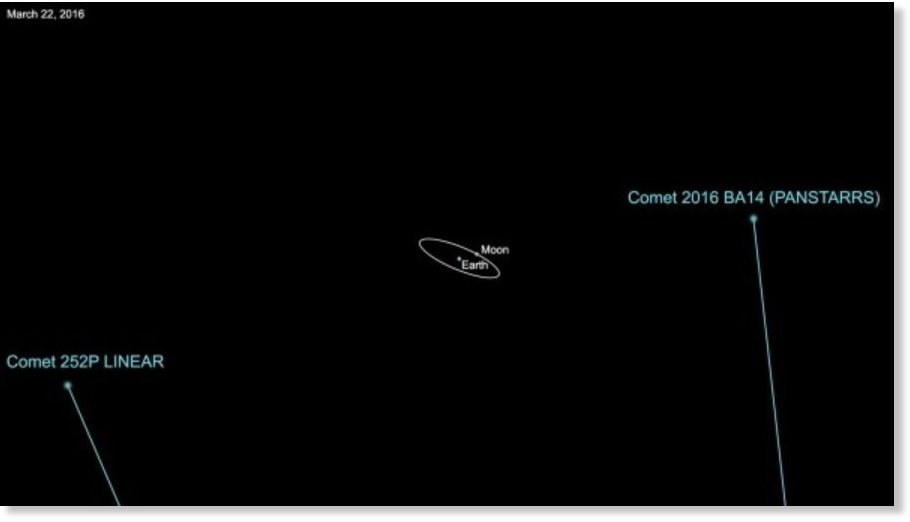
© NASA/JPL-CaltechComet 252P/LINEAR flew past Earth on March 21, 2016. On March 22, 2016, Comet P/2016 BA14 passed by at a distance of about 2.2 million miles (3.5 million kilometers).
Comet P/2016 BA14, discovered just two months ago on January 22, 2016 by the University of Hawaii's Pan-STARRS telescope, made history on March 22, becoming the closet comet to pass by Earth in 246 years. Radar images from the flyby indicate that the comet is about 3,000 feet (1 kilometre) in diameter:


At the time of its closest approach, the comet was about 2.2 million miles (3.5 million kilometres) away, making it the third-closest flyby of a comet in recorded history. First place goes to Comet D/1770 L1 (Lexell), which shaved Earth at just 5.9 lunar distances in July 1770.

For the second-closest flyby of a comet, we have to go back 650 years. Comet 55P/1366 U1 (Temple-Tuttle) is calculated to have passed by Earth in October 1366 at 8.9 lunar distances, about 1,410,100 miles (2.3 million km).
comets
© Slooh Community ObservatoryImagery captured by the Slooh Community Observatory's Chile Observatory Telescope showing comets 252P/LINEAR (right) and 2016 BA14 as they flew past Earth on March 21 and March 22, 2016, respectively.

Comet 2

New Comet: C/2016 E2 (Kowalski)

CBET nr. 4266, issued on 2016, March 16, announces the discovery of a comet (magnitude ~18) by R. A. Kowalski on CCD images obtained with the 0.68-m Schmidt telescope in the course of the Catalina Sky Survey on Mar. 15.44-15.46 UT. The new comet has been designated C/2016 E2 (Kowalski).

We performed follow-up measurements of this object, while it was still on the neocp. Stacking of 65 unfiltered exposures, 15 seconds each, obtained remotely on 2016, March 16.3 from H06 (iTelescope network - New Mexico) through a 0.25-m f/3.4 reflector + CCD, shows that this object is a comet with a diffuse irregular coma nearly 10 arcsec in diameter.

Our confirmation image (click on it for a bigger version)
Comet C/2016 E2
© Remanzacco Blog
M.P.E.C. 2016-F03 assigns the following preliminary elliptical orbital elements to comet C/2016 E2: T 2016 Feb. 6.70; e= 1.0; Peri. = 322.01; q = 1.07; Incl.= 136.00

Comet

Comet 252P/LINEAR brightens much faster than expected

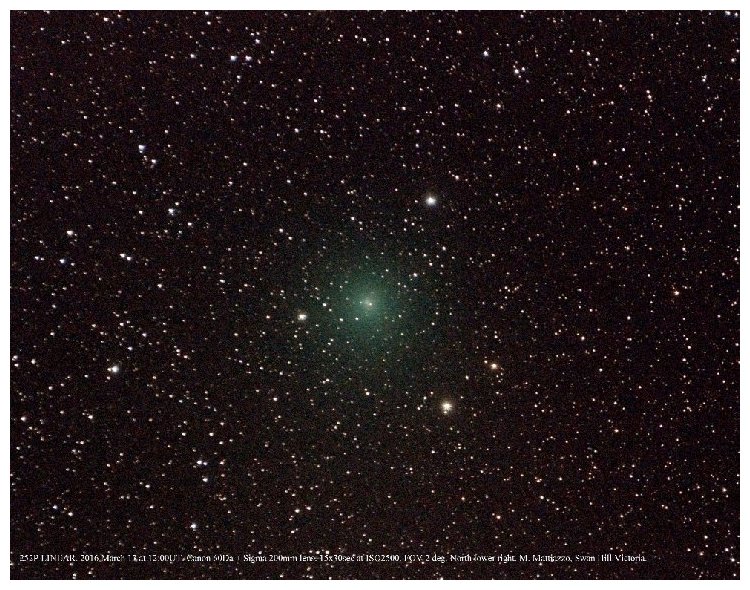
On March 21st, Comet 252P/LINEAR will make a close approach to Earth--only 0.036 AU (5.4 million km) away. This is the fifth closest cometary approach on record and, as a result, the normally dim comet could become an easy target for backyard telescopes. In fact, it is brightening much faster than expected: data. "Comet 252P/LINEAR has surpassed expectations and is now bordering on naked eye visibility for southern observers," reports Michael Mattiazzo of Swan Hill, Victoria, Australia, who took this picture on March 13th:
Comet 252P LINEAR
© Michael MattiazzoComet 252P LINEAR has surpassed expectations by showing a remarkable rate of brightening, about 0.5 magnitudes per day, over the period May 7 to 14 and is now bordering on naked eye visibility for southern observers.

The very large, diffuse coma is expanding rapidly, from 10 arcminutes on March 7 to 35 arcminutes on March 14. It may reach 1 degree across at closest approach on March 21. A dark southern sky and a good pair of binoculars is essential.
"Since March 7th, the comet has brightened about 0.5 magnitudes per day," continues Mattiazzo, "and now it is near 6th magnitude. The comet's atmosphere (coma) is expanding rapidly, too, from 10 arcminutes on March 7th to 35 arcminutes on March 14th. It may reach 1o across by March 21st."

This is a southern hemisphere event. At closest approach on March 21st, the brightening comet will speed through the constellations Triangulum Australis and Apus. Observers south of the equator can use this ephemeris to point their telescopes. In remote places with very dark skies, it is possible that no telescope will be required; naked eyes might suffice. Stay tuned for updates as the comet approaches.

Comet 2

Comet Siding Spring plunged the magnetic field around Mars into chaos

Comet Siding Spring
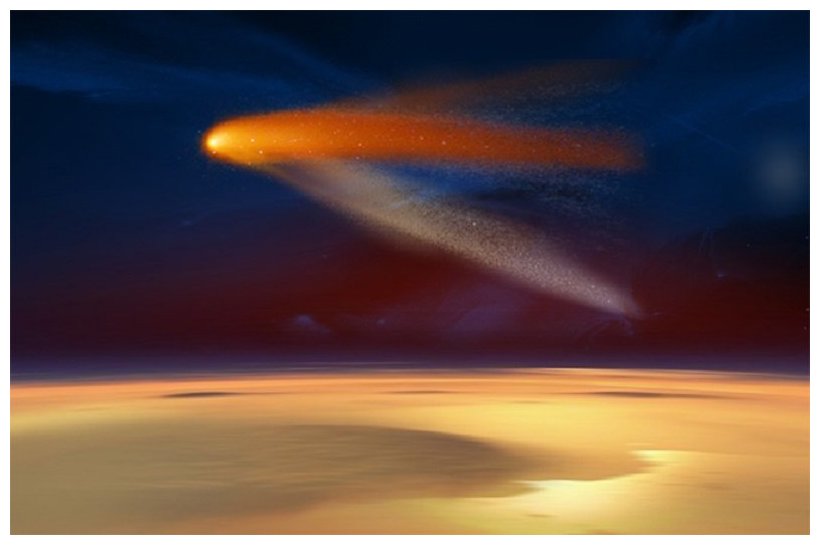
© NASA/JPL-CaltechThis artist's impression depicts Comet Siding Spring narrowly miss Mars in 2014.
When Comet C/2013 A1 (Siding Spring) swung past the Red Planet in October 2014, it was an unprecedented opportunity for an armada of Mars robots to have a ringside seat of the interplanetary spectacle. But as dazzling as the flyby was, the real drama wasn't seen by the cameras of Mars orbiters or rovers; it was detected by a magnetometer. And that magnetometer, located 100 miles above the Martian surface, detected chaos.

"Comet Siding Spring plunged the magnetic field around Mars into chaos," said Jared Espley, of NASA's Goddard Space Flight Center in Greenbelt, Md. and science team member of NASA's Mars Atmosphere and Volatile Evolution (MAVEN) spacecraft, in a NASA press release. "We think the encounter blew away part of Mars' upper atmosphere, much like a strong solar storm would."

Although Mars' magnetic field is weak and patchy (unlike Earth's strong, global magnetosphere), MAVEN's sensitive magnetometer detected a huge upheaval in orbit as Siding Spring's own magnetism rattled the planet's magnetic field.

The comet's nucleus may only be a third of a mile wide, but the atmosphere surrounding the nucleus (known as the coma) was as wide as 600,000 miles when it encountered Mars. (The coma is formed through solar heating — the ices contained within a comet's nucleus sublimate into space, pumping the coma with gas.) Through interactions with the solar wind, comets also generate their own magnetic fields that loop their way through the coma. So when Siding Spring buzzed Mars, coming as close as 87,000 miles, the cometary magnetism punched Mars' weak magnetic field, sending it into violent turmoil for several hours.

Comet 2

Comets & Asteroids - Summary for February 2016

During the month of February 2016, 3 new comets were discovered, there were 2 recoveries and cometary activity was detected for 2 previously discovered objects (earlier designated as asteroids). New fragments of comet P/2015 Y2 = P/2010 V1 (IKEYA-MURAKAMI) (see previous post) reported. According to a paper available on Arxiv, at least 17 fragments have been identified.

Moreover the binary nature of asteroid (2535) Hämeenlinna and a previously unknown shower of naked-eye meteors, now known as the Volantids, have been reported (see below for more about this news). "Current comet magnitudes" & "Daily updated asteroid flybys" pages are available at the top of this blog (or just click on the underline text here).

The dates below refer to the date of issuance of CBET (Central Bureau Electronic Telegram) which reported the official news & designations.

- Comet Discoveries

Feb 14 Discovery of C/2016 C1 (PANSTARRS)
Feb 15 Discovery of P/2016 BA14 (PANSTARRS)*
Feb 19 Discovery of C/2016 C2 (NEOWISE)
Comet P/2016 BA14
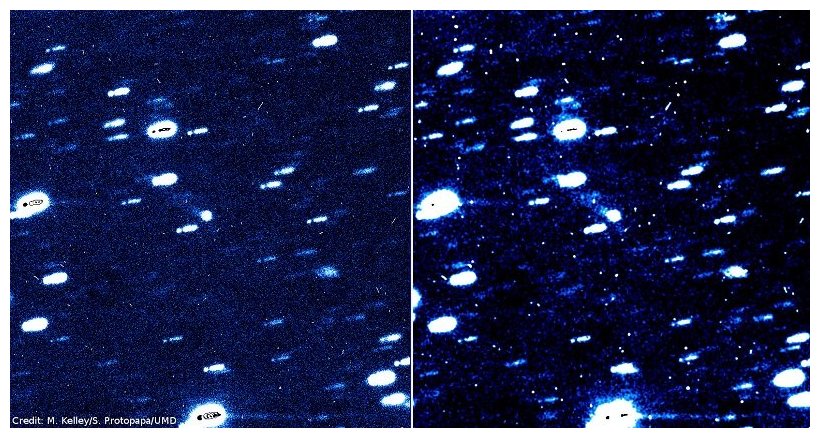
© M.Kelley/S.Protopapa/UMD Comet P/2016 BA14

Comet 2

Closest flyby of comet in centuries in March

Comet
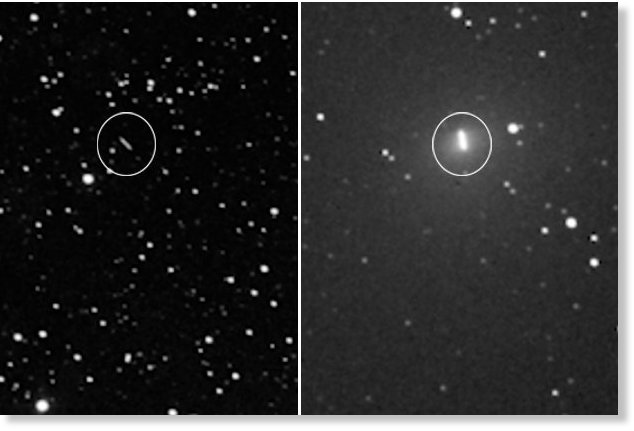
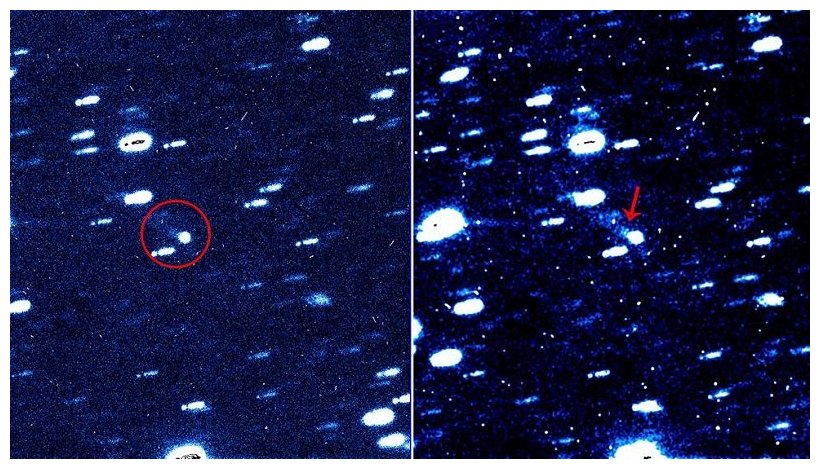
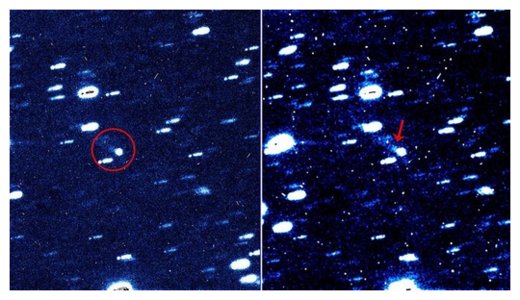
© M. Kelley/S. Protopapa/UMDThe image on the left is a combination of five 300-s exposures tracking the ‘asteroid,’ while the image on the right is a smoothed version to help enhance the tail (indicated by the arrow), proving that it is in fact a comet.
Astronomers with their eyes on the sky thought they spotted an asteroid, but a closer look revealed a comet.

It was initially labeled as asteroid 2016 BA14 by the Pan-STARRS survey, but a group of astronomers from the University of Maryland took a closer look and found something very intriguing: a tail. Rather than a rocky, metallic asteroid, it appears the space object is actually an icy comet.

That means it's one of two comets flying by Earth in March. The other, Comet 252P/LINEAR 12, will pass by on March 21.

The newly discovered comet will fly by Earth the very next day, March 22, in the morning, and it will set a record.

"The P/2016 BA14 (PanSTARRS) flyby is significant because it is one of the closest flybys of a comet since comet Lexell in 1770, which passed about six lunar distances away," Michael Kelley of the University of Maryland, who confirmed the asteroid was a comet, told weather.com. "Asteroids frequently flyby at such close distances, but comet encounters are rare."

It will be the third closest comet flyby of Earth of all time, but it will still be 9 times the distance to the moon - well out of Earth's range.Even more interesting than its close range, Kelley says, is the possibility that the comet is a sister comet to 252P/LINEAR 12.

Comet P/2016 BA14 could very well have broken off from comet 252P/LINEAR 12, Slate reports.

"If we can understand if and why these small comets broke apart years ago, we may be able to better determine the general impact threat comets present to the Earth," Kelley says.

Astronomers will keep a close eye on both comets through Hubble Space Telescope observations. If you want to see the comet, you'll need binoculars or a telescope.


Fireball 5

Newly discovered New Year's Eve meteor shower, the Volantids

A new network of video surveillance cameras in New Zealand has detected a surprise meteor shower on New Year's Eve. The shower is called the Volantids, named after the constellation Volans, the flying fish, from which the meteoroids appear to stream towards us.
Meteor Shower
© Danielle Futselaar/SETI InstituteNew Year’s Eve meteor shower.
"In a way, the shower helped chase bad spirits away," says SETI Institute meteor astronomer Peter Jenniskens. "Now we have an early warning that we should be looking for a potentially hazardous comet in that orbit."

In September of 2014, Jenniskens teamed up with Professor Jack Baggaley of the University of Canterbury in Christchurch, New Zealand, to establish a meteor video surveillance project in the southern hemisphere to find such warning signs of dangerous comets. This project was similar to the existing Cameras for Allsky Meteor Surveillance network (CAMS) in northern California. The CAMS network is sponsored by, and supports the goals of, the NASA Near Earth Object Observation program.