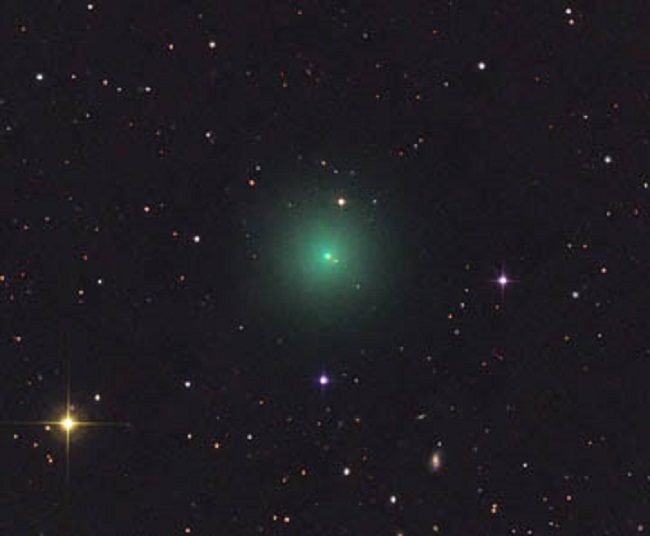
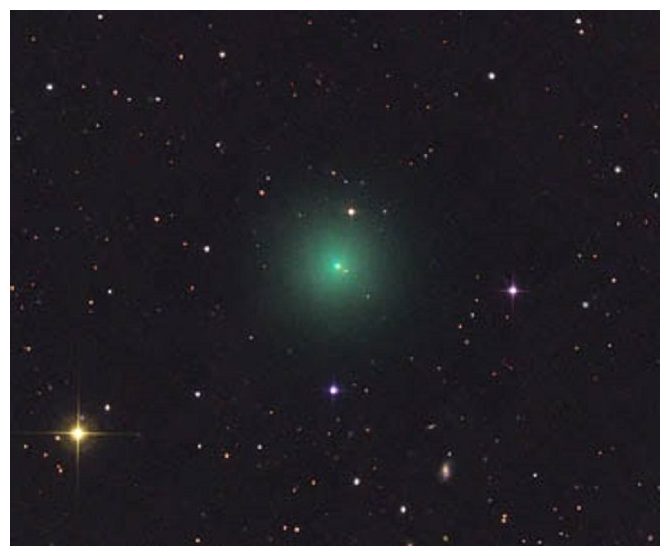
© Rolando LigustriNew Comet ASASSN1 (C/2017 O1) already glows aqua from carbon-laced gases. The comet is currently visible in the pre-dawn sky through modest-sized telescopes.
It feels like the FedEx guy just pulled up and dropped off a truckload of astronomical goodies. News arrived in my e-mail Monday about a new comet discovered by the
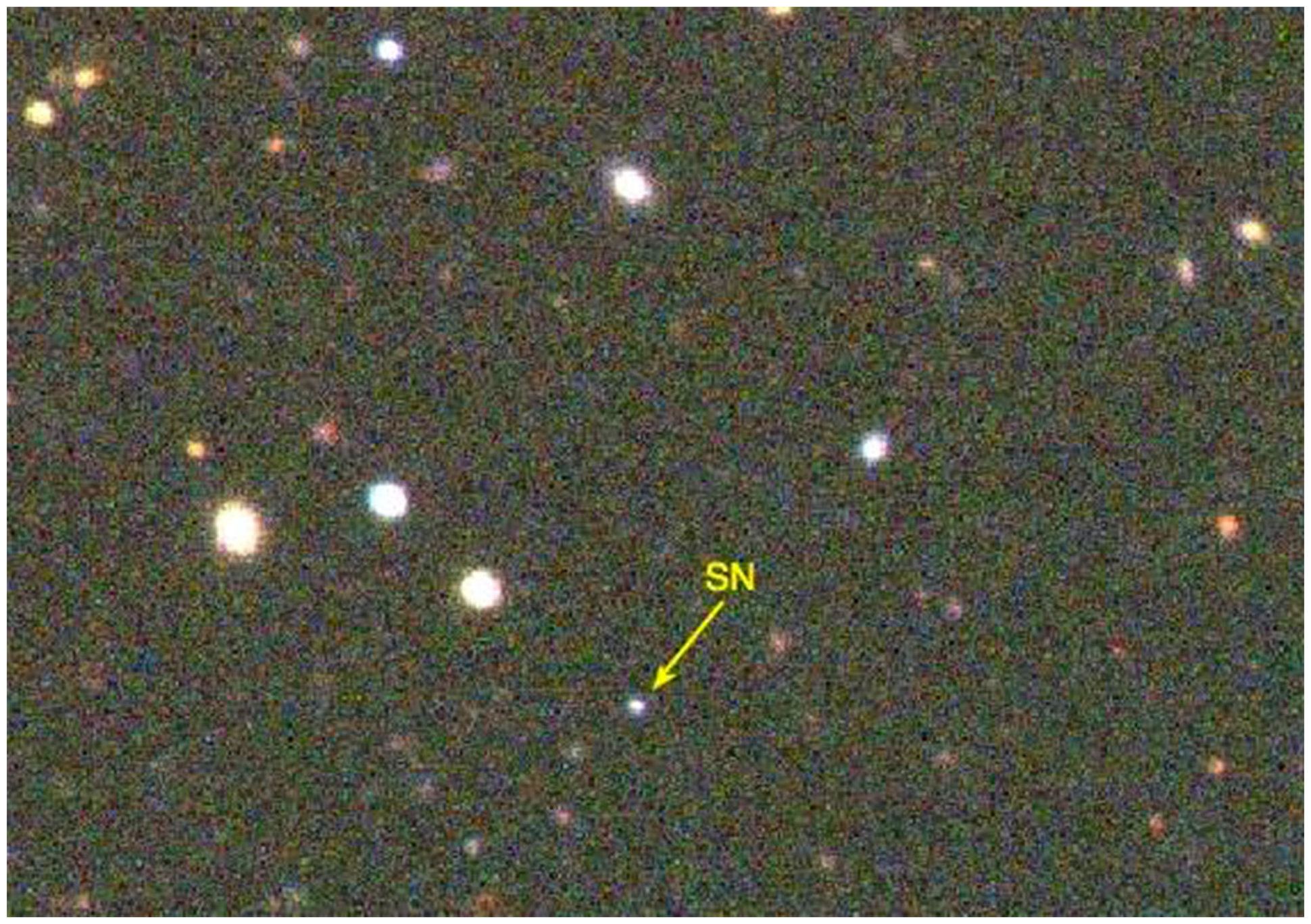
All-Sky Automated Survey for Supernovae (ASAS-SN).Founding member Benjamin Shappee and team have 498 bright supernovae and numerous other transient sources to their credit, but this is the group's
first comet discovery, ASASSN1 (C/2017 O1).
The 15th-magnitude object was
caught before dawn on July 19th in the constellation Cetus using data from the quadruple 14-cm "Cassius" telescope on Cerro Tololo, Chile. Don't be put off by that magnitude. The comet has brightened quickly in the past few days; visual observers are now reporting it at around magnitude +10 with a large (7′), weakly condensed coma. Chris Wyatt of Australia relates that a Swan band filter does a great job enhancing the apparent brightness and contrast of the coma, a sign this is a "gassy" comet.
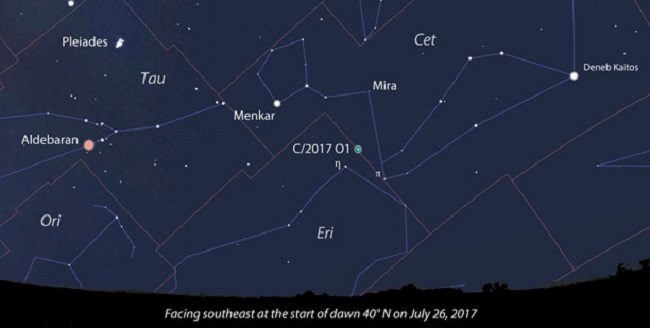
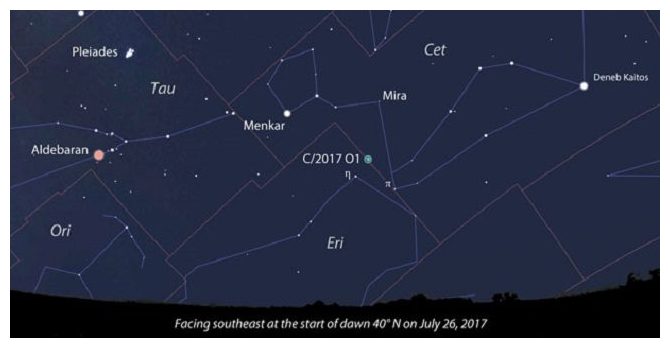
© StellariumThis wide-view map shows Comet ASASSN1's location at the Cetus–Eridanus border south of Alpha (α) Ceti (Menkar) on July 26th.
Assuming the orbit remains close to the current calculation, Comet ASASSN1 will move northeast across Cetus and Taurus this summer and fall, slowly brightening as it
approaches perihelion on October 14th in Perseus. It comes closest to the Earth four nights later, missing the planet by a cool 67 million miles. In a fun twist, ASASSN1 will slow down and spend the entire month of December and much of January within a few degrees of the North Star!











Comment: See also: Electric universe: Lightning strength and frequency increasing
The Electric Universe model is clearly explained, with a lot more relevant information, in the book Earth Changes and the Human Cosmic Connection by Pierre Lescaudron and Laura Knight-Jadczyk.