Volcanoes
S


Bizarro Earth

Indonesia volcano erupts forcing Bali flight cancellations

Volcanic ash clouds
Volcanic ash clouds have again disrupted the plans of Bali holidaymakers
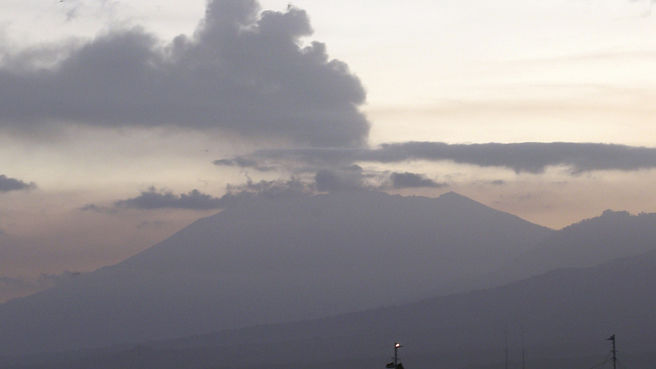
Disaster mitigation authorities in West Nusa Tenggara have raised the status of Indonesia's second highest active volcano to "alert" as it continues to spew ash, prompting an Australian airline to cancel all flights to and from Denpasar airport today.

Mount Barujari, Mount Rinjani's cone and a result of eruptions of the main volcano in 1994 and 1995, erupted on Sunday sending hot clouds and debris up to around 10,000 feet, Azhar, chief of the West Nusa Tenggara Disaster Mitigation Agency, said on Tuesday.

Although the status remains at alert, Azhar said, the agency had prepared a number of evacuation scenarios for some 40,000 residents living near the 3,726-meter volcano located in the North Lombok district.

"We will evacuate them immediately to the safest areas in North Lombok, East Lombok and West Lombok," said Azhar as quoted by news portal Okezone.com on Tuesday.

The volcanic activity has prompted Virgin Australia to cancel all of Tuesday's flights to and from Indonesia's most popular tourist destination island of Bali — neighboring Lombok.

Attention

Unexpected eruption from Lascar Volcano in Chile

Image
© Ed Darack/AlamyVolcan Lascar Spews Ash into the Atacama Sky.
Lascar, in the northern Andes of Chile, erupted unexpectedly today, producing a small plume of light grey ash that reached 2.5 kilometers (~8,200 feet) above the volcano (see above). The fact that there seemed to be little in the way of precursory activity (earthquakes, increased gas emissions) from Lascar suggests that this blast may have been a phreatic explosion driven by water flashing to steam in the volcano's summit crater or conduit.

Due to this minor eruption, the SERNAGEOMIN has raised the alert status at Lascar to Yellow, although the volcano is in a fairly remote part of the Chilean Andes—the Global Volcanism Program reports only ~8,100 people living within 100 kilometers (62 miles) of Lascar.

It has been over 2 years since Lascar last did anything and its last major eruption of Lascar was in 2005. However, it has produced some spectacular eruptions in the recent past, including the 1993 eruption that was a VEI 4. As with any of these small blasts, volcanologists will watch Lascar to see if this is a sign that it is awakening or merely a blip. Based on images on the Lascar webcam, the eruption appears to have waned rapidly (see below).

Image
© SERNAGEOMIN The light grey, ash-rich plume from Chile’s Lascar during its minor October 30, 2015 eruption.
The SERNAGEOMIN maintains two webcams pointed at Lascar, although only one is running right now.

Attention

Popocatepetl volcano in Mexico erupts spewing ash and smoke

Image
Popocatepetl volcano
Mexico's Popocatepetl volcano erupted on Thursday (29 October), belching ash and smoke across blue skies, authorities reported. A spectacular column of ash erupted from the volcano at 8.57am local time. The volcano is located 50 miles southeast of the capital, Mexico City.

National Civil Protection Coordinator Luis Felipe Puente said in his Twitter account, ash and smoke rose 3,000 metres above the crater of the volcano, in the direction of the north east.

Mexico's National Centre for Disaster Prevention (Cenapred) reported that a total of 141 exhalations of low intensity in the last 24 hours have been reported, following a series of rumblings at the massive volcano in recent months. Mexico contains over 3,000 volcanos but only 14 are considered active.


Cloud Lightning

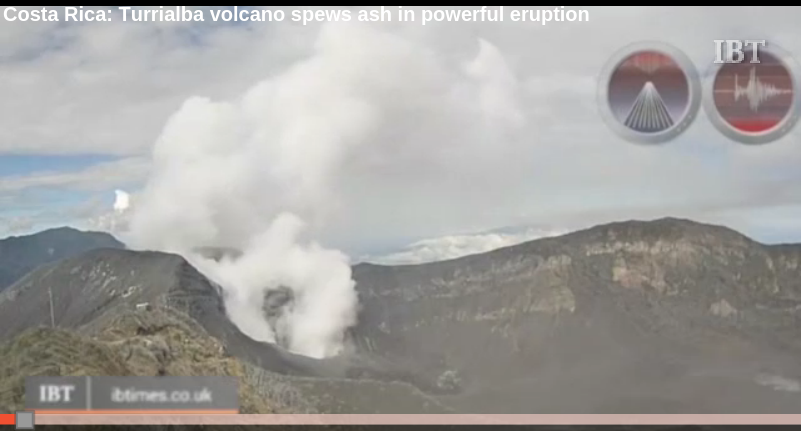
Costa Rica's Turrialba volcano spews ash in powerful eruption

Costa Ricas Turrialba volcano
Costa Ricas Turrialba volcano released a column of gas and ash into the sky on Tuesday (26 October) in the latest of a series of eruptions at the majestic volcano. According to officials, the eruption occurred at 8.37am local time (2.37pm GMT) and was a little bigger than recent activity at the site. Geologist Floribet Vega said that dozens of eruptions have been registered at Turrialba in recent days.

Comment: See our latest video recap of some of the other earth changes that occurred in September:

SOTT Earth Changes Summary - September 2015: Extreme Weather, Planetary Upheaval, Meteor Fireballs


Bizarro Earth

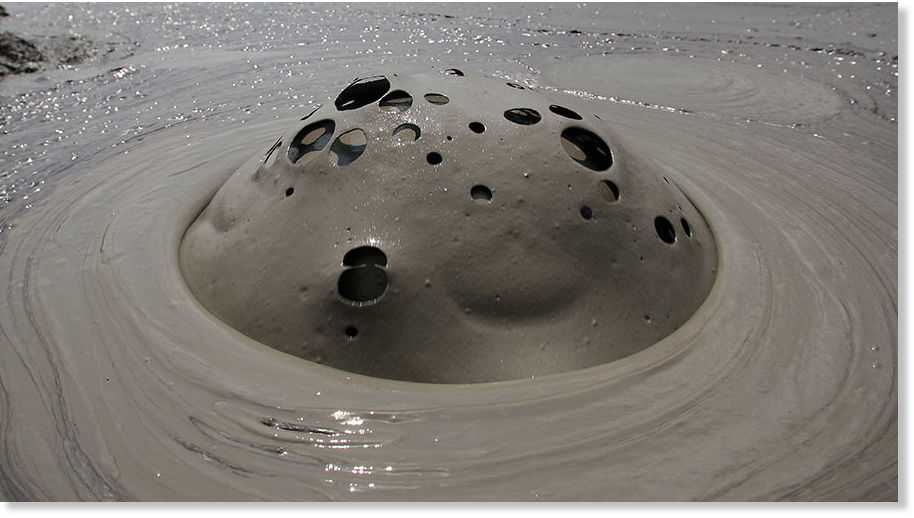
Offshore mud volcano erupts off Taman Peninsula, Russia

mud volcano off Taman peninsula
© Bogdan Cristel / Reuters
An abandoned autumn beach looking out on the Sea of Azov became a popular sightseeing attraction over the weekend, after mother nature created an incredible mud volcano, which formed a wide, flat island just a few dozen meters away from the shore.

Spewing a slurry made of water and gases mixed with sand and dirt, the mud volcano shot several meters into the air as it started forming an artificial island on Sunday, just off the coast of the Taman Peninsula.

The act of nature was recorded by local beach strollers who witnessed the mud volcano, most typically formed after hot water below the earth's surface begins to blend with mineral deposits, pushing the mixture to the surface. But unlike an actual volcano, the muddy imitation produces no lava.

Comment: Another sign of Earth 'opening up'? See also:


Attention

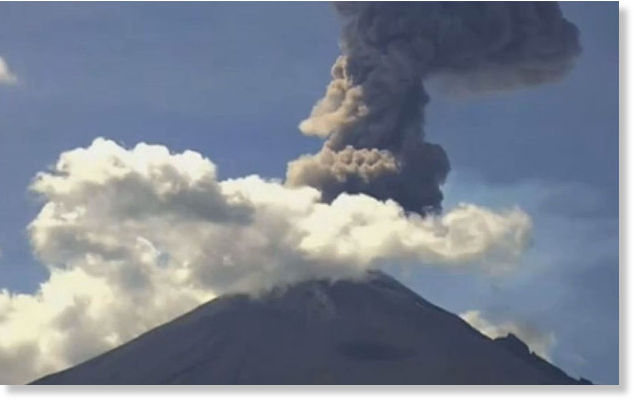
Mexico's Popocatepetl pumps ash and smoke 2,500 meters into the sky

Image
© The Telegraph, UK
Mexico's Popocatepetl volcano put on a spectacular display as it spewed out huge clouds of ash in to the sky.

The volcano, which is 50 miles south east of Mexico City spat ash and smoke 2500 metres above the volcano's crater.

Mexico's volcano experts says the volcano had around 40 exhalations with a series a of rumblings in the past three months.

There are around 3000 volcanoes in Mexico, but only 14 are active. Popocatepetl is one of the biggest and spans across three Mexican states and is the country's second highest peak.


Umbrella

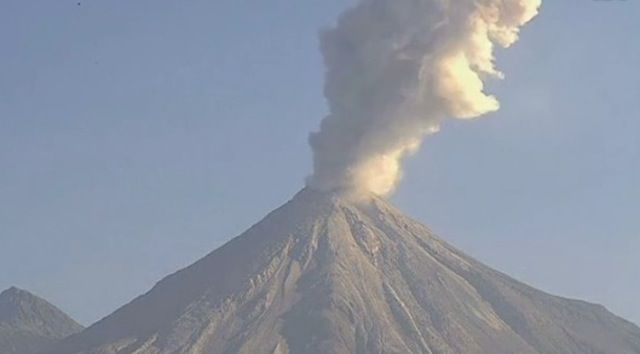
Mexico's Colima volcano erupts twice, spewing ash and smoke

Image
Mexicos Colima volcano erupted twice - at 9.46am and 11am - on 15 October, spewing ash and smoke into the air, authorities reported. The plume of gas reached a height of 2,000m in the southern direction, with moderate ash content, the head of Mexico's emergency services, Luis Felipe Puente, said on Twitter.

Located in the south-western Mexican state of Colima, the Fire Volcano has been exhibiting activity since 9 July. Over the past months, nearby villages have been blanketed with thick coats of ash, prompting evacuations.

Officially known as the Colima Volcano, it was previously active in January and February of 2015 and is part of the Pacific's Ring of Fire. Mexico contains more than 3,000 volcanos but only 14 are considered active.

Major eruptions have included the 1953 eruption of the Paricutin Volcano in Michoacan, the 1982 eruption of Tacana Volcano in Chiapas and the 1986 eruption of the Colima Volcano.

The Colima Volcano has erupted more than 40 times since the 16th century and local authorities have an emergency plan that includes continuous observation of the volcano and mandatory evacuations, if needed.


Info

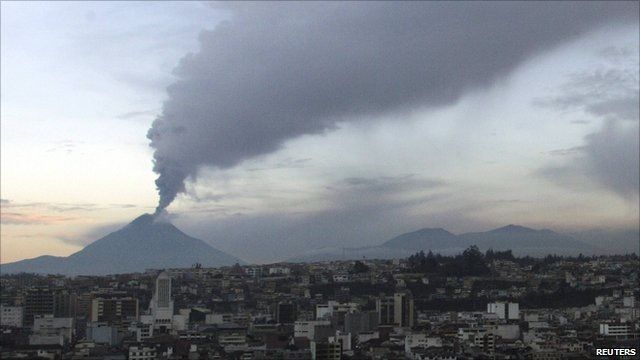
Tungurahua volcano in Ecuador spews gas, ash 2km into the air

Image
Tungurahua volcano (2011)
A second volcano is once again spewing plumes of ash in the mountain chain near Ecuador's capital.

The country's Geophysics Institute says the Tungurahua volcano shot out several bursts of gas and ash over the weekend, with one reaching more than a mile (about 2 kilometers) above 16,475-foot (5,023-meter) summit. It also hurled incandescent rock onto its slope.

The Cotopaxi volcano closer to the capital was relatively calm Monday after several outbursts in recent days. It shot ash and gas about 1.5 mile (2.5 kilometers) above its crater on Sunday.

It poses a greater threat to populated areas, standing about 30 miles (50 kilometers) southeast of Quito. Tungurahua is 87 miles (140 kilometers) south of the capital.

Arrow Up

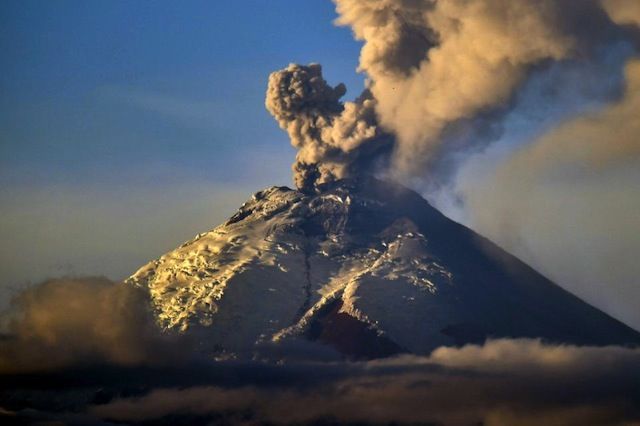
Ecuador's Cotopaxi volcano coughs 2 kilometer high column of ash

Image
© AFP/Rodrigo BuendiaPicture taken from Quito of the Cotopaxi volcano spewing ash on October 8, 2015.
Ecuador's Cotopaxi volcano, which began erupting in August after being dormant for 138 years, on Thursday coughed up a two-kilometer-high column of ash, officials said.

The giant ash column was visible from Quito, 45 kilometers (30 miles) to the north of the volcano, considered one of the world's most dangerous because its snow cap is vulnerable in an eruption and because of its close proximity to densely populated areas.

Ecuador's security coordination ministry said ash rose 2,000 meters above the volcano's crater, and warned some could fall on Quito's southern neighborhoods.

Cotopaxi, one of eight active volcanoes in Ecuador, last erupted in 1877.

The government declared a state of emergency in August after the volcano roared to life and has been conducting evacuation drills among the population.

An estimated 325,000 people could be affected if the eruption triggers mudslides and avalanches, according to the authorities.

Comment: There have been many reports of volcanic eruptions or volcanic activity in the past month - a lot of them in the Ring of Fire:


Arrow Up

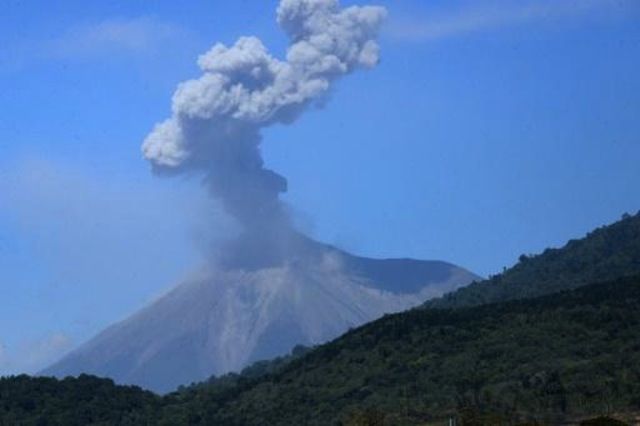
Guatamala's Fuego volcano roars to life; spews gas, ash 4,800 meters

Image
© AFP/Johan OrdonezIn February, a powerful eruption at Fuego forced authorities to declare an alert and close the airport in the capital
A volcano near the Guatemalan capital roared back to life on Wednesday, spewing ash high into the air, disaster safety officials said.

The Fuego volcano, which is just 50 kilometers (30 miles) from Guatemala City and its population of one million people, coughed out gas and ash 4,800 meters (16,000 feet) above sea level.

Despite at least two lava flows, Alejandro Maldonado, secretary of the disaster reduction office CONRAD, said the so-called "Fire Volcano" was not yet sufficiently dangerous to justify the evacuation of nearby villages.

Experts say the volcano -- one of the most active in Central America -- may become increasingly violent in the coming hours and could affect air traffic.

In February, a powerful eruption at Fuego forced authorities to declare an alert and close the airport in the capital.