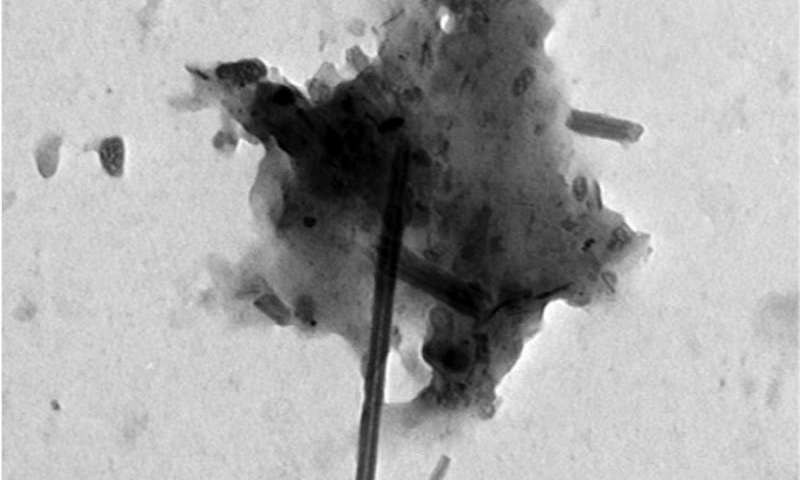
© Fathi Moussa/Paris-Saclay UniversityCarbon nanotubes (the long rods) and nanoparticles (the black clumps) appear in vehicle exhaust taken from the tailpipes of cars in Paris. The image is part of a study by scientists in Paris and at Rice University to analyze carbonaceous material in the lungs of asthma patients. They found that cars are a likely source of nanotubes found in the patients.
Rice University scientists working with colleagues in France have detected the presence of man-made carbon nanotubes in cells extracted from the airways of Parisian children under routine treatment for asthma. Further investigation found similar nanotubes in samples from the exhaust pipes of Paris vehicles and in dust gathered from various places around the city.
The researchers reported in the journal
EBioMedicine this month that these samples align with what has been found elsewhere, including
Rice's home city of Houston, in spider webs in India and in ice cores.The research in no way ascribes the children's conditions to the nanotubes, said Rice chemist Lon Wilson, a corresponding author of the new paper. But
the nanotubes' apparent ubiquity should be the focus of further investigation, he said.
"We know that carbon nanoparticles are found in nature," Wilson said, noting that round fullerene molecules like those discovered at Rice are commonly produced by volcanoes, forest fires and other combustion of carbon materials. "All you need is a little catalysis to make carbon nanotubes instead of fullerenes."
A car's catalytic converter, which turns toxic carbon monoxide into safer emissions, bears at least a passing resemblance to the Rice-invented high-pressure carbon monoxide, or HiPco, process to make carbon nanotubes, he said. "So it is not a big surprise, when you think about it," Wilson said.














Comment: Sound Science and Common Sense are On the Side of Organics