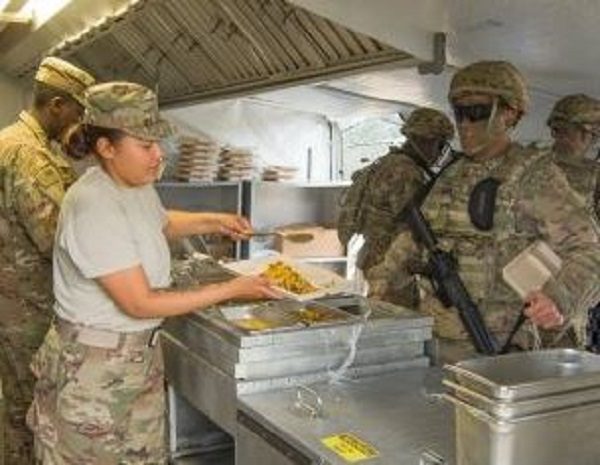
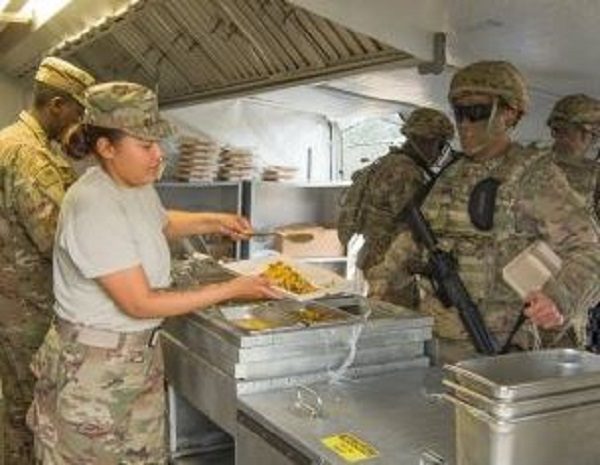
© Petty Officer 2nd Class Christopher Lange/Army.milPfc. Maria Pampolina, culinary specialist assigned to 10th Combat Aviation Brigade, provides food to unit members at a field site at Novo Selo Training Area.
There's no avoiding the debris of modern living on a trip to your local grocery store-rows and rows of foods and products that, if not ready to eat, are designed and packaged to be prepared quickly and to last an age. Makes sense, right? Busy lives require time-saving measures.
But it turns out that a considerable quantity of these items exist as a result of food-preservation experiments first conducted by the military, at the nexus of which is the
Natick Soldier Systems Center, the U.S. Army's food science lab in Massachusetts. What's more,
the military has partnered for decades with private corporations and state universities in order to refine these innovations and to disseminate them as widely into civilian life as possible-a partnership with a federal mandate, it should be noted.Some experts estimate that as many as 70 percent of products found in a typical supermarket originate with, or are influenced by, these experiments conducted by the military. But as Anastacia Marx de Salcedo, author of the well-received 2015 book
Combat-Ready Kitchen: How the U.S. Military Shapes the Way You Eat, points out, the military designed their products to be used in extreme, stressful situations over short periods of time.

















Comment: It's too bad that people have been so indoctrinated with the idea that meat eating is bad for the environment that they may actually avoid trying what could be a life-saving dietary intervention for fear that they would be harming the planet. But those who can get past the black and white thinking and adhere to the types of meat rearing that builds ecosystems, the benefits of the carnivore diet may give them a new lease on life.
See also: