Health & WellnessS


Health

Brainwashed by the mainstream media: Americans aren't ready to demand affordable healthcare - RT's Keiser Report

US citizens are joining up to save a few bucks on food, but when it concerns unity over affordable healthcare they call it socialism, says Max Keiser of Keiser Report. He thinks they are brainwashed by the mainstream media.

Info

Increasing your life expectancy: Modern medicine's impact on the extension of life

Centarian
All too often, we hear that the reason life expectancy has been increased is thanks to the marvelous developments in modern medicine. This is a message that is repeated many times and promoted by the medical industry - with little or no evidence.

In fact, the opposite may be the truth. A combination of not understanding the concept of life expectancy, ignoring scientific facts, plus a willingness to take credit when it is not due has seen the medical industry promote itself as the reason we live longer. Behind the scenes, this is little more than a marketing strategy for the big pharmaceutical companies.

Don't get me wrong; this does not undermine the fantastic role medical doctors play in acute life-saving events. These make a huge contribution to an individual's life expectancy but make an insignificant contribution to life expectancy for all of us.

Info

Antibiotic-Resistant superbugs are getting deadlier - viruses may be a solution

bacteria

It may seem absurd to fight disease with viruses, but bacteriophages could be the fix for a growing problem


The world's most frightening infections aren't carried by plague-infested rats, rabid dogs, or chimps with Ebola. They're transmitted by "superbugs" - disease-causing bacteria that can't be killed by antibiotics.

This year, superbugs will kill about 700,000 people, including 23,000 Americans. That toll will increase exponentially in the coming years as ever-evolving bacteria develop resistance to more and more antibiotics. Even hand sanitizers are struggling against certain microbes. By 2050, superbugs could kill 10 million people annually.

Comment: Phage therapy - fighting disease with viruses?
In this previously undocumented immune system, researchers uncovered bacteria-infecting viruses known as bacteriophage, which shield the body from invading infection.

The discovery, made possible with funding from the National Institutes of Health, concentrates on the protective layers of mucus which are present in all humans and animals. It serves both as a home for large populations of beneficial microbes - which can include fungi, bacteria and viruses - and as an entry point for infection.

A new immune system

The researchers sampled mucus from animals and humans - ranging from a sea anemone to a mouse and a person - and found that bacteriophage adheres to the mucus layer on all of them.

They placed bacteriophage on top of a layer of mucus-producing tissue and observed that the bacteriophage formed bonds with sugars within the mucus, causing them to adhere to the surface. They then challenged these mucus cells with E. coli bacteria and found that the bacteriophage attacked and killed off the E. coli in the mucus, effectively forming an anti-microbial barrier on the host that protected it from infection and disease.


Pills

Do psychotropic drugs enhance, or diminish, human agency?

drugs
From medication to recreational and spiritual substances, drugs offer us respite from pain, open opportunities for mental exploration, and escape from - or into - altered psychological states. They are our most widely available formal and informal implements for tweaking our mental condition. Consider the cold beer after a hard day at work, the joint before putting the needle on the record, the midday espresso, the proverbial cigarette break, Adderall during finals week, or painkillers to alleviate undiagnosed or chronic pain. Not to mention antidepressants to counter a sense of meaninglessness, and benzodiazepines because everything causes anxiety.

In short, drugs offer our most common path to a sense of psychological health. With a modicum of knowledge, millions of people modify their minds through chemistry every day. Considering the limited resources of time, support networks, money and patience, accepting the positivism of drugs seems more efficient and more feasible than psychodynamic therapy. This shift implies an expectation that there are quick and easy chemical levers into a wide range of mental states.

Attention

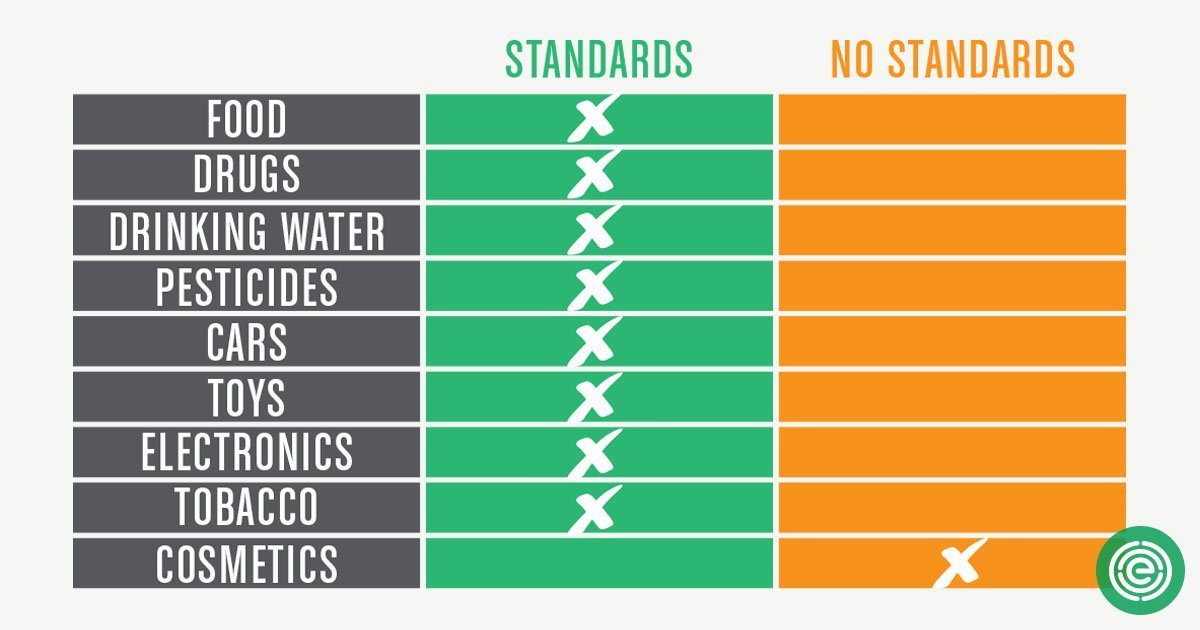
Resistance to change: After 80 years cosmetic chemicals are still unregulated

FDA regulation
It's been 80 years since Congress last voted to regulate cosmetics.

And a lot has changed since June 25, 1938 - the day Congress passed the Food, Drug and Cosmetics Act of 1938. These days cosmetics are a $60 billion-a-year business, and the average woman uses 12 products with 168 different ingredients every day.

The 1938 law only prohibited the sale of cosmetics with any "poisonous or deleterious substance," or any "filthy, putrid, or decomposed substance," so the Food and Drug Administration has so far only banned nine cosmetics ingredients for safety reasons. Members of Congress made other efforts to modernize cosmetics law, starting in the 1950s, but all of these attempts were defeated by the cosmetics industry.

Comment: Learn more about The Story of Cosmetics
The Food, Drug and Cosmetic Act of 1936 has only two pages that relate to cosmetics, and it has not been updated despite a sea change in the industry. The fact is, the Food and Drug Administration has no authority to make cosmetics companies test products for safety or recall products that are found to be harmful.

...Because the FDA doesn't test cosmetics for safety, that job goes to the Cosmetic Ingredient Review, which is funded and run by the cosmetics industry through its trade association, the Personal Care Products Council. Safety advocates are concerned that, in effect, the industry is policing itself.



Shoe

WHO study finds global lack of physical activity rising especially in wealthier countries

lack of activity
The World Health Organization (WHO) estimates that more than a quarter of the entire population on this planet are not getting enough physical exercise, this number has barely improved since 2001. There are many factors that contribute to this, but just how much damage are we doing by failing to be active?

The lack of physical exercise raises the risk of many health problems, such as heart disease, type-2 diabetes and various types of cancers.

Interestingly, according to their study published in The Lancet Global Health, higher income countries, such as the UK, were among the least active population. Women were also found to be more sedentary throughout the world, excluding two regions in Asia.

Comment: Read more about The Hidden Benefits of Exercise:


Cheeseburger

The Impossible Burger: Vegan GMO burger that 'bleeds' hits hundreds of fast food locations including 'Organic' ones

fake meat

From White Castle to 'Organic' Burger Joints like Bareburger, a bloody GMO burger is quickly gaining mass adoption. But is it as safe, healthy, and good for the planet as they claim?


It's no surprise that after $400 million dollars of funding, including contributions by notoriously pro-GMO power brokers like Bill Gates,1 that Silicon valley startup Impossible Foods genetically modified 'ground beef analogue product' has gained mainstream market penetrance in over 400 White Castle burger joints throughout the U.S this month.2 This is in addition to its already successful placement in Applebee's, Bareburger, and Whalburgers, and other independent restaurants throughout the country.

Comment: Documents reveal FDA safety concerns over fake meat burger


Health

The problem with excessive earwax

ear exam
Earwax, technically known as cerumen, is produced by glands inside your ear canal. It may be a gray, orange or yellow waxy substance, and is designed to protect, clean and lubricate the ear canal. It also provides protection against insects, water and bacteria.

The wax consists of dead skin cells, hair and secretions from glands in the outer ear canal. Other substances include lysozyme, an antibacterial enzyme, fatty acids, alcohols and cholesterol. In fact, earwax really isn't wax at all, but a mixture of water soluble, self-cleaning agents with protective, lubricating and antibacterial properties.

Excess earwax normally makes its way slowly out of the ear canal, carrying with it dirt, dust and other small particles. According to guidelines issued by the American Academy of Otolaryngology-Head and Neck Surgery Foundation, up to two-thirds of people in nursing homes may suffer from a condition in which the wax collects to a point where it can completely block the ear canal.1

Syringe

The Tennessee Sudden Infant Death Syndrome cluster: How Wyeth concealed the DPT vaccine SIDS link

Tennessee SIDS cluster
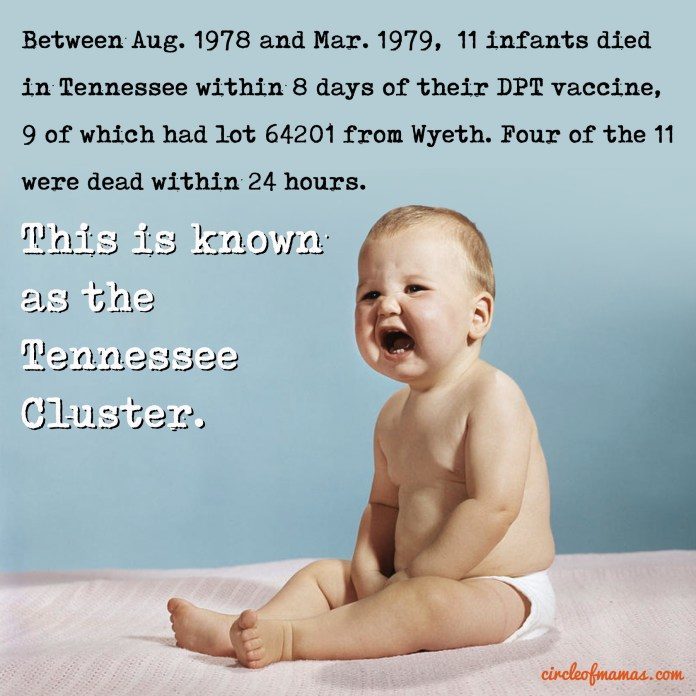
From August 1978 to March 1979, 11 infants died suddenly and unexpectedly within eight days of their DPT vaccination, all in Tennessee. Nine of the 11 infants had received the same lot of DPT vaccine (diphtheria-pertussis-tetanus) from Wyeth Laboratories: lot 64201. Four of the 11 were dead in 24 hours.

All of the deaths were classified as SIDS:
"Between August 1978 and March 1979, 77 infants in Tennessee died suddenly from unexpected causes - compared with 74 during the same period in 1977-78. These deaths were diagnosed as sudden infant death syndrome, or crib death. Of these 77 infants, eight died within a week of being vaccinated against diphtheria, tetanus and pertussis (whooping cough) using the same lot of DTP vaccine.

Of these eight infants, one died in November 1978 and one in January 1979, both within 24 hours of having been vaccinated with this lot of vaccine.

In early March, the CDC learned that two more infants had died within 24 hours of DTP vaccination, again from the same lot of vaccine produced by Wyeth Laboratories, Inc. That brought the total to four deaths within 24 hours of vaccination."
In March, Wyeth Labs agreed to recall all remaining doses of DPT from lot 64201, and several other lots as well.

Comment: Silent canaries: Vaccines and the causes of Sudden Infant Death Syndrome


Cow

SOTT Focus: A Tale of Two Studies: Looking Beyond Headlines to Decode What the Science Really Says About Diet

steak no steak
Oh, I understand. Eat steak, but don't eat steak. Thanks again, science.
In my last article I ranted against a recent study from The Lancet that claimed low-carb diets would take years off your life, despite having poor methodology and none of the study participants actually doing a low-carb diet. In a video linked in that piece, Dr. Aseem Malhotra of the NHS in the UK mentions another study put out recently, also by The Lancet, that had the exact opposite findings. Called the PURE study (Prospective Urban and Rural Epedemiological study), the study made headlines (although fewer than the low-carb bashing one) stating that meat and cheese are back on the menu, claiming they actually help heart health.

Many low-carbers were quick to jump on this as a confirmation of what they've been saying all along, using this study as counter-evidence to the latest study which had opposite results. To be fair, the PURE study is, overall, a better conducted study: PURE had ten times the number participants and better design overall. But it's still an epidemiological study with all the limitations inherent to this type of science. It still relied on Food Frequency Questionnaires (FFQs) and can still only make claims about correlation, not causation.

It's the height of confirmation bias to reject one study on the grounds of its execution but accept one that uses essentially the same methodology but gets the results one likes (note that Malhotra was not doing this, but was simply pointing out that contradictory evidence, of the same type, exists). Ironically, the American Heart Association (AHA) issued a statement about PURE, warning of the limitations of FFQs. Perhaps they should apply that standard to the studies that justify their own dietary recommendations.