Health & WellnessS


Heart

Hard Work While Fatigued Affects Blood Pressure

Working hard when fatigued may be admired by many Americans, but it is a virtue that could be harmful to one's health, according to new research by psychologists at the University of Alabama at Birmingham (UAB). The research supports a theory which suggests that exhausted individuals' cardiovascular systems are forced to work harder when they attempt to complete tasks, such as those encountered on the job or at school.

The research, published in the July issue of the International Journal of Psychophysiology, found that fatigued individuals had larger blood pressure increases than rested individuals under conditions where they viewed success as both possible and worthwhile. Investigators believe the effects were determined by effort on the part of the study participants, said UAB psychologist Rex Wright, Ph.D. , who led the study.

Pills

Flashback Ecstasy is the key to treating PTSD

At last the incurably traumatised may be seeing the light at the end of the tunnel. And controversially, the key to taming their demons is the 'killer' drug Ecstasy.

An Ecstasy tablet. That's what it took to make Donna Kilgore feel alive again - that and the doctor who prescribed it. As the pill began to take effect, she giggled for the first time in ages. She felt warm and fuzzy, as if she was floating. The anxiety melted away. Gradually, it all became clear: the guilt, the anger, the shame.

Coffee

Flashback Mobile phones 'more dangerous than smoking'

Brain expert warns of huge rise in tumours and calls on industry to take immediate steps to reduce radiation

Mobile phones could kill far more people than smoking or asbestos, a study by an award-winning cancer expert has concluded. He says people should avoid using them wherever possible and that governments and the mobile phone industry must take "immediate steps" to reduce exposure to their radiation.

The study, by Dr Vini Khurana, is the most devastating indictment yet published of the health risks.

Comment: Dr. Khurana's full report is available on his site.

It is presently being peer-reviewed for publication in a mainstream scientific journal.


Beer

Flashback Study links smoking bans to driving under the influence

Enacting city smoking bans appears to increase drunken driving, a study of arrests conducted by Wisconsin researchers asserts.

A national study to be released by the Journal of Public Economics found an increase of fatal accidents involving alcohol after communities prohibited smoking, compared to arrests in communities without a ban.

People

Best of the Web: Quality of Life: French smokers abandon bars, clubs and restaurants for private parties


Image
©Unknown
Private smoking parties have flourished since the public ban came into force

Smokers in France are uniting to beat a ban on lighting up in public by organising open-house parties where they can puff on their Gauloises until the early hours.

The parties, held in flats and houses but also in clandestine clubs, often draw dozens of people for a drink, a chat, a dance and a cigarette. Some are paying, others are free, but all welcome the smokers who are deserting bars, bistrots and night clubs.

The movement has flourished since the introduction of a smoking ban in all public places on January 1, and has been compared to the speakeasies that secretly served alcohol during the Prohibition in the US in the 1920s. Internet networks have sprung up to link the partygoers and inform them of planned festivities.

Display

Online Dating: Where Technology and Evolution Collide


dating
©Unknown

When searching for a soul mate, you might think that the more options, the better. But the rise of technology - notably, the Internet - has thrown a wedge in that perception.

Bulb

Low childhood I.Q. linked to dementia later in life

Children who have lower IQs are more likely to develop a type of dementia as adults compared to children with high IQs, new research says.

Clock

Studies Show the Value of Not Overthinking a Decision


Brain Decision Making

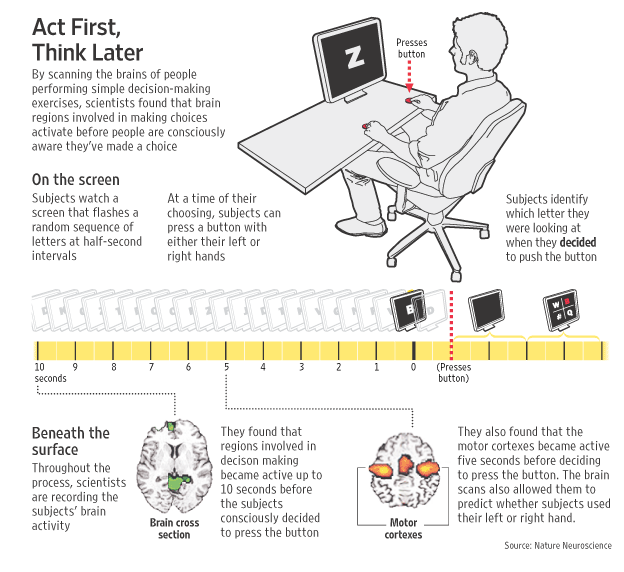
Fishing in the stream of consciousness, researchers now can detect our intentions and predict our choices before we are aware of them ourselves. The brain, they have found, appears to make up its mind 10 seconds before we become conscious of a decision -- an eternity at the speed of thought.

Their findings challenge conventional notions of choice.

"We think our decisions are conscious," said neuroscientist John-Dylan Haynes at the Bernstein Center for Computational Neuroscience in Berlin, who is pioneering this research. "But these data show that consciousness is just the tip of the iceberg. This doesn't rule out free will, but it does make it implausible."

Eye 1

Study: One in 10 had "silent strokes"


Silent Stroke
©Reuters/Sage Center for the Study of the Mind, University of California, Santa Barbara/Handout
An undated image of the human brain taken through scanning technology.

Routine brain scans in a group of middle-aged people showed that 10 percent of them had suffered a stroke without knowing it, raising their risk for further strokes and memory loss, U.S. researchers said on Thursday.

Calculator

Flashback 'Number blindness' more common than dyslexia

More children suffer from an innate condition that renders them incapable of understanding arithmetic and numbers than those who suffer dyslexia or "word blindness", according to a study of 1,500 school pupils.

The research found that between 3 and 6 per cent of children suffer from dyscalculia - the mathematical equivalent of dyslexia - compared to between 2.5 and 4.3 per cent of children who suffer from its linguistic counterpart.