Health & WellnessS


Health

SARS 2? Public health officials on alert after new virus detected

Image
© Agence France-Presse/ Nicolas TucatAn employee works on a sample analysis in a high-security lab.
World Health Organization (WHO) officials are on alert after two confirmed cases and one suspected case of a new virus from the same family as SARS appeared in Saudi Arabia last week. Doctors are watching for any sign the disease may spread.

The cases involve a coronavirus (named for the corona, or halo, visible around the virus under a microscope) that causes severe pneumonia and kidney failure in patients. One of the confirmed cases is a 49 year-old man in intensive care in a London hospital after being evacuated by air-ambulance to Britain from Qatar on September 11.

The other two confirmed cases have already died.

Dr. Ali Mohamed Zaki first revealed that a new coronavirus had been discovered last week in a 60-year-old man at the Soliman Fakeeh Hospital in Jeddah, Saudi Arabia on the ProMED-mail website, a site used to monitor infectious diseases around the globe. In the post, Zaki noted that the coronavirus was similar to those found in bats.

The most famous coronavirus was the Severe Acute Respiratory Syndrome (SARS) outbreak that killed about 916 and infected 8,422 worldwide. The potential threat of this particular coronavirus is not yet known, but World Health Organization (WHO) officials are monitoring the situation.

Comment: Whatever Happened to SARS?


Ambulance

Flashback Whatever Happened to SARS?

Image
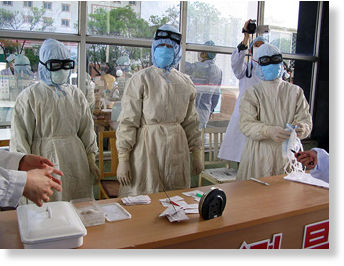
© WHO/PhilippinesExtraordinary biohazard prevention measures were taken during the SARS epidemic, including amongst the Philippine medical community
Nearly four years ago, the world was facing the first pandemic of the 21st century, SARS (Severe Acute Respiratory Syndrome), and everyone was scared. For months after a "fatal flu" emerged in November 2002, news of SARS outbreaks and casualties in Canada, China, Hong Kong, Singapore, Taiwan, and Vietnam dominated local and international headlines.

People knew that you could become infected by simply being exposed to someone with SARS, and once infected you might die in a matter of days. Thousands were quarantined. In the streets of Asian cities, if you just coughed slightly, people would run. But then, a mere nine months later, in July 2003, the World Health Organization (WHO) declared that transmission of the virus over.

What happened to SARS and are there lessons to be learned for dealing with other epidemics such as human avian influenza?

SARS infected over 8,000 people worldwide, of which fewer than 800 died - a mortality rate of less than 10 percent, and a far cry from those of other communicable diseases like HIV/AIDS (2.8 million deaths in 2005) and malaria (1-3 million deaths a year).

Comment: To learn more, read the Signs Special Supplements The Flu Threat and Ethnic Specific Weapons.


Stop

Cattle Now Being Fed Cookies and Candies Instead of Real Food

Candies
© NaturalSociety
Just when you thought the news couldn't get any stranger regarding the disturbing state of the agricultural industry, it most certainly has. In an effort to slash costs and increase profits, livestock corporations have now begun feeding their cattle super cheap processed foods like cookies, gummy worms, chocolate, fruit loops and a whole list of candies. Fattening up the cattle thanks to a large percentage of sugar content and no real nutritional value, the disease-riddled cattle end up fetching a larger price for farm owners.

The fruit loops-fed cattle also may end up on your dinner table, harboring even more dangerous additives than even cattle fed a diet of corn. Before accounting for the new diet of cookies and candy, conventionally raised cattle meat contains oftentimes an excessive amount of antibiotics (now admitted to be harming human health internationally), artificial hormones such as Monsanto's cloned growth hormone rBGH, resistant bacteria, genetically modified organisms (from corn) and other contaminants. Now, however, a few new problematic substances have entered the equation.

Cattle on a Diet of MSG, High-Fructose Corn Syrup, and GMOs

It is important to understand that almost all corn in the United States is genetically modified. Therefore, the 'traditional' factory farm diet of corn or grain is certainly not a safe option. It is, however, arguably better than 100% processed junk food that contains not just genetically modified organisms but ingredients like:
  • High-fructose corn syrup
  • MSG
  • Hydrogenated oils
  • Pesticides, herbicides, insecticides
  • Acrylamides
  • Artificial flavorings
  • Artificial colorings
  • Artificial sweeteners (like asapartame)
And many more. Each of these ingredients has of course been linked to a host of negative ailments ranging from cancer to cognitive disorders, however very few know the true dangers of such substances. High fructose corn syrup, for example, has been admitted to contain mercury - an element that is toxic in all forms. It is also important to note that the corn processed into high fructose corn syrup is, for the most part, always genetically modified. Such is also the case with aspartame, made from genetically modified bacteria waste. So now only are these cows being loaded up with processed food chemicals, mercury, and other additives, but they're also still receiving GMOs.

Eye 1

FDA Looking to Ban B6 Supplements, Give Boost to Big Pharma

Image
© Activist Post
Vitamin B6, naturally present in a variety of foods, is necessary for proper nerve function, protein synthesis, regulating blood sugar, and producing antibodies and hemoglobin. In other words, it's pretty important stuff. But, while many people get their B6 through supplements, the U.S. Food and Drug Administration is looking to make things a lot more difficult - by slowly taking all forms of B6 supplements off the market so Big Pharma can make millions off of prescriptions instead.

According to the Alliance for Natural Health (ANH), the FDA has already begun their crusade. They removed Pyridoxamine (a natural form of B6) supplements from the market at the request of BioStratum, a pharmaceutical company.

Why? Because BioStratum thinks it might be nice to use Pyrdoxamine in a prescription drug. They haven't developed the drug, we don't know what it is, and who knows when it will come to fruition, but the FDA honored a request from the big corporation to protect the company's interest.

Now, the FDA is poised to pull another B6 product: P5P.

Comment: Read more about this ongoing issue: FDA Set to Ban Your Supplements.

Websites like Alliance for Natural Health continue to shine a light on the ongoing corruption of 'regulatory agencies' like the FDA and their dirty deals with Big Pharma:


Attention

Experts Discuss the Findings of the Roundup/GM Cancer Trial


Comment: For more information about how Monsanto's toxic weedkiller Roundup 'Kills More Than Weeds' read the following articles:

Death by Multiple Poisoning, Glyphosate and Roundup

Roundup Birth Defects: Regulators Knew World's Best-Selling Herbicide Caused Problems, New Report Finds

Roundup weed killer kills human cells. Study intensifies debate over 'inert' ingredients

Monsanto™ Roundup Ready Crops Leading to Mental Illness, Obesity

Monsanto's Roundup is Causing DNA and Cellular Damage

Roundup's "Cocktail effect"? Nothing to worry about for Monsanto

Monsanto's Roundup Triggers Over 40 Plant Diseases and Endangers Human and Animal Health


Info

Gluten Sensitivity and Vertigo/Meniere's Disease

Image
© corepsychblog.com
Gluten is a known neurotoxin, and for many patients with gluten sensitivity, nervous system diseases are the only symptoms that manifest. Some neurologists have studied the connection in depth. To date, gluten has been shown to cause lesions in the brain and central nervous system on MRI, gluten has been shown to cause the body to make antibodies against nerve tissue.

Nerve Damage Improves on a Gluten Free Diet

There are a number of neurological diseases that have been shown to improve with a gluten free diet. The following is a short list of related neurological manifestations of gluten damage:

Attention

The Drugs Don't Work: A Modern Medical Scandal

Drugs
© Getty Images. Digital manipulation: Phil Partridge for GNL ImagingDrugs are tested by their manufacturers, in poorly designed trials, on hopelessly small numbers of weird, unrepresentative patients, and analysed using techniques that exaggerate the benefits.
Reboxetine is a drug I have prescribed. Other drugs had done nothing for my patient, so we wanted to try something new. I'd read the trial data before I wrote the prescription, and found only well-designed, fair tests, with overwhelmingly positive results. Reboxetine was better than a placebo, and as good as any other antidepressant in head-to-head comparisons. It's approved for use by the Medicines and Healthcare products Regulatory Agency (the MHRA), which governs all drugs in the UK. Millions of doses are prescribed every year, around the world. Reboxetine was clearly a safe and effective treatment. The patient and I discussed the evidence briefly, and agreed it was the right treatment to try next. I signed a prescription.

But we had both been misled. In October 2010, a group of researchers was finally able to bring together all the data that had ever been collected on reboxetine, both from trials that were published and from those that had never appeared in academic papers. When all this trial data was put together, it produced a shocking picture. Seven trials had been conducted comparing reboxetine against a placebo. Only one, conducted in 254 patients, had a neat, positive result, and that one was published in an academic journal, for doctors and researchers to read. But six more trials were conducted, in almost 10 times as many patients. All of them showed that reboxetine was no better than a dummy sugar pill. None of these trials was published. I had no idea they existed.

It got worse. The trials comparing reboxetine against other drugs showed exactly the same picture: three small studies, 507 patients in total, showed that reboxetine was just as good as any other drug. They were all published. But 1,657 patients' worth of data was left unpublished, and this unpublished data showed that patients on reboxetine did worse than those on other drugs. If all this wasn't bad enough, there was also the side-effects data. The drug looked fine in the trials that appeared in the academic literature; but when we saw the unpublished studies, it turned out that patients were more likely to have side-effects, more likely to drop out of taking the drug and more likely to withdraw from the trial because of side-effects, if they were taking reboxetine rather than one of its competitors.

I did everything a doctor is supposed to do. I read all the papers, I critically appraised them, I understood them, I discussed them with the patient and we made a decision together, based on the evidence. In the published data, reboxetine was a safe and effective drug. In reality, it was no better than a sugar pill and, worse, it does more harm than good. As a doctor, I did something that, on the balance of all the evidence, harmed my patient, simply because unflattering data was left unpublished.


Health

Brain: Multiple Contacts Are Key to Synapse Formation

Multiple synaptic contacts between nerve cells facilitate the creation of a new contact, as neuroscientists from the Bernstein Center Freiburg and the Forschungszentrum Jülich report in the latest issue of the journal PLoS Computational Biology. An integral mechanism of memory foundation is the formation of additional contacts between neurons in the brain. However, until now it was not known what conditions lead to the development of such synapses and how they are stabilized once created. By studying mathematical models, the scientists found a simple explanation for how and when synapses form -- or disappear -- in the brain.

The scientists investigated the hypothesis that synapses between nerve cells strengthen if they are active in quick succession. This consolidates memory. The team used theoretical computer models to determine what conditions need to be present for synapses to form -- or disappear. Until now it was not known how it is decided on the level of individual nerve cells whether a connection with another neuron will be formed or not. The problem is that a single cell has no access to information concerning whether a synapse will contribute to the establishment of a particular memory.

Health

Brain: Protein That Regulates Key 'Fate' Decision in Cortical Progenitor Cells Identified

Image
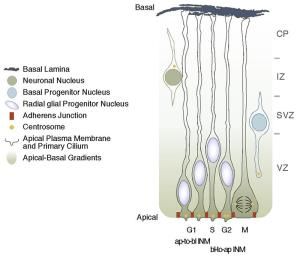
© Cold Spring Harbor LaboratoryDOCK7 regulates the movement of radial glial cells from the basal to apical location within the ventricular zone (VZ) of the developing mouse neocortex. On what appears to be the lower (apical) surface of the VZ, signals directing an RCG toward proliferation – i.e., reproduction of new RGCs – are dominant. On the upper (basal) surface of the VZ, dominant signals coax the RGC to split into new intermediate progenitors or neurons.
Researchers at Cold Spring Harbor Laboratory (CSHL) have solved an important piece of one of neuroscience's outstanding puzzles: how progenitor cells in the developing mammalian brain reproduce themselves while also giving birth to neurons that will populate the emerging cerebral cortex, the seat of cognition and executive function in the mature brain.

CSHL Professor Linda Van Aelst, Ph.D., and colleagues set out to solve a particular mystery concerning radial glial cells, or RGCs, which are progenitors of pyramidal neurons, the most common type of excitatory nerve cell in the mature mammalian cortex.

In genetically manipulated mice, Van Aelst's team demonstrated that a protein called DOCK7 plays a central regulatory role in the process that determines how and when an RGC "decides" either to proliferate, i.e., make more progenitor cells like itself, or give rise to cells that will mature, or "differentiate," into pyramidal neurons. The findings are reported in the September 2012 issue of Nature Neuroscience.

DOCK7 was already known to be highly expressed in various parts of the developing rodent brain, including the hippocampus and cortex. It had been shown by Van Aelst and colleagues to control the formation of axons -- wiring that connects neurons.

Health

Measles Epidemic Claims 22 Lives

An outbreak of measles, which has been raging in Likouala, North-eastern Congo since April, has already killed 22 people, the state-run radio said Friday.

The epidemic, which initially hit Liranga and Bétou, have now reached Impfondo and Epena.