Earth ChangesS


Cloud Lightning

China Floods Kill 52 People, More Rain Forecast in South

China flood
© n/a
Floods have killed 52 people and left 32 missing in China since the flood season started in June, a senior official said Wednesday, warning of more heavy rains.

Heavy rains have inundated parts of 12 provinces in central and southern China and affected 4.81 million people so far since the flood season arrived, Shu Qingpeng, deputy head of the Office of State Flood Control and Drought Relief Headquarters, told a Wednesday press conference.

In the worst-hit southwestern province of Guizhou, floods have killed 21 people and left 32 missing in the past few days, forcing nearly 100,000 people to evacuate.

More than 3,000 rescuers are working to locate the missing and fight the floods in the province's Wangmo County, where all the deaths and most of the missing were reported after downpours lashed the county Monday morning.

Bizarro Earth

US: 'Wild and Weird' Weather Leaves its Mark

Image
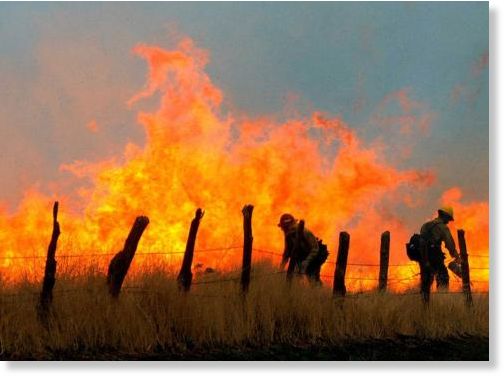
© Joe Gamm, The Amarillo Globe News, via APJames Dickinson, left, and Alton Pickup of the United States Forest Service Task Force attempt to slow the spread of a wildfire in Randall County, Texas, on May 25.
Monster tornadoes, historic floods, massive wildfires and widespread drought: Springtime has delivered a wallop of weather-related destruction and misery across much of the nation this year. And it may all be related.

Never mind the debate over global warming, its possible causes and effects. We've got "global weirding."

That's how climatologist Bill Patzert describes the wide range of deadly weather effects that have whipped the nation this year, killing hundreds of people and doing billions of dollars in damage to homes, businesses, schools and churches.

"Sometimes it gets wild and weird," says Patzert, a research scientist at NASA's Jet Propulsion Laboratory in Pasadena, Calif.

Cloud Lightning

Floods Swamp Earthquake-Ravaged Haiti, Killing 23

Image
© Agence France-Presse / Thony BelizaireChildren make their way to school through a flooded area in Port-au-Prince
Torrential rains lashed Haiti on Tuesday, flooding shanty towns, swamping the squalid camps erected after a 2010 earthquake and killing at least 23 people, officials said.

The worst rains to hit the impoverished country this year -- at the start of the hurricane season -- paralyzed the capital, where most of the deaths took place, according to officials at Haiti's civil protection agency.

Thunderstorms were pounding several north Caribbean islands early Tuesday, but there was little chance of the large low pressure area developing into a hurricane, according to the US-based National Hurricane Center (NHC).

Several days of rain had already swelled rivers, however, and the NHC warned of "flash floods and mudslides over portions of Haiti, the Dominican Republic, Jamaica and Cuba."

Haiti was most at risk of devastation from the wet weather, due to its crumbling infrastructure and ramshackle shelters for tens of thousands left homeless after the catastrophic 7.0 magnitude earthquake in January 2010.

Health officials here also fear an uptick in fatalities from a cholera outbreak that erupted last October. The diarrheal illness thrives in crowded areas where people rely on contaminated water.

Attention

Five Injured in 5.3-Magnitude Earthquake in China's Xinjiang

A 5.3-magnitude earthquake hit a remote county in northwest China's Xinjiang Uygur Autonomous Region Wednesday, causing a car pileup which left five injured.

The quake jolted Toksun County of Turpan Prefecture at 9:53 a.m., according to the China Earthquake Network Center.

Toksun County is about 160 km from Urumqi, the regional capital.

The quake caused several big rocks to roll down a mountain in the neighboring Dabancheng District, and onto a road forcing a driver to slam on his car brakes leading to a 17-car pileup, said Zhang Qirui, an official with the district's road bureau.

Five people were hurt in the collision, among whom two were severely injured, he said.

The epicenter was monitored at 43.0 degrees north latitude and 88.3 degrees east longitude with a depth of about 5 km, the center said.

The quake was followed by two large aftershocks, measuring 4.2- and 4.1-magnitude and occurring at 9:54 a.m. and 10 a.m., respectively, according to the center.

Radar

US: Small 3.9 Magnitude Quake Hits St. Louis Region

Missouri - A small earthquake rattled the St. Louis region early Tuesday, shaking some people awake but not causing any reported damage.

The quake, which hit at 3:10 a.m. Tuesday, was a magnitude 3.9 temblor, according to scientists examining data at the U.S. Geological Survey in Golden, Colo.

"A lot of people felt it, but we're not talking about damage," said Don Blakeman, a geophysicist with the U.S. Geological Survey. "It was pretty short duration."

The city closest to the epicenter was Richwoods, six miles northeast of the quake center.

About 2,600 people logged on to the Geological Survey's website to report having felt the quake. Several hundred people from the St. Louis area's ZIP codes reported the quake as having the intensity of subtle shaking.

Stop

Georgia, US: Fish Mystery Might Go Unsolved

Image
© Ogeechee RiverkeeperThousands of fish turned up dead on the Ogeechee River. What led them to become suceptible to a common bacteria is a mystery that environmental officials and river watchdogs are trying to solve.
Federal environmental regulators say, they might never know what led to a fish kill in the Ogeechee River. Orlando Montoya of W-S-V-H in Savannah reports, state officials now are discovering dead mussels.

A US Environmental Protection Agency memo released this week repeats what's already known about the kill -- that it was caused by a common bacteria.

But it then concludes, it might be impossible to know for certain what made the fish suceptible to the bacteria in the first place.

Fisheries manager Tim Barrett of the state Environmental Protection Division says, it's frustrating, but there are many factors.

Cloud Lightning

How wildfires create their own weather

Image
© Engine Capt. Tim Hill, Springerville Ranger DistrictThe Wallow Fire, seen Tuesday, just west of Eagar.
Wildfires are extremely dangerous and unpredictable. One thing that is predictable is the extreme weather conditions that fires bring to an area.

When a fire reaches into the the pine trees it fuels itself into a burning inferno. A pine tree provides the fuel for a fire as the tree sap burns very easily and quickly.

When a fire reaches into the tree tops, it is referred to as "crowning".

The water in the trees is turned into water vapor and released into the air as steam. The hot air will rise quickly and form a rain cloud, and the water vapor condenses as it rises. The ash or soot from the fire also provides a nuclei for the water vapor to attach to and grow into a rain drop.

Cloud Lightning

Natural disasters displaced 42 million people in 2010


About 42 million people were forced to flee their homes because of natural disasters around the world in 2010, more than double the number during the previous year, experts said Monday.

One reason for the increase in the figure could be climate change, and the international community should be doing more to contain it, the experts said.

The Internal Displacement Monitoring Centre said the increase from 17 million displaced people in 2009 was mainly due to the impact of "mega-disasters" such as the massive floods in China and Pakistan and the earthquakes in Chile and Haiti.

It said more than 90 per cent of the disaster displacements were caused by weather-related hazards such as floods and storms that were probably impacted by global warming, but it couldn't say to what extent.Associated Press

Bizarro Earth

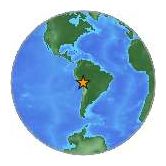
Southern Peru - Earthquake Magnitude 6.0

S.Peru Quake_080611
© USGSEarthquake Location
Date-Time:
Wednesday, June 08, 2011 at 03:06:18 UTC

Tuesday, June 07, 2011 at 10:06:18 PM at epicenter

Time of Earthquake in other Time Zones

Location:
17.059°S, 69.498°W

Depth:
101.3 km (62.9 miles)

Region:
SOUTHERN PERU

Distances:
131 km (81 miles) NE of Tacna, Peru

147 km (91 miles) SSE of Puno, Peru

153 km (95 miles) E of Moquegua, Peru

985 km (612 miles) SE of LIMA, Peru

Sun

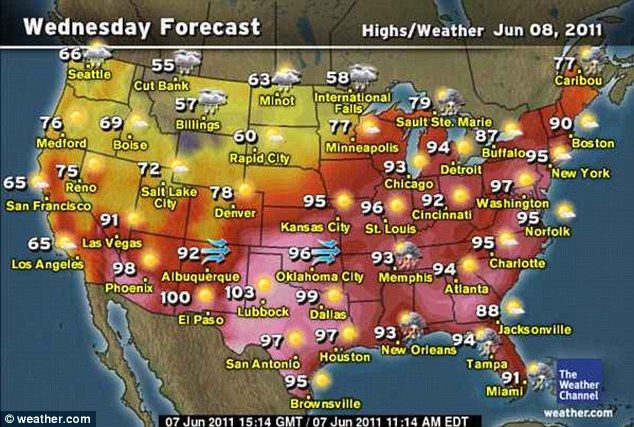
East Coast Warned of Heatwave as Historic Temperatures Hit US

US heatwave map
© Weather.comWednesday: Intense sunshine, rising humidity and hot air will push temperatures to 'dangerous' levels
Parts of the East Coast were put on alert Tuesday for a heatwave as unseasonably high temperatures began sweeping the US.

Temperatures were expected to soar up to 20 degrees above average in the northeast and could break records by midweek.

The National Weather Service issued an excessive heat warning from noon Wednesday until 8:00pm local time Thursday for much of southeastern Pennsylvania, northern Delaware and west central New Jersey, including the cities of Trenton, Philadelphia, Camden and Wilmington.