Earth ChangesS


Bizarro Earth

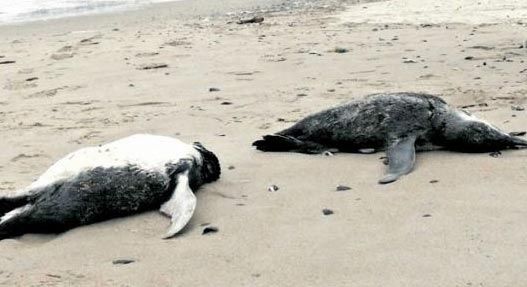
Hundreds of Penguins and other species Wash Up On Uruguayan Shores

 dead penguins
© Unknown

As many as 600 Magallan penguins have been found dead on Uruguayan coasts; scientists are investigating why so many penguins have died on their way to Brazilian waters.

Authorities said they also spotted turtles, several albatros, and dolphins, in addition to the large amount of penguins.

Scientists are baffled; though it is not unusual to have dead sea life in the area, as large boats do their maintenance in the vicinity, it is very unusual to have such large numbers, as well as the fact that no small animals have washed up ashore, only large animals.

Igloo

Namibia: Snow Sets Another Record

Snow Fall
© Namibian

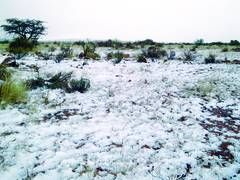
Images of snow covering mountains, roads, sheep and homes close to the Namib-Naukluft Park on Tuesday took Namibia by storm yesterday.

Reports and photographs of the snowfall circulated rapidly and widely across the Internet and inboxes bulged with rare images depicting snow in areas usually associated with heat and dust, not biting cold and white blankets of snow.

John Rabie from Namibgrens Guest Farm close to the Spreetshoogte Pass where the majority of snow and rain fell, described the scenes of low clouds, mist and snow on Tuesday.

"It was ice cold, especially as the wind was blowing," he said. The snow fell during the day, from around eleven in the morning until the afternoon.

He said the minimum temperature on Tuesday was minus two degrees Celsius, while the day's maximum temperature did not go above five degrees.
Although the temperatures had not improved by yesterday, the absence of wind took away the worst bite of the cold, he said.

"We lost one lamb," he said. He attributed the low number of stock losses to the fact that the wind had died down from Tuesday to Wednesday.

Radar

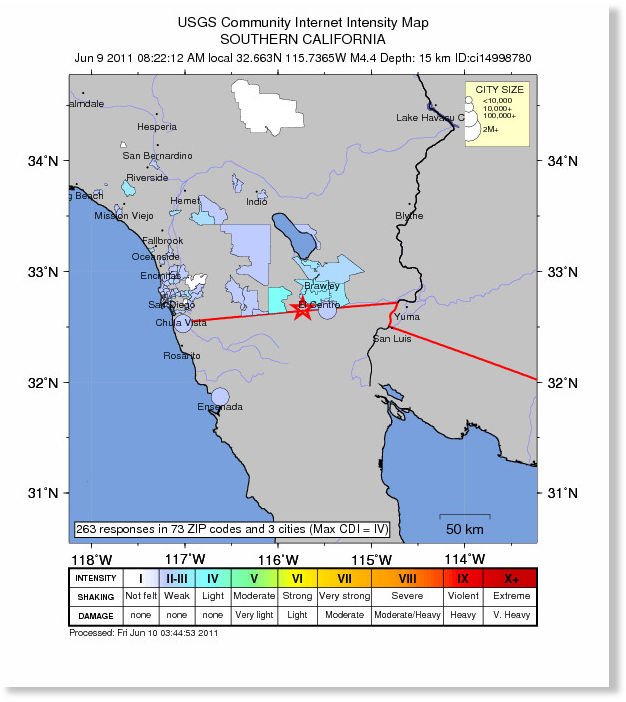
US: Magnitude 4.5 Earthquake Rattles California Border Region

Image
A magnitude 4.5 earthquake rattled the California-Mexico border on Thursday morning.

The temblor was recorded at 8:22 a.m. near Seeley, Calif., about 15 miles southwest of Calexico in Imperial County. The area was shaken by last year's 7.1 Easter Sunday quake, which caused more than $90 million in damage.

According to the U.S. Geological Survey, the quake was felt across Imperial County as well as in San Diego, Orange County and parts of the Inland Empire. No damage was reported.

Attention

1st Tropical Storm of the Season Forms in Pacific

Forecasters say Tropical Storm Adrian has formed far out in the Eastern Pacific, making it the first named storm of the 2011 hurricane season.

No coastal watches or warnings have been issued. Maximum winds around the center of the storm late Tuesday were about 45 mph. Forecasters say the storm is likely to strengthen.

The center of the storm is about 355 miles south of Acapulco, Mexico. It is barely moving west-northwest direction. That is expected to continue for the next couple of days.

Source: The Associated Press


Bizarro Earth

Bacteria-laced algae are invading freshwater streams across the globe

In the small, freshwater streams of South Dakota, a horrible menace is creeping along the rockbeds. Known as rock snot, it's a form of algae that clings to rocks and spreads rapidly until it takes over the entire ecosystem of the stream, often killing off local plants and microbes. The stuff has spread from North America all the way to New Zealand. But what's really weird is that rock snot can grow even in rivers that appear to have almost no nutrients in them at all. What is helping this algae grow so fast? Is it feeding on our fear?

A group of scientists wanted to find out. So they set about studying Didymosphenia geminata (its scientific name), also called Didymo, in one South Dakota waterway called Rapid Creek. What they discovered was that the algae could actually suck extra nutrients from water that appeared to be nutrient-free. And they do it by creating vast bacterial farms beneath the mats of rock snot. Essentially, the algae uses other life forms to create food for it.

Bizarro Earth

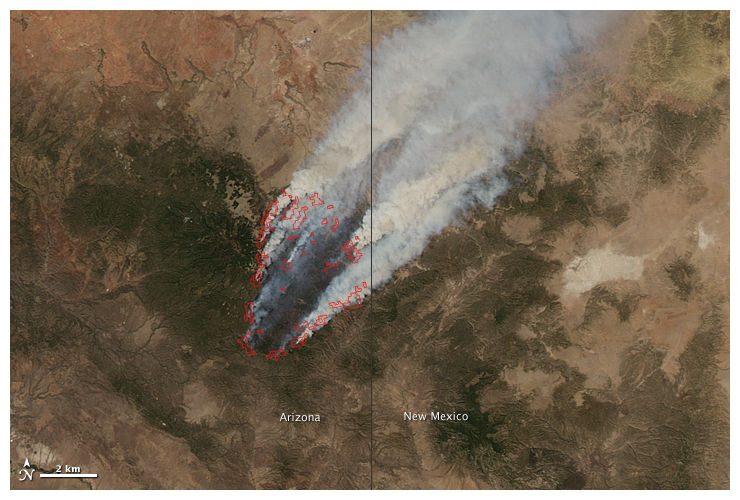
Wallow Fire, Arizona, USA

Wallow Fire
© Earth Observatory, NASANASA Earth Observatory image created by Jesse Allen, using data provided courtesy of the University of Wisconsin’s Space Science and Engineering Center MODIS Direct Broadcast system.
After several days of extreme fire behavior, the Wallow Fire has become the second largest fire in Arizona history. By early afternoon on June 8, 2011, the fire had consumed 389,000 acres (608 square miles), largely in the Apache National Forest, and was completed uncontained. This image, taken by the Moderate Resolution Imaging Spectroradiometer (MODIS) on the Aqua satellite, shows the fire at 1:25 p.m. local time.

The actively burning fire front (outlined in red) surrounds a vast area of charred land. High winds propelled the fire, igniting spot fires as much as three miles ahead of the fire front on June 8, said the Arizona Emergency Information Network. Dense plumes of smoke billow from the fire and stream northeast in the strong winds that drove the flames. The smoke has been affecting air quality through much of the United States.

Igloo

US: Butte, Montana - Snow is Falling this Morning

Snow levels are dropping down close to 5,500' this morning with snow in Butte!

The snow is not sticking too much and should melt off by this afternoon. Looking at MDOT cameras, there is accumulating snow developing on Big Hole Pass, Lost Trail Pass, Elk Park and over Homestake Pass this morning.

One to two inches of snow is possible for Butte, however, as temperatures warm up later this afternoon, thunderstorms could form. Now that is a crazy weather pattern!

Bizarro Earth

US: Wichita, Kansas Experiences Rare 'Heat Burst' Overnight

Last night Wichita experienced a very rare weather phenomenon known as a "Heat Burst." At 12:22 a.m. the temperature at Wichita's Mid-Continent Airport was 85 degrees. At 12:44 the temperature spiked to 102 degrees. This was a 17 degree increase in only 20 minutes. Winds also gusted between 50 and 60 MPH. The heat burst winds and temperatures rapidly dissipated as they spread across Sedgwick and Southern Butler Counties.


A heat burst is caused when rain falls into very dry air, high up in the atmosphere. The rain quickly evaporates as it falls through the dry parcel of air and that parcel cools rapidly. This dense mass falls rapidly toward the ground, heating up as it compresses. When this hot ball of air hits the ground it spreads out in every direction creating very strong, warm and dry winds.

About an hour before the heat burst, wind gusts up to 40 miles per hour battered the Wichita metro area. This was due to outflow winds from severe weather south of the city, and not related to the heat burst.

Cloud Lightning

US: Part of Missouri River Closed, Crops at Risk

mississippi floods farmland
© n/a
Rising water levels on the Missouri River are threatening to flood up to 500,000 acres of key corn and soybean production areas in the western Midwest.

The U.S. Coast Guard on Wednesday closed a part of the river to all vessel traffic where the state lines of Nebraska, Iowa and Missouri meet.

The flooding has sparked a scramble for supplies in the soymeal cash market as several processing plants are expected to shut when flood waters disrupt rail service in some areas.

The overflow of the Missouri River follows flooding of farm land in the South by the Mississippi River last month.

The United States is the world's No. 1 grower and exporter of corn and soybeans, and top shipper of wheat.

Cloud Lightning

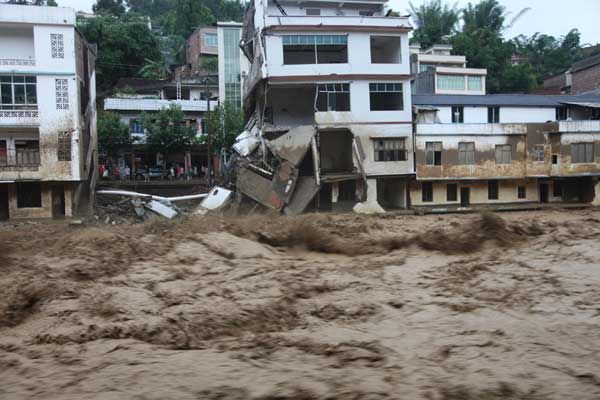
China: Guizhou hit by sudden heavy rain, 21 dead, 31 missing

Image
© XinhuaFloodwater rushes through Wangmo county, Southwest China's Guizhou province, June 6, 2011.
After months without rain, many parts in southern China are now experiencing flooding. One week ago, provinces of Guizhou, Jiangxi, Hunan,Hubei, Jiangsu and Anhui were suffering severe drought.

But the situation took a sudden turn over the weekend, as several provinces including Guizhou, Hunan, Jiangxi and Zhejiang were hit by heavy rains over the weekend. The once-parched land is now virtually underwater.