Earth ChangesS


Bizarro Earth

The swallows are dying: 'This type of mortality event is unprecedented'

Swallow
© Wikimedia CommonsFile photo of a Violet-green Swallow.
Salem, Oregon - The stormy weather we had recently didn't just knock down some trees and power lines, it also took a toll on one of the state's bird populations.

The Oregon Department of Fish and Wildlife (ODFW) has received a number of calls about dead and dying Barn and Violet-green Swallows, with reports coming in from the Port of Saint Helens to as far south as Junction City.

It's estimated that thousands of the birds have died this past week. Groups of 10 to 200 have been reported dead in barns and other structures and, according to ODFW, the deaths appear to be in greater numbers near rivers and standing water.

"This type of mortality event is unprecedented and considered a rare and unusual event," said Colin Gillin, ODFW State Wildlife Veterinarian. "The effect on bird populations is unknown."

What happened to the birds? Experts are blaming the recent heavy rains and high winds, which they believe prevented the swallows from getting food. When the birds were examined by a lab at Oregon State University, the swallows were thin and it was obvious they had not eaten recently.

Swallows feed on insects and when the weather gets bad, it has an effect on the young and weaker birds because they suddenly become unable to take in enough food to meet their energy requirements.

Sick or dead wildlife can be reported to the ODFW Health Lab at (866) 968-2600. Keep in mind that only licensed wildlife rehabilitators may treat sick or injured wildlife.

Bizarro Earth

USGS: Earthquake Magnitude 6.4 - 114km SE of Amsterdam Island

Amsterdam Island Quake_041013
© USGS
Event Time
2013-10-04 17:26:14 UTC
2013-10-04 22:26:14 UTC+05:00 at epicenter

Location
38.555°S 78.448°E depth=10.0km (6.2mi)

Nearby Cities
114km (71mi) SE of Amsterdam Island,
2543km (1580mi) SSE of Ile Rodrigues, Mauritius
2831km (1759mi) SE of Mahebourg, Mauritius
2833km (1760mi) SE of Plaine Magnien, Mauritius
2866km (1781mi) SE of Port Louis, Mauritius

Technical Details

Cloud Lightning

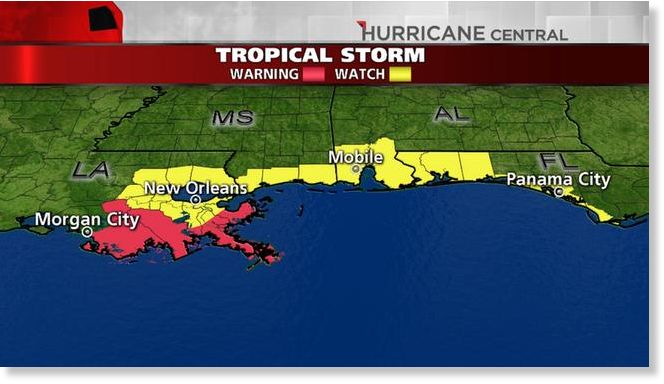
Evacuations ordered as Tropical Storm Karen nears U.S. coast

Authorities issued mandatory evacuation orders for low-lying areas south of New Orleans on Friday as a weakened Tropical Storm Karen closed in on the Louisiana coast after disrupting U.S. energy output in the Gulf of Mexico. Karen's top winds were holding at 50 mph (85 kph), down from 65 mph (105 kph) a day earlier, and National Hurricane Center forecasters in Miami said the storm looked less likely to strengthen into a hurricane.
Image
Oil output in the U.S. Gulf of Mexico had been cut in half as oil and gas firms shut platforms and evacuated some workers in preparation for the storm, which could still strengthen before landfall. The Gulf accounts for about 19 percent of U.S. oil production and 6 percent of natural gas output.

The mayor of Grand Isle, Louisiana, clamped a mandatory evacuation on the popular vacation and fishing destination on a barrier island south of New Orleans. Evacuations were also ordered in Lafourche Parish in the south, and residents in much of Plaquemines Parish, southeast of New Orleans, were told to be out of their homes before nightfall.

The Sand Dollar Motel and Marina on Grand Isle was a frenzy of activity on Friday as boaters scrambled to get their vessels to higher ground and marina employees secured the premises. "It's already pouring here and the wind is real strong," said marina owner Susan Gaspard, who added that squalls had been hitting all morning.

Karen's projected path shifted slightly westward and it was expected to move ashore over Louisiana on Saturday night and into Mississippi on Sunday.

Snowflake Cold

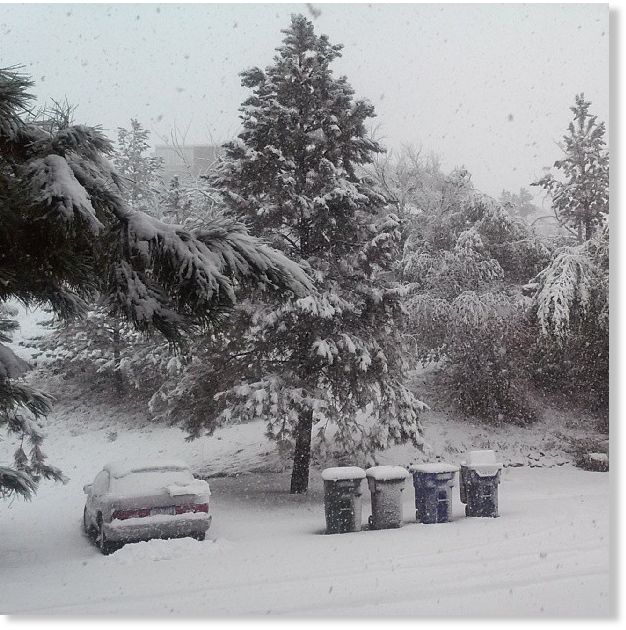
A snapshot from the Black Hills blizzard - South Dakota

When the National Weather Service issued a blizzard warning for the Black Hills of South Dakota region on Thursday afternoon, many of my friends and I shrugged it off. Seeing a bit of October snow in the Black Hills is certainly not unheard of, but no one believed it would be the major weather event that news outlets predicted.

Boy, were we wrong. We woke up Friday to heavy, blowing snowfall in Rapid City. Treacherous road conditions shut down schools, clinics, and part of Interstate 90. Up to 5,000 residents are without power in Rapid City, according to the Rapid City Journal. Widespread power outages are also being reported in Custer, Deadwood, Spearfish and Sturgis. More than a foot of snowfall is predicted in the region before the blizzard warning ends Saturday at 9 a.m.

Luckily, my husband and I have power, although our lights are flickering, and I hear tree branches, weighted from the heavy snow, cracking and crashing down as I write.

We're snuggling in today with a pot of coffee, blankets, and each other -- since I work from home and his office is closed due to the blizzard. We're just hoping that this October blizzard is a fluke -- otherwise, it's going to be a very long winter in South Dakota.

Here are photos from Friday morning:
Image
Additional images

Snowflake Cold

"Unseasonably" intense fall snow storm hits U.S. upper Midwest - up to 3 feet of snow and high winds expected

Powerful storms crawled into the Midwest on Friday, dumping heavy snow in South Dakota, spawning a tornado in Nebraska and threatening dangerous thunderstorms from Oklahoma to Wisconsin.

A foot of snow had fallen in western South Dakota's scenic Black Hills by early Friday, bringing blizzard conditions that shuttered roadways and even canceled a polka bar crawl in an Old West tourist town. Residents were bracing for as much as 3 feet of snow, along with wind gusts of up to 70 mph, from an unseasonably intense fall snow storm.
Image
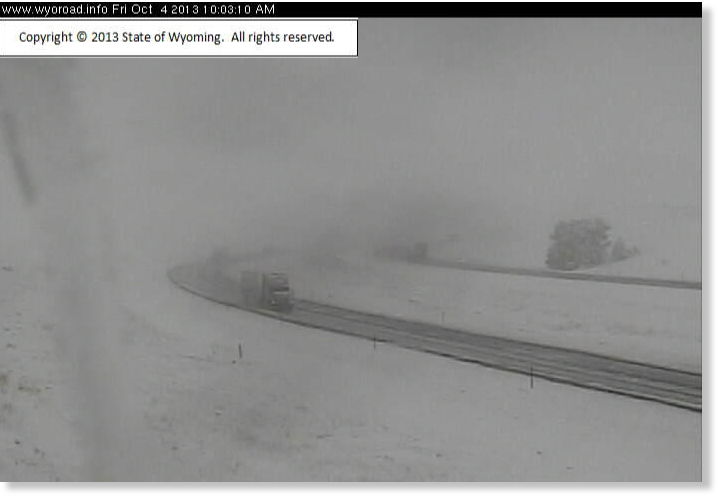
© State of WyomingTraffic cam from I-80 in Wyoming
The typically bustling Pilot Travel Center just west of Rapid City was like a ghost town Friday morning, as drivers were likely heeding forecasters' warnings to stay off the roads, said store general manager John Barton.

The blowing snow was picking up outside the truck stop along Interstate 90, which was closed for about 30 miles thanks to a storm gaining strength as it moved in from Colorado and Wyoming. Conditions were expected to deteriorate throughout the day.

Attention

Intense earthquake swarm offshore North Iceland - 1, 000 quakes in 6 days

Image
An intense earthquake swarm has been going on offshore North Iceland, 10 km NW of Gjögurtá, since September 25, 2013. This morning, 2 earthquakes reaching magnitude 3 and 3.2 occurred at 06:14 and 07:41 UTC. Roughly 1 000 earthquakes have been recorded by Icelandic Meteorological Office in last 6 days (IMO).

The depths of the quakes vary from about 15 km depth (crust-mantle boundary) to near surface. The area is located on an active fault line related to rifting, and a possible cause of the earthquake swarm could be a magmatic intrusion at Tjörnes Fracture Zone volcano (VD).

Bug

Diesel fumes confuse honeybees when foraging

Exhaust fumes from diesel could be changing the scent of flowers and making it harder for honeybees to collect pollen and nectar, according to a new study.

Image
© Tracey Newman, Guy Poppy and Robbie GirlingA bee lands on a oilseed rape flower
Pollutants found in diesel exhaust alter levels of chemicals released by flowers which honeybees use to locate and identify varieties with the largest amounts of pollen and nectar, researchers found.

Tests in a laboratory designed to mimic the effect of exhaust fumes on the smell of oilseed rape showed that the bees' ability to recognise the odour was reduced by about two thirds.

Although exhaust fumes are unlikely to be the main cause of the sharp decline in Britain's bee populations, they could be exacerbating the problem, researchers said.

Fumes which prevent honeybees recognising the smell of flowers could "have serious detrimental effects on the number of honeybee colonies" as well as reducing the pollination of vital crops and lowering honey yields, they claimed.

Snowflake Cold

State emergency: Chile frost hits fruit crops and wine with damage of $1 billion

Wine pouring
© UnknownAffected region is Chile's main fruit and wine producing area
Santiago - Chile declared a state of emergency on Thursday after a late frost caused an estimated $1 billion worth of damage to fruit crops, potentially hitting wine production as well.

The affected central region is the main fruit and wine producing area in Chile, the world's No.7 wine producer, and includes vineyards owned by prominent local wine label Concha y Toro.

The industry is one of Chile's most important after copper, with fruit exports worth $4.3 billion in 2012 and wine worth $1.8 billion, according to government figures.

"These frosts are the worst that agriculture has faced in 84 years, impacting the area from Coquimbo to Bio Bio," the national agricultural society said as Agriculture Minister Luis Mayol pledged aid for affected farmers.

Fruit trade association Fedefruta has given an early estimate of up to $1 billion of damage from the extensive cold snap in late September.

Bizarro Earth

Mutant skate named Elvis caught by Portsmouth fishermen

Skate
© National Museum HistoryElvis the Thornback skate, with an extra fin resembling a quiff, will live in an open top tank in the Blue Reef Aquarium in Portsmouth.
A museum fish curator has identified a skate's unusual appendage as an extra pelvic fin, rather than a genetic throwback to its shark relative.

An unusual skate has been caught by fishermen in the Solent with an extra fin.

It was taken to the Portsmouth Blue Reef Aquarium for identification, where it is now being held for safekeeping.

Aquarium staff have nicknamed it Elvis because the fin resembles a quiff.

Skate or shark?

Aquarium staff originally thought the extra appendage was a dorsal fin from a genetic throwback to a shark. Skate are distantly related to sharks.

On closer inspection, however, they realised it was more likely a bizarre mutation.

Natural History Museum fish curator James Maclaine, who was brought in to identify the fin, realised it was something entirely new.

'Mutated skates do turn up from time to time, sometimes with fin anomalies that make them heart-shaped, but we still have never seen anything quite like this one before,' Maclaine said.

'The general consensus is that it's a mutation, and probably more likely an out of place extra pelvic fin rather than a new dorsal fin," he said.

Bizarro Earth

Elusive giant squid washes up on Spanish beach

Giant Squid_1
© El Diario Montanes, Video ScreengrabLike other giant squid, the one that washed ashore in Cantabria on Oct. 1, 2013, sported enormous eyes.
A giant squid, whose oversized eyes and gargantuan blob of a body make it look more mythical than real beast, washed ashore Tuesday (Oct. 1) at La Arena beach in the Spanish community of Cantabria.

The beast measures some 30 feet (9 meters) in length and weighs a whopping 400 pounds (180 kilograms); and according to news reports, it is a specimen of Architeuthis dux, the largest invertebrate (animals without backbones) on Earth.

The giant squid is currently at the Maritime Museum of Cantabria, according to El Diario Montanes.

Tsunemi Kubodera, a zoologist at Japan's National Science Museum in Tokyo, and his colleagues, captured the first live footage of an Architeuthis giant squid in its natural habitat in 2012. The video revealed the elusive creature off the Ogasawara Islands, about 620 miles (1,000 kilometers) south of Tokyo at a depth of around 2,066 feet (630 m); the three-man crew aboard a submersible followed the giant squid down to 2,950 feet (900 m).