Earth ChangesS


Cow

October blizzard taking a toll on livestock

dead livestock
© Erick In The Woods
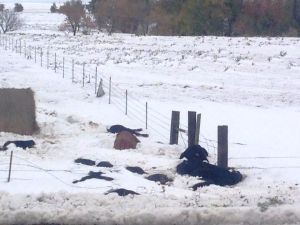
Along SD Hwy 212, dead cattle are being found. There are reports of losses of over 200 head from just one herd, south of Dupree, SD. Travelers came across this scene near the Gerald Woodward ranch, Dupree.
Sturgis , South Dakota - The cost to what is being called one of the worst blizzards in South Dakota's history will reach into the multi-millions. In Sturgis and other Black Hills communities, collapsed roofs, extended power outages, damage from felled trees, the cost of around the clock emergency response divisions and the equipment needed; and the extra crews that are being brought in - will be the norm in the foreseeable future.

But in the vast expanse of the foothills and prairies north, east, and west of the Black Hills, a huge economic impact is beginning to emerge. Lost livestock, drifting with 60 mile per hour wind gusts and blinding snow, were driven with the storm, trailing over buried fence lines. Those that made it through the blizzard, are still lost or stranded. And reports of hundreds of head of livestock that didn't make it, are beginning to come in.

According to Meade County Dispatch, owners are attempting to locate lost livestock. Being hampered by poor road conditions and unable to reach livestock once located, is slowing not only that process but an accurate count of how much producers have lost.

Windsock

Where have all the hurricanes gone? 'Mysterious lack of activity' this year despite widespread predictions of a very active season

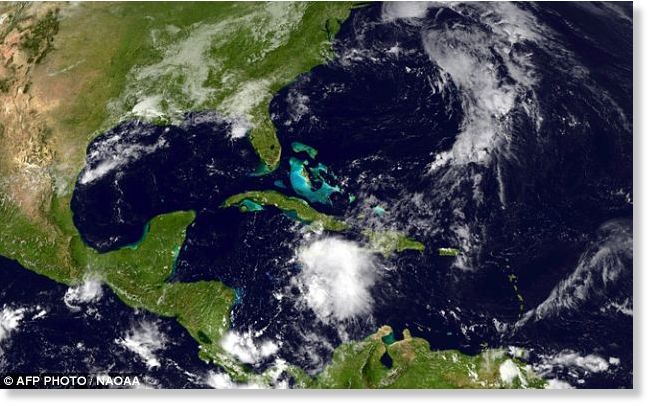
Experts predicted a very busy hurricane season, but scientists say there has been a 'mysterious lack of activity' this year.

The unusually weak Atlantic storms can be partially blamed on factors such as the especially dry air, lack of El Nino, and colder than normal waters, but as a whole it has scientists scratching their heads.

It also has many wondering what factors they need to start considering in order to improve seasonal predictions in the future.
Image
© AFP/ NOAAWeak and alone: Tropical Storm Jerry swirls September 30 in the Central Atlantic during what has been a shockingly slow hurricane season. Scientists predicted a frenzied season, but it has actually been slower than normal
The weak year also appears to be a trend, according to at least on scientist.

'My research has highlighted the dramatic multi-year downturn in global hurricane activity beginning in 2007 which slightly recovered before dropping even further here in 2013,' writes Dr. Ryan Maue.

According to Maue, only four other years on record have had a lower total storm energy as of September 30: 1962, 1977, 1983, and 1994.

Though the number of storms has been near normal, they have been weaker or more short-lived than usual in the reports the Washington Post.

A big reason for this could be dry air.

Evil Rays

Mysterious earthquake swarm damages many villages in Galati, Eastern Romania

Image
© digi24.ro
Image
© digi24.ro
For a couple of weeks, an unusual earthquake swarm is going on in Eastern Romania, close to Moldovia border. Galati is the province where the earthquakes are happening.

The Galati area experienced dozens of earthquakes up to a Magnitude of 3.8 (last one just before writing this article). The quakes have an extremely shallow depth, have a relatively high shaking intensity and are causing a lot of damage in the villages near the epicenter areas (the epicenters have to be situated in an area of many kms and not in one location).

Some people are not waiting for more earthquakes and left their houses due do the damage, fearing a collapse if further quakes would strike.

Galati is a region with relatively low seismic activity and earthquake swarms like the current events are only known from the newspapers in other regions / countries (ER could trace some unconfirmed reports that a number of earthquakes occurred in March 1894!).

Cloud Precipitation

Typhoon Fitow slams Okinawa on way to China followed by Danas

Typhoon Fitow
© JRC
Winds gusting to 55 meters per second (125 miles per hour) halted air traffic and caused power outages on Okinawa's Miyakojima island as Typhoon Fitow blew through on course for northern Taiwan and China's coast, with a second storm following close behind.

Taiwan's Central Weather Bureau hoisted a typhoon warning as Fitow neared the island's north coast today, while Chinese maritime authorities issued red alerts, the highest level, for storm tides and waves, Xinhua News Agency reported.

Fitow was heading west-northwest at about 20 kilometers per hour, some 220 miles (350 kilometers) north of Taipei at 1 p.m. Japan time, the Japan Meteorological Agency reported. Its central atmospheric pressure was 960 hectopascals with maximum sustained winds of 40 meters per second.

Typhoon Danas, with a central pressure of 970 hectopascals, was about 650 miles southwest of Okinawa's main island, moving west-northwest at 35 kilometers per hour, according to JMA. The storm is forecast to curve northward after passing over Okinawa tomorrow, brushing past the southwest coast of Kyushu and southern South Korea before turning northeast through the Sea of Japan.

Fitow caused blackouts of 6,800 homes in Miyakojima city, public broadcaster NHK reported. It also forced delays and cancellations of some flights to and from Okinawa, All Nippon Airways Co. and Japan Airlines Co. said on their websites today.

Fitow is forecast to make landfall between east China's Fujian and Zhejiang provinces tomorrow morning, Xinhua said. Storm tides are expected to rise as much as 2 meters above normal along the coast, Xinhua said.

Bizarro Earth

Thai provinces hit by floods, 31 dead, 2 million affected

About two million people in 27 provinces are still being affected by flooding, the Disaster Prevention and Mitigation Department reported on Sunday.

The death toll from the floods had risen to 31 as of Sunday morning, the department said.

Chanthaburi, Chon Buri and Khon Kaen provinces have recently been hit by flooding, but the situation had eased in Kanchanaburi, Prachuap Khiri Khan, Chumphon, Kalasin, Nakhon Ratchasima, Phayao, Mae Hong Son, Lampang and Mukdahan.

According to the department, the Pasak Jolasid dam was holding 1.04 billion cubic metres of water and was discharging 60.5 million cubic metres of water every three hours.

Water levels in the Chao Phraya river in the eastern part of Ayutthaya's Phra Nakhon Si Ayutthaya district had risen by five to eight centimetres.

In Ayutthaya's Tha Rua district, water levels continued to rise and 55 villages had been hit by floods.

In Ayutthaya's Nakhon Luang district, water levels in the Pasak river increased to 7.54 metres, about 0.76 metre higher than its banks.

Igloo

Upper Midwest struck by unusual autumn tornadoes, snowstorm

Chicago
Unusual Storm
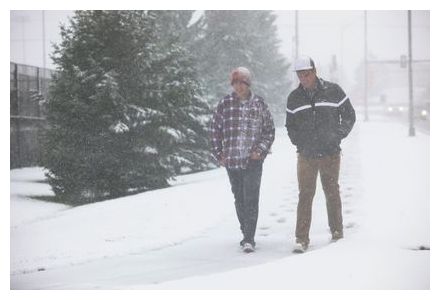
© Reuters/Kristina Barker/Rapid City JournalDustin Dunn (L) and Matthew Wenzel, both students at the South Dakota School of Mines & Technology in Rapid City, walk along Canyon Lake Boulevard in Rapid City, South Dakota, October 4, 2013.
- The upper Midwest was recovering on Saturday from an unusual autumn wallop from a fierce snowstorm that trapped dozens of people in vehicles in western South Dakota and a swarm of tornadoes that left at least 15 people injured in rural Nebraska and Iowa.

More than 80 motorists remained stranded in western South Dakota after a blizzard rolled out of the Rocky Mountains and dumped up to three feet of snow on parts of the Northern Plains.

"Our priority right now is to get those people to a warm location," said Alexa White, spokeswoman for the Rapid City-Pennington County Emergency Management Office in South Dakota. "Many of them are out of gas in their vehicles."

To the east, emergency responders combed through debris in Iowa and Nebraska after 18 reports of tornadoes touching down overnight, including some cutting a swath as wide as a mile.

Fifteen people were injured in Wayne, Nebraska, including one man who suffered broken bones when his pickup truck was hit by a tornado, according to Nebraska emergency management spokeswoman Jodie Fawl.

Fawl said the twister did millions of dollars of damage - pummelling a local airplane hanger, farm implement supply businesses and several homes.

Rainbow

Breathtaking night sky: Aurora Borealis over Minnesota


This spectacular show of bright red, green, white, purple and orange was captured over Saint Cloud, Minnesota, 65 miles (105 kilometers) northwest of the state's most populous urban areas, the Twin Cities of Minneapolis-St. Paul.

It began shortly before midnight and lasted through dawn.

Auroras are visible along the earth's poles and are the result of highly charged particles in the solar wind colliding with atoms from earth's atmosphere.

The colors depend on the altitude and the gas involved in the collision.


Comment:
ScienceDaily

Sep. 29, 2012 - The sun erupted with a wide, Earth-directed coronal mass ejection (CME) on Sept. 27, 2012 at 10:25 p.m. EDT. CMEs are a phenomenon that can send billions of tons of solar particles into space that can reach Earth one to three days later, affecting electronic systems in satellites and on the ground. Experimental NASA research models estimate that the CME is traveling at around 700 miles per second and will reach Earth on Sept. 29.

Bizarro Earth

Moo times two: Calf born with two heads

Two Headed Calf
© Courtesy WPTZ Vermont
A newly born two-headed calf is calling a Whiting, Vermont dairy farm home.

"It just was something different for us today," said dairy owner Kirstin Quesnel. "Just like with humans we have some abnormalities with animals and animal births and this just happened to be one of them."

The condition, called polycephaly, is extremely rare. The calf was supposed to be a twin, but the egg inside the mother failed to split.

"We had a vet take a look at her earlier today to check all of her signs, and she seems to be doing very well," Quesnel said.

The calf spent much of Wednesday sleeping and getting her photo taken. She is also trying to walk, but her neck is not strong enough to carry the weight of two heads.

Otherwise, she's perfectly healthy, but without a name.

"Call it a miracle or call it unique, call it whatever you will, we were just blessed with this and we'll see where it goes from here."

Snowflake Cold

Norway's wheat production impacted by Climate Change

A correspondent in Oslo writes:
"The official view in Norway is in contrast to what the people experience because of cooling weather: Late spring gives flooding and avalanches when late snow-melting in the mountains. Water pipes freeze because of early and deep frost in the winter. Insect populations down 40% in 5 years because of cool and wet summers. This of cause is bad for pollination of fruit and berries. The grain harvest in Norway this summer is down 18% from average the last 5 years, despite increase in area and better seeds. But officially it is getting warmer."
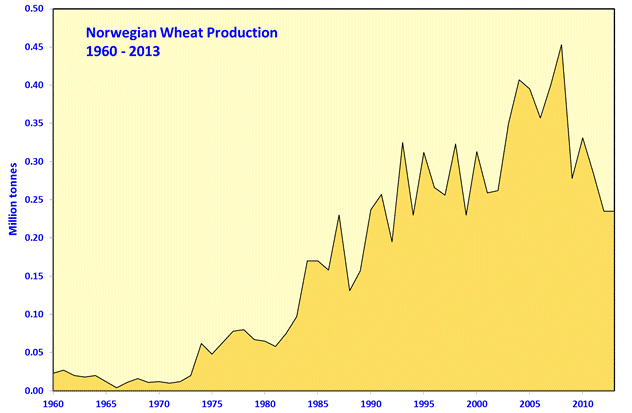
Some of those observations are anecdotal but some facts can be checked - Norwegian wheat production for example. The following figure shows Norwegian wheat production from 1960. Wheat production is off 48% from its peak:
Image
© Unknown

Snowflake

Storm brings snow, tornadoes to Great Plains

Rapid City
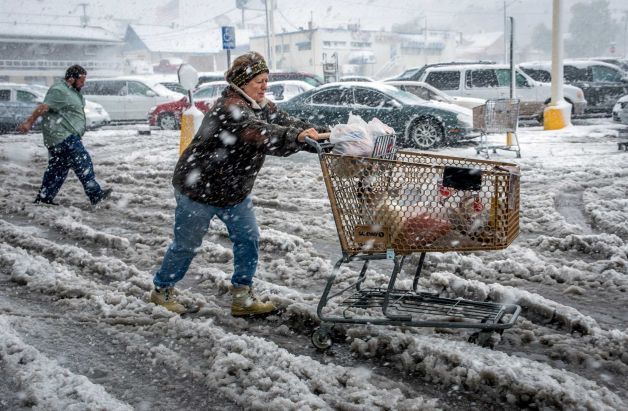
© Steve McEnroe Brenda Nolting, of Rapid City, S.D., rolls her cart to her car after stocking up on necessities Friday, Oct. 4, 2013 at a local supermarket in Rapid City. An early snow storm has swept through Wyoming and western South Dakota, dropping more than a foot of snow in places.
Sioux Falls, SD - A storm system that buried parts of Wyoming and South Dakota in heavy, wet snow on Friday also brought powerful thunderstorms packing tornadoes to the Great Plains.

A storm dumped at least 33 inches of snow in a part of South Dakota's scenic Black Hills, National Weather Service meteorologist Eric Helgeson said Friday afternoon. Later in the day, thunderstorms rolled across the Plains, and witnesses reported seeing tornadoes in Nebraska, Iowa and South Dakota. There were no reports of deaths from any of the tornadoes.

Earlier in the day, snow was blamed for the deaths of three people who were killed in a traffic accident on snow-slicked U.S. 20 in northeast Nebraska.

Forecasters said the cold front would eventually combine with other storms to make for a wild, and probably very wet, weekend for much of the central U.S. and Southeast.

Some of the greatest damage from tornadoes seemed to be in Wayne, Neb., a town of 9,600 where witnesses said at least four homes were destroyed. Mayor Ken Chamberlain said all of the residents in town were accounted for, but the storm caused millions of dollars in damage to an area that includes businesses and the city's softball complex.