
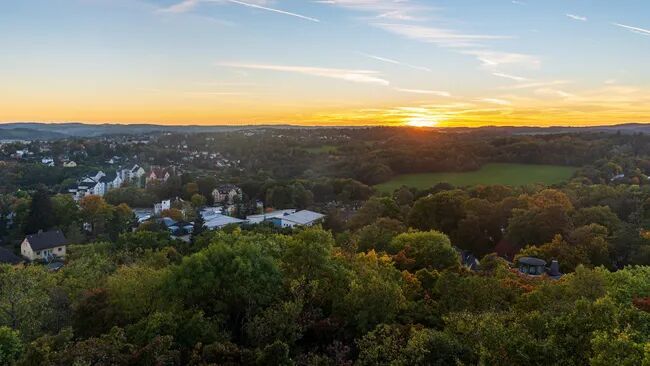
© honza28683 via Getty ImagesThough it's nowhere near a tectonic plate boundary, the Vogtland region is known for its earthquake swarms.
The quakes are in Vogtland, a region known for regular, low-level earthquake swarms. These swarms tend to last several weeks and lead to mostly mild shaking. The largest known quakes from the area are around magnitude 4.5, said Torsten Dahm, a geophysicist at the GFZ German Research Centre for Geosciences who's leading a project monitoring this region.
Dahm and his colleagues recently finished deploying a new network of seismometers installed in boreholes in the Vogtland area. These seismometers captured a late-March earthquake swarm unlike others seen in the area — the center of the swarm jumped 9 miles (15 kilometers) to the north, compared with previous swarms. And instead of occurring on a vertical fault line underground, it seems to have taken place on a near-horizontal underground structure.










Comment: There's certainly been a significant number of 'surprising' and 'unusual' seismic and volcanic reports in recent years, and it seems reasonable to suppose that this signals an uptick in activity: Volcanoes, Earthquakes And The 3,600 Year Comet Cycle
See:
- Surprise magma chamber growing under Mediterranean submarine volcano Kolumbo
- 'One day it will just go off': are Naples' volcanic craters at Campi Flegrei about to blow?
- Santorini is still an active volcano, scientists remind tourists
- Mount Etna collapse 'could trigger tsunami in Ionian sea', slow subsidence of 4cm over 15 months detected
- Iceland's 'exceptional' volcanic unrest continues, 800 earthquakes yesterday, 10,500 since swarm began on October 25th
- Washington volcano Mount St. Helens is 'recharging', 50 small earthquakes recorded in 1 week
- Major 'magnetic anomaly' discovered deep below New Zealand's Lake Rotorua, situated on dormant volcano
- Magma rapidly rising beneath 'dormant' volcano Mount Edgecumbe in Alaska, 'rare reactivation' revealed in new study
- Scientists discover ancient, underwater volcano is still active — and covered in up to a million giant eggs
Also check out SOTT radio's: