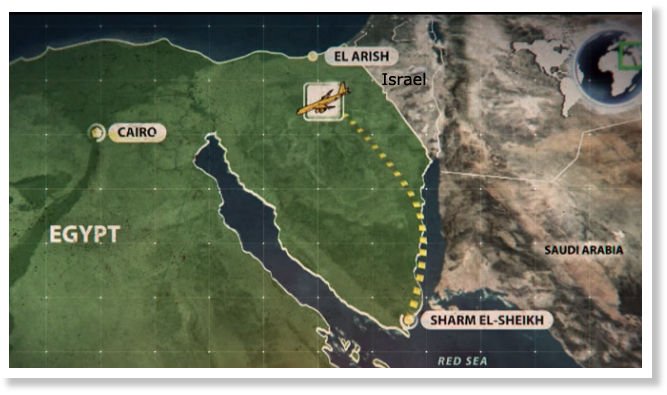
The crash of Kolavia Flight 7K9268 from Sharm el Sheikh, Egypt, to St. Petersburg, Russia, on October 31st killed all 224 passengers and crew, making it Russia's worst ever aviation accident.
The Airbus A321 disappeared from radar over the Sinai desert 23 minutes after takeoff. No emergency signal was broadcast by the pilots. The plane began a rapid, almost vertical, descent from around 31,000 ft until it disappeared from radar at around 28,000 ft. The plane's debris and passenger bodies were spread over a 20 sq km area, with one 3-year-old passenger allegedly found 8 km from the main crash site. This strongly suggests that the plane broke up in mid-air.
Russian aviation experts have discounted the idea that the plane was shot down by a missile or that a bomb exploded on board. A technical fault that could have caused the plane to suddenly plummet out of the sky and incapacitated the pilots before they could send a distress signal is also implausible. Even if both engines failed simultaneously, the plane would still have been 'airworthy' enough to allow the flight crew to glide the plane to an emergency landing over the course of at least 25 minutes.
Something else, something extremely violent, sudden and catastrophic befell the plane and its passengers. Viktor Yung, deputy director of the airline, echoed this assessment when he
said today that only an "external force" could have caused the plane to suddenly plummet from the sky.
"
As the catastrophic incident started to develop, the crew members were rendered completely incapable. This explains why they didn't attempt to contact air traffic and report the incident happening on board," Yung said. Aleksandr Smirnov, who supervises the company's fleet,
said that "the only possible explanation is a mechanical force acting on the aircraft, there is no combination of system failures that could have broken the plane apart in the air."












Comment: Forget About Global Warming: We're One Step From Extinction!