
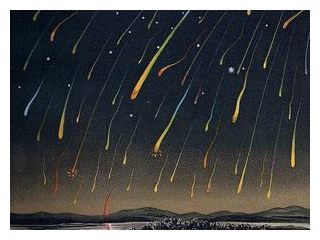
© EarthSky Org
Sometimes, after a meteor shower, people report hearing the meteors. Some exceptionally bright meteors have been reported as being accompanied by a low hissing sound - like bacon sizzling.
For years, professional astronomers dismissed the notion of sounds from meteors as fiction. Typically, a meteor burns up about 100 kilometers - or 60 miles - above the Earth's surface.
Because sound travels so much more slowly than light does, the rumblings of a particularly large meteor shouldn't be heard for several minutes after the meteor's sighting. A meteor 100 kilometers high would boom about five minutes after it appears. Such an object is called a "sonic" meteor. The noise it makes is related to the sonic boom caused by a faster-than-sound aircraft.
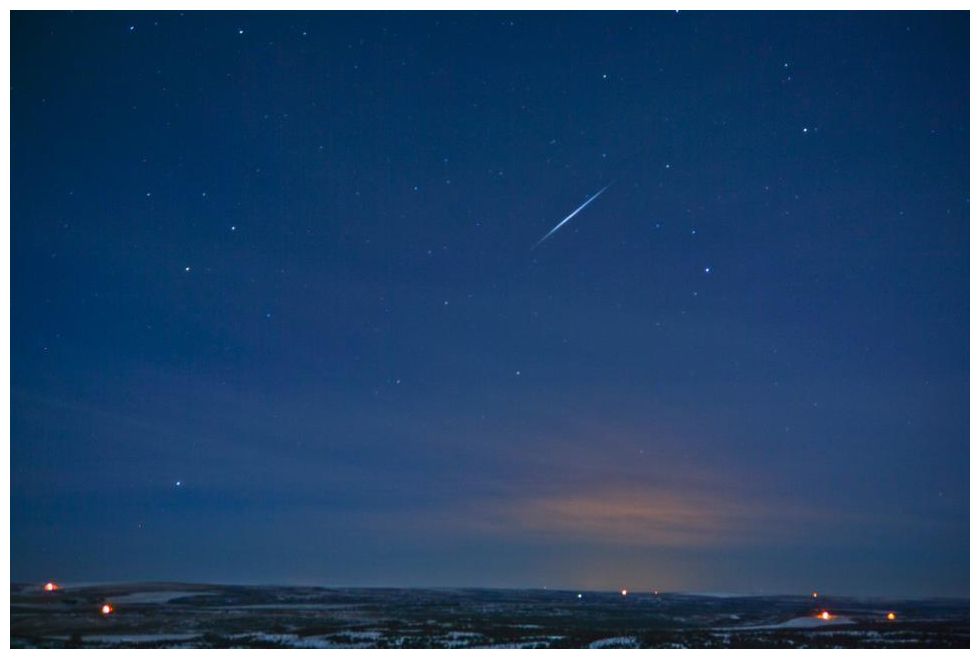
© Susan Jensen2013 Quadrantid meteor by EarthSky Facebook friend Susan Jensen in Odessa, Washington.
The explanation is that meteors give off very low frequency radio waves, which travel at the speed of light. Even though you can't directly hear radio waves, these waves can cause physical objects on the Earth's surface to vibrate. The radio waves cause a sound - which our ears might interpret as the sizzle of a meteor shooting by.





Most prominent effect of DA14 should be due to his charge interacting with earth.
Wait and see.