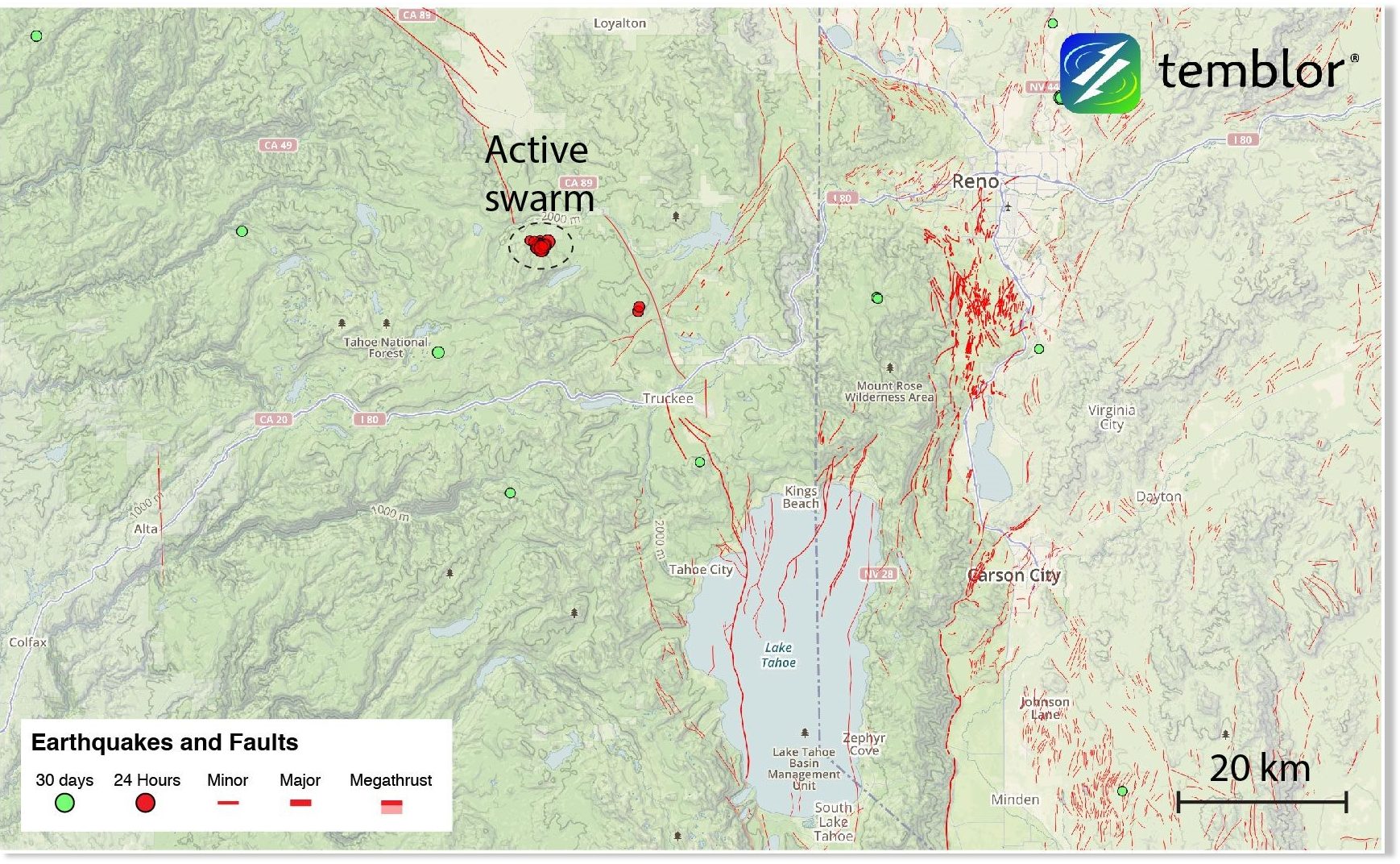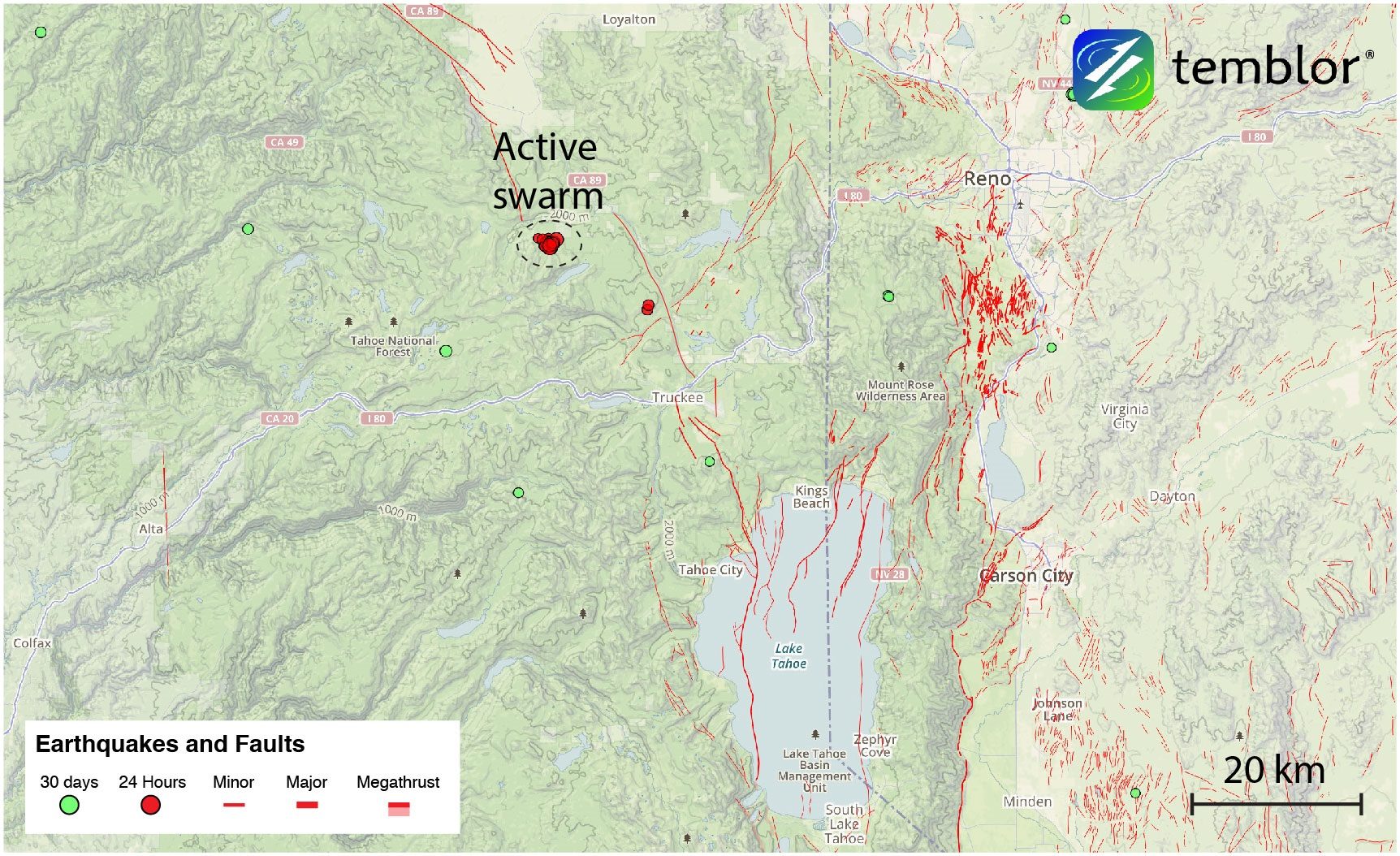
This Temblor map shows the location of the active earthquake swarm relative to the cities of Reno and Carson City, as well as Lake Tahoe.
At just past
2 a.m. local time a small seismic swarm began just west of Reno, Nevada. The swarm kicked off with a M=3.7, and has been followed by 18 more earthquakes, including a M=3.9 that garnered nearly 500 felt reports on the USGS website. While none of these quakes have been large enough to case any damage, as only light shaking was recorded, reports came in from Carson City, and even Sacramento, 130 km away. As swarms can precede larger events, and because a large earthquake could do significant damage to the area, we thought we'd take a closer look at this part of eastern California and western Nevada.
This part of the Western United States, in between the Sierra Nevada Microplate and the Basin and Range Province, is what is known as Walker Lane. This shear zone, together with the San Andreas Fault, accommodates the majority of plate motion between the Pacific and North American plates. Walker Lane is predominantly made up of discontinuous sets of right-lateral strike-slip faults. In the area around this morning's swarm, there are several mapped faults, including the Polaris Fault and East Truckee Fault Zone.
While these are known right-lateral faults, consistent with the predominant motion in the area, the sense of slip on today's earthquakes is ambiguous. One of the reasons why this is the case is because due to the small magnitudes, the quakes may have occurred on smaller antithetic faults rather than structures associated with the large northwest-southeast-trending right-lateral faults.