Science of the SpiritS


People 2

New study links wisdom to meditation

meditation
A new study has found an association between meditation and wisdom.

Researchers with the University of Chicago's Department of Psychology have found that meditation, and physical practices such as ballet, might lead to increased wisdom. The study, "The Relationship between Mental and Somatic Practices and Wisdom," was published in PLOS ONE.

The researchers gave 298 participants a survey that asked about their experiences practicing meditation, the Alexander Technique (a method for improving posture, balance, coordination, and movement), the Feldenkrais Method (a form of somatic education that seeks to improve movement and physical function, reduce pain, and increase self-awareness), and classical ballet. The participants also answered psychological exams related to various elements of wisdom, such as empathy and anxiety.

Comment: Want to know more about meditation? The Éiriú Eolas Stress Control, Healing and Rejuvenation Program is a form of breathing and meditation techniques designed to be informative, effective and life changing! Interested in learning more about the numerous benefits of a breathing and meditation program like Éiriú Eolas? Check out the program here and try it today!


Light Saber

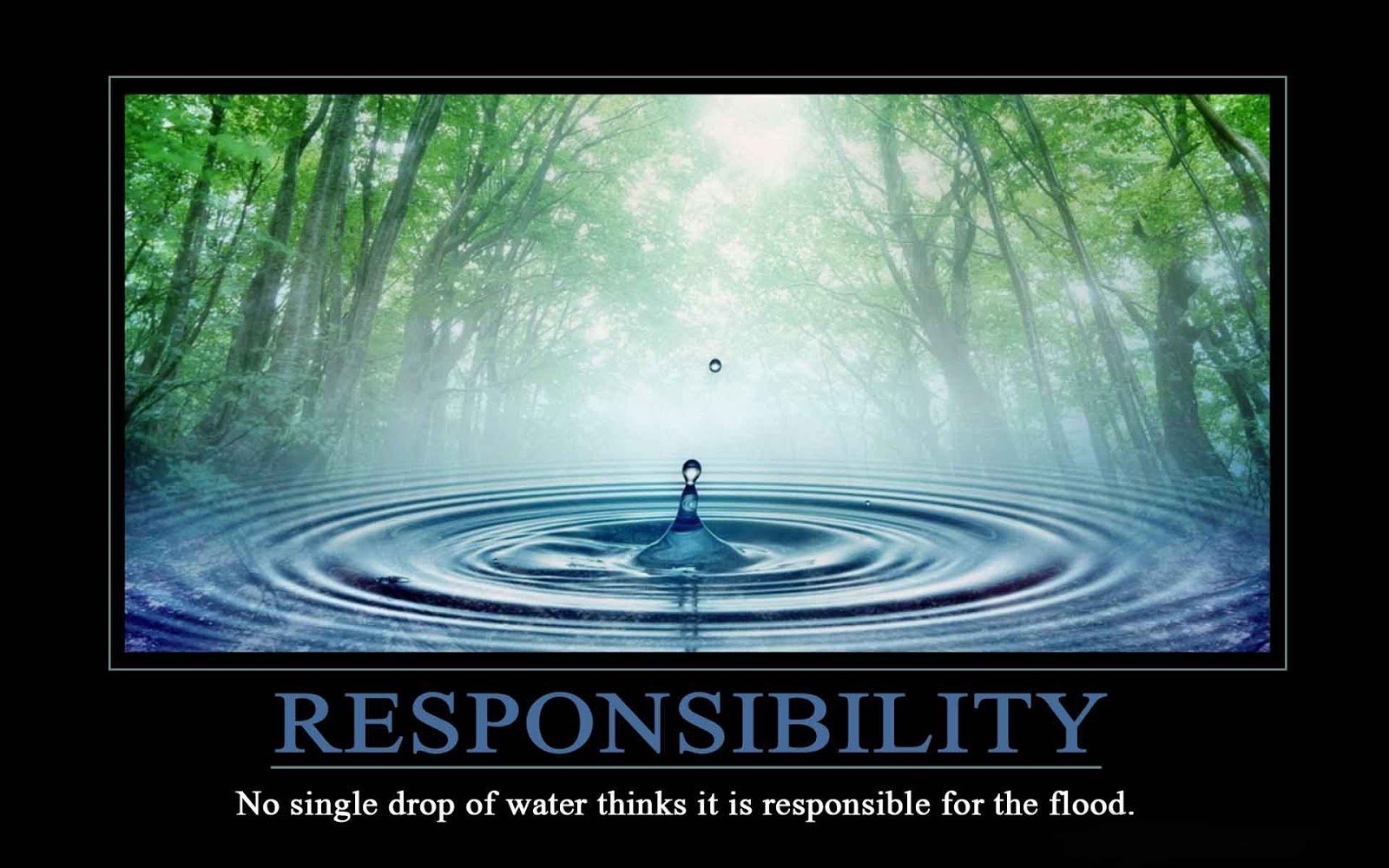
Acting responsibly is a power that opens possibilities in our lives

responsibility
"The fault, dear Brutus, is not in our stars, but in ourselves." — William Shakespeare
We all know someone who chronically avoids responsibility. Things just happen to them — nothing they did contributed to their circumstances. They were late because there was traffic, not because they didn't leave earlier. They didn't drop the ball at work; nobody else stepped up either. Someone "just stopped talking" to them; it has nothing to do with them being a bad friend.

These people have an external locus of control, meaning they don't feel they can influence the environmental factors that affect their lives. It's just simply luck. Their lives are determined by fate.

In reality, our locus of control is somewhere in between internal and external. We can't control everything and it's an exercise in futility to try. But we aren't helpless and our actions actually carry a considerable amount of weight. In fact taking responsibility — keeping our promises, fulfilling our duties, and owning the decisions we make — opens up a wide array of possibilities in our lives. Responsibility is power, so it's a wonder why anyone would avoid it.

Comment:


Info

Higher wisdom is linked to a form of dance and ancient traditional practices

Brain
Higher wisdom is correlated with these diverse activities. Classical ballet has been linked to increased wisdom by a new study. The research also confirmed that many varieties of meditation are linked to greater wisdom. The link, the researcher shows, is down to how meditation reduces anxiety.

Comment: See also: The proven health benefits of meditation


Heart - Black

Like attracts like: Narcissists tend to form friendships with other narcissists

narcissist dark triad
© Pexels, Public DomainWhen it comes to narcissistic friendships, does “like attract like” or do “opposites attract?
Take a look at your circle of friends. Chances are some of your friends are loud while you are quiet, others are funny but you're serious. Friends don't tend to share your personality traits — unless, of course, you're a narcissist. A recent study published in the journal Personality and Social Psychology Bulletin suggests narcissists tend to form friendships with other narcissists due to shared personality traits.

"There is evidence that narcissists are even more tolerant of others' narcissistic traits (e.g., bossy aggressive, arrogant, selfish) when they possess these characteristics themselves... based on their positive self-view and tendency to be less repelled by narcissistic traits," wrote the authors, in the study.

Researchers from Humbolt University in Germany gathered 290 pairs of best friends and asked them to fill out measurements of psychology's Dark Triad, three personality traits, including narcissism, Machiavellianism, and psychopathology, which all have a malevolent connotation, and the Big Five — extraversion, agreeableness, openness, conscientiousness and neuroticism. For each personality, its profile similarity and how much it depended on Dark Triad personality traits were determined. The researchers were able to see if personalities, good and bad, clumped together between best friends.

Comment: Andrew Lobaczewski had something similar to say in reference to psychopaths, in his masterwork Political Ponerology.
They learn to recognize each other in a crowd as early as childhood, and they develop an awareness of the existence of other individuals similar to them. They also become conscious of being different from the world of those other people surrounding them.
Although narcissists generally don't produce the the same scale of destruction as full-blown psychopathy, they are still capable of doing a fair amount of damage in human relationships.


Info

Anxious people have completely different perceptions of the world

anxious brain
© Pixabay, public domainPeople who suffer from anxiety find it harder to distinguish between stressful stimuli and neutral ones, putting them on high-alert.
The brains of anxiety sufferers may have completely different wiring than people who don't have the mental disorder, according to a new study out of the Weizmann Institute of Science in Israel. People with an anxiety disorder may have already felt somewhat like a worrisome outsider to the average laid-back person, but the research backs this up by delving into the brain mechanisms that make them feel "different."

It turns out that something known as overgeneralization is to blame for the unique brain of anxiety sufferers. Humans and animals are wired to respond to stressful stimuli or potential dangers as a survival mechanism, but overgeneralization occurs when a person can't differentiate from a stressful stimuli and a neutral, non-stressful one.

Comment: Additional information about lifestyle changes that can help cure anxiety:


Books

Mental flexibility improved by reading and writing literature

Reading
Some types of reading may help people suffering from depression. Writing which challenges the reader to think more deeply could boost mental flexibility, new research finds. People who read poetry and other texts that required them to re-evaluate the meaning showed fascinating changes to patterns of activation in the brain. Greater mental flexibility — which these patterns suggested — allows people to better adapt their thoughts and behaviors to evolving situations. Rather than always being guided by habits, people with greater mental flexibility are better at seeking out new solutions.

Comment: Professor Philip Davis provides important information in how to rewire the brain.

See also: Recording and rewinding our thoughts -- is it possible?


Info

The benefits of self-knowledge: Vital signs for understanding your identity

knowledge, meditation
"To know thyself is the beginning of wisdom." This famous quote is often attributed to Socrates. But what exactly do you know when you "know yourself?"

This blog will reveal 6 elements of self-knowledge that can help you understand your own identity. As you live your daily life, you can look for clues to these important building blocks of Self.

But first, why is it important to know yourself?

The Benefits of Self-Knowledge

Maybe it's obvious, but here in a nutshell are a few reasons why you might want to know your own nature:
  • Happiness. You will be happier when you can express who you are. Expressing your desires, moreover, will make it more likely that you get what you want.
  • Less inner conflict. When your outside actions are in accordance with your inside feelings and values, you will experience less inner conflict.
  • Better decision-making. When you know yourself, you are able to make better choices about everything, from small decisions like which sweater you'll buy to big decisions like which partner you'll spend your life with. You'll have guidelines you can apply to solve life's varied problems.
  • Self-control. When you know yourself, you understand what motivates you to resist bad habits and develop good ones. You'll have the insight to know which values and goals activate your willpower.
  • Resistance to social pressure. When you are grounded in your values and preferences, you are less likely to say "yes" when you want to say "no."
  • Tolerance and understanding of others. Your awareness of your own foibles and struggles can help you empathize with others.
  • Vitality and pleasure: Being who you truly are helps you feel more alive and makes your experience of life richer, larger, and more exciting.

Comment:


Cloud Grey

What feels like depression might really be grief

depression,schlafstörungen,trauer,apathie
© fotolia / Photographee.eu
You feel sad and the world seems without color or flavor. You do not see the point of getting out of bed, but you have felt like this for several days and there are things that need to be done, so you get moving. This feels a lot like a depression, but there is a good reason to feel this way: you are grieving.

When depression is grief, the feelings can be very similar, and can last for some time. Traci was only 23 when her mother rapidly died from a late stage ovarian cancer. Traci welled with unpredictable tears and found it hard to go to work after her 2 days off for the funeral. After a couple of weeks her doctor wanted to put her on antidepressants. Paul, on the other hand, was ready to jump into marriage with the love of his life when she said she could not do it, she took a job in another city and left home with no notice. He could not eat or sleep, lost 15 pounds in 2 weeks and alarmed his daughter who wanted him to get on medication that would ease his depressed mood. Kimberly went to work and went home and did nothing but sit on the couch, watching some TV, ordering pizza for dinner and spent hours looking at pictures and videos she had taken of her dog who had disappeared from the yard one recent morning.

The biggest, and most common cause of deep grief is losing a loved one: a parent, a spouse or worse, a child. But grieving at the loss of a pet who was part of family life and even grieving the loss through divorce of a relationship or a way of life that was valued, can throw a person into a depression-like state. These behaviors and moods all make sense when put into the context of loss, but in our culture there is tremendous impatience with grieving. It is too often labeled as depression, and too often medicated, thereby blunting the normal process of grieving that allows people to move forward.


Comment:


Question

Is complaining negatively altering your brain?

complaining
© thestorytellers.comComplaining turns your brain to mush
Listening to someone complain, even if it's yourself, has never done anyone any good. Some people say that it may act as a catharsis, a way to let go of negative emotions and experiences, and maybe letting it all out once in a while does feel good, but taking a closer look at what complaining actually does to the brain gives us even more cause to strive for a positive frame of mind and cut out the complaining.

"Synapses That Fire Together Wire Together"

The brain is a complex physical organ that somehow works in tandem with consciousness to create the personality of a human being, always learning, always re-creating and re-generating itself. It is both the product of reality and the creator of reality, and science is finally beginning to under stand how the brain actually creates reality.

Chalkboard

The results are clear: Homework is damaging to young kids and should be banned until High School

homework
© Katarina Gondova via iStock
"There is no evidence that any amount of homework improves the academic performance of elementary students."

This statement, by homework research guru Harris Cooper, of Duke University, is startling to hear, no matter which side of the homework debate you're on. Can it be true that the hours of lost playtime, power struggles and tears are all for naught? That millions of families go through a nightly ritual that doesn't help? Homework is such an accepted practice, it's hard for most adults to even question its value.

When you look at the facts, however, here's what you find: Homework has benefits, but its benefits are age dependent.

For elementary-aged children, research suggests that studying in class gets superior learning results, while extra schoolwork at home is just . . . extra work. Even in middle school, the relationship between homework and academic success is minimal at best. By the time kids reach high school, homework provides academic benefit, but only in moderation. More than two hours per night is the limit. After that amount, the benefits taper off. "The research is very clear," agrees Etta Kralovec, education professor at the University of Arizona. "There's no benefit at the elementary school level."

Before going further, let's dispel the myth that these research results are due to a handful of poorly constructed studies. In fact, it's the opposite. Cooper compiled 120 studies in 1989 and another 60 studies in 2006. This comprehensive analysis of multiple research studies found no evidence of academic benefit at the elementary level. It did, however, find a negative impact on children's attitudes toward school.