Science of the SpiritS


Family

It's what you do that counts: Study suggests most people stay true to their intrinsic moral colors

kindness, giving
Kindness and generosity elevates all our morals
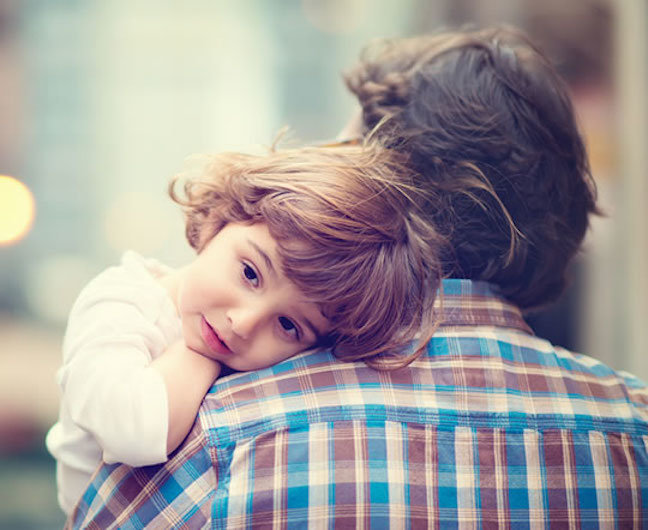
When judging the character of a friend, co-worker or potential romantic partner, pay attention to little acts of kindness or cruelty because these are likely part of a consistent behavioral pattern.

U.S. presidential candidates Hillary Clinton and Donald Trump have been criticized for their seeming willingness to cut corners on core principles when they consider it necessary to make some progress toward a laudable goal.

While philosophers and voters can debate the pros and cons of situational ethics, new research from Washington University in St. Louis suggests that most people stay true to their intrinsic moral colors -- good or bad -- when dealing with day-to-day choices, regardless of extenuating circumstances or well-intended reform efforts.

"Our studies provide new and important evidence for the stability of moral character," said Kathryn Bollich, lead author of two recent studies exploring how evolving personality traits and competing ethical quandaries influence moral behavior.

"Using naturally observed, everyday behaviors and self-reports of moral decision-making, we demonstrate that one's morality is stable," Bollich said. "These findings suggest that efforts to modify moral character may not be so simple. For example, efforts to make a roommate or romantic partner more helpful and sympathetic, or less condescending and critical of others, may be met with slow and minimal success."


Fire

Primal rage: 5 tips to make unproductive anger productive

guy expressing rage
If you get to this point, you probably should have expressed your anger sooner...
If you ask the average person on the street to list "primal emotions," I'd venture that anger would be one of the first examples they offer. I think we automatically connect a primal state with anger because anger's power is more reminiscent of instinct than sentiment. It's an emotion that can instantaneously engulf our entire being—a red hot feeling that can send all rational thought and genuine self-interest down the toilet in a nanosecond. While other emotions have their physical hold, anger can grip us in a way few others can. Fear, the other primary instinctual emotion, generally lifts with a clear, even euphoric release (as long as its situational, not a product of neuroses). Anger, however, doesn't die so easily. Like the embers in a fire, it needs ample time to fade. The visceral energy of anger is remarkably durable. We kid ourselves if we think we're immune to its inherent human force. That said, how can we keep it reined in enough to not thwart our own well-being (not to mention anyone else's)? How can we control or manage it—even channel it? In short, how can we have and express anger without getting burned by it?

Comment: Anger is a powerful emotion and is often not handled well in modern society. People often repress their anger, which then builds up and explodes, or leaks out in other covert ways. Others may suppress their anger with alcohol or drugs, damaging their body instead of expressing their anger. Both of these are all the more prevalent today as people en masse are angry at their psychopathic leaders, whether they're aware of that and directing it properly, or not.

In Chinese medicine, the liver is the seat of anger, so a properly functioning liver is related to properly felt and expressed anger; likewise, a poorly functioning liver can result in anger that isn't expressed properly and timely--improving liver function can improve one's relationship to anger. Feeling and expressing healthy anger enforces one's boundaries and can improve relationships through emotional honesty. That isn't a license to explode and mistreat people when one is angry, but making others aware that you're angry and if they're crossing your boundaries or demanding too much, that they're doing so and it's not ok to do so. For more information:


Cloud Precipitation

Parents who hide their true feelings from their children worsen the quality of their relationships

parent child
© Shutterstock
Some parents always try to hide their negative emotions and amplify their positive emotions.

Parents who always try to put on a happy face for the sake of the children may be doing more harm than good, a new study finds.

Hiding negative emotions and exaggerating positive emotions can actually damage parents' well-being, the psychologists found.

Parents who tried to be 'perfect' for their children reported lower authenticity, worse relationship quality and were less responsive to their children.

Comment: Being afraid to show our true feelings sends a signal to our children that it is not appropriate to express their own emotions, setting the stage for a lifelong habit of squelching their feelings and perhaps causing untold negative effects on their health and well-being.


People

Test: Are you a narcissist and if so, what kind?

masque narcissisme
© Inconnu
In a new TED-Ed video, W. Keith Campbell explains different types of narcissism.

According to the video, narcissism is "a set of traits classified and studied by psychologists" in which an individual has an inflated sense of self-importance.

Narcissism as a personality trait can be classified as "vulnerable" or "grandiose." Grandiose narcissists are the most common type. They are often extroverted and seek to "pursue attention and power." Vulnerable narcissists are more introverted. They have a strong sense of entitlement and are easily threatened.

Hearts

"Holding space" for people: What it means and ways to do it well

holding space emotional healing
© Heather Plett
When my mom was dying, my siblings and I gathered to be with her in her final days. None of us knew anything about supporting someone in her transition out of this life into the next, but we were pretty sure we wanted to keep her at home, so we did.

While we supported mom, we were, in turn, supported by a gifted palliative care nurse, Ann, who came every few days to care for mom and to talk to us about what we could expect in the coming days. She taught us how to inject Mom with morphine when she became restless, she offered to do the difficult tasks (like giving Mom a bath), and she gave us only as much information as we needed about what to do with Mom's body after her spirit had passed.

"Take your time," she said. "You don't need to call the funeral home until you're ready. Gather the people who will want to say their final farewells. Sit with your mom as long as you need to. When you're ready, call and they will come to pick her up."

Ann gave us an incredible gift in those final days. Though it was an excruciating week, we knew that we were being held by someone who was only a phone call away.

In the two years since then, I've often thought about Ann and the important role she played in our lives. She was much more than what can fit in the title of "palliative care nurse". She was facilitator, coach, and guide. By offering gentle, nonjudgmental support and guidance, she helped us walk one of the most difficult journeys of our lives.

The work that Ann did can be defined by a term that's become common in some of the circles in which I work. She was holding space for us.

Post-It Note

Psychology of persuasion: The Third-person effect

Obi-Wan Kenobi
© Lucasfilm Ltd.
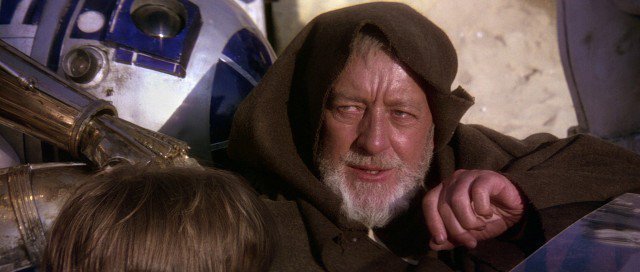
Why people think they are less influenced than others by adverts and persuasive messages.

One of the most intriguing things about the psychology of persuasion is how many people say that persuasion attempts have little or no effect on them. Other people, oh sure, adverts, work on them. But not you and I, we're too clever for that.

Attractive woman holding a bottle of beer? Hah! How stupid do they think we are? We know what they're doing and we wouldn't fall for such cheap tactics.

Would we?

Persuasive experiments

So pervasive is this feeling that only 'other' people are influenced by things like adverts that many studies have explored the idea, with an initial surge in the 1980s and 90s. Psychologists wanted to see how much people thought they were influenced by persuasive messages like adverts and compare it with actual attitude changes, if any.

Typically these studies first got participants to watch an advert, read a newspaper article or other medium containing a persuasive message. Then they were asked how much it had influenced them and how much it might influence other people. Since the experimenters measured actual persuasion and knew from previous research how influential the messages were, they could compare people's guesses with reality.

What they found, in study after study, was that participants thought others would be influenced by the message, but that they themselves would remain unaffected. When psychologists looked at the results, though, it was clear that participants were just as influenced as other people. This was dubbed the 'third-person effect'.

Comment: See also: SOTT Radio Network - The Truth Perspective #7: You are not so smart - understanding our cognitive biases


People 2

Opposites don't attract: We're hard-wired to seek out similarity in relationships

similars
A groundbreaking new study on how we seek similarity in relationships refutes the idea that "opposites attract," instead suggesting we're drawn to people who are like-minded. The study could lead to a fundamental change in understanding relationship formation, and sounds a warning for the idea that couples can change each other over time.

Assistant Professor of Psychology Angela Bahns (Wellesley College) and Professor of Psychology Chris Crandall, University of Kansas are the paper's lead authors.

In what might be considered a paradigm shift, the study's most surprising discovery is that people in relationships do not change each other over time. Instead, Bahns and Crandall's evidence places new emphasis on the earliest moments of a relationship, revealing that future friends or partners are already similar at the outset of their social connection, a major new finding, say the authors.

Snowflake

Intentions: Can they heal the water?

water intentions
By connecting to the water we become inspired to take action
We were born in water. Water is our first medicine... I teach people to thank the water every day of your life... The river; the lake near your house; the glass of water you're holding in your hand. Thank the water for giving us life. - Grandma Agnes Pilgrim, 13 Indigenous Grandmother Council
Born from the cooling steam of ancient volcanic fires, water is the life blood of our planet. Water covers 78% of the surface of the globe and fills nearly 70% of our bodies. Water flows through obstacles, removes barriers, breaks down mountains and awakens life.

Comment: Learn more about the amazing properties of water: Health & Wellness Show - Feb 19, 2016 - Water: What Do We Really Know?
Water: it makes up the majority of our planet and our own bodies, filling everything from the earth and skies to our own cells. Yet what is actually known about this mysterious substance, so vital to life? It may surprise us to find that, despite its prevalence in our lives, scientists admit that there is still a great deal to learn about water. Does water have a "memory"? Are there really only three phases of water (liquid, solid and vapour) or is there a "fourth phase of water?" Does water create energy? When we speak to water, does it listen? Is there a structure to water?


Calendar

Slow and steady wins the race: Study links impatience to shorter chromosome length

Chromosomes
© Exume Images/Shutterstock
Impatient people may be more likely to have shorter telomeres, parts of human chromosomes that that tend to get shorter as people age, according to a new study.

Previous research has shown that people with shorter telomeres may be more likely to develop common diseases associated with aging — such as cancers, diabetes and cardiovascular diseases — compared with people who have longer telomeres, the researchers said.

The new study shows for the first time that impatience is linked to people's telomere length, said study co-author Soo Hong Chew, a professor of economics at the National University of Singapore.

In the study, researchers looked at the relationship between impatience and telomere length among 1,158 undergraduate students in Singapore. The researchers measured the participants' levels of impatience by asking them to choose between receiving a smaller amount of money in a day or more money later.

The participants also underwent a blood test, so the researchers could assess the length of the individuals' telomeres, the protective "caps" at the ends of chromosomes. These structures defend the rest of the chromosome from the erosion, or shortening, that happens each time a cell divides.

In the first task in the study, the researchers asked the people to choose between receiving $100 the next day and receiving $101 in about a month.

In the second task, the participants had to chose between receiving $100 the next day and receiving $104 about a month later. Over a series of eight more tasks, the researchers gradually increased the amount in the second option, so that, by the last task, it involved receiving $128 in about a month's time. Meanwhile, the first option remained unchanged, at $100 the following day.

The higher the amount of money it took to convince a person to delay receiving the financial reward by a month, the higher was that person's level of impatience, the investigators said.

Comment: The art of developing patience


People 2

Disposable friendships: People who move around a lot have the same attitude towards friends as they do objects

broken link
© Shutterstock
Moving home a lot is linked to thinking that friendships and close social ties are more disposable, new research finds. Moving around a lot is also linked to the same attitude of disposability towards objects.

Dr Omri Gillath, one of the new book's authors, said:
"We found a correlation between the way you look at objects and perceive your relationships.

If you move around a lot, you develop attitudes of disposability toward objects, furniture, books, devices — basically whatever merchandise you have at home, your car even."
Modern societies are often highly mobile, with people moving around for work, school or just to start afresh.

The research found that the more people have moved around the country, the more they tend to have a disposable view of both objects and close social ties.