
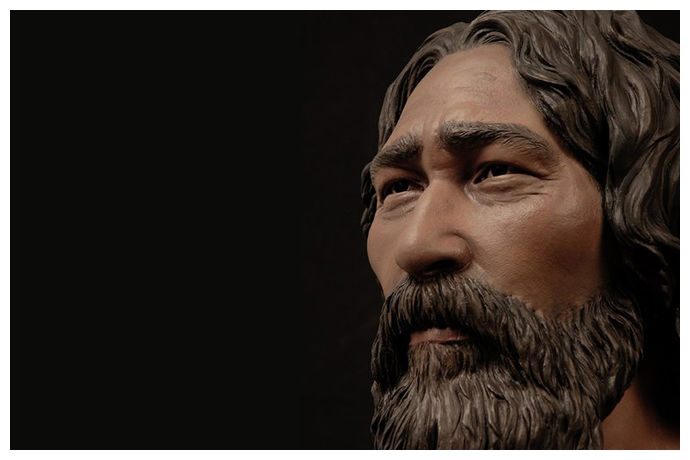
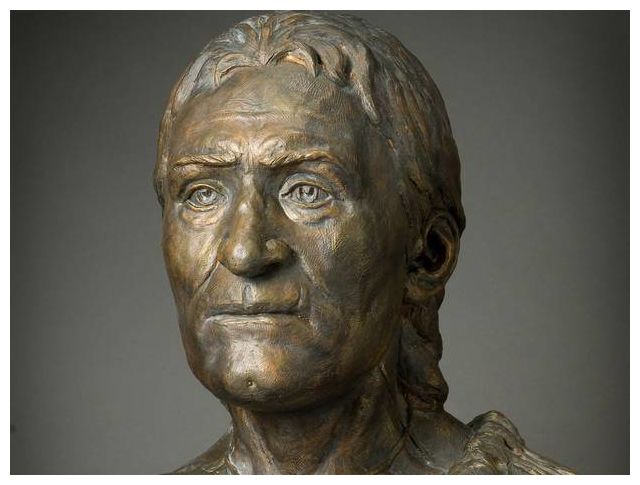
© Brittney Tatchell, Smithsonian InstitutionThis sculpted bust of Kennewick Man by StudioEIS is based on forensic facial reconstruction by sculptor Amanda Danning.
The international study, published in the journal Nature, is likely to reignite a bitter legal and scientific battle over the ultimate fate of the skeleton.
"Kennewick Man's genome sequence is closer to that of Native Americans than any other contemporary people's including the Ainu and Polynesians," senior author Eske Willerslev, from the University of Copenhagen's Centre for GeoGenetics, told Discovery News.
The researchers from the University of Copenhagen and Stanford University School of Medicine used the latest in DNA isolation and sequencing techniques to analyze the genetic material in the ancient bones.
"Although the exterior preservation of the skeleton was pristine, the DNA in the sample was highly degraded and dominated by DNA from soil bacteria and other environmental sources," lead author Morten Rasmussen said.
"With the little material we had available, we applied the newest methods to squeeze every piece of information out of the bone," he added.
Willerslev, Rasmussen and colleagues compared the DNA sequences from the skeleton with those of modern Native Americans.
They concluded that, although it is impossible to assign Kennewick Man to a particular tribe, he is closely related to members of the Confederated Tribes of the Colville Reservation in Washington.












Comment: See also Joe Quinn's Sott Focus:
The British Empire - A Lesson In State Terrorism