Puppet MastersS

Folder

Blacklist used by construction firms to disrupt environmental protests

Image
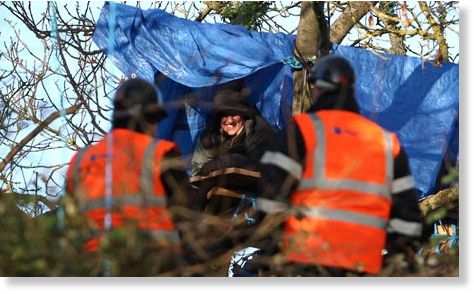
© Photograph: Gareth Fuller/PAA road protester near Crowhurst, Sussex: over half of the UK's top construction firms are thought to have been involved in keeping a blacklist of environmental activists.
Industry found to have files on more than 200 activists, provided by security services or police - prompting calls for official inquiry

Hundreds of environmental activists were on a secret "blacklist" used by construction firms in an attempt to disrupt high-profile protests against road building and other developments.

Files on more than 200 campaigners were held alongside a list of more than 3,000 construction workers who had raised legitimate health and safety concerns or belonged to a trade union.

Last week MPs said the list had deprived thousands of people of work and driven some families to destitution. Evidence of the growing scale of the operation carried out by the Consulting Association has led to renewed calls for an official inquiry.

Chuka Umunna, the shadow business secretary, told the Guardian: "This is greatly concerning and we still don't know what the full scale of the blacklisting scandal was. In light of this new evidence, it is crucial that a full investigation of blacklisting commences."

During a debate on blacklisting in parliament last week, Umunna said more than half of the top 20 construction firms in the UK were involved.

Ambulance

At least 19 killed in Yemen in two separate attacks

Image
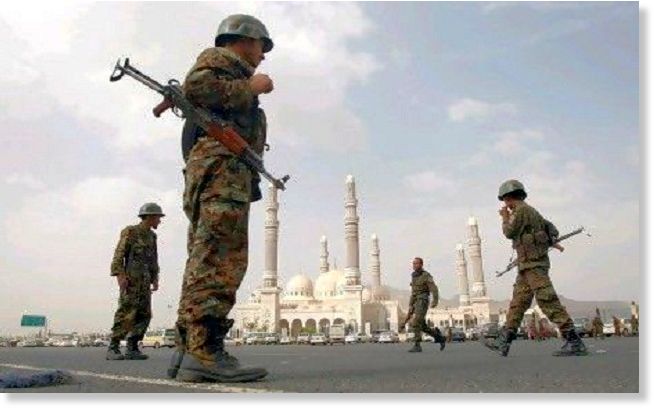
© AFP PhotoYemeni soldiers stand guard outside the Al Saleh mosque during a memorial service to commemorate the victims of a suicide bombing in Abyan province on August 5, 2012, in Sanaa.
In two separate attacks, a car bomb and a suicide bomber have killed at least 19 people in Yemen on Monday.

A car bomb has killed at least 11 killed and injured 17 in Rida city, 100 miles south east of the Yemeni capital, Al Arabiya correspondent reported Monday.

Also, a suicide bomber killed at least eight Yemeni soldiers on Monday after troops backed by tanks attacked an al-Qaeda stronghold, al-Bayda province, a following the collapse of talks to free three Western hostages, local officials and residents said.

Tackling lawlessness in the impoverished Arabian Peninsula state, which flanks the world's biggest oil exporter Saudi Arabia, is an international priority. The United States views Yemen as a frontline in its struggle against al-Qaeda.

Stormtrooper

New Arizona bill wants hospitals policing immigration

Image
© rui vale sousa/Shutterstock
The state that brought you SB 1070, perhaps the harshest immigration law in the nation, is at it again with a bill that could bring illegal immigrant-hunting into new territory: hospitals.

Proposed last week by Republican state Rep. Steve Smith, HB 2293 would require hospital workers to verify the immigration status of uninsured people seeking care. They'd have to make note of any undocumented patient, and then call the police.

Speaking outside the Arizona capitol on Thursday, Rep. Smith called it simply "a data-collection bill" to figure out how much Arizona is spending on illegal immigrant care, promising that no one would be denied treatment or deported once their status is disclosed.

V

Violent protests greet Egypt emergency decree

Image
© REUTERS/Amr Abdallah DalshRiot policemen beat a protester opposing Egyptian President Mohamed Mursi, during clashes along Qasr Al Nil bridge, which leads to Tahrir Square in Cairo January 28, 2013. Monday was the fifth day of violence in Egypt that has killed 50 people and prompted the Islamist president to declare a state of emergency in an attempt to end a wave of unrest sweeping the Arab world's biggest nation.
A man was shot dead on Monday in a fifth day of violence in Egypt that has killed 50 people and prompted the Islamist president to declare a state of emergency in an attempt to end a wave of unrest sweeping the Arab world's biggest nation.

Under emergency powers announced by President Mohamed Mursi for the cities of Port Said, Ismailia and Suez on Sunday, the army will have the right to arrest civilians and to help police restore order.

A cabinet source told Reuters any trials would be before civilian courts, but the step is likely to anger protesters who accuse Mursi of using high-handed security tactics of the kind they fought against to oust president Hosni Mubarak.

Star of David

Israel uses deadly weapons on unarmed Palestinian protesters - watchdog

Image
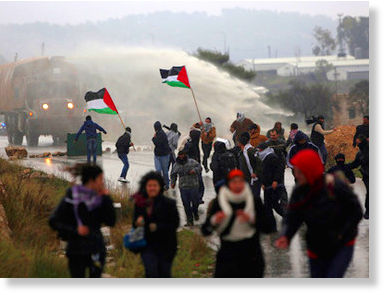
© Reuters / STRProtesters run as an Israeli Army truck fires a water cannon, containing a foul-smelling substance, during clashes with stone-throwing protesters in the West Bank village of Nabi Saleh, near Ramallah
Israel is using lethal force on unarmed Palestinian protesters in the West Bank, according to the latest report by the Israeli human rights group B'Tselem. It says 56 people were killed in the clashes, with an average age of 18.

In the 31-page report, B'Tselem accused Israeli security forces of having "extensively and systematically violated" rules that ban deadly response to a non-lethal assault. B'Tselem has been working on the report, 'Crowd Control: Israel's use of Crowd Control Weapons in the West Bank' for the past year.

Only in the past fortnight, the Israeli military shot dead two Palestinians in the clashes.

Since 2005, six people were killed by rubber-coated metal bullets and two by teargas canisters, both supposedly non-lethal weapons which were fired directly at protesters, according to B'Tselem.

Live ammunition was utilized in other 48 cases of death. The average age of those killed was reportedly 18-and-a-half.

The typical riot dispersal tools of security forces include teargas, rubber-coated bullets, stun grenades, live ammunition, skunk and water cannons, pepper spray, and sponge rounds - non-lethal weapons which are not dangerous for long-term health if used correctly.

Display

Report: Pentagon planning massive cybersecurity increase

Image
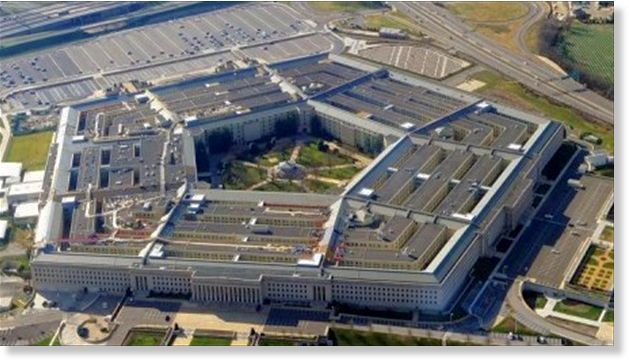
The US Department of Defense has approved a fivefold expansion of its cybersecurity force over the coming years in a bid to increase its ability to defend critical computer networks, The Washington Post reported.

Citing unnamed US officials, the newspaper said the Defense Department's Cyber Command, which currently has a staff of about 900, will expand to about 4,900 troops and civilians.

The decision to expand the Cyber Command was made by senior Pentagon officials late last year in recognition of a growing threat in cyberspace, the report said.

Last November, Defense Secretary Leon Panetta conceded that US cybersecurity needed more financial support and human capital.

Eye 1

Pentagon's new massive expansion of 'cyber-security' unit is about everything except defense

Image
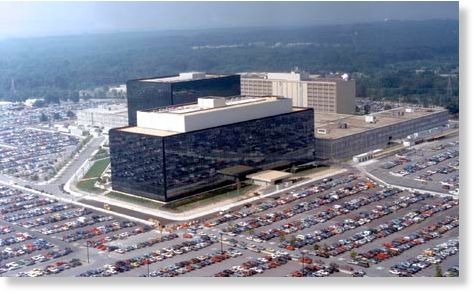
© Photograph: NSA/Getty ImagesThe National Security Agency (NSA) headquarters in Fort Meade, Maryland. Among other forms of intelligence-gathering, the NSA secretly collects the phone records of millions of Americans, using data provided by telecom firms AT&T, Verizon and BellSouth.
Cyber-threats are the new pretext to justify expansion of power and profit for the public-private National Security State.

As the US government depicts the Defense Department as shrinking due to budgetary constraints, the Washington Post this morning announces "a major expansion of [the Pentagon's] cybersecurity force over the next several years, increasing its size more than fivefold." Specifically, says the New York Times this morning, "the expansion would increase the Defense Department's Cyber Command by more than 4,000 people, up from the current 900." The Post describes this expansion as "part of an effort to turn an organization that has focused largely on defensive measures into the equivalent of an Internet-era fighting force." This Cyber Command Unit operates under the command of Gen. Keith Alexander, who also happens to be the head of the National Security Agency, the highly secretive government network that spies on the communications of foreign nationals - and American citizens.

The Pentagon's rhetorical justification for this expansion is deeply misleading. Beyond that, these activities pose a wide array of serious threats to internet freedom, privacy, and international law that, as usual, will be conducted with full-scale secrecy and with little to no oversight and accountability. And, as always, there is a small army of private-sector corporations who will benefit most from this expansion.

Cell Phone

Google faces legal action over alleged secret iPhone tracking

Image
Google is facing a fresh privacy battle in the UK over its alleged secret tracking of the internet habits of millions of iPhone users.

An estimated 10 million Britons could have grounds to launch a privacy claim over the way Google circumvented Apple's security settings on the iPhone, iPad and desktop versions of its Safari web browser to monitor their behaviour.

At least 10 British iPhone users have started legal proceedings and dozens more are being lined up, according to Dan Tench, the lawyer behind the action at the London-based firm Olswang.

"This is the first time Google has been threatened with a group claim over privacy in the UK," Tench told the Guardian. "It is particularly concerning how Google circumvented security settings to snoop on its users. One of the things about Google is that it is so ubiquitous in our lives and if that's its approach then it's quite concerning."

Sheriff

NYPD Commissioner Ray Kelly: Police to use Tera-Hertz scanners within six months

Image
The New York Police Department will begin using scanner technology that can see through a person's clothes within the year, according to Commissioner Ray Kelly.

"We've been looking at it for several years, looking at it with the Department of Defense, and also Metropolitan Police in London," he said on CBS News' Face the Nation.

New technology called Tera-Hertz scanners or T-Ray machines can be used to detect whether a person is carrying a concealed firearm. The new device utilizes T-rays, which pass through fabric and paper, but not cannot pass through metals.

Document

ACLU takes on the DEA for seeking prescription records without a warrant

Image
© Shutterstock
The American Civil Liberties Union is seeking to block the Drug Enforcement Administration from obtaining prescription records without a warrant in Oregon.

The state of Oregon filed suit against the DEA last year after the agency sought to access the Oregon Prescription Drug Monitoring Program (PDMP), a database of prescription records for certain drugs. The ACLU and its Oregon affiliate hope to join the lawsuit on behalf of patients and doctors.

"Oregon law and the U.S. Constitution clearly require the DEA to get a warrant just like any other law enforcement agency," David Fidanque of the ACLU of Oregon said. "The ACLU opposed the creation of the Oregon prescription database precisely because we were concerned about protecting the privacy of patients and doctors who have done nothing wrong. The Legislature agreed to add the search warrant requirement to partially address that concern."