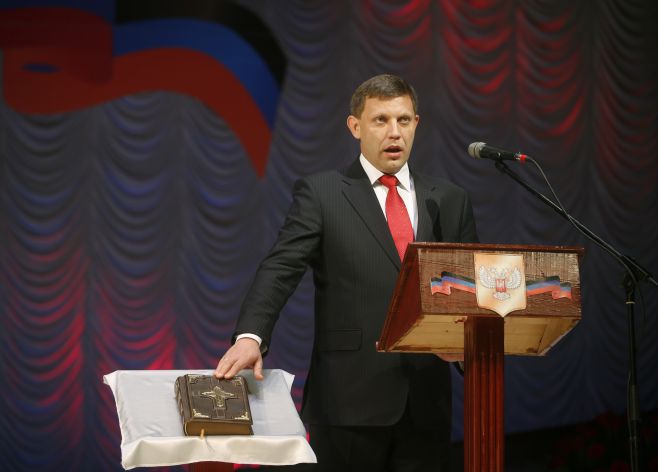
Alexander Zakharchenko sworn in as head of the Donetsk People's Republic on November 4, 2014
If you visit my supreme council and realize that you cannot trust anyone. [
He sighs.] It's here, on the corner. The worst thing is that for some people the war is a way of making money, the redistribution of the spheres of influence... My dream ... You asked me what is my dream. [
He flicks cigarette ashes.] Yes, I have a dream. Maybe it's stupid. Perhaps you will be laughing. Many people laugh. If I were one of them I'd also laugh at such a dream. But ... I also understand the structure and the economy of Donbass, so
I want to improve the level of living of my fellow countrymen so that it was even higher than in Poland. Our land is unique, rich in minerals...
Marina: Donbass showed me miserable villages and miners from makeshift coalmines (kopankas) who...
Alexander: No. [
He is lighting a cigarette, interrupting.] Let's not compare mines and kopankas. There are mines and there are kopankas. So, descending into a kopanka is degrading for a miner. My father thirty years worked in a mine. I have a year and a half of the underground service. But as a professional miner, my Dad would never go down in a kopanka. Going down there was beneath his dignity.
Marina: Why?
Alexander: A mine is a man's job. Kopanka is just a way of extraction of coal from the earth.
Marina: Do you remember your first descending into a mine?
Alexander: Yes, I remember. And will never forget. Despite my family are miners and they always talked about mines, when I was descending, I knew what awaits me there, but it was ... crazy.
Marina: Scary?
Alexander: No. It was interesting. I was not scared. I was scared only twice: it can be scary at the time of [gas] emissions or when the trolley has slipped from the rails and rushes towards you, while you are standing in its way. But all of this is not as bad as what I see here every day.
Marina: What do you see?
Alexander: Abkhazian [a nickname] has just come, the commander of the International Brigade. In yesterday's battle he had the three-hundreds [injured soldiers]. One of them lost his hand. He is disabled now. I saw him today [
looks at the wrist, compresses his fingers]. I also had my hand nearly torn off. Maybe it's not so bad. Terrible is when the whole arm is torn off. Or when you are struck in the head by shrapnel.
Marina: Haven't you got used to losses?
Alexander: We can get used to the number of those killed. For you, six killed people who were found in the grave was a tragedy. And here we do not understand why you consider those six a tragedy (there was a broad discussion in the Russian press and on the diplomatic level burials found in the territory of the DPR. - Russian Reporter), when dozens die here every day. Why those six were so special for the journalists? Why?
Marina: Why do you think?
Alexander: Some of the answers that come to my mind... I was even afraid to articulate them. When people are killed every day, it becomes statistics. And when that pregnant woman was found in a grave ... and it coincided with the specific political moments ... And before that occurrence, those moments simply didn't overlap. Or some cosmic rays did not converge at the right point and so those deaths were not interesting ...
But we here have quite a different attitude to death. Do you know who understands us? The miners, for example, from Vorkuta. Kuzbass will understand us. Every day I was going down into the mine, and my brother was going up. When I was going up, my brother was going down. My mother and wife were waiting. We all understand that we can never see the descended one again.
Marina: Can a person constantly worry all through those long hours of his shift?
Alexander: No. But
death, the blunted awareness of it, is always with us. The thought of death sits in each miner and his family.
Marina: This thought, when death finally comes, does it help you to cope with the pain?
Alexander: No. It hurts anyway. But the thought of death is always there and never goes away.
Marina: If it hurts anyway, what's the point of this thought?
Alexander: It gives us strength. We become stronger when we prepare ourselves for the time when one of us does not come back. Why the battlefields didn't break us, as it happened with Kharkov and Odessa? For Odessa the incident was a shock, and they froze.
But we were ready to die, and for us the events became a motivation for uprising. You see, death... it is important how you treat it. What are you dying for? If you know what for, then you're ready to give your life away.









Comment: See also: