
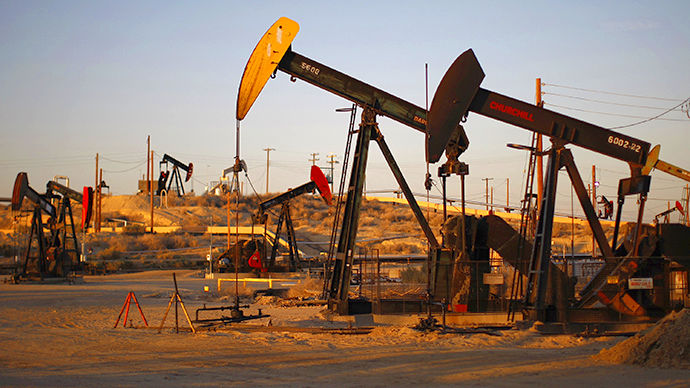
© AFP Photo / David Mcnew
Some analysts viewed the Saudi move as a means of pushing out competitors in a saturated market with falling demands that have been caused by economic stagnation. Within this group of analysts, there were also those that viewed this as an attack on the growing shale industry in the US. According to RusEnergy analysts Mikhail Krutikhin, Saudi Arabia is trying to push US shale production out from the market by making extraction unprofitable and ultimately expanding its share of the market at the expense of US producers. [1] The decline in oil prices will hurt production in areas not controlled by the Organization of Petroleum Exporting Nations (OPEC) and this may be a means of preventing the oil market from transforming from a «seller's marker» into a «buyer's market». [2] Others, like Lukoil's Leonid Fedun, maintained that the US shale industry risked becoming the victim of its own success. [3]
On the other end of the spectrum, there were analysts that viewed things from a geopolitical prism. It was posited by this group of analysts that the Saudi move was made to pressure Ecuador, Iran, Russia, and Venezuela by Washington and its allies over issues like the Iranian nuclear program and the crises in Ukraine and Syria. In other words, petro-politics was at play and the market was not acting «freely» or «on its own» in bringing down the price of oil; it was a US strategy of economic warfare and coercive diplomacy.
The price drop should not be viewed in either a strictly business sense or a strictly geopolitical sense. In this regard, Russian President Vladimir Putin raised important questions about it during a press conference held in Milan on October 17, 2014. After separate talks with Italian Prime Minister Matteo Renzi and Austrian Chancellor Werner Faymann on the sidelines of the Tenth Asia-Europe Meeting (ASEM) Summit, President Putin pointed out that the price drop would also hurt US companies. He pointed out that lower oil prices would knock down the profitability of shale production, from so-called tight oil, and US-controlled hydraulic fracturing operations in North America and around the world.
Speaking in terms of US dollars, Putin told a TASS news agency reporter, which had brought up the issue, that he did not believe that any energy producers wanted major price drops. This included the US, which has steadily been positioning itself to become a major global energy exporter through hydraulic fracturing or fracking. According to Putin, the production cost of US shale-based hydrocarbons - tight oil and shale gas - break even at a rate of eighty dollars; he pointed out that the «the price drop on the world markets will deal a very heavy blow to this type of activity in the United States as well.» [4]
Putin's key point was this: «As for conspiracy theories, conspiracies are always possible. However, in this case they hit the conspirators the hardest, if they do exist. I have already mentioned that the budgets in the main oil producing countries are also based on oil prices, around $85-90 a barrel, I believe».[5]












Comment: With every passing day, we can see that the U.S. government is increasingly losing their grip on reality. 411 representatives of the
peopleoligarchy just voted in favor of a hysterical anti-Russian bill, all based on a pack of lies. See: SOTT EXCLUSIVE: U.S. Congress votes overwhelmingly in favor of hysterical anti-Russia bill