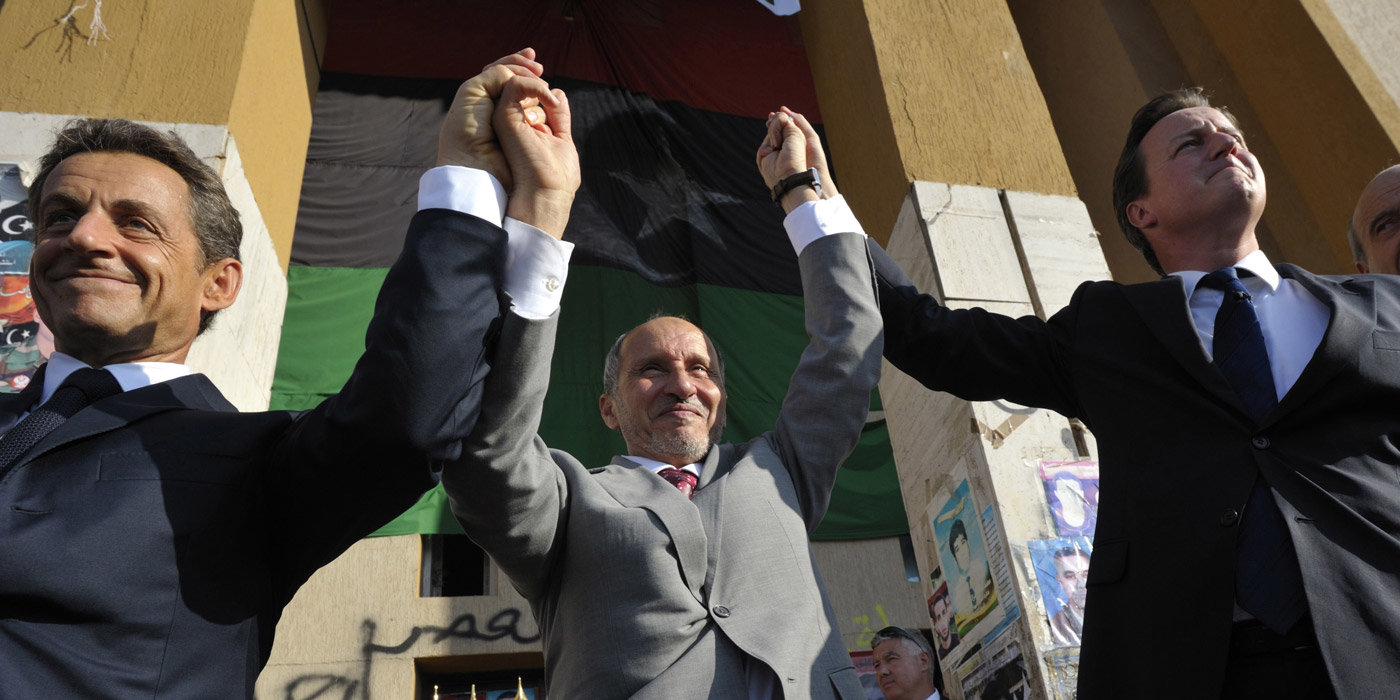
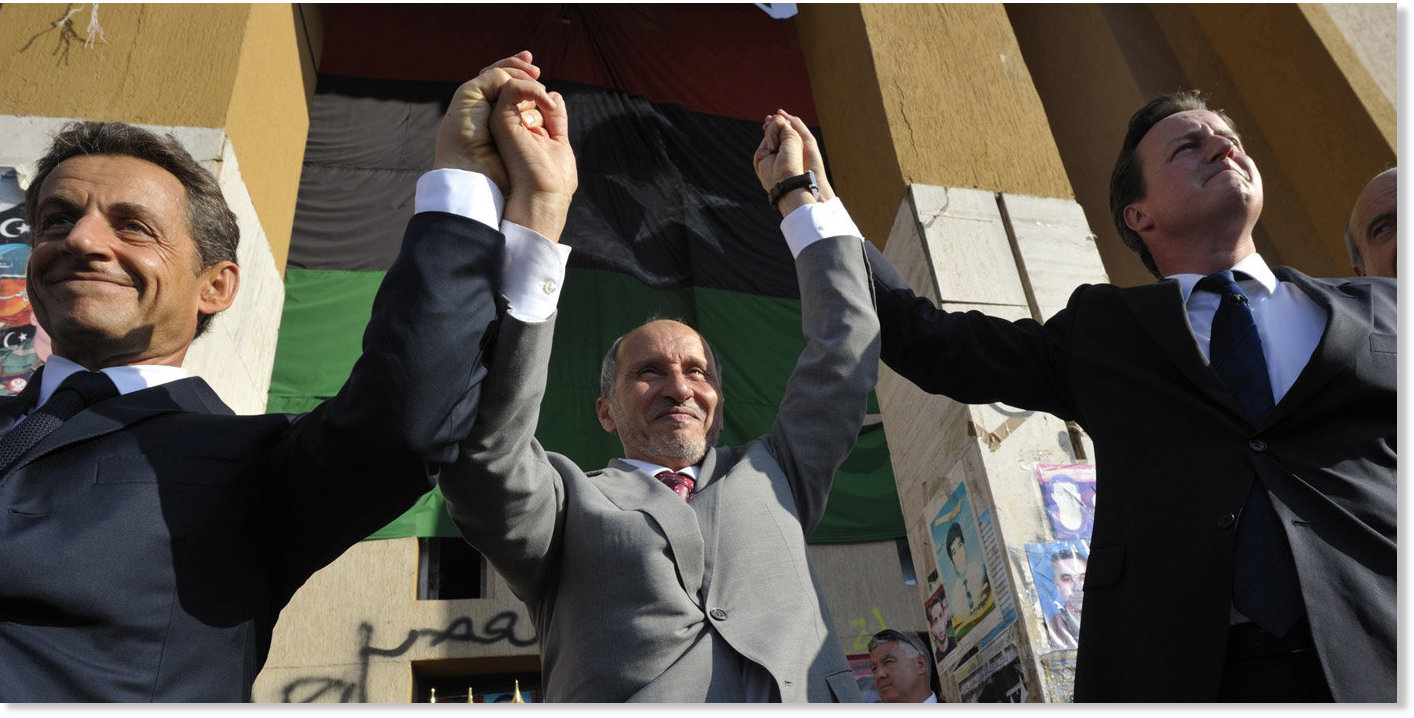
© Philippe Wojazer/APFrench President Nicholas Sarkozy, left, Libya’s NTC leader Mustafa Abdul-Jalil, center, and British Prime Minister David Cameron, right, gesture during their visit to Benghazi, Libya, Sept. 15, 2011
The immediate aftermath of the NATO bombing of Libya was a time of
high gloating. Just as Iraq War advocates pointed to the capture and killing of Saddam Hussein as proof that their war was a success, Libya war advocates pointed to the capture and brutal killing of Muammar el-Qaddafi as proof of their vindication. War advocates such as
Anne-Marie Slaughter and
Nicholas Kristof were writing columns celebrating their prescience and mocking war opponents as discredited, and the
New York Times published
a front-page article declaring: "U.S. Tactics in Libya May be a Model for Other Efforts." It was widely expected that Hillary Clinton, one of the leading advocates for and architects of the bombing campaign, would be regarded as a Foreign Policy Visionary for the grand Libya success: "We came, we saw, he died," Clinton
sociopathically boasted about the
mob rape and murder of Qaddafi while guffawing on
60 Minutes.
Since then, Libya — so predictably — has all but completely collapsed, spending years now drowning in instability, anarchy, fractured militia rule, sectarian conflict, and violent extremism. The execution of Saddam Hussein was no vindication of that war nor a sign of improved lives for Iraqis, and the same was true for the mob killing of Qaddafi. As I
wrote the day after Qaddafi fled Tripoli and Democratic Party loyalists were prancing around in war victory dances: "I'm genuinely astounded at the pervasive willingness to view what has happened in Libya as some sort of grand triumph even though virtually none of the information needed to make that assessment is known yet, including: how many civilians have died, how much more bloodshed will there be, what will be needed to stabilize that country, and, most of all, what type of regime will replace Qaddafi? ... When foreign powers use military force to help remove a tyrannical regime that has ruled for decades, all sorts of chaos, violence, instability, and suffering — along with a slew of unpredictable outcomes — are inevitable."












Comment: Burundi authorities have every reason to suspect these 'journalists' are only there to cause trouble.
There is no 'escalating crisis' in Burundi.
The Western media is spinning one in order to make the case for Western intervention to remove Nkurunziza from power.
See also: Western NGOs' war propaganda prepares way for R2P 'Humanitarian Intervention' in Burundi