Puppet MastersS


Dollar

Best of the Web: Britain is at the heart of the global tax haven network

David Cameron
Bare-faced liar and psychopath, David Cameron
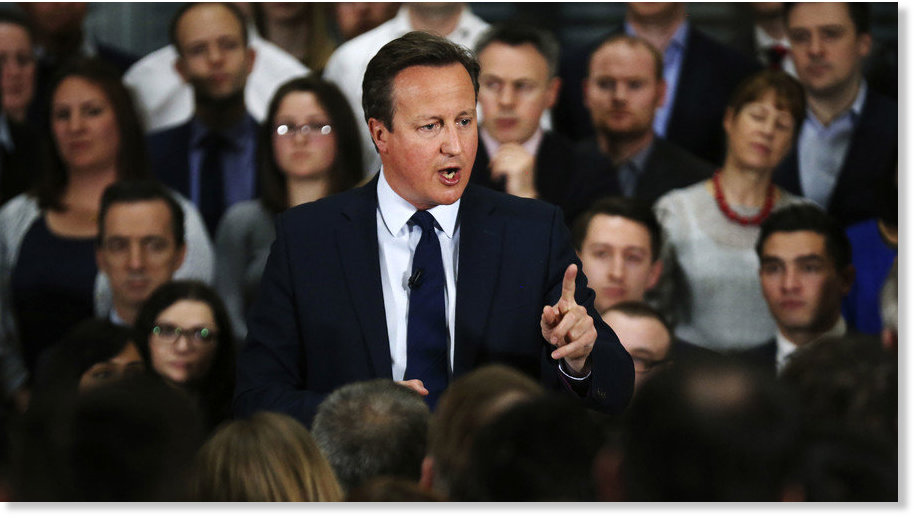
The British government's claim to be tackling tax evasion is about as credible as Al Capone claiming to be leading the fight against organized crime. In fact, Britain is at the heart of the global tax haven network, and continues to lead the fight against its regulation.

The 11 and a half million leaked documents from Panamanian law firm Mossack Fonseca have proven, once again, what we have already known for some time - that the 'offshore world' of tax havens is a den of money laundering and tax evasion right at the heart of the global financial system.

Despite attempts by Western media to twist the revelations into a story about the 'corruption' of official enemies - North Korea, Syria, China and, of course, Putin, who is not even mentioned in the documents - the real story is the British government's assiduous cultivation of the offshore world. For whilst corruption exists in every country, what enables that corruption to flourish and become institutionalized is the network of secretive financial regimes that allow the world's biggest criminals and fraudsters to escape taxation, regulation and oversight of their activities. And this network is a conscious creation of the British state.

Propaganda

Robert Parry on fact-free media: Neocons still dominate the news

hiatt
Fred Hiatt: neocon, liar, warmonger.
Several weeks ago, I received a phone call from legendary investigative reporter Seymour Hersh who had seen one of my recent stories about Syria and wanted to commiserate over the state of modern journalism. Hersh's primary question regarding reporters and editors at major news outlets these days was: "Do they care what the facts are?"

Hersh noted that in the past - in the 1970s when he worked at The New York Times - even executive editor Abe Rosenthal, who was a hard-line cold warrior with strong ideological biases, still wanted to know what was really going on.

My experience was similar at The Associated Press. Among the older editors, there was still a pride in getting the facts right - and not getting misled by some politician or spun by some government flack.

That journalistic code, however, no longer exists - at least not on foreign policy and national security issues. The major newspapers and TV networks are staffed largely by careerists who uncritically accept what they are fed by U.S. government officials or what they get from think-tank experts who are essentially in the pay of special interests.

Info

Russia and NATO agree to meet for the first time in almost 2 years

O zastavniku Žiki, pukovniku Đonu te Sporazumu između Srbije i NATO-a iz pera Miroslava Lazanskog
© Wikipedia
NATO and Russia will meet for the first time since the military bloc suspended all cooperation with Moscow in 2014. Ukraine, Afghanistan, and military relations will be among the topics discussed at the meeting set to be held within the next two weeks.

"Following consultations with Russia, we have agreed to hold a meeting of the NATO-Russia Council at Ambassadorial level," the bloc said in a statement released on Friday. "This meeting will take place in the next two weeks at the NATO headquarters in Brussels," it added.

"The NATO-Russia Council [NRC] will discuss the crisis in and around Ukraine and the need to fully implement the Minsk Agreements. We will discuss military activities, with particular focus on transparency and risk reduction. We will also address the security situation in Afghanistan, including regional terrorist threats."

Comment: See also:


Airplane

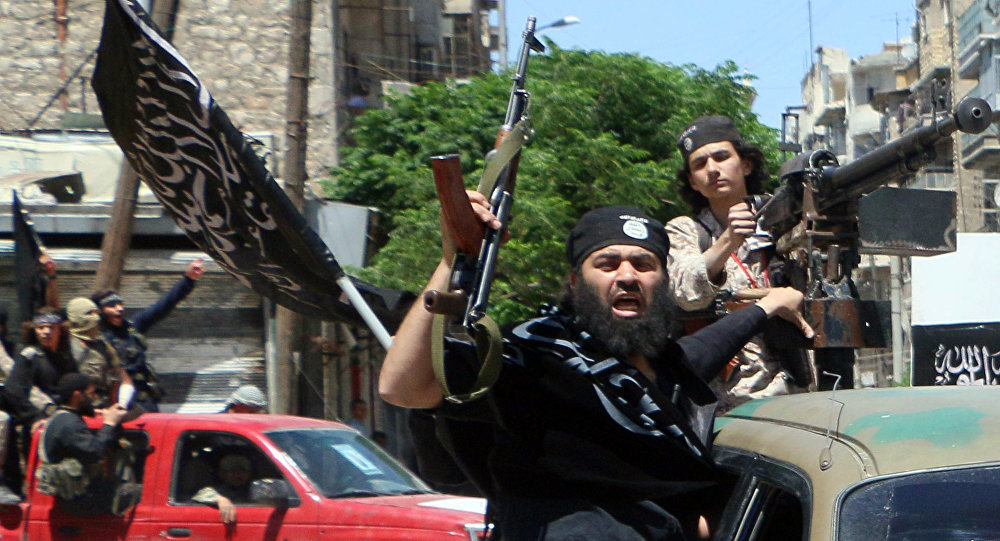
U.S. sends 3000 tons of weapons and ammo to al-Qaeda in Syria; Russian sends aid to civilians

Syrian al-Qaeda
© AFP 2016/ AMC / FADI AL-HALABI"America rules!"
The United States via its Central Intelligence Service is still delivering thousands of tons of additional weapons to al-Qaeda and others in Syria.

The British military information service Janes found the transport solicitation for the shipment on the U.S. government website FedBizOps.gov. Janes writes:
The FBO has released two solicitations in recent months looking for shipping companies to transport explosive material from Eastern Europe to the Jordanian port of Aqaba on behalf of the US Navy's Military Sealift Command.

Released on 3 November 2015, the first solicitation sought a contractor to ship 81 containers of cargo that included explosive material from Constanta in Bulgaria to Aqaba.
...
The cargo listed in the document included AK-47 rifles, PKM general-purpose machine guns, DShK heavy machine guns, RPG-7 rocket launchers, and 9K111M Faktoria anti-tank guided weapon (ATGW) systems. The Faktoria is an improved version of the 9K111 Fagot ATGW, the primary difference being that its missile has a tandem warhead for defeating explosive reactive armour (ERA) fitted to some tanks.
The Janes author tweeted the full article (copy here).

Comment: Meanwhile, from Russia with love:


Snakes in Suits

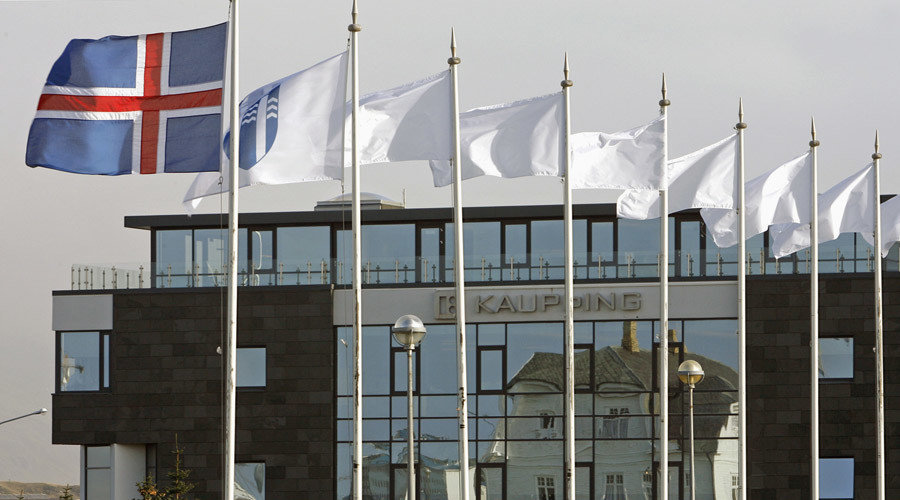
Iceland passes law allowing jailed bankers to walk free amid Panama Papers scandal

Iceland flag
© Bob Strong / ReutersThe Iceland flag flies next to the headquarters of Kaupthing Bank in Reykjavik.
Three top figures from Iceland's failed Kaupthing Bank have been released from jail after barely serving a quarter of their sentences due to a new law. It comes as Iceland deals with a fresh scandal linking the ex-PM to both the Panama offshore revelations and the bank.

Former chairman of Kaupthing, Sigurdur Einarsson, its biggest shareholder, Olafur Olafsson, and the finance director of the Luxembourg branch, Magnus Gudmundsson, were released from the low-security Kviabryggju prison on Thursday.

The bankers have served just one year of their four-to-five year sentences. All were convicted of financial fraud ahead of the collapse of the country's biggest bank in October 2008.

The bankers were accused of concealing an investor from Qatar who bought a 5.1 percent equity stake in Kaupthing, with the money illegally provided as a loan from the bank itself.

The release was made possible due to a new law which was rushed through a parliamentary vote in March.

The law enables prisoners to spend double the amount of time under electronic surveillance in the comfort of their own homes than previously had been allowed, while being released earlier from jail.

USA

Russia seen as threat to US aim for global domination

boot globe
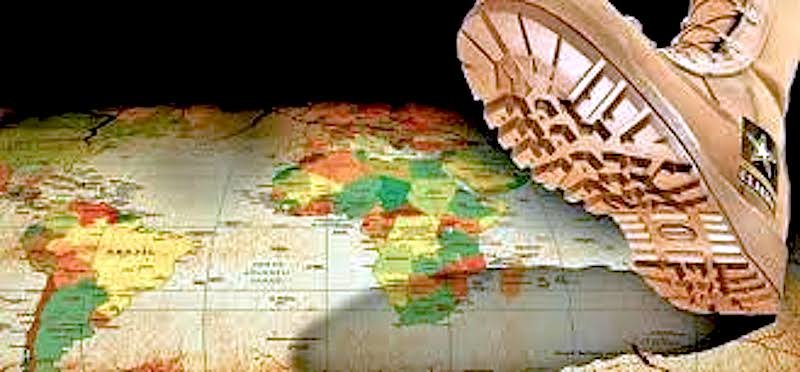
© real-agenda.comUS gives the world the boot. All tread, no soul.
Russian moves on the global stage are interrupting the whole discourse about American superpower presence in the world. That would not be tolerated, says Gerry Sussman, Professor of Urban Studies and Planning at Portland University. Barack Obama has warned the world to prepare for the threat of nuclear terrorism, but his Defense Secretary Ash Carter has placed other alleged threats even higher on the list. Carter said reforms were necessary to make the US military more "agile" and able to address the five strategic challenges it faces, which he identified as 'Russia, China, North Korea, Iran and terrorism.'

RT: Why do you think Russia is once again topping the Pentagon's threat list?

Gerry Sussman: I think Russia, just as the Soviet Union in an earlier era, serves as a kind of unifying theme for putting together a very disunified foreign policy around a common target. We can see this again and again. I was looking at the 'Panama Papers' reporting on CNN and the main focus was on President Putin rather than some of the American allies; Mr. Poroshenko in Ukraine, who has been actually listed where as you know Putin is not even listed, but there is an inference made about his associates, is the word they use. So, I think it serves as a unifying force to build a kind of a new Cold War consensus, to give some semblance of direction to American foreign policy where there really isn't any.

The US has actually lost quite a bit of power over the years in the Middle East and Eastern Europe, and I think it's just a way of creating an old bogeyman in the person of President [Vladimir] Putin and in Russia itself. And I think it is also because various US agencies involved in foreign policymaking - the State Department, the CIA, the military - are all in disarray with regard to working closely together and having one voice. I think it is also a reflection of this weakness of this particular (US) president who is in power. He refers to other agencies rather than showing political leadership in giving some direction to US foreign policy.

RT: Specifically, what threat does the Pentagon think Russia poses to the US?

GS: It represents a threat to America's global interests, to its hegemony around the world. This is the mindset of the elites in American foreign policy decision making: Anything that constitutes... a balance of power approach, which I think is generally what Russia is pursuing, this constitutes a threat to a hegemonic power that seeks global domination wherever and whenever it has interests and its interest are military, oil, political interest in general, the interest of the transnational community, and the defense of the Israeli state. There are multiple interests and anything that stands in the way of disrupting US hegemony in the pursuit of these interests constitutes a threat.

Comment: Russia becomes the number one target as US credibility wanes and its leadership is dwarfed by the stunning intervention of Russia in Syria and its continued pragmatism in the face of global chaos. There are many lessons to be learned, but for the US and its mindset, not likely.


Sherlock

Pepe Escobar: From Palmyra to Panama, the elites wage hybrid war

Mossack Fonseca law firm
© AFP 2016/ RODRIGO ARANGUA
The Panama Papers, stripped to the bone, may reveal themselves, as I have argued, essentially as an infowar operation initiated by the NSA - which would conveniently target mostly Global South "enemies" (as in the BRICS nations) and selected, disposable, Western pawns.

In its current stage, the Panama Papers have morphed into a weaponized psyops posing as an 'activist leak', straight from the Hybrid War playbook.

The relentless, expert mainstream media exposure has been at pains to portray the massive leak as "responsible journalism", yet without addressing eyebrow-raising questions on how the leak really came about; how 2.6 terabytes of data, including 5 million emails, have been selectively edited; how it was obtained without encryption; how there was not a single leak while the whole hoard was being sorted out by 400 or so reporters for over a year; and how the information is being selectively released.

"Responsible journalism" gatekeepers are spinning that this came from a digital musketeer; a whistleblower. Not necessarily. The leak has already sparked a credibility war between WikiLeaks and the new mainstream leakers, the heavily compromised, Washington-based, US foundations-funded ICIJ.

The NSA thesis is sustained by the fact the NSA specializes in breaking into virtually any database and/or archive anywhere, stealing "secrets" and then selectively destroying/blackmailing/protecting assets and "enemies" according to US government interests. Add to it that Ramon Fonseca, founding partner of Mossack Fonseca, is stressing, "We rule out an inside job. This is not a leak. This is a hack."

Snakes in Suits

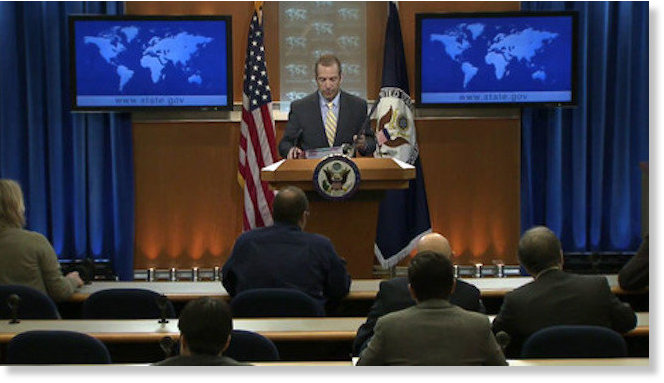
State Department can't explain the difference between Panama leaks and Snowden revelations

Department of State
© U.S. Department of State / YouTube
US officials, always sensitive to anti-American leaks and harsh to whistleblowers, now appear unconcerned about how the Panama Papers came to light. Grilled by reporters, the State Department could not tell if the US-funded leak was actually data theft or not.

US State Department spokesperson Mark Toner on Thursday appeared to be seriously confused as to what stance to take in respect of the Panama leaks, with the investigative reporting group that released them partially funded by the American government via the USAID agency.

When AP reporter Matt Lee asked if the US government sees the documents published by the International Consortium of Investigative Journalists (ICIJ) as stolen, Toner dodged the question, saying it was for the "Panamanian legal system or legal process to decide on."

Toner was then asked a seemingly simple yes-or-no question: "If someone comes across hundreds of thousands of pages of confidential documents and publishes them, and they were clearly not meant to be seen by the public, you don't think that that's theft?"


Eye 1

German intelligence spied on US State Dept., UK Ministry of Defense, and Israeli PM's office

surveillance camera
© Tobias Schwarz / ReutersSurveillance cameras overlook the building site of the new headquarters of the Bundesnachrichtendienst (BND), Germany's Federal Intelligence Service in Berlin
New snooping targets by the German Federal Intelligence Service (BND) have been revealed by Der Spiegel - this time it's the US State Department and Israeli PM Benjamin Netanyahu's office in the crosshairs.

The list of the German foreign intelligence agency's targets published by the German magazine on Sunday also lists the UK's Ministry of Defence, NASA and the US Air Force.

German espionage programs reportedly targeted some departments of Austria and Belgium's interior ministries, as well as at least two subdivisions of the European Aeronautic Defense and Space Company (EADS) and Eurocopter.

OPEC, the International Monetary Fund and the UN International Drug Control Program were also among the BND's targets.

However, the report provides no details on the nature of the surveillance, its aims and objectives or the exact times it took place, saying only that it occurred in "recent years."

Comment: Regardless of whether one country is an "ally" of another country or not, it appears that everyone in the West is spying on each other. With friends like these, who needs enemies?


Георгиевская ленточка

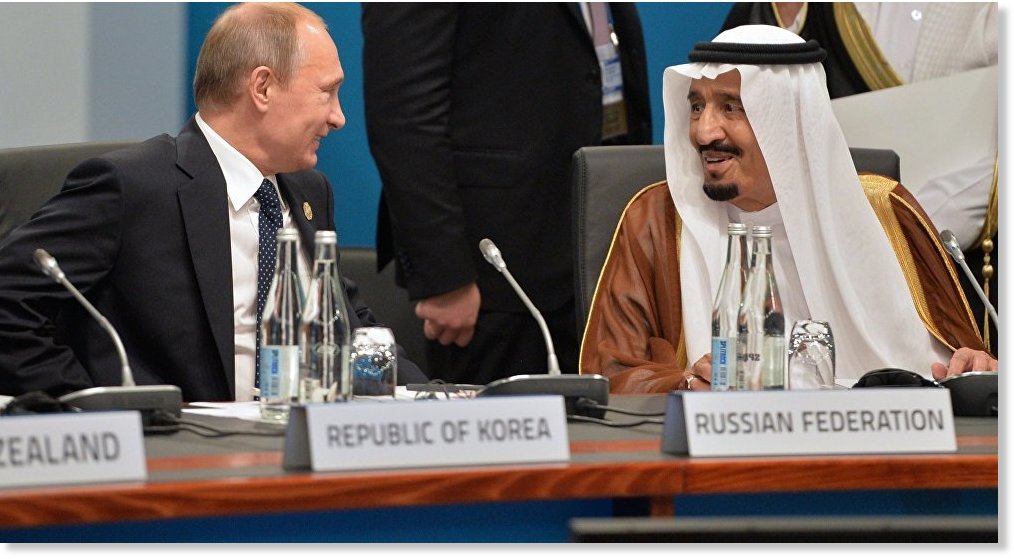
Saudi Arabia looking to build relations with Russia due to waning US influence in Middle East

putin saudi king salman
© Sputnik/ Alexei Druzhinin
Saudi Arabia has set on a course of building pragmatic relations with Russia, amid the weakening US influence, according to US journalist David Gardner.

After King Salman bin Abdulaziz Al Saud came to the throne in 2015 the main reins of power fell in the hands of his son and deputy crown prince Mohammed bin Salman.

Under his control, Riyadh has adopted a more assertive line in its global and regional policy. The kingdom started a military operation against Houthi rebels in Yemen, intensified support for Syrian militants and cut diplomatic ties with Iran.

At the same time, there is another visible trend - approaching with Moscow, despite the fact that Moscow supports some of Riyadh's foes.

"Alliances of convenience are hardly new to the Middle East. The will to power of entrenched regimes often coexists with pragmatism, making strange bedfellows of sworn enemies," the article for Financial Times read.