Puppet MastersS


Eiffel Tower

About time! French parliament to discuss possibility of lifting anti-Russian sanctions

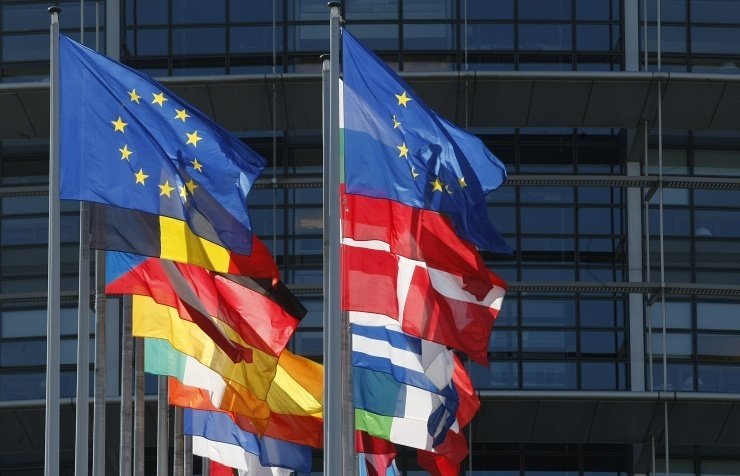
EU flags
© AP Photo/Christian Lutz
The French National Assembly (lower house of parliament) will hold debates for the first time on the possible cancellation of the EU sanctions against Russia on April 28, member of the center-right Republicans party Thierry Mariani who initiated this parliamentary debate said on Monday.

According to him, this is a proposal to pass "a resolution calling on the French government not to extend the restrictive measures and economic sanctions imposed on Russia by the European Union." "The parliamentarians will for the first time speak out on the issue of the European sanctions against Russia. This draft resolution that has received the signatures of more than 80 lawmakers will be considered at an open session on Thursday, April 28," Mariani said.

According to the parliamentarian, the anti-Russian sanctions bring France nothing but harm, therefore they should be lifted. "Useless and ineffective sanctions against Russia have today become a heavy burden for the French agriculture. That's why I urge members of the parliamentary majority to show responsibility and stop shifting it to Brussels," he said.

Bad Guys

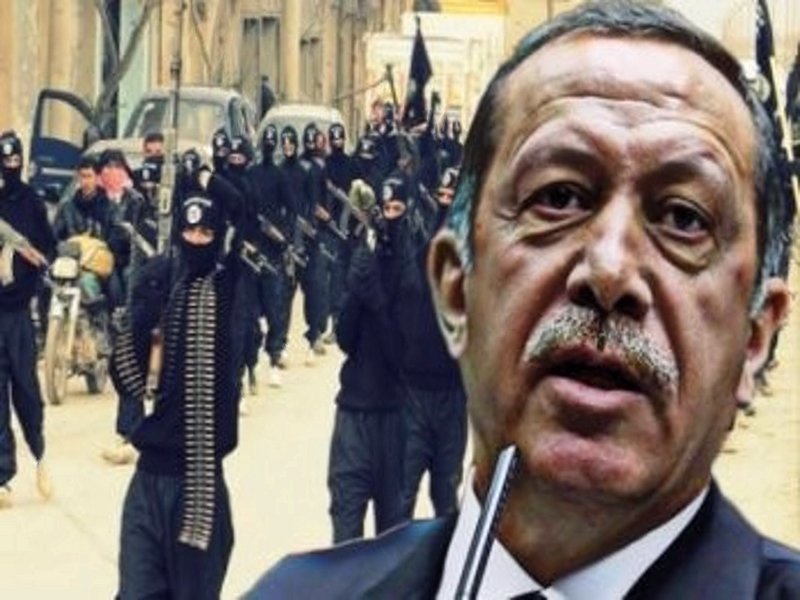
Syrians reveal that Turkey continued oil trade with ISIS until at least February

erdogan con isis
Although last year the Turkish government repeatedly denied it was involved in the illegal oil trade with Daesh, turns out it was all lies, as up until recently Turkey continued to buy illegal oil from Daesh militants, according to locals living near one of the Syrian oil fields, RT reported.

Last December, the Russian Defense Ministry provided satellite images showing oil being smuggled from Daesh-controlled oil fields in Syria to Turkey. Turkish President Recep Tayyip Erdogan rejected the allegations, claiming Turkey wasn't involved in financing terrorist activities.

However, residents of the Syrian town of Shaddadi near the Jabisah oil field in the Hasakah province told otherwise. They said that up until February when Daesh still controlled the oil field, the jihadists continued to send oil to Raqqa and then ship it to Turkey using the Tell Abyad checkpoint on the Turkish-Syrian border.

Comment: Further reading: Turkey's war against the Kurds (part 2): Power, terror, and the pretext for war


Quenelle - Golden

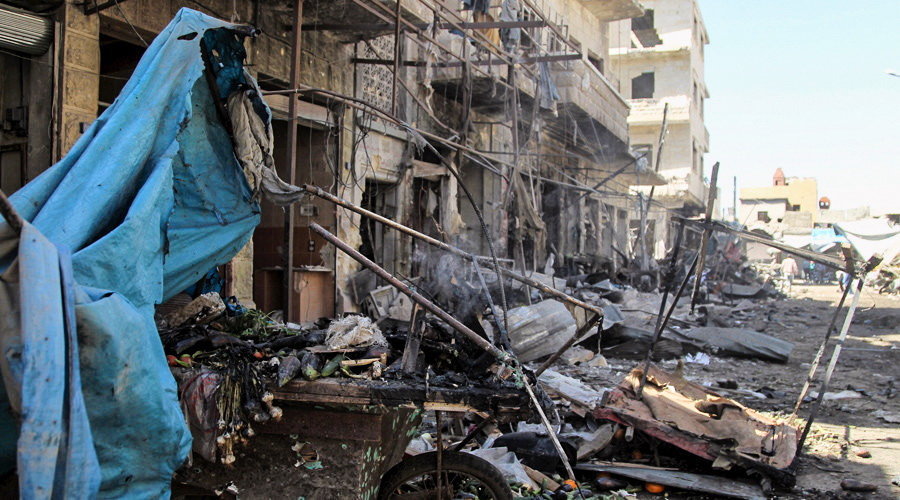
Russia helps rebuilding efforts in war-torn Syria: Signs contracts worth of $950mn

Syria
© Ammar Abdullah / Reuters
Damascus and Moscow have signed nearly a billion dollars worth of agreements to rebuild war-torn Syria, according to the Prime Minister Wael al-Halqi. The two countries intend to develop energy, trade, finance and other sectors of the economy. "The Russian side has responded to the idea of restoring [Syrian] infrastructure. Therefore, a lot of deals were signed, including $675 million and $280 million agreements," said the Syrian prime minister.

According to al-Halqi, more than 60 percent of the power stations in Syria are shut down and need fuel to restart. "Despite all the things Syria has undergone, it has managed to maintain the infrastructure. However, the production of electricity depends on fuel, and the oil sector has been more affected by terrorism than the electricity sector," said the prime minister. Syria has offered Russia a chance to participate in exploring and developing oil and gas on land and offshore. In particular, Russia was invited to upgrade the Baniyas refinery - Baniyas is a city in Tartous Governorate, northwestern Syria, located 55 km south of Latakia - and construct a refinery with Iran and Venezuela.

Comment: Russia has a long-term plan to rebuild Syria after the terrorists there are defeated.
See also:


Play

South Front: Obama boosts U.S. boots on the ground in Syria, fighting in Aleppo continues (plus: Russia's Black Sea frigates)

south front
International Military Review - Syria, April 25


Attention

Best of the Web: Turkey's war against the Kurds (part 2): Power, terror, and the pretext for war

Cizre
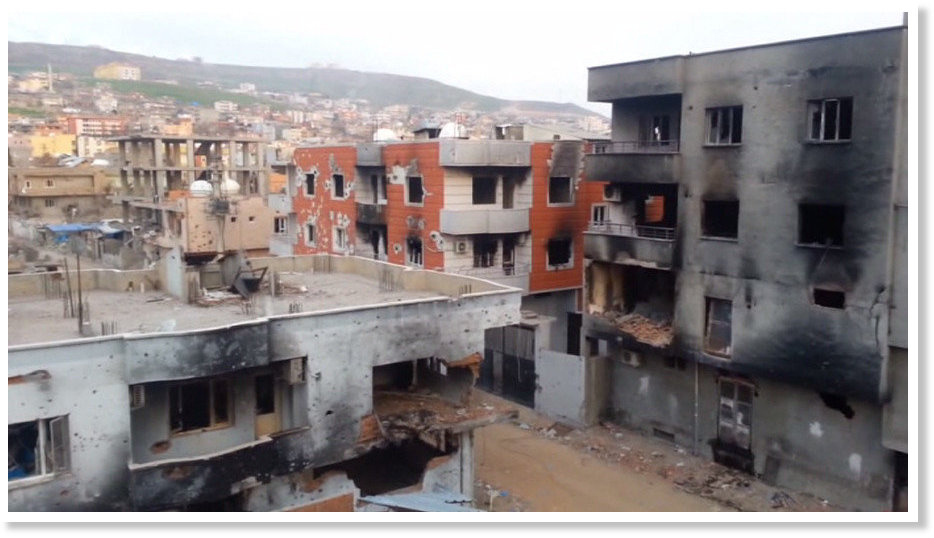
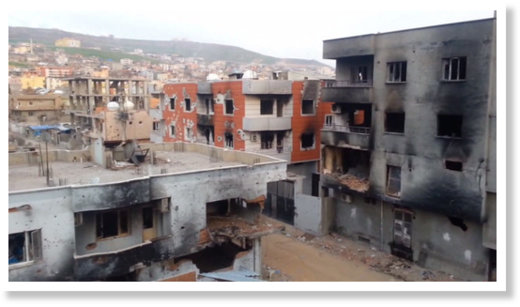
© RTKurdish town Cizre, destroyed by Turkish military.
The Rejection of Peace


Turkey's war against its Kurdish population in its current iteration is as much about Erdogan and the Turkish power structures consolidating and maintaining their power as is their crackdown against journalism. It has not been waged as a war to protect Turkish civilians from Kurdish insurgents but instead as a means to "protect" the oppressive power hierarchies that exist which seek to maintain the disparate position of the political-economic elite. Instead of listening to the legitimate grievances of the Kurdish population, Erdogan and the AKP have chosen a strategy of violence, terrorism, and xenophobia in order to degrade the growing political power of the Kurds and to consolidate their rule and the continuation of their criminal policies.

The pro-Kurdish People's Democracy Party (HDP) and the Kurdish military wing Kurdistan Worker's Party (PKK) have not been demanding independence, instead they have been calling for autonomy. This in the face of Turkey's political establishment historically treating the Kurds as second class citizens and denying them the right to be educated using their native language. In response they have organized societal institutions in a radically different manner than the Turkish state, prioritizing the ideal of local, non-hierarchical forms of direct democracy. In their view, as Professor of Economics at the University of Greenwich Mehmet Ugur explains, this is because "the nation state is now considered an anachronistic institution; and local democracy (including recognition and representation of distinct identities) has been embraced as a solution not only for the Kurdish question but also for democratisation in Turkey, Iraq and Syria."

Comment: Part 1 available here: Turkey's war against the Kurds (part 1): Turkey's state sponsorship of terrorism in Syria


Snakes in Suits

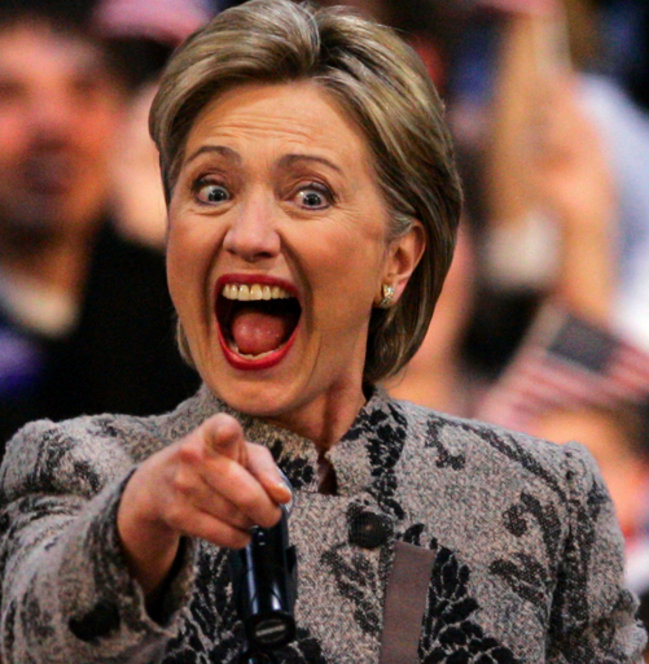
Evaluate Hillary Clinton by her results, not her words

hillary clinton crazy face
BOLO: presidential candidate, armed and considered extremely dangerous, known to cackle with creepy laughter at inappropriate times.
Hillary Clinton's major result was produced while she was the U.S. Secretary of State, her refusing at that time to call the coup in Honduras on 28 June 2009, a "coup." By her refusing to call it a coup, the U.S. Government, under Barack Obama, was enabled to continue financial aid to the Honduran Government, and this financial aid, in turn, enabled the coup-installed regime to become stabilized and to remain in place, despite the rest of the world's government's having condemned it.

Here is one recent result of her action regarding Honduras:
Drugs, Dams, and Power: The Murder of Honduran Activist Berta Cáceres

This is how she did it — how she (with follow-through by the U.S. President) produced it:
Hillary Clinton's Six Foreign-Policy Catastrophes

And this is what she says about it, in retrospect:
Hillary Clinton is lying about the criminal U.S.-backed coup in Honduras. It should be as scandalous as Libya

In other words: She's not apologetic about what she did and what its disastrous consequences were — she ignores them.

Snakes in Suits

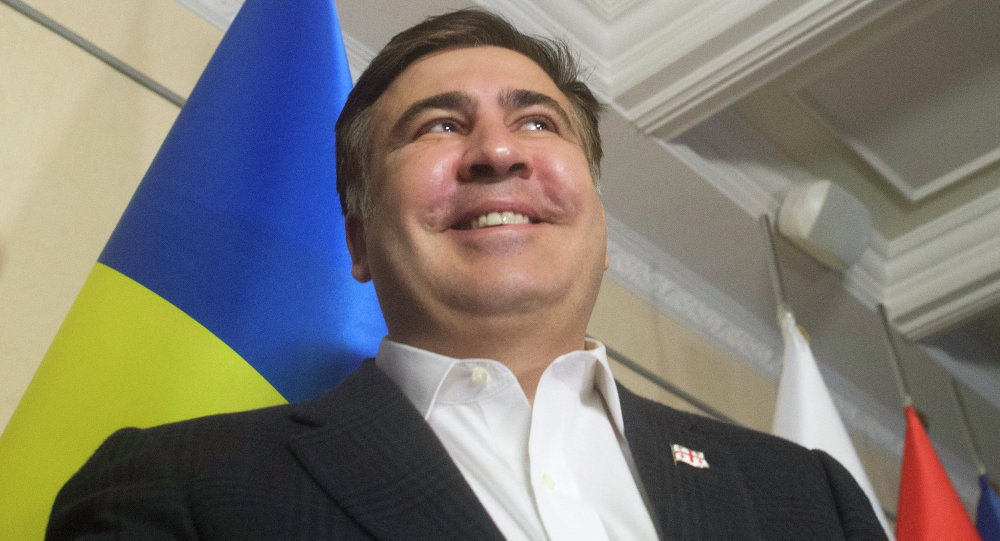
Wishful thinking: Saakashvili plots return to Georgia after Ukraine fiasco

Mikheil Saakashvili
© Sputnik/ Iliya Pitalev
Disgraced former Georgian President Mikheil Saakashvili, currently the governor of Ukraine's Odessa region, appears to be homesick. The former president, who had his Georgian citizenship revoked and faces criminal charges including embezzlement and abuse of power, told Georgian television channel Rustavi 2 that he has plans to return home.

Saakashvili explained that he would return to the country following parliamentary elections scheduled for October, saying that he expects the United National Movement, a center-right opposition party which he formally leads, to win a majority and form the government.

"It's necessary to hold the elections, to win, and to come and help the people who have won," the politician noted.

Light Sabers

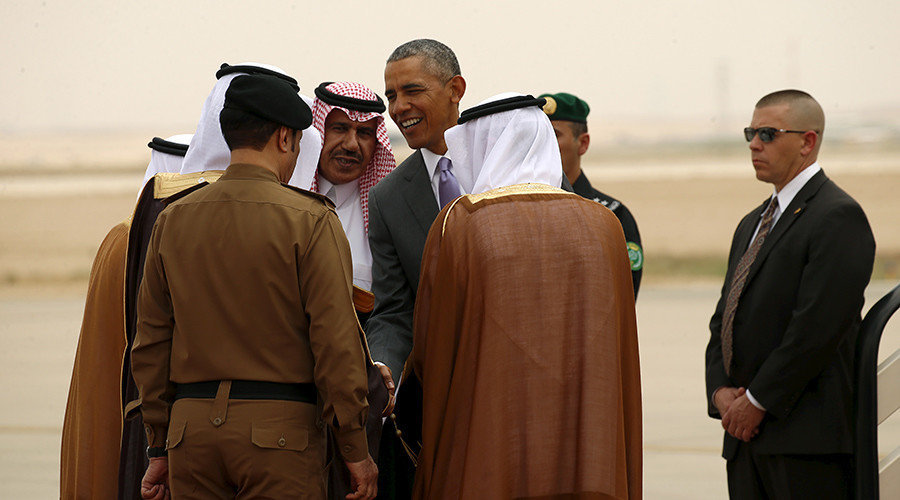
Obama snubbed by Saudi king at airport

Obama Saudi Arabia
© Kevin Lamarque / ReutersU.S. President Barack Obama is greeted upon his arrival at King Khalid International Airport for a summit meeting in Riyadh, Saudi Arabia April 20, 2016.
Obama, who has visited Saudi Arabia more times than any US president before him, was not greeted by the Saudi king at the airport. Saudi state television broadcast no live pictures of the US president's arrival. It was the US ambassador to Saudi Arabia and a local governor who met the American leader off the plane.

President Obama came to Saudi Arabia to take part in a summit of Persian Gulf leaders and discuss Islamic State, Al Qaeda and Yemen with King Salman. This comes in stark contrast to the reception of other high-profile guests, whom the 80-year-old King Salman greeted personally on the airfield.

Obama did have a two-and-a-half hour conversation with King Salman later, a talk that reportedly "really cleared the air," the US administration officials assured the American media. Barack Obama's visit has been downplayed by the Middle Eastern newspapers, too, generally saying that as a "lame duck" Obama hardly has time to mend strained relations, the BBC reports.

The usually extremely close relations between Washington and Riyadh have been fraying recently over a number of issues Saudi Arabia regards as matters of life and death.

Comment: For more behind-the-scenes action on the Saudi/American drama, you won't want to miss: Pepe Escobar: US nixed OPEC oil deal by threatening to reveal Saudi role in 9/11


X

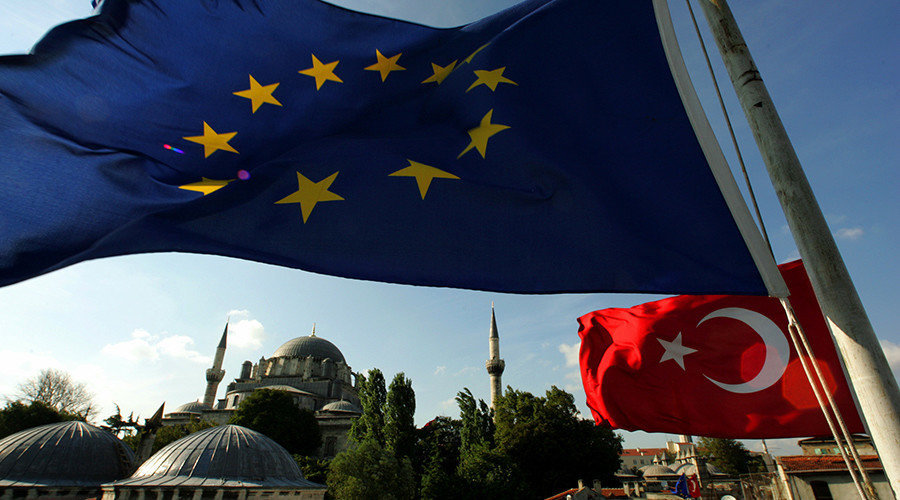
Turkey failing to meet half of conditions needed for visa-free travel to EU

Turkey EU
© Stringer / Reuters
Turkey has met less than half of the conditions required for its citizens to be granted visa-free travel to the European Union, according to an EU official. The country has until the end of the month to reach the benchmarks laid out by Brussels. The chance at visa-free entry into Europe for Turkish citizens is being offered in return for Ankara's vow to take back all illegal immigrants who cross into Greece from Turkey. Marta Cygan, a director in the European Commission's Migration and Home Affairs unit, told the European Parliament on Thursday that Turkey has now satisfied 35 of the 72 conditions entirely or almost entirely.

"The Turkish authorities have definitely been accelerating the implementation of administrative and legal reforms allowing them to fulfill the requirements," she told lawmakers, as quoted by Reuters.

The country has until April 30 to meet the necessary requirements, which include sharing more information on fraudulent documents used to travel to the EU, issuing biometric passports, and granting access to its labor market and other services to non-Syrian refugees seeking shelter in the country.

The country's backlog of around 140,000 asylum applications must also be reduced, and Ankara must establish an independent body to monitor rights abuses by law enforcement and government authorities.

Comment: In other words, Turkey and the EU are playing games with each other while they burn the world to the ground. It's not difficult to see that these 'plans' and 'deals' are all for naught.


Stock Up

IMF not welcome! Syria and Russia consider joint bank for trade and redevelopment

Syrian Prime Minister Wael Nader Halqi
© AP Syrian Prime Minister Wael Nader Halqi
Syria and Russia are considering the possibility of setting up joint banks to carry out transactions between the two countries, Syrian Prime Minister Wael Nader Halqi told Sputnik.

"The Russian-Syrian business council has expressed a wish to open a joint Russian-Syrian bank with an equity participation of 50 percent by each side. The Syrian participation will be provided by Syrian businessmen with sufficient banking experience. This bank would be controlled by the countries' central banks," Halqi said.

"At the moment, there is a discussion at the Central Bank of Syria on the most appropriate form for the creation of a Russian bank in Syria, in order to ease the financing of banking transactions between the two countries, which serves mutual interests and will simplify trade," he added.

Syria and Russia are holding consultations on the possibility of transactions in their national currencies Wael Nader Halqi said.

"Back in 2013, the Central Bank of Syria prepared a detailed bank mechanism on the exchange [of goods] in national currencies and presented it to the Russian side to a representative of the Russian Central Bank's head. Several rounds of negotiations were held on this mechanism. We were told that consultations with Russian banks were ongoing. Work on examining this issue, as well as the issue of cooperation with Syrian banks in this is still ongoing. Soon we will be told the names of these banks," Halqi said in an interview.

Comment: A Russian-Syrian joint bank created for the redevelopment of Syria is a wonderful alternative to the country being continually plundered by the IMF and the Western banking elite. We know this would have been reality had the Americans been allowed free reign in Syrian's destruction. As it stands, Syria is free from IMF debt and thus free from Western influences, pressures and exploitation. Another score for Russia!