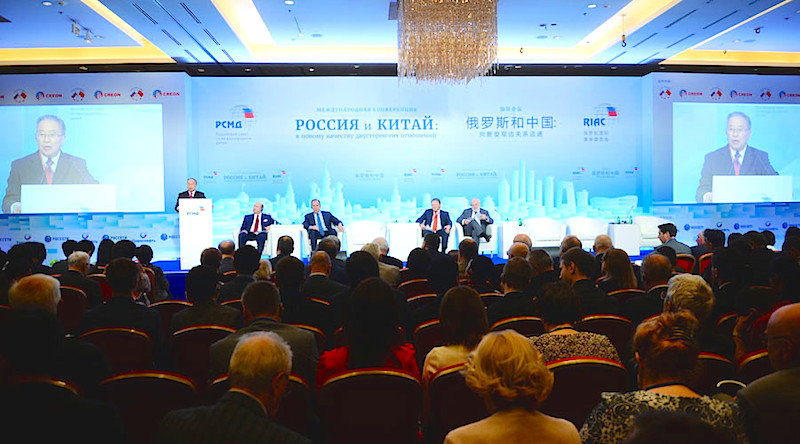
© Kirill Kallinikov / SputnikSecond international conference "Russia-China: Towards a New Quality of Bilateral Relations
despite Western sanctions and Washington's disapproval of their strategic alliance, participants of the Russia-China forum in Moscow told RT. The conference titled
"Russia and China: Taking on New Quality of Bilateral Relations" took place on May 30 and May 31. It was organized by the Russian International Affairs Council.
"Together we can become a center that can influence global processes," Boris Titov, co-chairman of the Russian-Chinese Friendship committee and Russia's ombudsman for entrepreneurs' rights, told RT on the sidelines of the conference on Tuesday.
While securing funding in the West has become more difficult, the
sanctions themselves do not pose a great challenge for Russia-China cooperation, as they do not affect mutual projects involving mid-sized and small businesses, according to Titov. "We view sanctions as of little importance to the economy," stressed the ombudsman. Huge markets for Russian goods have been created in China, especially environment-friendly products, which are high in demand.
"Politics always contradicts economic interests, business is far away from politics,
we need honest and direct relations," the co-chairman noted, adding that one of the main obstacles to closer cooperation is the sprawling red tape afflicting both countries. Taking into account China's vast experience living under sanctions, Russia and China "will be able to go through this period significantly better together."
For Russia, the
expansion of economic activities into Asia, and East Asia in particular, is of crucial importance, as the region provides "significant opportunities" in terms of investment and trade, Yaroslav Lisovolik, chief economist at the Eurasian Development Bank, said. Lisovolik said, given the West's apparent reluctance to remedy relations with Russia and Beijing, it will "simply start to lose investment and trade flows" to sanctions, seriously calling their long-term effectiveness into question.
Countries imposing indiscriminate restrictive measures that hurt mostly the broad masses, and not targeted at elites, "should be ready to take the price of sanctions" on their own economies, said Nandan Unnikrishnan, Vice President and Senior Fellow at the Observer Research Foundation in New Delhi.
"If you sanction me you cannot be my partner," the researcher stressed, adding that he thinks that sanctions remain "an impediment to the growth of closer economic ties" between China and Russia.
The intertwined nature of US-China economic relations is forcing Chinese leaders to carefully examine all of the consequences before "the strategic embrace takes place between China and Russia," he observed. Despite the complexity of relations in the US-China-Russia triangle, the potential for China-Russia cooperation is still "huge," as they share a
common multipolar approach to international relations.

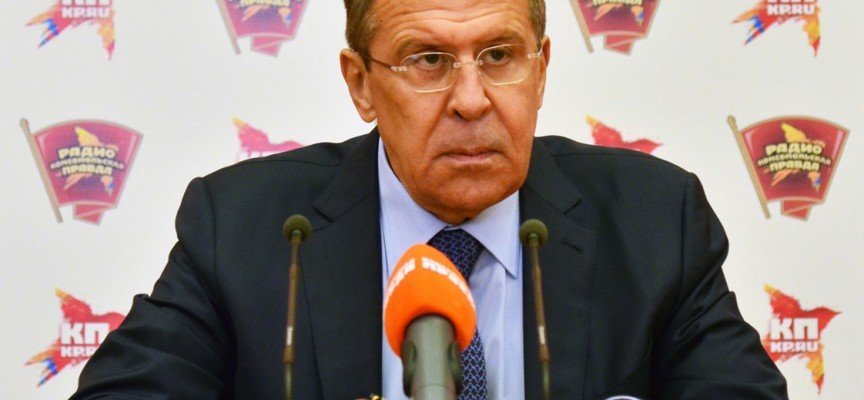













Comment: You can read the full interview here: Foreign Minister Sergey Lavrov's interview to Komsomolskaya Pravda, Moscow, May 31, 2016. One more interesting tidbit: