Puppet MastersS


Radar

NATO and Germany build up forces for war against Russia

nato flag
The defence ministers of all NATO member states met in Brussels on June 7 and decided to take all necessary steps over the next two years to be able mobilise a total of 90 military, naval and air force combat units at short notice and at any time.

To this end, two new headquarters will be built, with one of them located in Norfolk, Virginia. According to the US Defence Department, the Norfolk centre will organise the rapid deployment of combat units across the Atlantic, so that the "entire spectrum of transatlantic missions" can be successfully carried out.

"The return of the major powers and a resurgent Russia demand that NATO focus on the Atlantic to ensure a capable and credible deterrent," Pentagon spokesman Johnny Michael declared in early May. The new NATO command will be "the linchpin of transatlantic security."

Comment: These preparations are either designed to scare Russia into capitulating to Western demands to be subjugated - or, are in actual preparation for some kind of military 'intervention' in Russia (or where Russian forces are). All the pathological Pentagon needs to do when it is ready to attack is to come up with some half-baked pretext it thinks Westerners will believe is justifiable.

All of the recent and not-so-recent news about terrorist organization NATO seems to point to this.


Dollar Gold

China can seriously hurt America in the escalating trade war

Sun Yanan
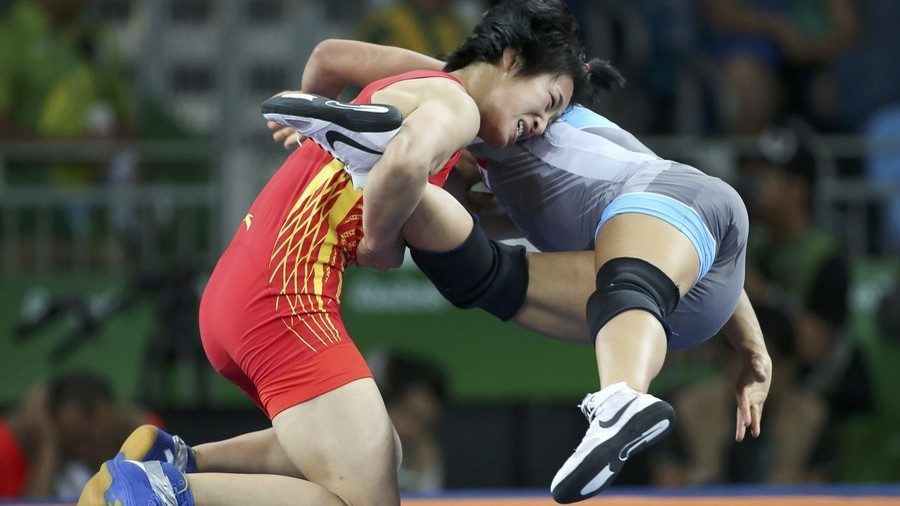
© ReutersSun Yanan at 2016 Rio Olympics
The threat of a full-scale trade war between the US and China has dominated the news in recent weeks. The countries have exchanged import tariffs on each other's goods, and are threatening further protective steps.

After numerous threats to tax Chinese imports, US President Donald Trump fired the first shot by approving $50 billion in tariffs that will come into force on July 6. Beijing immediately responded by imposing a 25-percent tariff on American imports worth $34 billion, which will come into effect on the same day.

Trump issued a threat to impose additional 10-percent levies on $200 billion of Chinese goods coming to the US. This prompted a pledge from China's Commerce Ministry to "forcefully fight back" with "qualitative" and "quantitative" measures.

The mutual exchange came two months after the White House slapped China and several other nations, including Russia and India, with an import tax of 25 percent on steel and 10 percent on aluminum. In late May, the measure was extended to the EU, Canada and Mexico.

Now that everyone's cards are on the table, the question is what else China can do to protect itself and minimize damages in this fierce fight between the world's two largest economies. Let's explore the possibilities.

Eye 1

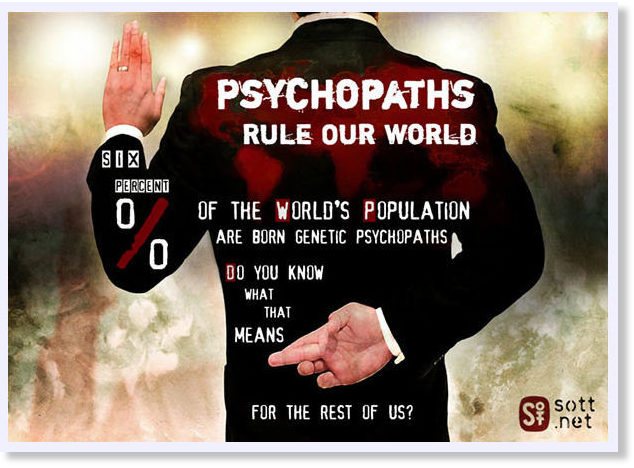
SOTT Focus: California is Full of Psychopaths, but Not as Bad as D.C., Study Finds

six percent psychopaths
Ever feel like there's something sinister lurking behind the crunchy granola, yoga-loving, avocado-eating facade of your fellow Californians? Now there's research to back you up.

California is among the two U.S. states with the highest concentration of psychopaths, according to a working study from Southern Methodist University released on the Social Science Research network this week. The study looks at trends in personality traits across areas (the study hasn't yet gone through the full peer review process, so take the findings with a grain of salt).

The only places with more psychopaths? Connecticut (thanks, hedge funds!) and, shocker, the District of Columbia. Other highly psychopathic states include New Jersey, New York and Wyoming, while West Virginia, Vermont and Tennessee are among the least psychopathic states.

'The presence of psychopaths in District of Columbia is consistent with the conjecture found in Murphy (2016) that psychopaths are likely to be effective in the political sphere' the author writes.

X

Hungary passes 'Stop Soros' law banning NGOs from providing benefits to illegal immigrants

Soros
© Laszlo Balogh / ReutersHungarian government poster saying "Don't let George Soros have the last laugh," seen at a Budapest subway stop last year
Hungary's parliament has passed a law that could see anyone helping illegal immigrants claim asylum in the country imprisoned. The 'Stop Soros' law is named after Hungarian-born billionaire and open-borders advocate, George Soros.

The law was voted on in the Hungarian parliament on Wednesday, where Viktor Orban's right-wing Fidesz party holds a two-thirds majority. Under the law, individuals who aid migrants, informing them about the asylum procedure or "providing financial or property benefit" will be liable for a 12-month prison sentence. NGOs working with migrants will need to seek licenses and will see the scope of their work severely restricted.

The law was criticized by Human Rights Watch, who called it "the latest salvo in the Hungarian government's war on refugees and those who help them."

Chess

Trump to sign executive order to end separation of illegal immigrant families

Trump huge
The White House has been harshly criticized for its "zero-tolerance" policy, as it has led to the separation of thousands of children from their families at the border.

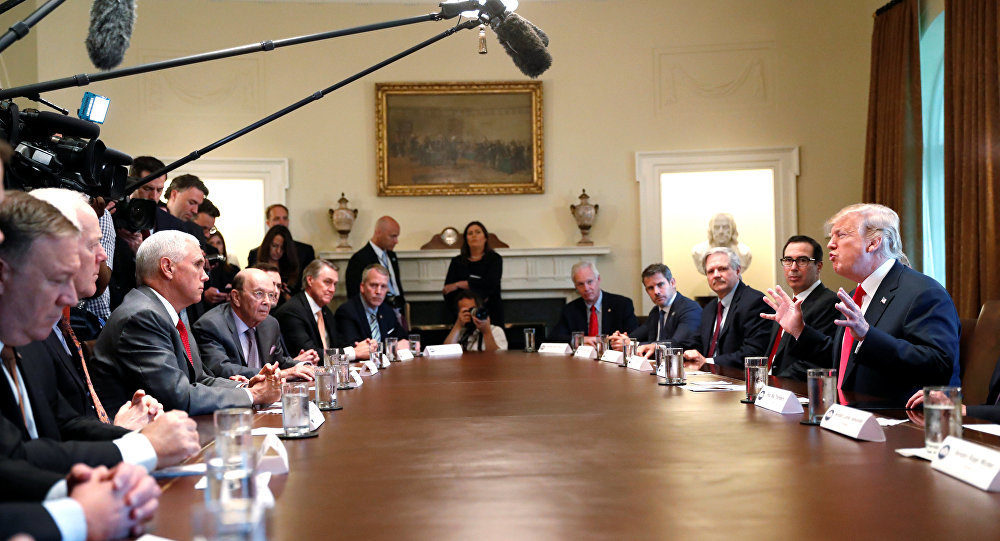
US President Donald Trump announced on Wednesday that he would sign "something pre-emptive" in order to put an end to the separation of immigrant families at the southern borders of the country.

"We're going to be signing an executive order in a little while...We've got to be keeping families together," Trump said as quoted by a pool reporter. "So I'm going to be signing an executive order in a little while before I go to Minnesota but, at the same time, I think you have to understand, we're keeping families together but we have to keep our borders strong. We will be overrun with crime and with people that should not be in our country."

Windsock

Kiev plays the Crimean Tatar card to drive a wedge between Moscow and Ankara

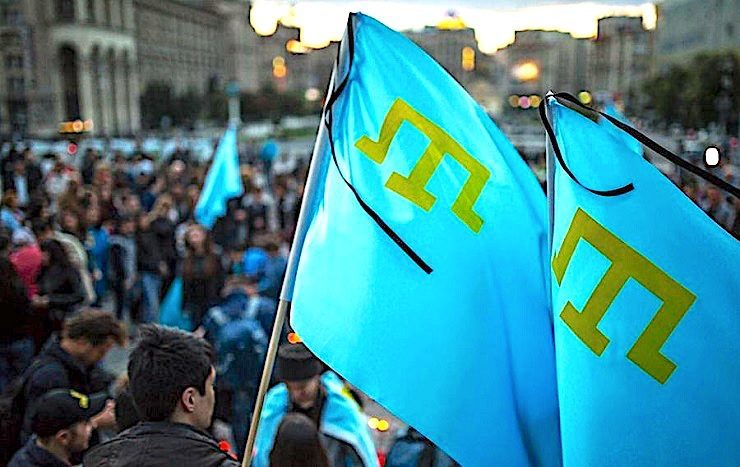
Flag of Crimea
© UnknownFlags of Crimea wave in street rally.
Previously, Turkey had little to no difficulties in playing two of the opposing geopolitical powers, namely the US and Russia, against each other. When tensions began mounting between bilateral relations with one side, Ankara would typically perform a one-eighty to pursue a rapprochement with the other.

However, these days, while reading the headlines, it might appear that Russia has suddenly become Tayyip Erdogan's most trusted ally. He and his supporters are up in arms against the US, which they have recently branded as Turkey's archenemy. The EU, and especially Germany, has long been on Turkey's bad side. On the other hand, Russia has proven time and time again that it's a trustworthy partner - whether in Syria, in the support it provided Erdogan in his feud against Fethullah Gülen and his movement, or in Turkey's aspirations to become an energy heavyweight.

Yet, it's been noted that appearances can be misleading. Ankara's so-called pivot to Moscow is, in actuality, consistent with a broader trend in Turkish foreign policy of late. It is a bid to assert autonomy in foreign affairs, rather than a step towards a lasting alliance with the Kremlin.

This notion can be proven by the rapidly strengthening ties between Ankara and Kiev, which Ukraine tries to exploit to the best of its abilities to cause harm to Russia, which means that Turkey's interests often diverge from Russia's.

Comment: A complexity of history and opportunity, mixed with bias and the need for leverage in this worthy glimpse at the dynamics and stick points comprising the Turkish-Ukranian-Russian connections.


Snakes in Suits

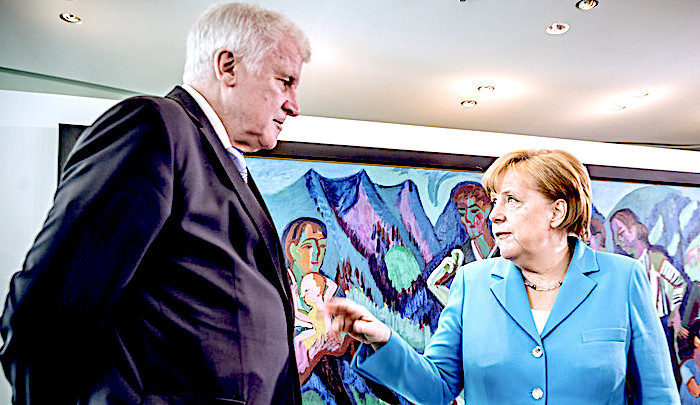
IM Seehofer puts Merkel under deadline; Germany to kick out migrants if there is no deal with EU

MerkelSeehofer
© Michael Kappeler/Global Look PressChancellor Angela Merkel • Interior Minister Horst Seehofer
German police will start unilaterally turning away migrants who applied for asylum in a different state if Chancellor Angela Merkel fails to negotiate an EU-wide solution, Interior Minister Horst Seehofer said.

Speaking at a Monday briefing, the key Merkel ally and Christian Social Union (CSU) party head said that the chancellor effectively approved almost all provisions of his so-called "master plan." He also wished Merkel "much luck" in her negotiations with other European nations, expected to take place at the European Council on June 28-29, and said his party supports "any European decision" aimed at resolving the migration problem.

However, Seehofer also showed determination to go it alone, saying that if Merkel's talks ultimately fail, then they'll be compelled to "act on a national basis."
"We stick to our position that should the immediate rejection at the border not be possible, I would immediately order the police that people who either have prohibition of entry or prohibition of stay should be immediately turned away at the border," he said.
The new measures would be applied particularly to migrants, who either registered or applied for asylum in another EU country, the interior minister said.

Comment: Seehofer has given Merkel an ultimatum she had to refuse. A power play quickly requited.


Boat

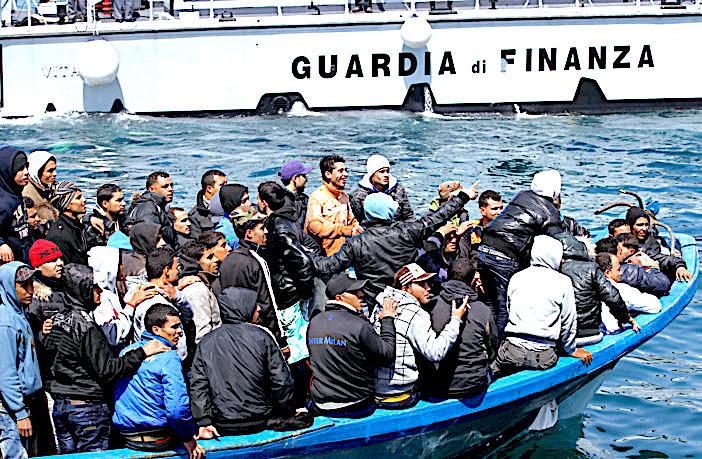
Hungary: EU members should follow example of Italy, ban migrant ships from their harbors

Migrant boat
© photofilippo66
If decisions as to "which migrants entering Europe should be given refugee status" were made in Brussels "it would even pose a greater danger than migrant quotas", Antal Rogan, head of the prime minister's cabinet office, told public Kossuth Radio on Sunday morning.

Rogan said that countries accommodating hundreds of thousands or millions of migrants were facing serious, everyday problems, while migration "poses a danger for central Europe because of the open internal borders". That is why Hungary would not receive migrants and cannot be obliged to do so, Rogan said, and argued that the country "had not agreed to do anything of the kind when it joined the EU".

Rogan said that it was not Hungary but "George Soros's organisations" that broke European laws "with support from the Brussels". European leaders promote "the ideology of a United States of Europe which nobody has approved" rather than the interests of member states.

Rogan called it "appalling" that "Soros's ships routinely carry migrants from Africa to Europe" and urged that EU members should follow the example of Italy and ban such ships from their harbours. "The right principle is to assist where there is a problem and send aid to countries of origin rather than import the problem to Europe and then distribute it among EU members," he said.

Comment: There are indications of revolt within the EU. Many are seeing the manipulations of certain member countries more clearly as resources, equilibrium and good will are taxed to the limit by the massive migrant influx and all that comes with it. Societal and economic stability is not served by quick and massive movements. Was this the idea? Is there a plan afoot to cripple and destroy the EU?

See also:


Russian Flag

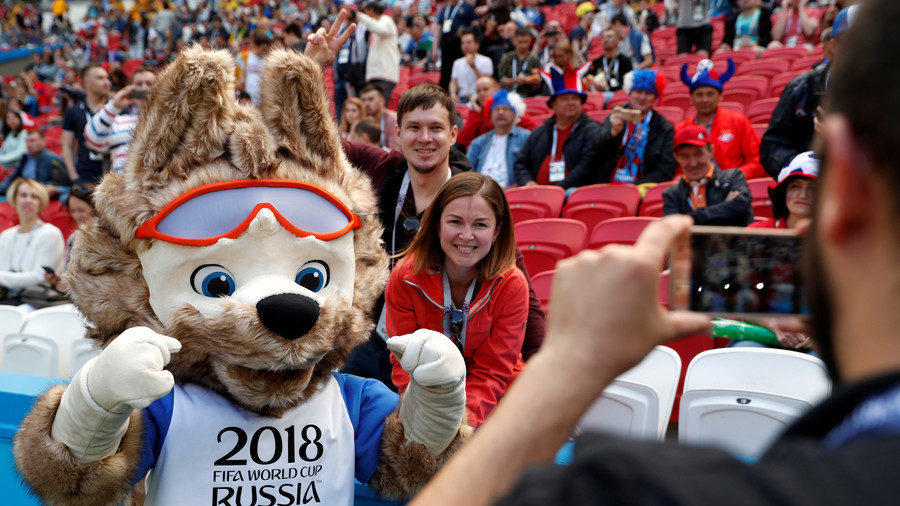
SOTT Focus: Multipolar World: In World Cup, as in Life, Times They Are A-changin'

russia world cup
© John Sibley / ReutersWorld Cup 2018 mascot Zabivaka, June 16, 2018
It was the dogs what done it. The picture of the "pile of canine corpses on the streets of Russia killed in the name of the world cup," I mean.

Or at least the thousands of people who had retweeted the image thought so, before it turned out the dead dogs were Pakistani, killed for public health reasons in Karachi five years before. A lie half-way around the world before the truth could get a leash on it.

It was that Pavlovian reaction which made me take the World Cup for my topic this week.

There are of course no dead dogs on the streets of Russia, the strays are comfortably in kennels for the duration. No tanks either. No racist mobs rampaging, as we'd been told to expect. No homophobic gangs gone "queer-bashing" (unlike in Mississippi). Just millions of Russians, opening their arms, their hospitality and their hearts to a multi-colored peaceful invasion of football-lovers, quickly finding out that Russia ain't what "they" said it would be.

Violin

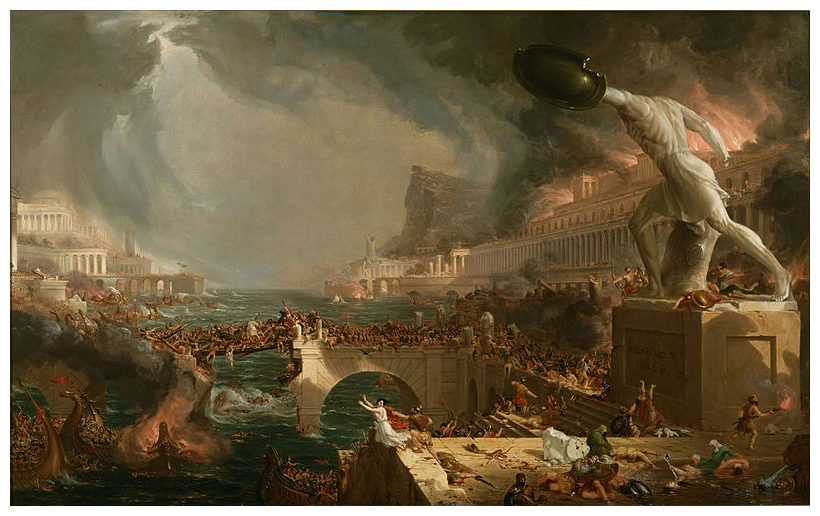
Learning from the USSR: Markers of the collapse of the American Empire

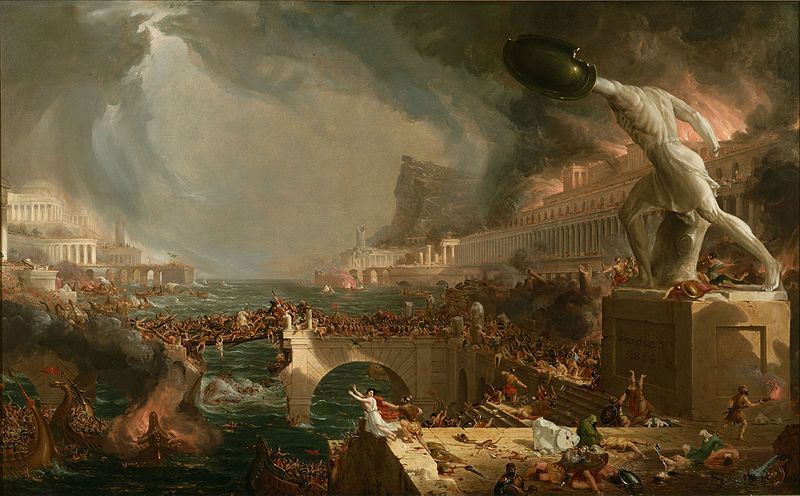
The Course of Empire
© Wikimedia Commons
In thinking through the (for now) gradually unfolding collapse of the American empire, the collapse of the USSR, which occurred close through three decades ago, continues to perform as a goldmine of useful examples and analogies. Certain events that occurred during the Soviet collapse can serve as useful signposts in the American one, allowing us to formulate better guesses about the timing of events that can suddenly turn a gradual collapse into a precipitous one.

When the Soviet collapse occurred, the universal reaction was "Who could have known?" Well, I knew. I distinctly remember a conversation I had with a surgeon in the summer of 1990, right as I was going under the knife to get my appendix excised, waiting for the anesthesia to kick in. He asked me about what will happen to the Soviet republics, Armenia in particular. I told him that they will be independent in less than a year. He looked positively shocked. I was off by a couple of months. I hope to be able to call the American collapse with the same degree of precision.

I suppose I was well positioned to know, and I am tempted to venture a guess at how I achieved that. My area of expertise at the time was measurement and data acquisition electronics for high energy physics experiments, not Sovietology. But I spent the previous summer in Leningrad, where I grew up, and had a fair idea of what was up in the USSR. Meanwhile, the entire gaggle of actual paid, professional Russia experts that was ensconced in various government agencies in Washington or consuming oxygen at various foundations and universities in the US had absolutely no idea what to expect.

I suspect that there is a principle involved: if your career depends on the continued existence of X, and if X is about to cease to exist, then you are not going to be highly motivated to accurately predict that event. Conversely, if you could manage to accurately predict the spontaneous existence failure of X, then you would also be clever enough to switch careers ahead of time, hence would no longer be an expert on X and your opinion on the matter would be disregarded. People would think that you screwed yourself out of a perfectly good job and are now embittered. Right now I am observing the same phenomenon at work among Russian experts on the United States: they can't imagine that the various things they have spent their lives studying are fast fading into irrelevance. Or perhaps they can, but keep this realization to themselves, for fear of no longer being invited on talk shows.

I suppose that since expertise is a matter of knowing a whole lot about very little, knowing everything about nothing-a thing that doesn't exist-is its logical endpoint. Be that as it may. But I feel that we non-experts, armed with the 20/20 hindsight afforded to us by the example of the Soviet collapse, can avoid being similarly blindsided and dumbfounded by the American one. This is not an academic question: those who gauge it accurately may be able to get the hell out ahead of time, while the lights are mostly still on, while not everybody is walking around in a drug-induced mental haze, and mass shootings and other types of mayhem are still considered newsworthy.

This hindsight makes it possible for us to spot certain markers that showed up then and are showing up now. The four that I want to discuss now are the following:

1. Allies are being alienated
2. Enmities dissipate
3. Ideology becomes irrelevant
4. Military posture turns flaccid

Comment: Interestingy, we just heard of the US decision to withdraw from the UN Human Rights Council. Those at the helm of the collapsing US Empire fail to see that by petulantly isolating themselves they will end up isolated. If that is not a confirmation of the excellent analysis above, we don't know what is!