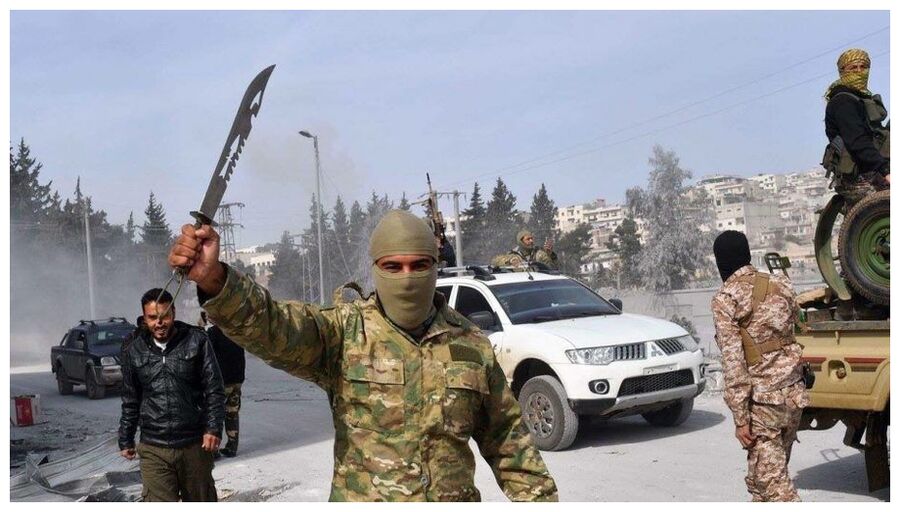
© Social Media
The Syria story, it seems, is not so simple as '
President Assad fell' and the '
technocratic Salafists' rose to power.
At one level, the collapse was predictable. Assad was known to have been influenced by Egypt and UAE for some years past. They had been
urging him to break with Iran and Russia, and to shift to the West. For some 3-4 years he had been incrementally signalling and implementing such a move. Iran especially faced increasing obstacles over operational matters in which they were co-operating with Syrian forces. His shift was meant as a message to Iran.
The financial situation of Syria - after years of U.S. Caesar sanctions,
plus the loss of all agricultural and energy revenues seized by the U.S. in occupied north-east Syria - was catastrophic. Syria simply had no economy.No doubt, reaching out to Israel and Washington was presented to Assad as the only practical exit to his dilemma. 'Normalisation' could lead to the lifting of sanctions, they implored him. And Assad, according to those in touch with him, (even at the eleventh hour before the HTS 'invasion') was believing that Arab States close to Washington would have opted for his continued leadership, rather than see Syria fall prey to Salafist zealots.
To be clear: Moscow and Tehran had warned Assad that his army (as a whole) was too fragile, too underpaid, and too penetrated and bribed by foreign intelligence services, to be expected to defend the state effectively. Assad also was warned repeatedly about the threat from Idlib jihadists planning to take Aleppo, but the President not only ignored the warnings - he rebutted them.
He was offered a very large external military force not once, but twice, even in 'the last days', as Jolani's militia were advancing. Assad refused. "
We are strong", he told an interlocutor on the first occasion; yet shortly afterwards, on a second occasion, he admitted: "
My army is running away".
Assad was not abandoned by his allies. It was by then too late.
He had flip-flopped once too often. Two of the principal actors (Russia and Iran) were frustrated and rendered unable to help - absent Assad's consent.A Syrian who knew the Assad family, and who spoke with the President at some length just prior the Aleppo invasion, had found him surprisingly sanguine and unflustered - assuring his friend that there were forces enough (2,500) in Aleppo to deal with Jolani's threats, and hinting that President Sissi might be ready to step in with aid for Syria. (Egypt of course feared Muslim Brotherhood Islamists taking power in a former secular Ba'athist state).














Comment:
Russia will survive the blow: