Puppet MastersS


Eye 2

Flashback Cheney admits that he lied about 9/11

Image
What Else Did He Lie About?

The New York Times' Maureen Dowd writes today:
In a documentary soon to appear on Showtime, "The World According to Dick Cheney," [Cheney said] "I got on the telephone with the president, who was in Florida, and told him not to be at one location where we could both be taken out." Mr. Cheney kept W. flying aimlessly in the air on 9/11 while he and Lynn left on a helicopter for a secure undisclosed location, leaving Washington in a bleak, scared silence, with no one reassuring the nation in those first terrifying hours.

"I gave the instructions that we'd authorize our pilots to take it out," he says, referring to the jet headed to Washington that crashed in a Pennsylvania field. He adds: "After I'd given the order, it was pretty quiet. Everybody had heard it, and it was obviously a significant moment."

***

When they testified together before the 9/11 Commission, W. and Mr. Cheney kept up a pretense that in a previous call, the president had authorized the vice president to give a shoot-down order if needed. But the commission found "no documentary evidence for this call."
In other words, Cheney pretended that Bush had authorized a shoot-down order, but Cheney now admits that he never did. In fact, Cheney acted as if he was the president on 9/11. *

Vader

Flashback "If I would have to do it all over again, I would": Dick Cheney stands by his love of torture

Dick Cheney
© unknown
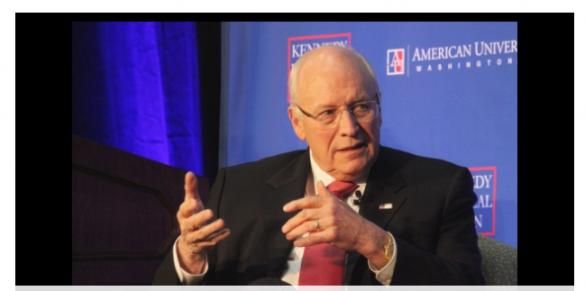
Dick Cheney gave a speech to a crowd of AU students and reiterated his love for waterboarding.

Former VP Dick Cheney doubled down on his love of torture during the Bush Administration when he was speaking to an American University event in Bender Arena and claimed that waterboarding was not torture. Ask any expert in the field of interrogation tactics and they will tell you that waterboarding is torture. Not so with Cheney, who swears that it wasn't covered under the Geneva Conventions. He said he'd do it all over again if he had to.

Nuke

Iran vows to rebuild nuclear sites after Western airstrikes

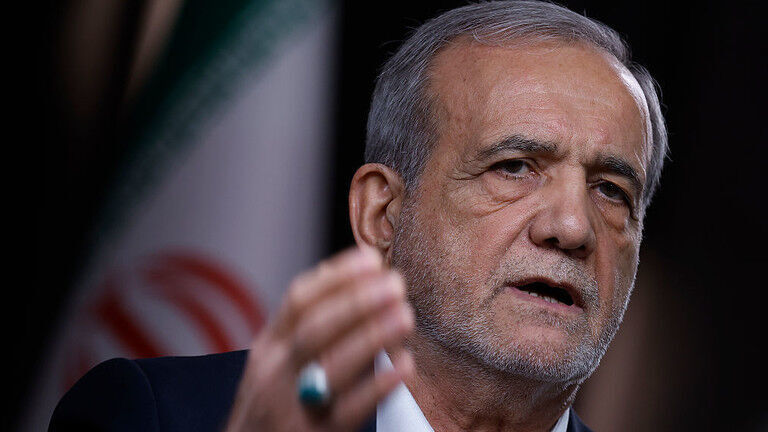
Iranian President Masoud Pezeshkian
Iranian President Masoud Pezeshkian.
Iran will rebuild nuclear facilities targeted in US and Israeli strikes earlier this year, President Masoud Pezeshkian has said, reiterating that his country is not seeking to develop nuclear weapons.

In June 2025, the US and Israel launched coordinated airstrikes on Iran's Fordow, Natanz, and Isfahan nuclear sites, causing major damage, according to satellite imagery and defense analysts. They described it as preemptive strikes to halt Iran's progress toward developing a bomb.

Afterward, President Donald Trump warned that the US could launch renewed strikes if Iran restarts the damaged sites. Tehran, which insists its program is peaceful, condemned the attacks as a violation of sovereignty.

"The scientific knowledge is in the minds of our scientists. Destroying buildings and factories will not create a problem for us - we will rebuild, and with greater strength," Pezeshkian told state media on Sunday during a visit to the Atomic Energy Organization of Iran (AEOI).

Comment: The withdrawel by the US likely due to Israeli pressure, of the 2015 nuclear deal did not help in promoting trust. The bombing of Iran's nuclear facilities has only hardened the stance of Iran. The maximum pressure and bullying of North Korea by the West only achieved the opposite and the fact that North Korea now has nuclear weapons is the one reason it has not been invaded or bombed by the US. Iran has learned by the example of North Korea that a potential for a nuclear response gives leverage.


Jet5

SOTT Focus: The AI Drones Used In Gaza Now Surveilling American Cities


Comment: We predicted, decades ago, that the end-goal of 9/11, the War on Terror, and the 'blending' of US and Israeli government policy was to remake the USA in Israel's image...


drones over US
© UnknownDrones over America
AI-powered quadcopter drones used by the IDF to commit genocide in Gaza are flying over American cities, surveilling protestors and automatically uploading millions of images to an evidence database.

The drones are made by a company called Skydio which in the last few years has gone from relative obscurity to quietly become a multi-billion dollar company and the largest drone manufacturer in the US.

The extent of Skydio drone usage across the US, and the extent to which their usage has grown in just a few years, is extraordinary. The company has contracts with more than 800 law enforcement and security agencies across the country, up from 320 in March last year, and their drones are being launched hundreds of times a day to monitor people in towns and cities across the country.

Skydio has extensive links with Israel. In the first weeks of the genocide the California-based company sent more than one hundred drones to the IDF with promises of more to come. How many more were delivered since that admission is unknown. Skydio has an office in Israel and partners with DefenceSync, a local military drone contractor operating as the middle man between drone manufacturers and the IDF. Skydio has also raised hundreds of millions of dollars from Israeli-American venture capitalists and from venture capital funds with extensive investments in Israel, including from Marc Andreessen's firm Andreessen Horowitz, or a16z.

And now these drones, tested in genocide and refined on Palestinians, are swarming American cities.

Nuke

The policy of nuclear gunboats

Nuke Sub
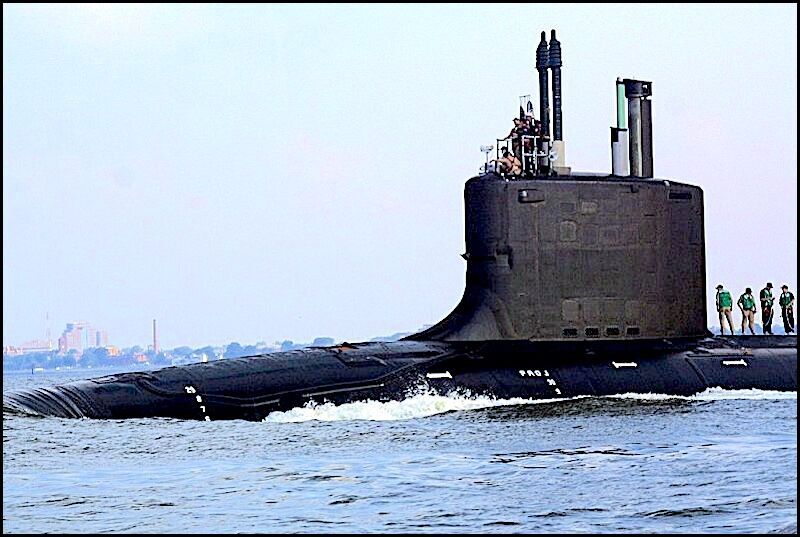
© unknownNuclear Submarine
It should come as no surprise that Russia has spent so much money miniaturizing nuclear power plants and equipping its delivery systems with them: 9M730 Burevestnik missiles and Status-6 Poseidon torpedoes. The United States is dispersing its nuclear technology by providing Australia and South Korea with nuclear-powered submarines, and by supplying Ukraine with long-range missiles. But in this arena, the Pentagon is technically outmatched.

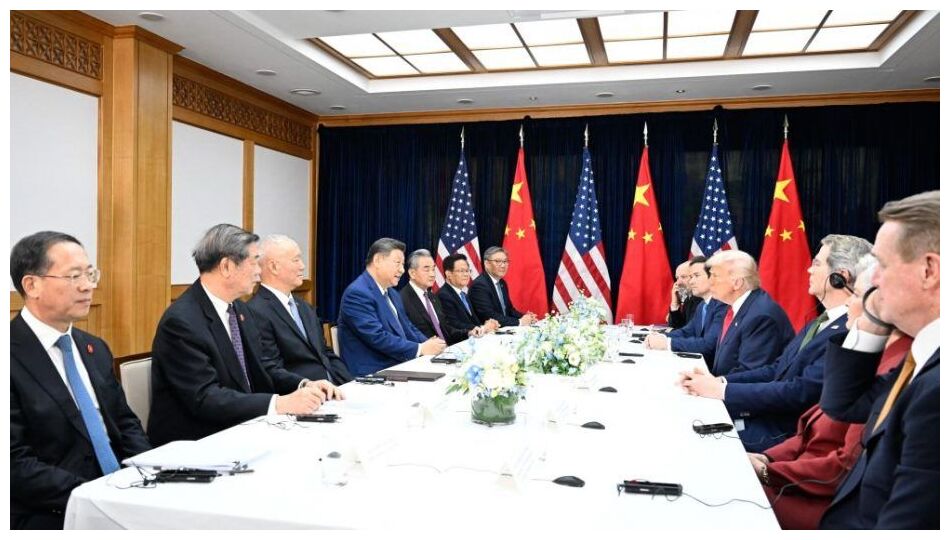
US President Donald Trump hailed the agreement with Chinese President Xi Jinping as a major success. The United States will reduce the tariff on major Chinese goods by 10%, bringing it down to 47%. In exchange, China will resume purchasing US soybeans and postpone for one year the restrictions on rare earth mineral exports to the US. In reality, this is a limited and precarious trade truce.

Significant was the statement made by Chinese Foreign Minister Wang Yi before the meeting between Xi Jinping and Donald Trump. Without naming specific countries but clearly referring to the United States, he warned:
"A multipolar world is emerging," urging an end to "the politicization of economic and trade issues, the artificial fragmentation of global markets, and the use of trade wars and tariff battles. The frequent withdrawal from agreements and the failure to uphold commitments, while blocs and cliques enthusiastically form, have subjected multilateralism to unprecedented challenges."

Comment: If weapon-addicted Ukraine is manufacturing, it will be using.


Star of David

Like Gaza, Israel is threatening to destroy the Lebanon ceasefire

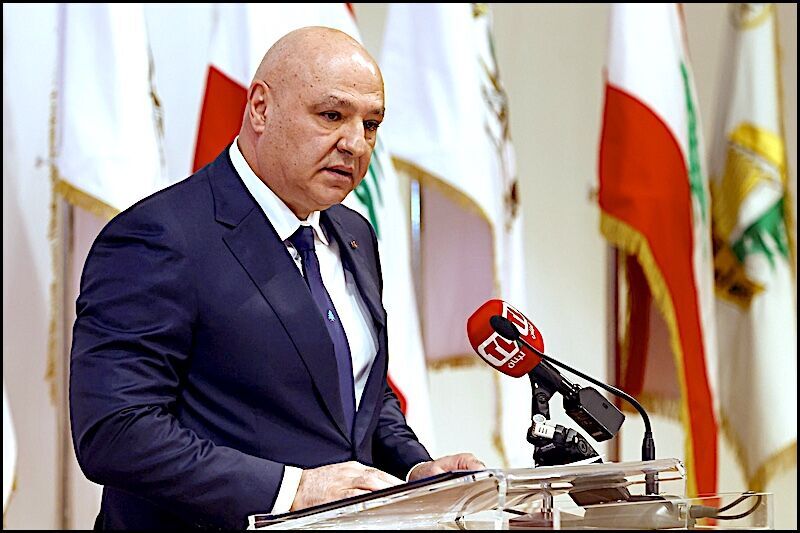
Lebanese President Joseph Aoun
© Lebanese Presidency Office/APA ImagesLebanese President Joseph Aoun attending the Commemoration of the Army Martyrs • Yarzeh, Beirut, Lebanon • July 31, 2025
A year-old "ceasefire" is being upheld in Lebanon despite almost daily Israeli military strikes. The Trump administration can still prevent the fragile truce from falling apart, but only if it forces Israel to follow the agreement.

In Gaza this week, we've seen yet another bloody demonstration of Israel's odd definition of "ceasefire." In Israel's view, it means the other side ceases while Israel continues to fire. If the opposition "behaves" according to Israeli diktats, Israel's firing will be lessened, though not eliminated. If the opponents take even the slightest action outside of Israel's orders, the firing increases very quickly and by many orders of magnitude.

Gaza and the West Bank are prime examples. But another is Lebanon, where a year-old "ceasefire" is maintained despite near daily Israeli military attacks.

Post-It Note

Experts say FBI's Arctic Frost memo lacked legal basis for Trump probe, revives comparisons to discredited Russia investigation

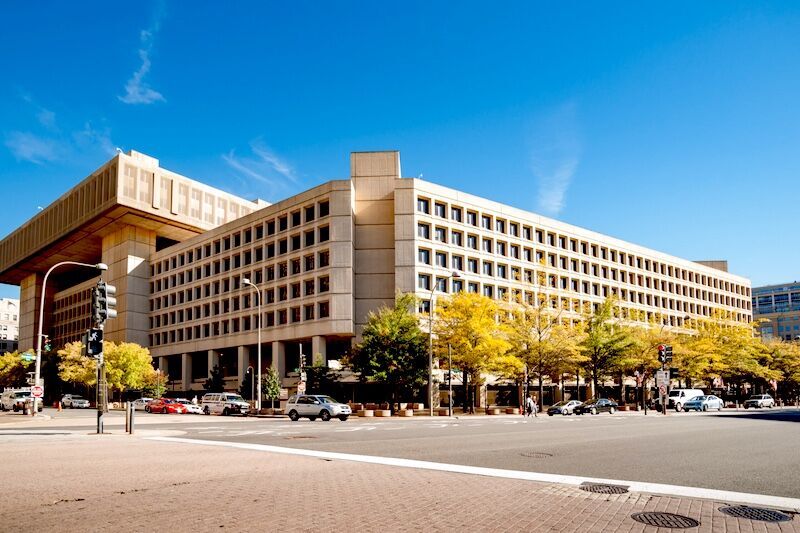
JEHoover Bldg
© Washington DC USAJ Edgar Hoover Building home of FBI • Washington DC
The memo that triggered a sweeping federal investigation into Trump and GOP electors relied on thin evidence, internal bias, and media reports, according to former prosecutors, FBI officials, and congressional leaders.

The FBI's justification for launching its Arctic Frost investigation into Donald Trump and hundreds of Republican allies over the 2020 election has come under scrutiny after the release of a memo experts say lacked evidence, legal grounding, and precedent. According to a Just the News report, former federal prosecutors and FBI agents reviewing the document identified deep flaws in its rationale, likening it to the discredited "Crossfire Hurricane" probe from 2016.

The Arctic Frost inquiry began in April 2022, shortly after Trump signaled his intention to run again for president. It was based on claims that Trump's team submitted alternate electors as part of a conspiracy to obstruct the congressional certification of the 2020 election. But the memo relied on CNN articles and testimony from the Democrat-led January 6 Committee, raising concerns about political bias and the use of circular reporting.

House Judiciary Chairman Jim Jordan, who obtained the memo from FBI Director Kash Patel, said the same mindset that drove the Russia probe reappears here. "Sure looks that way," Jordan told Just the News.
"Same mindset that said we're going to put the dossier in the intelligence community assessment, even though we know the dossier is garbage. That same mindset that was there in 2016 is the mindset we see now in 2022 with Arctic Frost, and then as it transformed into Jack Smith, special counsel later in 2022."

Comment: See also:
New declassification: Papadopoulos transcript exposes Crossfire Hurricane corruption


USA

U.S. foreign policy in contention: Is Trump allowed to agree a deal with China (but not Russia or Iran)?

China US Meeting
© Public Domain
U.S. foreign policy, drenched in the hubris that the U.S. won the Cold War militarily (in Afghanistan); won it economically (liberal markets); and culturally too, (Hollywood) — and therefore rightly deserves, as Trump puts it, the "fun" of "running both the country the world". Well, that policy is now in contention for the first time.

Will this matter?

This month, the RAND Organisation, an institution whose shadow has long lain across U.S. foreign policy matters, has challenged the Cold War hubris in respect to China.

Though the report focuses on America's preoccupation with the threat of China's ascendancy, the implications of questioning the doctrine — that no challenger to U.S. hegemony, financial or military, can be tolerated — does cut to the absolute heart of U.S. foreign policy practice.

The key finding from RAND is that "China and the U.S. should strive to achieve a modus vivendi" together through "each accepting the political legitimacy of the other, constraining efforts to undermine each other, at least to a reasonable degree".

To propose that each side should acknowledge and accept the legitimacy of the other, rather than see 'the other' as a malignant threat, would in itself represent a small revolution.

Were it to apply to China, then why not to Russia or Iran too?

More telling: RAND prescribes that the U.S. leadership in particular should reject notions of 'absolute victory' over China - as well as to accept the One China Policy by stopping provoking China through military-minded visits to Taiwan designed specifically to keep China threatened and on edge.

This comes on the eve of Trump's scheduled meeting with President Xi Jinping in Kuala Lumpur, in which Trump is seeking a 'trade deal' with China that reaffirms his dominance and gives him space for his radical plans to re-structure America's financial landscape - if he can.

Can the pivot proposed by RAND truly be accepted in DC? RAND does possess real weight in Washington - so does this report reflect a split in the structural architecture of the Dark State? Other signs (in the Middle East/ West Asia) point in the opposite direction.

The U.S. has been running the same foreign policy playbook for decades. So, is the U.S. even capable of such radical cultural transformation, as advocated by RAND?

Radar

Best of the Web: Did China down two US Navy aircraft in the South China Sea?


Comment: Spoiler alert: yes they probably did!


nimitz china helicopter hornet
Accident or Attack? In what is considered a highly unusual event, two U.S. naval aircraft flying from the U.S. aircraft carrier Nimitz (CVN 68), an MH-60R Sea Hawk helicopter and an F/A-18 Super Hornet fighter crashed within a 30-minute time span in the volatile South China Sea on Sunday.


Comment: To be clear that's Sunday 26 October 2025.


This is the fourth F/A-18 that the navy has lost this year.

The incidents occurred amid President Trump's tour of Asia, during which he is expected to meet a host of Asian leaders, including China's leader, Xi Jinping, making it more suspicious, and embarrassing.

The South China Sea is an extremely sensitive geopolitical region, and potential flashpoint for conflict, where China asserts ownership over much of the region, despite an international court ruling rejecting Beijing's claims.

Over the last two decades, China has bolstered its illegal claims by constructing military installations across the sea, including artificial militarized islands on reefs, challenging U.S. efforts to ensure freedom of navigation in these international waters.

The U.S. Navy's operations in the region are part of a broader strategy to counter China's maritime expansion and aggression.

Fortunately, all five U.S. crew aboard the two downed aircraft were rescued. While the USS Nimitz is our oldest carrier, commissioned 50 years ago and on its last deployment before decommissioning next year, experts say this is unlikely to be related to the two crashes.

Comment: It was almost certainly a successful Chinese 'sneak attack'. That it occurred right as Trump was going to meet Xi, cap in hand, speaks to its timing and purpose: "we'll talk to you and make deals, but we don't have to, and your military ought to get out of our sphere of influence..."

Washington's response has been to order a "show of force" in the region, sending more destroyers to the South China Sea:

us warships south china sea
Satellite photo shows the USS Nimitz (CVN-68) and its strike group - including the destroyers Gridley (DDG-101), Wayne E. Meyer (DDG-108), Lenah Sutcliffe Higbee (DDG-123), the cruiser Princeton (CG-59), and likely the destroyer Fitzgerald (DDG-62) - are now operating in the western Philippine Sea, roughly 100 miles south of the disputed Scarborough Shoal.


SOTT Logo Radio

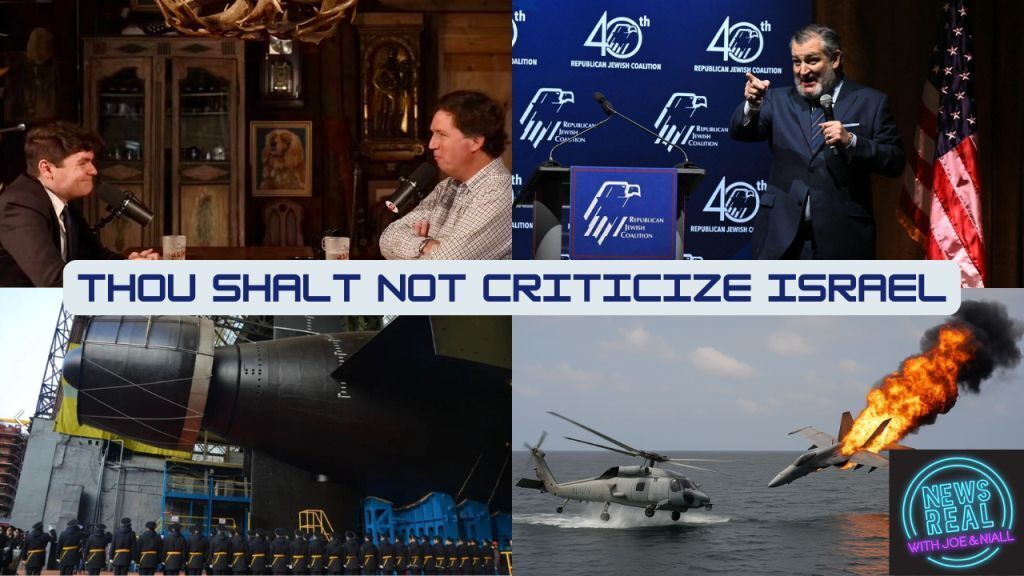
SOTT Focus: NewsReal: Neutralize Tucker! Berserker Reactions to Carlson-Fuentes Interview

fuentes carlson newsreal
His surprise appearance on Tucker Carlson's show is something of a 'marker event' in the meteoric rise of polemic right-wing commentator Nicholas Fuentes to American political prominence. In the end it was a civil conversation fleshing out background to his controversial takes, and general agreement on what's been taking place in the US recently: growing, significant public backlash against Israel's wars and outsized influence in American politics. So, what pretty much everyone's talking about!

But, for some reason, THESE TWO PEOPLE are apparently 'strictly verboten' from being allowed to meet, much less discuss the 'elephant in the room'. The 'guilty flee where none doth pursue', so the extreme - and childishly inane - reactions of mainstream pundits and politicians betray a sense of 'doom' on their part regarding this 'culture war' shift in the USA. How will 'the enforcers' respond? In their customary manner? Or do their regular tactics no longer work?


Running Time: 02:04:27

Download: MP3 — 114 MB