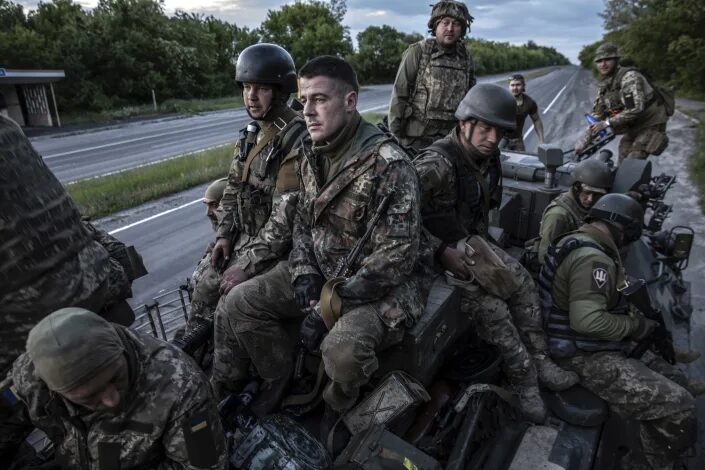
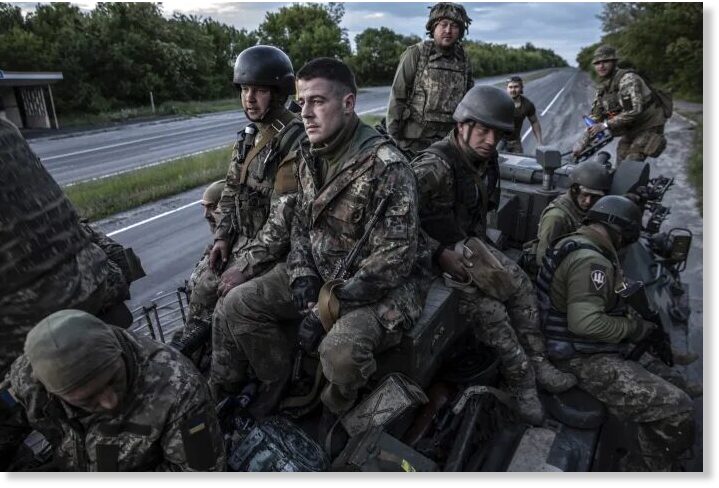
© Finbarr O'Reilly/The New York TimesUkrainian soldiers from the 95th Air Assault Brigade board an armored vehicle as they head toward the frontline near the city of Kramatorsk in eastern Ukraine on May 25, 2022.
President Volodymyr Zelenskyy of Ukraine has provided near-daily updates of Russia's invasion on social media; viral video posts have shown the effectiveness of Western weapons in the hands of Ukrainian forces; and the Pentagon has regularly held briefings on developments in the war.
But despite the flow of all this news to the public,
U.S. intelligence agencies have less information than they would like about Ukraine's operations and possess a far better picture of Russia's military, its planned operations and its successes and failures, according to current and former officials.
Governments often withhold information from the public for operational security. But these
information gaps within the U.S. government could make it more difficult for the Biden administration to decide how to target military aid as it sends billions of dollars in weapons to Ukraine.
U.S. officials said
the Ukrainian government gave them few classified briefings or details about their operational plans, and Ukrainian officials acknowledged that they did not tell the Americans everything.
Of course the U.S. intelligence community collects information about nearly every country, including Ukraine. But U.S. spy agencies, in general, focus their collection efforts on adversarial governments, like Russia, not current friends, like Ukraine. And while Russia has been a top priority for American spies for 75 years, when it came to the Ukrainians, the United States has worked on building up their intelligence service, not spying on their government.
The result, former officials said, has been some blind spots.
Comment: This is called throwing Zelensky and Ukraine as a whole under the bus.
Here's CFR head Richard Haass
in conversation with former Deputy Commander of the United States European Command Stephen M. Twitty:
TWITTY: I think the war in the Donbas is starting to turn to the Russians' favor ...
HAASS: ... Why don't we reverse [our policies]? General Twitty, is there something that the president said? Are things we're not doing that we should be doing? Is there things that you would recommend at this point?
TWITTY: Well, as I take a look at this, you know, Secretary Austin came out that we're going to weaken Russia. We have not really defined what weaken means, because if you take a look at the Ukrainians right now, I take a strong belief in Colin Powell's doctrine — you overwhelm a particular enemy with force. And right now, when you take a look at Ukraine and you take a look at Russia, they're about one to one. The only difference is Russia has a heck of a lot of combat power than the Ukrainians.
And so there's no way that the Ukrainians will ever destroy or defeat the Russians, and so we got to really figure out what does weaken mean in the end state here. And I will also tell you, Richard, there's no way that the Ukrainians will ever have enough combat power to kick the Russians out of Ukraine as well, and so what does that look like in the end game.
... from a military standpoint, if that's the way then the means would be the Ukrainians lack, again, the ability to pull that off to pre-2014. They just lack that ability. They don't have the combat power.
And I also want to remind you we hear a lot about Russian casualties and Russian losses. We hear very little about Ukrainian losses, and keep in mind they're losing soldiers throughout this war as well. They started at approximately two hundred thousand. Who knows where they are today?
And so it's hard to recruit and maintain that level of professionalism in that military. So that's my first point. The end, ways, and means, they lack that, to be able to go back to the pre-2014.
The second point that I would make is, you know, as you look at the DIME — diplomatic, informational, military, and economic — we're woefully lacking on the diplomatic piece of this. If you notice, there's no diplomacy going on at all to trying to get to some type of negotiations. And I don't think that we can lead that, given where Putin thinks about us.
But if you sit back and think about those that could possibly be a part of this negotiation team, you know, you have the — two of them are in — that I'm going to list are in NATO. One is President Orbán out of Hungary. Perhaps he can help out in the negotiation effort. The other one is President Erdoğan of Turkey. Longtime friends of President Putin, although some view that relationship as transactional. I don't know. Let's put it to the test and see.
Ukrainian intel official Vadim Skibitsky
admitted as much to the
Guardian:
"This is an artillery war now," Vadim Skibitsky, the deputy head of Ukraine's military intelligence, told The Guardian on Friday.
Ranged combat is going to decide the outcome of the conflict between the two countries, "and we are losing in terms of artillery," he acknowledged.
Ukrainian troops are currently firing 5,000 to 6,000 artillery rounds a day, and their stockpiles are running out fast, the intelligence official said. "We have almost used up all of our [artillery] ammunition and are now using 155-caliber NATO standard shells," he said.
Kiev is also severely outgunned in the Donbass, having almost run out of the Soviet- and Russia-designed artillery pieces it had at the start of Moscow's military operation, according to Skibitsky. "Ukraine has one artillery piece to 10 to 15 Russian artillery pieces," he pointed out.
"Everything now depends on what [the West] gives us," the intelligence official said. "Our Western partners have given us about 10% of what they have."












Comment: