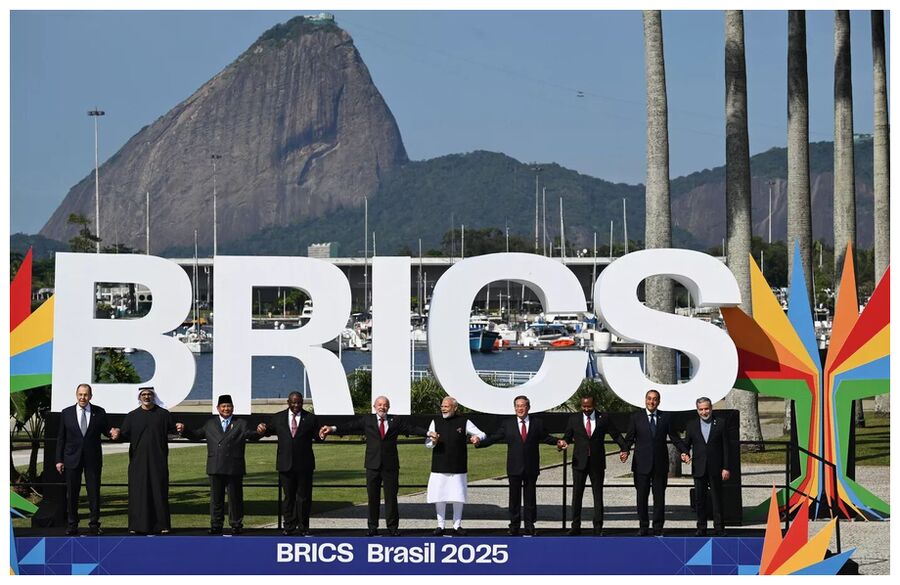
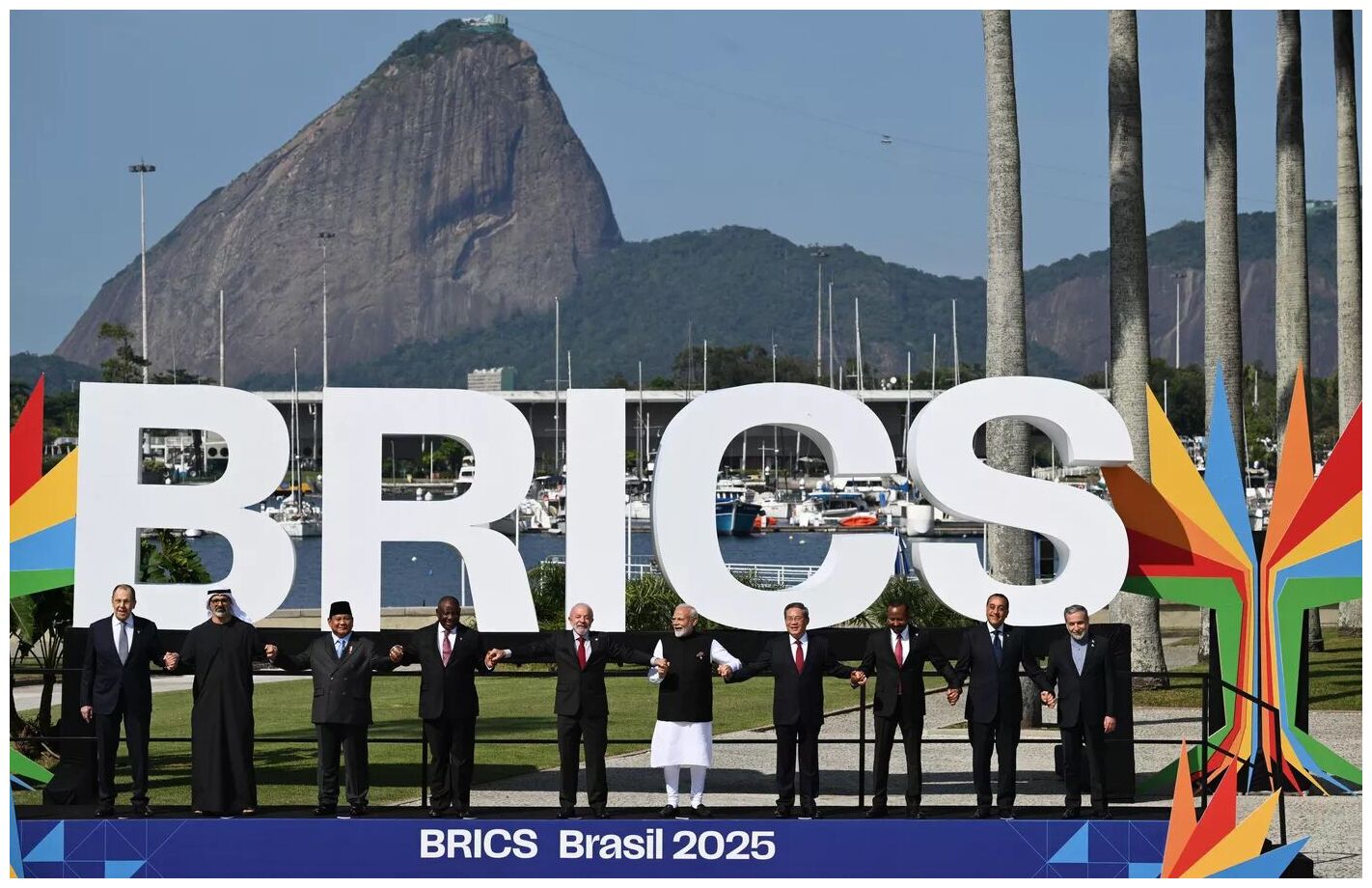
© Sputnik / Kirill ZykovRussian Foreign Minister Sergey Lavrov, Crown Prince of Abu Dhabi and Chairman of the Abu Dhabi Executive Council Sheikh Khaled bin Mohamed bin Zayed Al Nahyan, Indonesian President Prabowo Subianto, South African President Cyril Ramaphosa, Brazilian President Luiz Inacio Lula da Silva, Indian Prime Minister Narendra Modi, Chinese Premier Li Qiang, Ethiopian Prime Minster Abiy Ahmed, Egyptian Prime Minister Mostafa Madbouly and Iranian Foreign Minister Abbas Araghchi attend a family photo opportunity during the 17th BRICS Summit in Rio de Janeiro, Brazil.
In his book co-written with top economist Sergey Bodrunov,
Regulations of the Noonomy (international edition published this year by Sandro Teti Editore in Rome), leading Russian economist Sergey Glazyev stresses the need to "ensure a full-fledged switch to national currencies in mutual trade and investment within the EAEU and the CIS, and further - within the BRICS and SCO, the withdrawal of joint development institutions from the dollar zone, the development of their own independent payment systems and interbank information exchange systems."
When it comes to financial innovation - compared to the current structure of the international financial system - The Unit is in a class of its own.
The Unit is essentially a benchmark token - or an index token; a post-stablecoin, digital monetary tool; totally decentralized; and with intrinsic value anchored in real assets: gold and sovereign currencies.The Unit can be used either as part of a new digital infrastructure - what most of the Global South is striving for; or as part of a traditional banking setup.
When it comes to fulfilling traditional money functions, The Unit is - pardon the pun - right on the money. It's meant to be used as a quite convenient medium of exchange in cross-border trade and investments - a key plank of the diversification actively pursued by BRICS+.
It should also be seen as an independent, reliable measure for value and pricing, as well as a better store of value than fiat money.
The Unit is academically validated - including by Glazyev himself - and properly governed by IRIAS (International Research Institute for Advanced Systems), set up in 1976 in accordance with the UN statute.
And
crucial at this next step, The Unit is to be launched early next year on the
Cardano blockchain, which uses
the digital currency Ada.
Ada has a fascinating background - named after Ada Lovelace, a 19th-century mathematician, daughter of none other than Lord Byron, and recognized as the first computer programmer in History.
Anyone, anywhere can use Ada as a secure exchange of value; and very important, without the need to ask a third party to mediate the exchange.
That means every Ada transaction is permanently secured and recorded on the Cardano blockchain. That also means that every Ada holder also holds a stake in the Cardano network.
Cardano has been around for 10 years now - and is a quite popular blockchain. It's backed by some quite big venture capital firms such as IOHK, Emurgo and the Cardano Foundation. Essentially, Cardano is an excellent option for regular payments because transactions are cheap and fast.















Comment: More from ZeroHedge: