
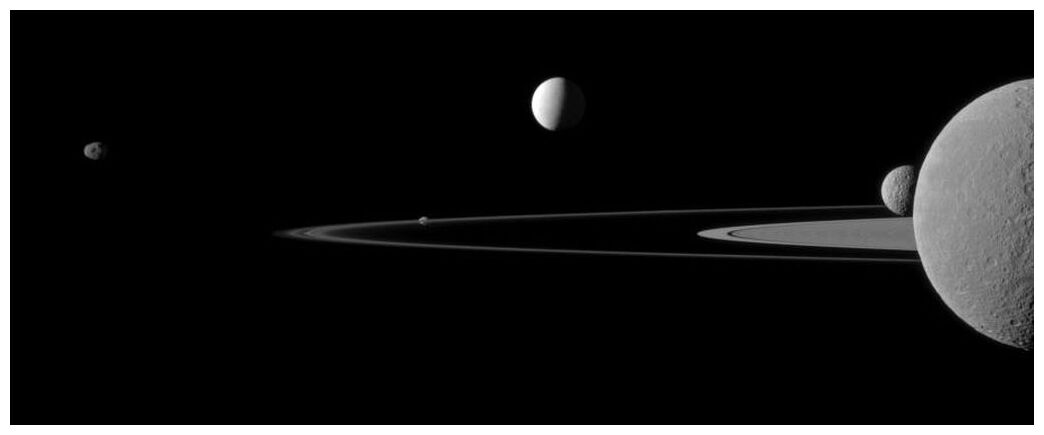
© NASA/JPL-Caltech/Space Science InstituteFive of Saturn's moons, from left: Janus, Pandora, Enceladus, Rhea, and Mimas.
A team of scientists has found a whopping 128 previously unknown moons hanging around Saturn, in a discovery officially recognized by the International Astronomical Union. This brings the planet's total number of known moons to 274, leaving Jupiter, with its mere 95 moons, in the dust.
The first hint that there were more moons awaiting discovery came between 2019 and 2021, when 62 such objects were identified. Other small objects were also spotted at the time that couldn't yet be designated.
"With the knowledge that these were probably moons, and that there were likely even more waiting to be discovered, we revisited the same sky fields for three consecutive months in 2023," says astronomer Edward Ashton of Academia Sincia in Taiwan.
"Sure enough, we found 128 new moons. Based on our projections, I don't think Jupiter will ever catch up."

















Comment: Space.com adds: