Science & TechnologyS


Info

The science behind the return of the Dire Wolf

Dire Wolfs
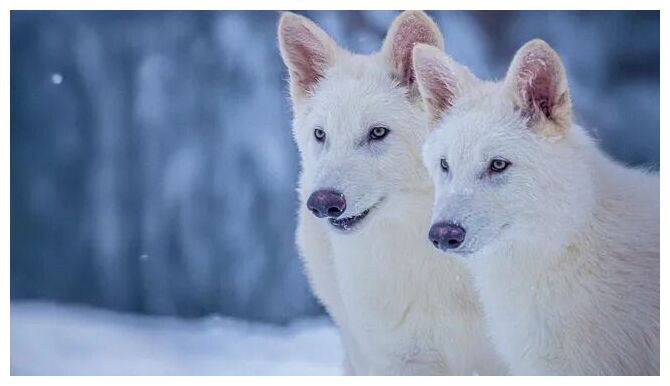
© Colossal BiosciencesRomulus and Remus are two 6-month-old dire wolves, created by genetically engineering cells from living gray wolves.
Nature gave the world the dire wolf 2.6 million years ago, and then, through the hard hand of extinction, took it away — some 10,000 to 13,000 years ago when the last of the species died out. Now, the dire wolf is back, brought bounding into the 21st century by Colossal Biosciences, a Dallas-based biotech company. On April 8, Colossal announced it had used both cloning and gene-editing based on two ancient samples of dire wolf DNA to birth three pups, the six-month-old males Romulus and Remus and the two-month-old female Khaleesi.

"Our team took DNA from a 13,000 year old tooth and a 72,000 year old skull and made healthy dire wolf puppies," said Colossal CEO Ben Lamm in a statement that accompanied the announcement of the births. "It was once said, 'any sufficiently advanced technology is indistinguishable from magic.' Today, our team gets to unveil some of the magic they are working on."

So what, exactly, does that work involve?

Traditional cloning — the kind that famously resulted in Dolly the sheep in 1996, and has since been used to create clones of pigs, cats, deer, horses, mice, goats, gray wolves, dogs and more — is a relatively straightforward, if invasive, process. First, a single cell is taken from a tissue sample of the animal to be cloned. That cell's nucleus — which contains the individual's entire genetic code — is then extracted and inserted into a donor ovum from the same species whose own nucleus has been removed. The ovum carrying the new genetic material is allowed to develop into an embryo and then transferred into the womb of a surrogate, which ultimately gives birth to an exact duplicate of the animal from which the donor cell was taken.

Colossal says its dire wolf work had key differences. Scientists first analyzed the genome of the dire wolves contained in the ancient tooth and skull. Comparing those genomes to that of the gray wolf — the dire wolf's closest living relative — they identified 20 differences in 14 genes that account for the dire wolf's distinguishing characteristics, including its greater size, white coat, wider head, larger teeth, more powerful shoulders, more-muscular legs, and characteristic vocalizations, especially howling and whining.

Next, they harvested endothelial progenitor cells (EPCs), which form the lining of bloodvessels, from the bloodstreams of living gray wolves — a less invasive procedure than taking a tissue sample — and edited the 14 genes in their nuclei to express those 20 dire wolf traits. This is trickier than it seems, since genes often have multiple effects, not all of them good. For example, as the company explains in its press release, the dire wolf has three genes that code for its light coat, but in gray wolves they can lead to deafness and blindness. The Colossal team thus engineered two other genes that shut down black and red pigmentation, leading to the dire wolf's characteristic light color without causing any harm in the edited gray wolf genome.

Comet 2

New comet discovered: C/2025 F2 (SWAN) - and it has a glorious 'tail'

Amateur astronomers are monitoring a bright new comet easily detectable by backyard telescopes. Introducing, Comet SWAN25F:
Comet SWAN25F
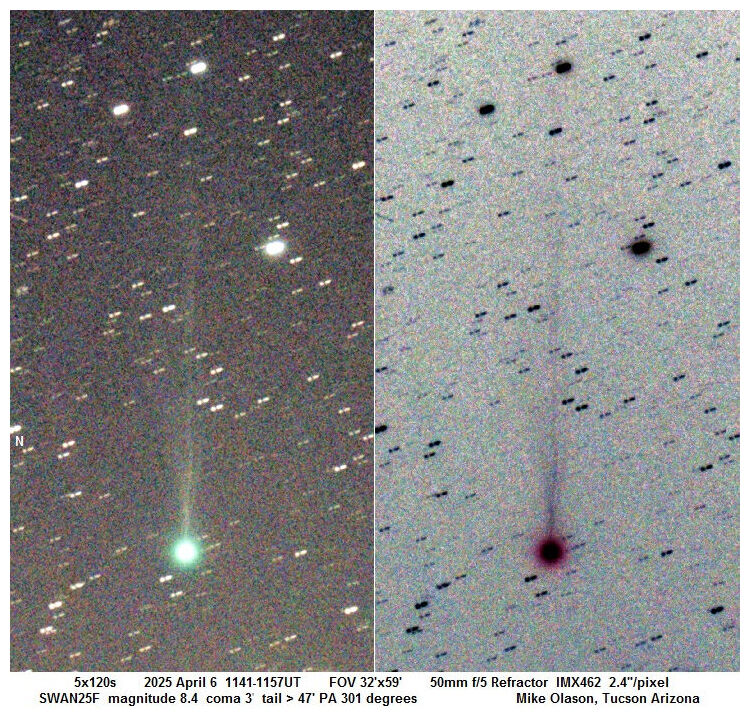
© Mike OlasonComet SWAN25F taken by Mike Olason on April 6, 2025 @ Tucson, Arizona.
"Newly-discovered Comet SWAN25F is brightening nicely as it approaches the sun," reports Mike Olason, who sends these pictures from Tucson, Arizona. "On the morning of April 6th, the comet was magnitude 8.4 with a bright green 3' wide coma and a thin tail that extended well beyond my field of view."

The comet is named after the SWAN camera onboard the Solar and Heliospheric Observatory (SOHO). Australian amateur astronomer Michael Mattiazzo noticed the comet in online images. SWAN is a special camera that maps hydrogen in the solar wind, which suggests this comet may be rich in the element.

Cassiopaea

New nova in the 'Teapot'

A new nova for early risers plus three fun observing projects for the week ahead.

New Nova in Teapot
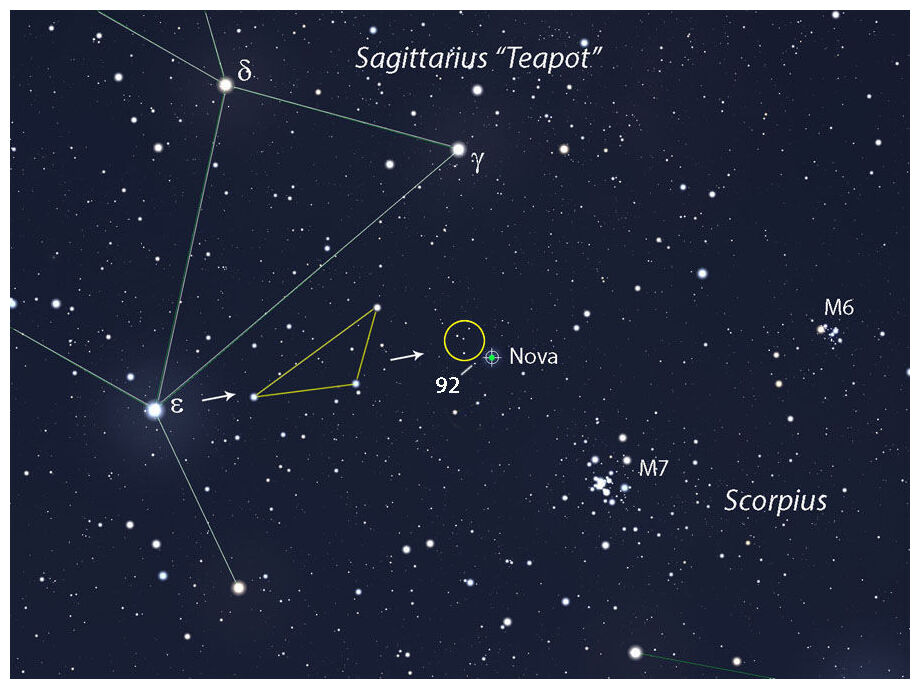
© Stellarium with additions by Bob KingThe nova is located between the Teapot's "Spout" and the bright open cluster M7 in Scorpius. I include a suggested star-hopping route, starting at the 2nd magnitude star Epsilon (ε) Sagittarii. Once you've arrived at the asterism (circled), use the chart below to pinpoint the nova's location. North is up.
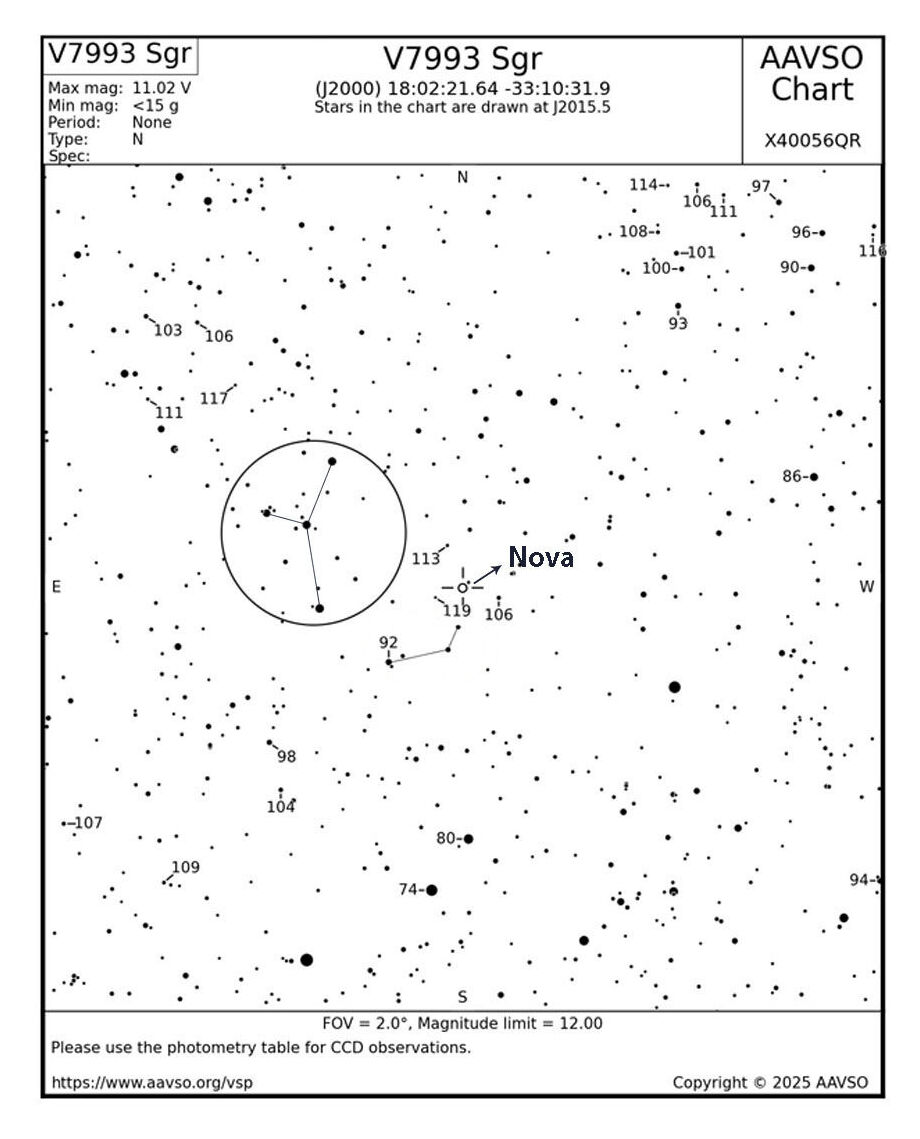
We have a new "star" in the night sky. In truth, it's been there for billions of years, but it only first revealed itself a little more than a week ago. Nova Sagittarii 2025 no. 3 was independently discovered on March 23-24 by the Russian New Milky Way (NMW) Survey and Japanese amateur Tadashi Kojima at a right ascension of 18h 02′ and declination of -33° 11′. Both parties caught the star around magnitude 13; two days later it had brightened to 10.5. Despite its southerly declination, the nova stands more than 10° above the horizon before the start of dawn, making it an attainable target even for observers in the northern U.S.

Nova Sagittarii 2025 no. 3
© Courtesy of the AAVSOIt's a quick hop to the nova from the circled asterism. Take a close look at the star's color — many novae glow red from hydrogen emission during the early phase of the explosion. V7993 Sgr has also been reported to have a red color. Decimals are omitted in the comparison star magnitudes. For example, 106 equals magnitude 10.6.
Clouds have thwarted my attempts to see it, but most estimates posted to the AAVSO peg it at magnitude 10.7 on April 1st. Not long after its discovery, the star received the official designation V7993 Sagittarii, making it the 7,993rd variable star to be discovered in Sagittarius. Although novae can appear anywhere in the sky, they're far more common within the star-dense band of the Milky Way, and especially in Sagittarius where we face toward the galactic center. In fact, this is the third nova discovered so far this year in the constellation.

Rocket

SpaceX makes history: Astronauts orbit over the Earth's poles

earthrise view space
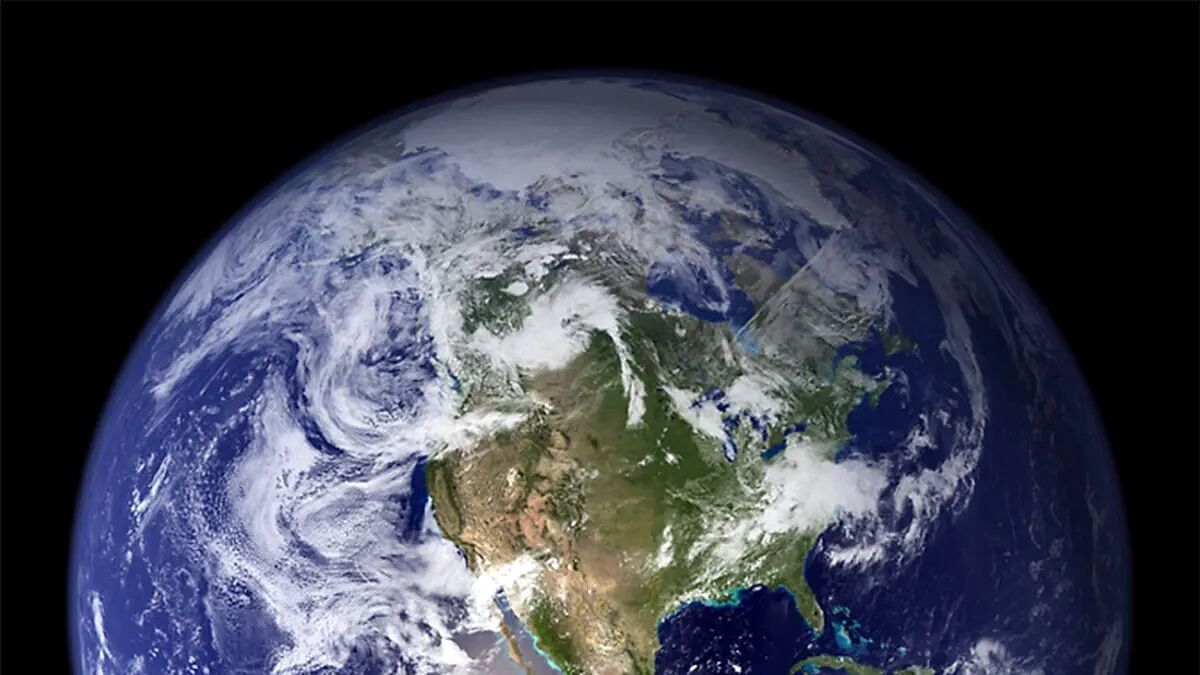
© NASA’s Earth ObservatoryThe astronauts got a much better view of the poles than this.
Why haven't we done it before? Usually, rockets are launched from west to east, for several important reasons.

On Monday, SpaceX made space history, as four astronauts were launched into a pole-to-pole orbit not traveled by any human before them. But why is this orbit so unusual, and why has nobody done it before?

Though the Fram2 mission is a private one on behalf of cryptocurrency billionaire Chun Wang, the crew has a few scientific tasks.

"During their multi-day mission, Dragon and the crew will explore Earth from a polar orbit and fly over Earth's polar regions for the first time," SpaceX explains. "They will also conduct 22 research [experiments] designed to help advance humanity's capabilities for long-duration space exploration and understanding of human health in space. Throughout Fram2's time on-orbit, the crew are planning to take the first X-ray in space, perform exercise studies to maintain muscle and skeletal mass, and grow mushrooms in microgravity."

Comment: More cool videos from the mission:


Blue Planet

Scientists drilled into Belize's Great Blue Hole and discovered a worrying trend

great blue hole ocean belize
The Great Blue Hole off the coast of Belize
Tropical storms have been steadily increasing in frequency over the past 5,700 years, new evidence from sediment in the Great Blue Hole reveals, with a massive spike in the past two decades.

Scientists took a 98-foot core sample from the bottom of the Great Blue Hole off the coast of Belize to uncover patterns of tropical cyclones over the last 5,700 years. (Image credit: Schafer & Hill/Getty Images)

Tropical cyclones in the Caribbean are getting more frequent — and could increase significantly in the coming decades, evidence found buried deep within the Great Blue Hole suggests.

Researchers took a sediment core from the Great Blue Hole sinkhole, situated about 50 miles (80 kilometers) off the coast of Belize, which revealed that tropical cyclones have increased in frequency over the past 5,700 years. The scientists described their findings in a study published March 14 in the journal Geology.

Attention

North America is 'dripping' down into Earth's mantle, scientists discover

N.America global
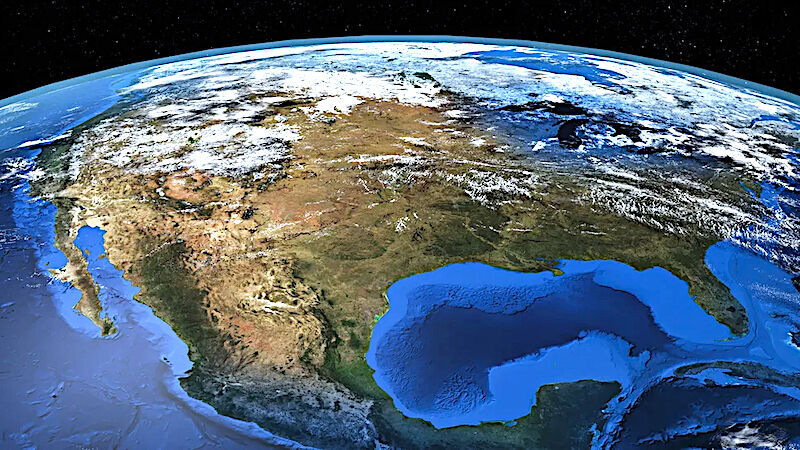
© Timothy Hodgkinson/AlamyNorth America's underside may be "dripping" down into mantle below.
Seismic mapping of North America has revealed that an ancient slab of crust buried beneath the Midwest is causing the crust above it to "drip" and suck down rocks from across the continent.

An ancient slab of Earth's crust buried deep beneath the Midwest is sucking huge swatches of present-day's North American crust down into the mantle, researchers say.

The slab's pull has created giant "drips" that hang from the underside of the continent down to about 400 miles deep (640 kilometers) inside the mantle, according to a new study. These drips are located beneath an area spanning from Michigan to Nebraska and Alabama, but their presence appears to be impacting the entire continent.

The dripping area looks like a large funnel, with rocks from across North America being pulled toward it horizontally before getting sucked down. As a result, large parts of North America are losing material from the underside of their crust, the researchers said.

Black Cat 2

Why the cat wags her tail: The mystery of animal play

ocelot and dog playing
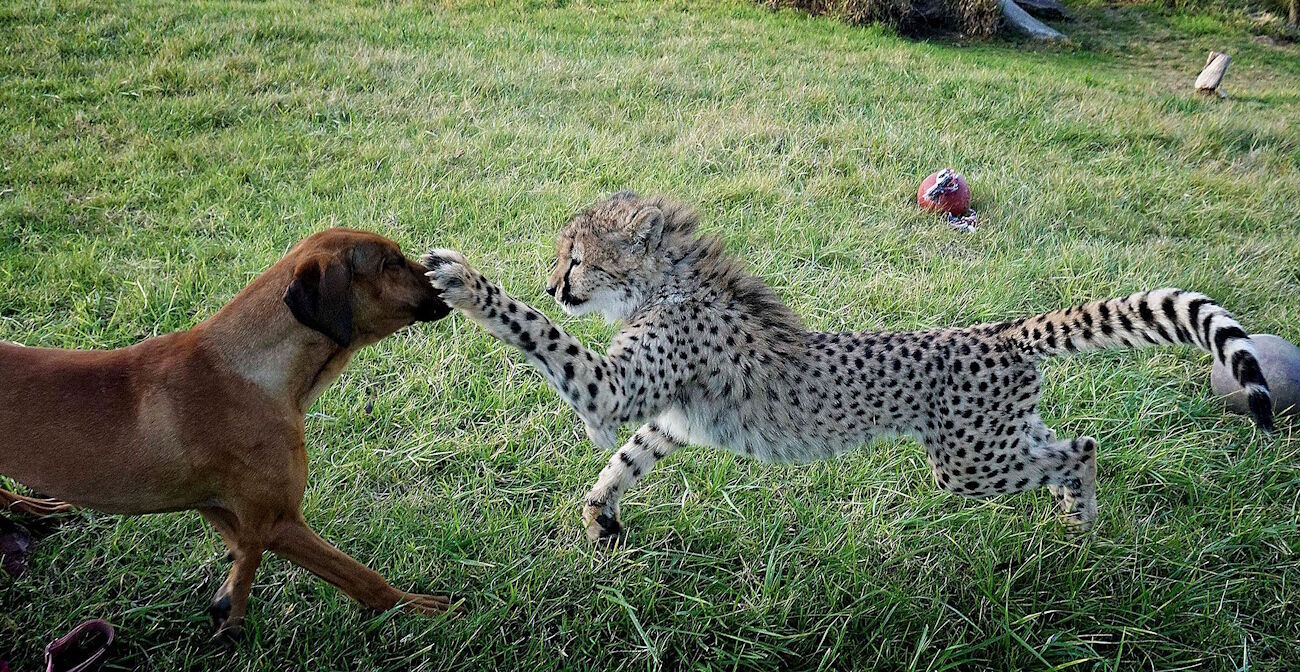
© Sandy Huffaker/The New York Times/HeadpressRaina the Rhodesian ridgeback and Ruuxa the cheetah at the San Diego Zoo Safari Park in California, 2015.
Here's a puzzle: how could evolution favour such a costly, frivolous and fun activity as animal play?

In Cheshire, a fox is poised to pounce on its mate when a badger bursts from a bush. The badger starts chasing the fox, which keeps leaping away, finally distancing itself. Then the fox suddenly turns back, approaches cautiously, and jumps sideways, facing the badger head-on. Back arched, head low, it stops, remains still. After a pause, the badger swiftly resumes the chase, causing the fox to hop around before lunging at its companion and darting off together.


In Orlando, three dolphins are swimming in unison when one forms a perfect bubble ring. Another immediately approaches and blows another ring, which merges with the first to create a larger hoop. The third dolphin appears to attempt to pass through it, completing their improvised choreography.


Animals often engage in play, from the spectacular to the subtle. Hyenas stage mock brawls, cats spin in circles chasing their tails, octopuses play push-and-pull with bottles, dogs bury sticks only to dig them up moments later... Even polar bears have been spotted playing with dogs, grabbing them in what looks like a hug, rolling in the snow, and letting the dogs gently nibble their lips. Such scenes make us grin with delight. But is that all there is to it?

Comment: Though the author is clearly in the Darwinist camp, she raises some interesting questions about animal intelligence, and the need to widen limited lens with which we tend to view it.

Another famous example of animal play from 2015. There seems to be no motivation except enjoyment of the experience, The bird is even able to distinguish the best sliding spot:


Archaeology

'Exquisitely preserved' gigantic claws from Mongolia reveal strange adaptation in dinosaurs

dinosaur sickle claws
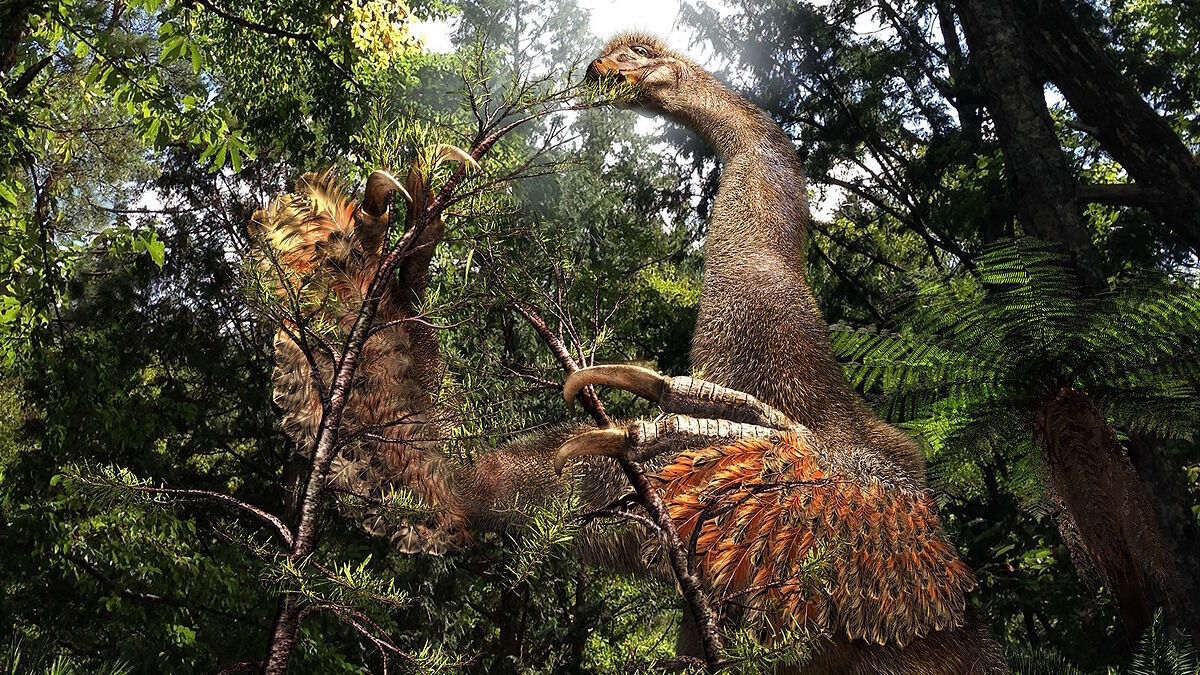
© Masato HattoriThe newfound dinosaur species Duonychus tsogtbaatari had two extraordinarily long sickle-shaped claws on each hand.
A new species of dinosaur with strange claws has been unearthed in Mongolia by paleontologists.

This new genus and species is a therizinosaur, plant-eating, two-legged giants with long claws, and was discovered buried in the Gobi Desert, according to a new study published Tuesday (March 25) in the journal iScience.

Unlike other therizinosaurs, which have three fingers on their hands equipped with long, sharp claws, this new species only has two fingers. This unique anatomy inspired its scientific name, named Duonychus tsogtbaatari, which is Greek for "two digits" and honors the Mongolian paleontologist Khishigjav Tsogtbaatar.

"Many species of therizinosaurs have been discovered, and this group had pretty much been defined by their three-fingered hands sporting large claws," study co-author Darla Zelenitsky, a paleontologist at the University of Calgary in Canada, told Live Science in an email. "To find a specimen with only two fingers/claws was surprising as this was so out of the ordinary for this group of dinosaurs."

Books

Lost tale of Merlin and King Arthur legend deciphered from hidden manuscript

fragment manuscript merlin king arthur legend
© Cambridge University LibraryThe ancient text containing a fragment of the legend of Merlin was found stitched into the binding of a manuscript from the 16th Century
The fragment was sewn inside another book.

An intriguing sequel to the tale of Merlin has sat unseen within the bindings of an Elizabethan deeds register for nearly 400 years. Researchers have finally been able to reveal it with cutting-edge techniques.

It is the only surviving fragment of a lost medieval manuscript telling the tale of Merlin and the early heroic years of King Arthur's court.

In it, the magician becomes a blind harpist who later vanishes into thin air. He will then reappear as a balding child who issues edicts to King Arthur wearing no underwear.

The shape-shifting Merlin - whose powers apparently stem from being the son of a woman impregnated by the devil - asks to bear Arthur's standard (a flag bearing his coat of arms) on the battlefield. The king agrees - a good decision it turns out - for Merlin is destined to turn up with a handy secret weapon: a magic, fire-breathing dragon.

Attention

Sahara Desert shows abrupt extreme climate change is natural, nothing human about it

Abrupt, dramatic climate changes happen naturally. Scientists find Sahara went from green to parched in just a matter of decades.
Symbol image generated by Grok AI.
© NoTricksZoneSymbol image generated by Grok AI.
The claim that human emissions are causing the climate to change dramatically and abruptly is used to instill fear among the population. Without human emissions, the climate would still change, but much more calmly and gradually, so they like to have us believe.

But anyone who has studied climate history knows that climate change tends happen abruptly, often over the course of just a few decades.

One example is the Sahara, which wasn't always a desert. Trees and grasslands dominated the landscape from roughly 10,000 years ago to 5,000 years ago, scientists reported in a paper published in 2013. "Then, abruptly, the climate changed, and north Africa began to dry out."

The study published in Science says it all took just a few hundred years.