Science & TechnologyS


Lightning

What doesn't kill you: Lightning strikes on a species of tropical tree makes it grow stronger

Dipteryx oleifera panama tree lightning strikes
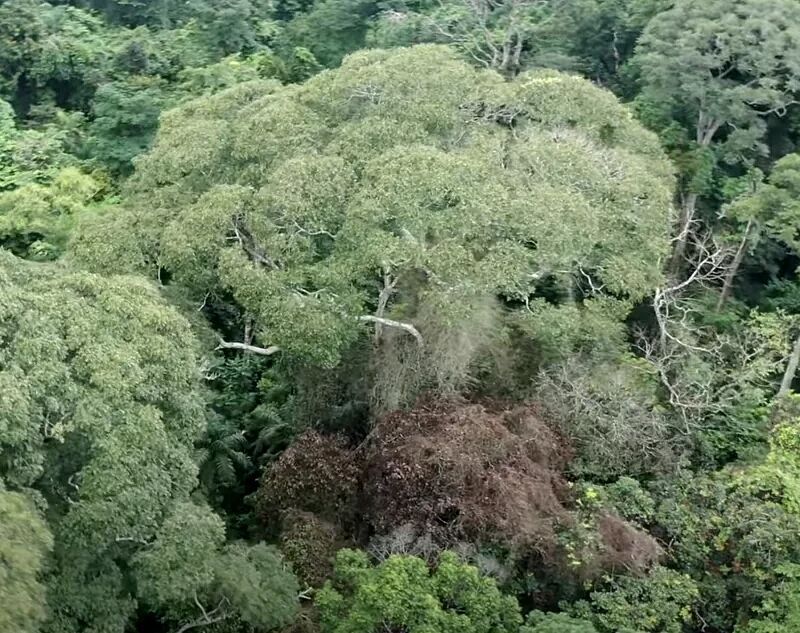
© Evan Gora /Screenshot by NPRResearchers studying lightning's effects on Panama's forests found that one tree, Dipteryx oleifera, often survives being hit by lightning — and even benefits from the overall effects. One of the trees is seen here at center, four weeks after it was hit by a lightning strike that killed neighboring trees (the brown mass at lower center).
Researchers studying lightning's effects on Panama's forests found that one tree, Dipteryx oleifera, often survives being hit by lightning — and even benefits from the overall effects. One of the trees is seen here at center, four weeks after it was hit by a lightning strike that killed neighboring trees (the brown mass at lower center).

Lightning strikes kill millions of trees each year — but it turns out that some large tropical trees can not only survive a strike, but also benefit from its effects, according to a recent study.

The lightning's immense power cleanses these trees of parasitic vines. It also zaps trees nearby, reducing competition. One tree called Dipteryx oleifera, a towering presence in Panama's forests, is particularly adept at thriving after enduring events that are deadly to most other trees.

Magnify

Purple haze: The human eye does not actually see purple, it's actually your brain making it up

purple graphic not real color
© aire images/Getty ImagesIt’s just a pigment of your imagination
You might be today years old when you realize there is no purple in the rainbow. There is no P in ROYGBIV.

But wait, what about violet? Well, despite what you may have come to believe, violet is not purple. In fact, violet (along with the rest of the colors in a naturally occurring rainbow) has something purple doesn't — its own wavelength of light. Anyone who ever ended up with a sunburn knows violet wavelengths are real, as the Sun's ultraviolet (UV) radiation is the reason you need to wear sunscreen, even though you can't see those wavelengths (more on that later). Red, orange, yellow, green, blue, and indigo are all just as real.

But purple? Well, purple is just your brain's way of resolving confusion.

That's right. Red and blue (or violet) wavelengths are two opposite extremes on the spectrum. When you see both of these wavelengths in the same place, you eyes and brain don't know what to do with them, so they compensate, and the clashing wavelengths register as the color we call purple. It doesn't actually exist.

Blue Planet

Scientists discover new phylum of microbes in Earth's deep soil

deep earth soil new phylum microbes
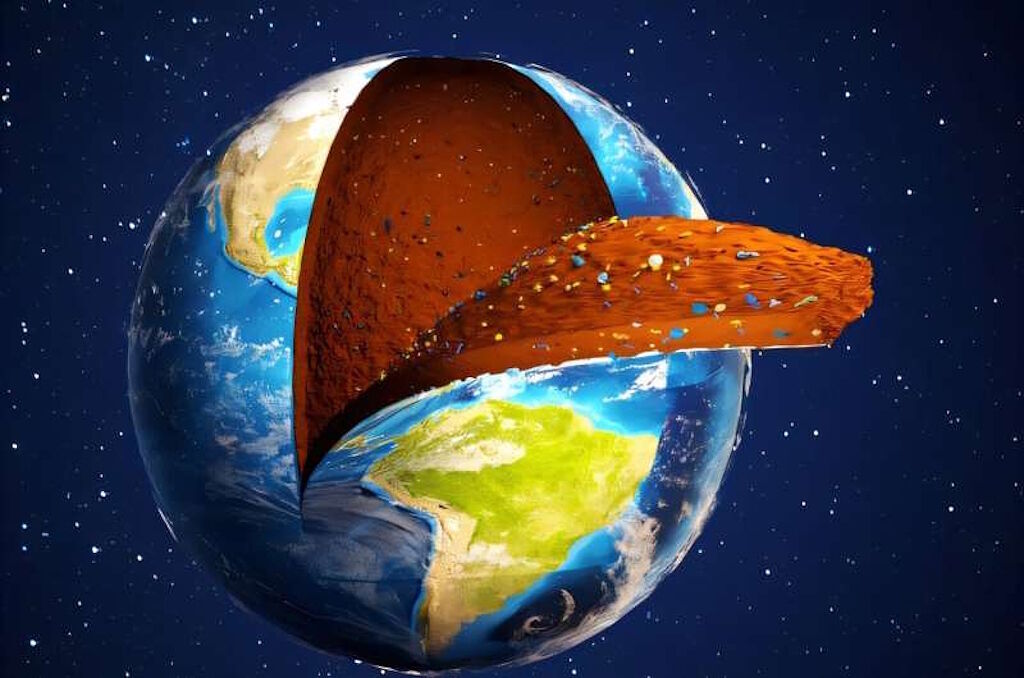
© Michigan State UniversityThis image shows the Earth's Critical Zone, which extends from the tops of trees down through the soil to depths up to 700 feet and depicts the microbes which live throughout this zone. This zone supports most life on the planet as it regulates essential processes like soil formation, water cycling and nutrient cycling, which are vital for food production, water quality and ecosystem health.
Scientists have discovered a new phylum of microbes in Earth's Critical Zone, an area of deep soil that restores water quality. Ground water, which becomes drinking water, passes through where these microbes live, and they consume the remaining pollutants. The paper, "Diversification, niche adaptation and evolution of a candidate phylum thriving in the deep Critical Zone," is published in the Proceedings of the National Academy of Sciences.

Leonardo da Vinci once said, "We know more about the movement of celestial bodies than about the soil underfoot." James Tiedje, an expert in microbiology at Michigan State University, agrees with da Vinci. But he aims to change this through his work on the Critical Zone, part of the dynamic "living skin" of Earth.

"The Critical Zone extends from the tops of trees down through the soil to depths up to 700 feet," Tiedje said. "This zone supports most life on the planet as it regulates essential processes like soil formation, water cycling and nutrient cycling, which are vital for food production, water quality and ecosystem health. Despite its importance, the deep Critical Zone is a new frontier because it's a major part of Earth that is relatively unexplored."

Info

Holograms that can be grabbed and manipulated

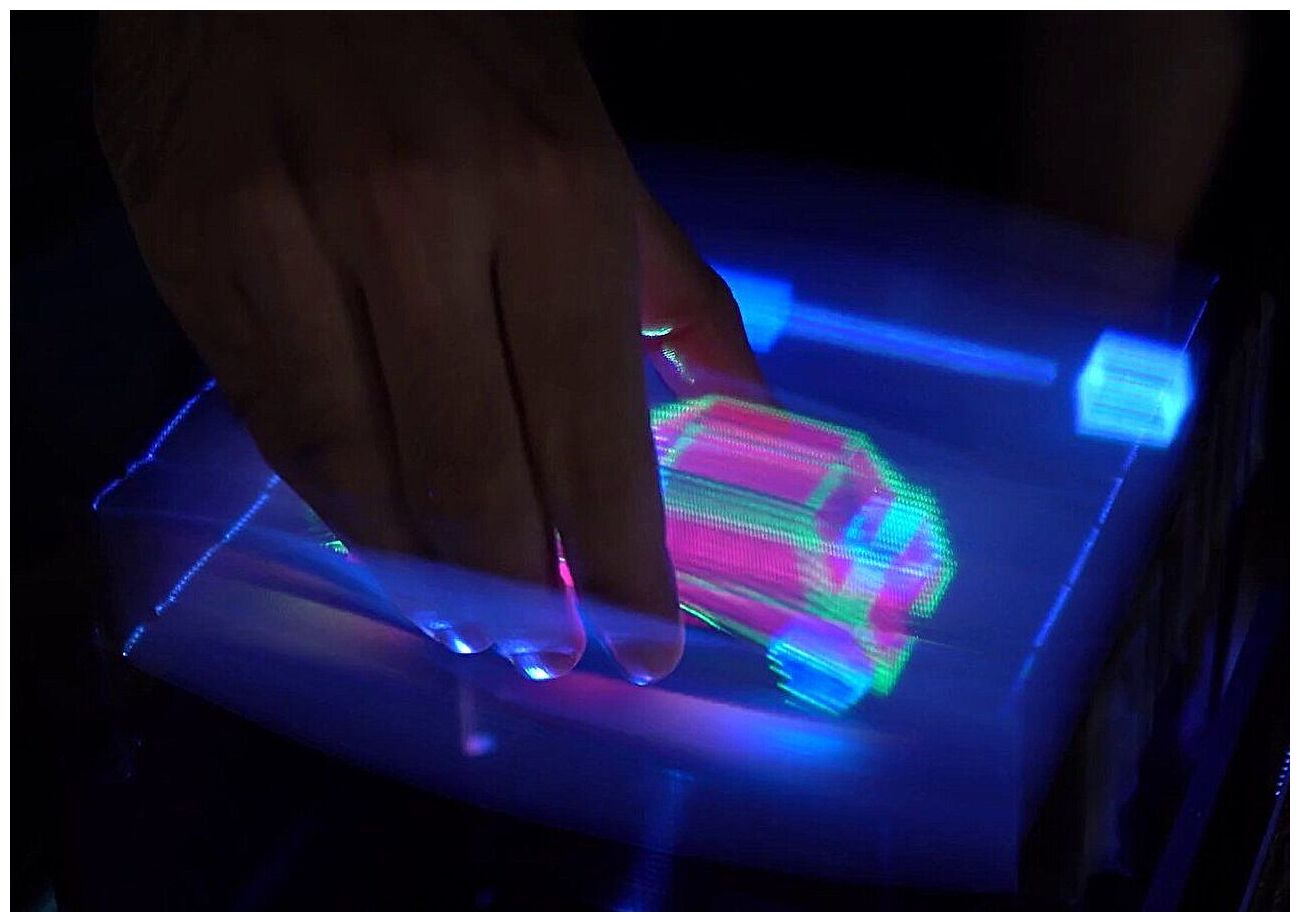
A 3D car is grabbed and rotated by a user.
© Iñigo Ezcurdia 2025A 3D car is grabbed and rotated by a user.
Researchers have succeeded, for the first time, in displaying three-dimensional graphics in mid-air that can be manipulated with the hands. The team includes Doctor Elodie Bouzbib, from Public University of Navarra (UPNA), together with Iosune Sarasate, Unai Fernández, Manuel López-Amo, Iván Fernández, Iñigo Ezcurdia and Asier Marzo (the latter two, members of the Institute of Smart Cities).

"What we see in films and call holograms are typically volumetric displays," says Bouzbib, the first author of the work. "These are graphics that appear in mid-air and can be viewed from various angles without the need for wearing virtual reality glasses. They are called true-3D graphics.

"They are particularly interesting as they allow for the 'come-and-interact' paradigm, meaning that the users simply approach a device and start using it."

"Commercial prototypes of volumetric displays already exist, such as those from Voxon Photonics or Brightvox Inc., but none allow for direct interaction with the holograms," the team points out. Asier Marzo, the lead researcher, comments that direct interaction means "being able to insert our hands to grab and drag virtual objects."


Info

Earth's first crust composition discovery rewrites geological timeline

Researchers have made a breakthrough discovery that changes our understanding of Earth's early geological history, challenging beliefs about how our continents formed and when plate tectonics began.

A study published today in Nature reveals that Earth's first crust, formed about 4.5 billion years ago, probably had chemical features remarkably like today's continental crust.
Earth Crust
© Macquarie UniversityMeteor bombardment: Early Earth was bombarded by meteors which played a crucial role in disrupting and recycling Earth’s first crust.
This suggests the distinctive chemical signature of our continents was established at the very beginning of Earth's history.

Professor Emeritus Simon Turner from the Faculty of Science and Engineering at Macquarie University led the study, which included researchers from around Australia and the UK and France.

"This discovery has major implications for how we think about Earth's earliest history," says Professor Turner.

"Scientists have long thought that tectonic plates needed to dive beneath each other to create the chemical fingerprint we see in continents.

"Our research shows this fingerprint existed in Earth's very first crust, the protocrust - meaning those theories need to be reconsidered."

Info

The science behind the return of the Dire Wolf

Dire Wolfs
© Colossal BiosciencesRomulus and Remus are two 6-month-old dire wolves, created by genetically engineering cells from living gray wolves.
Nature gave the world the dire wolf 2.6 million years ago, and then, through the hard hand of extinction, took it away — some 10,000 to 13,000 years ago when the last of the species died out. Now, the dire wolf is back, brought bounding into the 21st century by Colossal Biosciences, a Dallas-based biotech company. On April 8, Colossal announced it had used both cloning and gene-editing based on two ancient samples of dire wolf DNA to birth three pups, the six-month-old males Romulus and Remus and the two-month-old female Khaleesi.

"Our team took DNA from a 13,000 year old tooth and a 72,000 year old skull and made healthy dire wolf puppies," said Colossal CEO Ben Lamm in a statement that accompanied the announcement of the births. "It was once said, 'any sufficiently advanced technology is indistinguishable from magic.' Today, our team gets to unveil some of the magic they are working on."

So what, exactly, does that work involve?

Traditional cloning — the kind that famously resulted in Dolly the sheep in 1996, and has since been used to create clones of pigs, cats, deer, horses, mice, goats, gray wolves, dogs and more — is a relatively straightforward, if invasive, process. First, a single cell is taken from a tissue sample of the animal to be cloned. That cell's nucleus — which contains the individual's entire genetic code — is then extracted and inserted into a donor ovum from the same species whose own nucleus has been removed. The ovum carrying the new genetic material is allowed to develop into an embryo and then transferred into the womb of a surrogate, which ultimately gives birth to an exact duplicate of the animal from which the donor cell was taken.

Colossal says its dire wolf work had key differences. Scientists first analyzed the genome of the dire wolves contained in the ancient tooth and skull. Comparing those genomes to that of the gray wolf — the dire wolf's closest living relative — they identified 20 differences in 14 genes that account for the dire wolf's distinguishing characteristics, including its greater size, white coat, wider head, larger teeth, more powerful shoulders, more-muscular legs, and characteristic vocalizations, especially howling and whining.

Next, they harvested endothelial progenitor cells (EPCs), which form the lining of bloodvessels, from the bloodstreams of living gray wolves — a less invasive procedure than taking a tissue sample — and edited the 14 genes in their nuclei to express those 20 dire wolf traits. This is trickier than it seems, since genes often have multiple effects, not all of them good. For example, as the company explains in its press release, the dire wolf has three genes that code for its light coat, but in gray wolves they can lead to deafness and blindness. The Colossal team thus engineered two other genes that shut down black and red pigmentation, leading to the dire wolf's characteristic light color without causing any harm in the edited gray wolf genome.

Comet 2

New comet discovered: C/2025 F2 (SWAN) - and it has a glorious 'tail'

Amateur astronomers are monitoring a bright new comet easily detectable by backyard telescopes. Introducing, Comet SWAN25F:
Comet SWAN25F
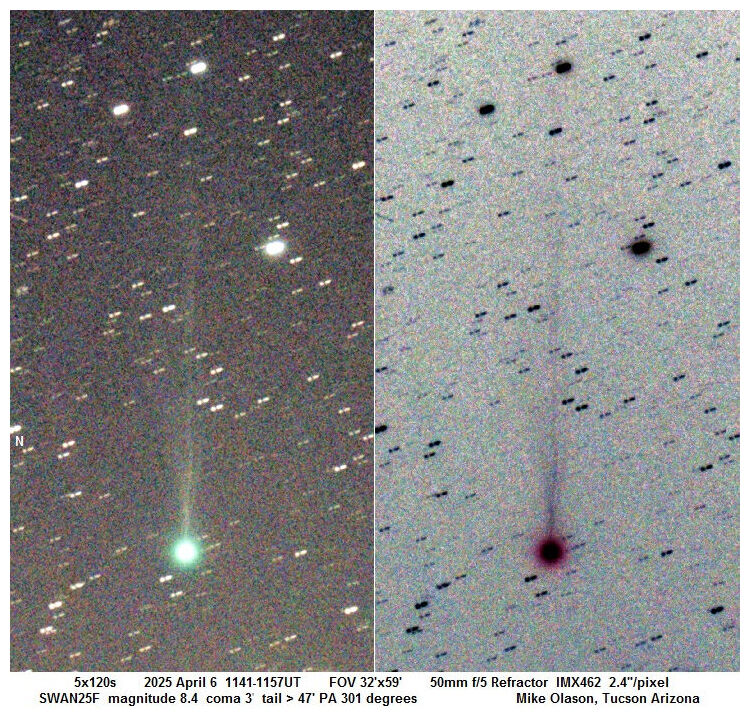
© Mike OlasonComet SWAN25F taken by Mike Olason on April 6, 2025 @ Tucson, Arizona.
"Newly-discovered Comet SWAN25F is brightening nicely as it approaches the sun," reports Mike Olason, who sends these pictures from Tucson, Arizona. "On the morning of April 6th, the comet was magnitude 8.4 with a bright green 3' wide coma and a thin tail that extended well beyond my field of view."

The comet is named after the SWAN camera onboard the Solar and Heliospheric Observatory (SOHO). Australian amateur astronomer Michael Mattiazzo noticed the comet in online images. SWAN is a special camera that maps hydrogen in the solar wind, which suggests this comet may be rich in the element.

Cassiopaea

New nova in the 'Teapot'

A new nova for early risers plus three fun observing projects for the week ahead.

New Nova in Teapot
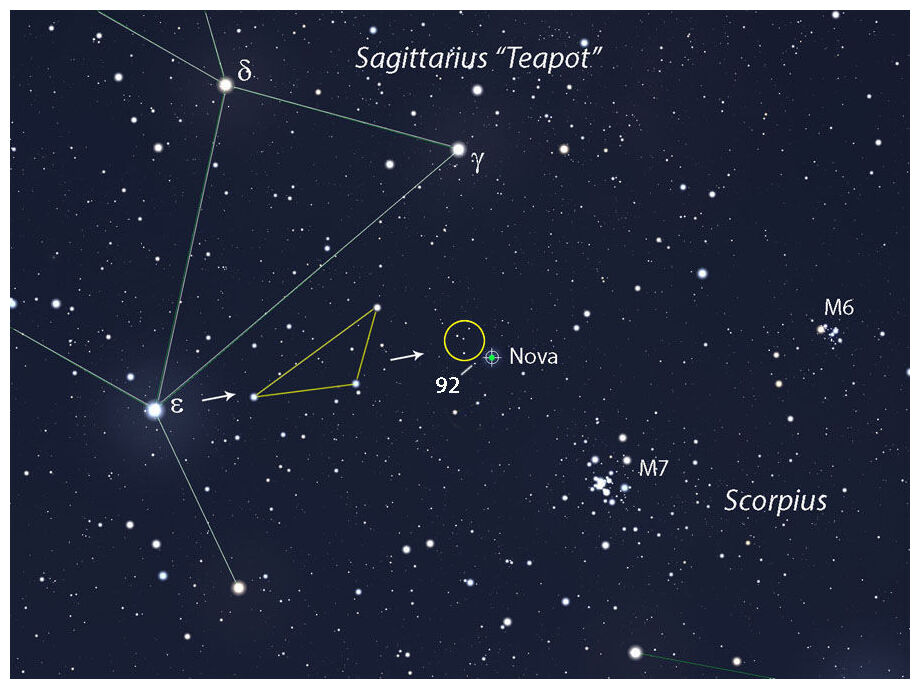
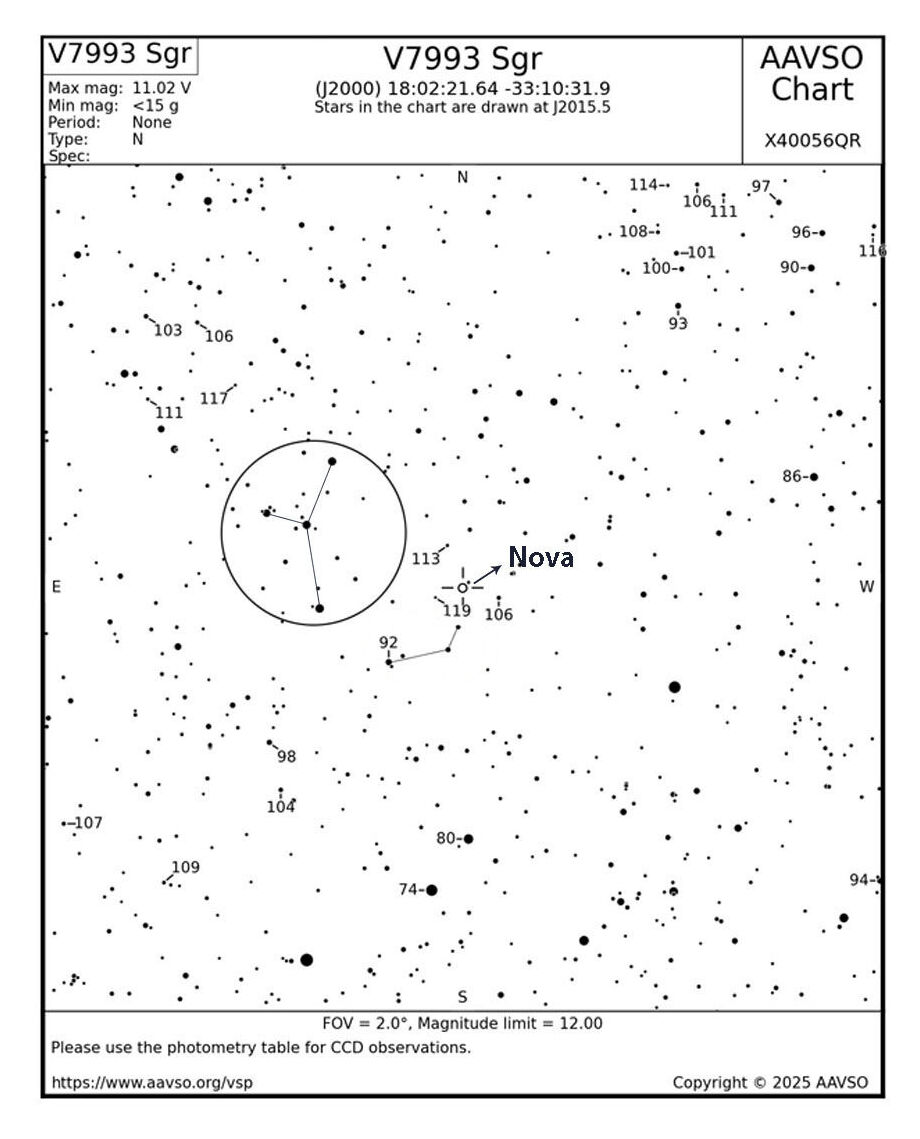
© Stellarium with additions by Bob KingThe nova is located between the Teapot's "Spout" and the bright open cluster M7 in Scorpius. I include a suggested star-hopping route, starting at the 2nd magnitude star Epsilon (ε) Sagittarii. Once you've arrived at the asterism (circled), use the chart below to pinpoint the nova's location. North is up.
We have a new "star" in the night sky. In truth, it's been there for billions of years, but it only first revealed itself a little more than a week ago. Nova Sagittarii 2025 no. 3 was independently discovered on March 23-24 by the Russian New Milky Way (NMW) Survey and Japanese amateur Tadashi Kojima at a right ascension of 18h 02′ and declination of -33° 11′. Both parties caught the star around magnitude 13; two days later it had brightened to 10.5. Despite its southerly declination, the nova stands more than 10° above the horizon before the start of dawn, making it an attainable target even for observers in the northern U.S.

Nova Sagittarii 2025 no. 3
© Courtesy of the AAVSOIt's a quick hop to the nova from the circled asterism. Take a close look at the star's color — many novae glow red from hydrogen emission during the early phase of the explosion. V7993 Sgr has also been reported to have a red color. Decimals are omitted in the comparison star magnitudes. For example, 106 equals magnitude 10.6.
Clouds have thwarted my attempts to see it, but most estimates posted to the AAVSO peg it at magnitude 10.7 on April 1st. Not long after its discovery, the star received the official designation V7993 Sagittarii, making it the 7,993rd variable star to be discovered in Sagittarius. Although novae can appear anywhere in the sky, they're far more common within the star-dense band of the Milky Way, and especially in Sagittarius where we face toward the galactic center. In fact, this is the third nova discovered so far this year in the constellation.

Rocket

SpaceX makes history: Astronauts orbit over the Earth's poles

earthrise view space
© NASA’s Earth ObservatoryThe astronauts got a much better view of the poles than this.
Why haven't we done it before? Usually, rockets are launched from west to east, for several important reasons.

On Monday, SpaceX made space history, as four astronauts were launched into a pole-to-pole orbit not traveled by any human before them. But why is this orbit so unusual, and why has nobody done it before?

Though the Fram2 mission is a private one on behalf of cryptocurrency billionaire Chun Wang, the crew has a few scientific tasks.

"During their multi-day mission, Dragon and the crew will explore Earth from a polar orbit and fly over Earth's polar regions for the first time," SpaceX explains. "They will also conduct 22 research [experiments] designed to help advance humanity's capabilities for long-duration space exploration and understanding of human health in space. Throughout Fram2's time on-orbit, the crew are planning to take the first X-ray in space, perform exercise studies to maintain muscle and skeletal mass, and grow mushrooms in microgravity."

Comment: More cool videos from the mission:


Blue Planet

Scientists drilled into Belize's Great Blue Hole and discovered a worrying trend

great blue hole ocean belize
The Great Blue Hole off the coast of Belize
Tropical storms have been steadily increasing in frequency over the past 5,700 years, new evidence from sediment in the Great Blue Hole reveals, with a massive spike in the past two decades.

Scientists took a 98-foot core sample from the bottom of the Great Blue Hole off the coast of Belize to uncover patterns of tropical cyclones over the last 5,700 years. (Image credit: Schafer & Hill/Getty Images)

Tropical cyclones in the Caribbean are getting more frequent — and could increase significantly in the coming decades, evidence found buried deep within the Great Blue Hole suggests.

Researchers took a sediment core from the Great Blue Hole sinkhole, situated about 50 miles (80 kilometers) off the coast of Belize, which revealed that tropical cyclones have increased in frequency over the past 5,700 years. The scientists described their findings in a study published March 14 in the journal Geology.