Science & TechnologyS


TV

Scientists built largest brain 'connectome' to date by having a lab mouse watch 'The Matrix' and 'Star Wars'

brain cells
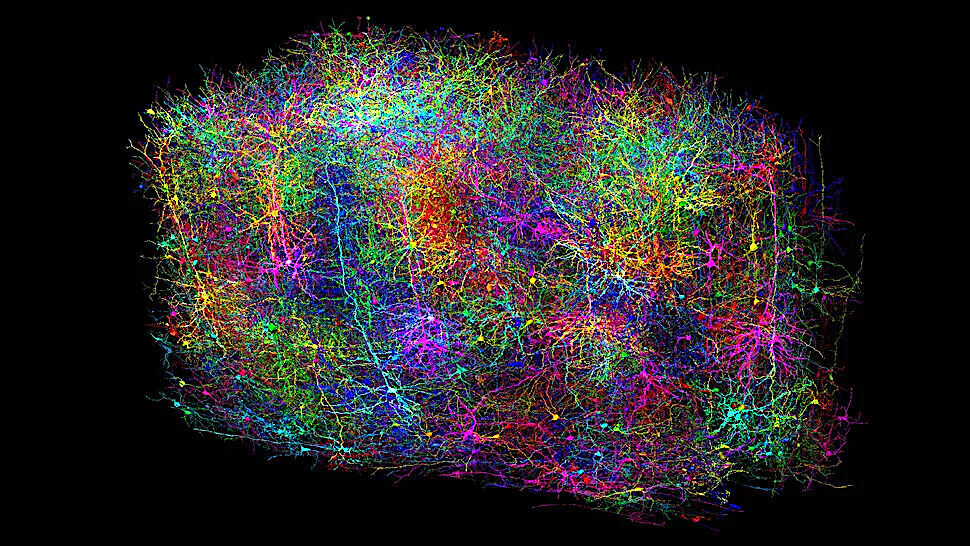
© Allen InstituteThis reconstruction shows more than 1,000 of the 120,000 brain cells captured by the MICRONS project, described below. Each reconstructed neuron is a different random color, and a subset of the neurons have been rendered as glowing in different ways, to represent the fact that the dataset includes functional recordings from some cells.
Using advanced microscopes that capture brain cell anatomy and activity, a portion of a mouse's brain was mapped and rendered into a 3D atlas that creates new possibilities for neuroscience.

The mammal brain is a complex network of billions of cells connected via trillions of nodes that neuroscientists have yet to tease apart. Now, researchers have mapped the many brain cells and connections in a portion of the mouse brain spanning just 1 cubic millimeterroughly the size of a grain of sand.

"A millimeter seems small, but within that millimeter there are kilometers of wiring," Jacob Reimer, a neuroscientist at Baylor College of Medicine, told Live Science. Reimer is the senior author of one of 10 new studies in which scientists detailed how they constructed this remarkable brain map.

Reimer is part of the MICrONS consortium, a team of more than 150 researchers from multiple U.S. institutions. In their series of papers published in Nature journals on April 9, the researchers not only unveiled the 3D neural map, called a "connectome," but also described how they used this dataset to explore the brain's workings.

"This approach bridges a fundamental gap in neuroscience between observing what neurons do and understanding how they're connected," Lilianne Mujica-Parodi, a neuroscientist at Stony Brook University who was not involved with the work, told Live Science in an email.


Cloud Precipitation

Geoengineers want Boeing 777s to dump sulfur into the sky, risking acid rain catastrophe: journal 'Earth's Future'

airplane
Plan "would strongly increase side‐effects such as acid rain," study authors admit.

Scientists are proposing to modify Boeing 777 aircraft to spray sulfur dioxide into the stratosphere in an attempt to cool the Earth in the name of debunked, so-called "climate change" — despite fully acknowledging the serious risk of acid rain and other environmental disasters.

A new study published today in Earth's Future openly admits that this method, called stratospheric aerosol injection (SAI), would sharply increase dangerous side effects like acid rain because it requires "three times more" aerosol to achieve the same cooling effect compared to previous high-altitude schemes.
"However, this low‐altitude strategy requires three times more injection than high‐altitude SAI, and so would strongly increase side‐effects such as acid rain," the study's authors warn​.
Rather than developing new, specially-designed aircraft to reach the ideal 65,000 feet altitude, researchers from University College London and Yale now propose dumping sulfur at just 42,000 feet — within the existing capabilities of modified 777s​.

The ironic catch?

At lower altitudes, sulfur particles would rain out of the sky much faster — meaning a massive increase in the amount of pollutant dumped into the atmosphere.

Galaxy

Why 21 cm is our Universe's "magic length"

galaxy Messier 81 Very Large Array
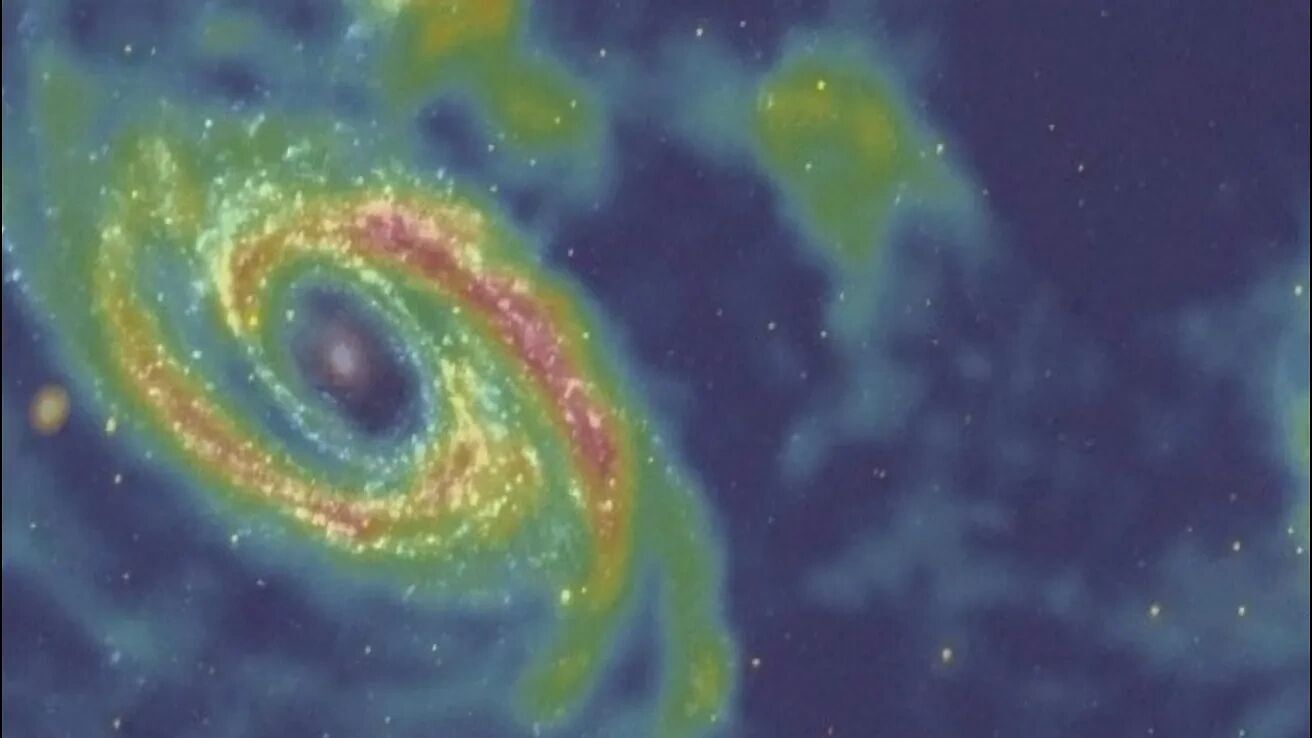
© NRAO/AUI/NSFThis map of the galaxy Messier 81, constructed from data taken with the Very Large Array, maps out this spiral-armed, star-forming galaxy in 21 centimeter emissions. The spin-flip transition of hydrogen, which emits light at precisely 21 centimeters in wavelength, is in many ways the most important length for radiation in the entire Universe.
Photons come in every wavelength you can imagine. But one particular quantum transition makes light at precisely 21 cm, and it's magical.

In our Universe, quantum transitions are the governing rule behind every nuclear, atomic, and molecular phenomenon. Unlike the planets in our Solar System, which could stably orbit the Sun at any distance if they possessed the right speed, the protons, neutrons, and electrons that make up all the conventional matter we know of can only bind together in a specific set of configurations. These possibilities, although numerous, are finite in number, as the quantum rules that govern electromagnetism and the nuclear forces restrict how atomic nuclei and the electrons that orbit them can arrange themselves.

In all the Universe, the most common atom of all is hydrogen, with just one proton and one electron. Wherever new stars form, hydrogen atoms become ionized, becoming neutral again if those free electrons can find their way back to a free proton. Although the electrons will typically cascade down the allowed energy levels into the ground state, that normally produces only a specific set of infrared, visible, and ultraviolet light. But more importantly, a special transition occurs in hydrogen that produces light of about the size of your hand: 21 centimeters (about 8¼") in wavelength. Even as a physicist, you'd be well justified to call this the "magic length" of our Universe, as it just might someday unlock the darkest secrets hiding out in the deepest cosmic recesses from which starlight will never escape.

Volcano

Distributed Acoustic Sensing (DAS): Transforming fiber optic cables into subsurface 'stethoscopes' for revolutionizing volcano and natural disaster monitoring

Volcanos
© forwardpathway.comDAS Volcano Monitoring
A New Era in Volcanic Monitoring: Caltech's Fiber Optic Breakthrough in Iceland

Hey guys, let's chat for a minute about something truly fascinating happening over in Iceland. Your friendly editor here, always on the lookout for cool science that makes a real difference in people's lives. We've all seen the news, right? The Reykjanes Peninsula has been quite restless lately, a lot more rumbling and grumbling under the surface than folks have seen in, well, a very long time - like, centuries! It's a reminder of the powerful forces at play beneath our feet. This uptick in volcanic activity, particularly near the town of Grindavik, has obviously brought a lot of worry and disruption.

But here's where the cool part comes in, a truly innovative approach to keeping an eye on things. Researchers at Caltech, in a fantastic bit of international teamwork, have been using something called Distributed Acoustic Sensing, or DAS for short. Now, bear with me for a second, because this sounds a bit technical, but it's actually pretty straightforward and super clever. Think of it this way: you know those underground fiber-optic cables that carry all our internet traffic and phone calls? Turns out, you can use those same cables as incredibly sensitive listeners to what's happening underground.

Chalkboard

Mathematicians crack 125-year-old problem, unite three physics theories

A breakthrough in Hilbert's sixth problem is a major step in grounding physics in math.

motion of fluids.
© Floriana/Getty ImagesMathematicians suggest they have figured out how to unify three physical theories that explain the motion of fluids.
When the greatest mathematician alive unveils a vision for the next century of research, the math world takes note. That's exactly what happened in 1900 at the International Congress of Mathematicians at Sorbonne University in Paris. Legendary mathematician David Hilbert presented 10 unsolved problems as ambitious guideposts for the 20th century. He later expanded his list to include 23 problems, and their influence on mathematical thought over the past 125 years cannot be overstated.

Hilbert's sixth problem was one of the loftiest. He called for "axiomatizing" physics, or determining the bare minimum of mathematical assumptions behind all its theories. Broadly construed, it's not clear that mathematical physicists could ever know if they had resolved this challenge. Hilbert mentioned some specific subgoals, however, and researchers have since refined his vision into concrete steps toward its solution.

In March mathematicians Yu Deng of the University of Chicago and Zaher Hani and Xiao Ma of the University of Michigan posted a new paper to the preprint server arXiv.org that claims to have cracked one of these goals. If their work withstands scrutiny, it will mark a major stride toward grounding physics in math and may open the door to analogous breakthroughs in other areas of physics.

In the paper, the researchers suggest they have figured out how to unify three physical theories that explain the motion of fluids. These theories govern a range of engineering applications from aircraft design to weather prediction — but until now, they rested on assumptions that hadn't been rigorously proven. This breakthrough won't change the theories themselves, but it mathematically justifies them and strengthens our confidence that the equations work in the way we think they do.

Each theory differs in how much it zooms in on a flowing liquid or gas. At the microscopic level, fluids are composed of particles — little billiard balls bopping around and occasionally colliding — and Newton's laws of motion work well to describe their trajectories.

But when you zoom out to consider the collective behavior of vast numbers of particles, the so-called mesoscopic level, it's no longer convenient to model each one individually. In 1872 Austrian theoretical physicist Ludwig Boltzmann addressed this when he developed what became known as the Boltzmann equation. Instead of tracking the behavior of every particle, the equation considers the likely behavior of a typical particle. This statistical perspective smooths over the low-level details in favor of higher-level trends. The equation allows physicists to calculate how quantities such as momentum and thermal conductivity in the fluid evolve without painstakingly considering every microscopic collision.

Microscope 2

The creatures that exist between life and death

rotofir microscopic animal
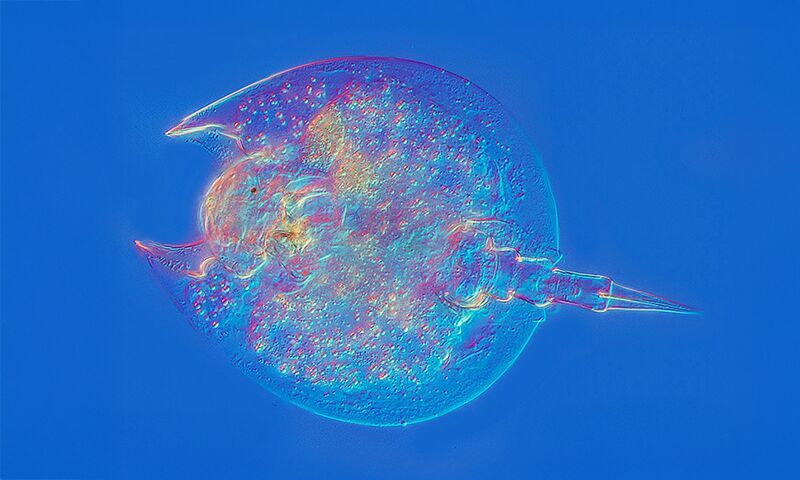
© Robert Budan/canadiannaturephotographer.comThe rotofir Lepadella ovalis - with head withdrawn into the lorica
At the dawn of microbiology, scientists glimpsed unseen worlds and stumbled into a philosophical purgatory

In the late 1600s, self-made scientist Antonie van Leeuwenhoek embarked on a project that would make him question the very nature of life and its limit. And would send ripples of philosophical and scientific quandaries through the generations that persist today. Peering through the hand-ground lenses he crafted, magnifying his subjects 275 times, the Dutch cloth merchant and naturalist was the first human to glimpse an otherworldly microcosmos where astonishing creatures seemed to defy the laws of nature and survival. He called them, adoringly, "animalcules."

In 1687, he discovered some animalcules so peculiar in form and function that he would spend decades observing them. We now know these tiny animals, which had wheel-like appendages that van Leeuwenhoek correctly surmised were for feeding, as rotifers. They live in watery environments throughout the globe, from the tropics to Antarctica, in oceans, temporary puddles, and even in moisture within moss. But van Leeuwenhoek wasn't satisfied just watching them. He decided to test these ubiquitous animals' limits. He wanted to see what would happen to them when their surrounding aqueous environment dried up.

Sun

Professor Nir Shaviv: Global warming mostly caused by Sun, not humans

The Sun over mountains
© Alex Braga/Unsplash.Professor Shaviv says that possibly two-thirds of the 20th century's warming is related to increased solar activity.
Astrophysicist Nir Shaviv says IPCC has got it wrong as they attribute global warming to anthropogenic greenhouse gas emissions and leave out solar effects.

"There's no such thing as a scientific consensus," Nir Shaviv, a professor at the Racah Institute of Physics at the Hebrew University of Jerusalem, says in response to a question about what he thinks of the widespread claim that there is a scientific consensus on the anthropogenic nature of climate change. "In science, we deal with open questions and I think that the question of climate change is an open question. There are a lot of things which many scientists are still arguing about," he explains.

Indeed, there are scientists who say that climate change is caused entirely by humans and the situation is very dire. But then there are those who say that although humans are causing much of the warming, the situation is not as bad as we are being told by politicians and activists through the media. Some think that CO2 plays an important part in the current warming trend and some believe its role is insignificant.

Although Shaviv assesses that some of the warming in the 20th century is indeed the result of increasing atmospheric CO2 concentrations, then most of the change is a natural phenomenon.
"My research has led me to strongly believe that based on all the evidence that's accumulated over the past around 25 years, a large part of the warming is actually not because of humans, but because of the solar effect," he says.

Explosion

China tests non-nuclear hydrogen bomb, science paper shows

white hot fireball
© UnknownWhite-hot fireball from non-nuclear hydrogen bomb
The weapon generates a white-hot fireball that lasts 15 times longer than TNT's fleeting flash.

Chinese researchers have successfully detonated a hydrogen-based explosive device in a controlled field test, triggering devastating chemical chain reactions without using any nuclear materials, according to a study published last month.

The 2kg (4.4lbs) bomb generated a fireball exceeding 1,000 degrees Celsius (1,832 degrees Fahrenheit) for more than two seconds - 15 times longer than equivalent TNT blasts - without using any nuclear materials, it said.

Developed by the China State Shipbuilding Corporation's (CSSC) 705 Research Institute, a key player in underwater weapon systems, the device uses a magnesium-based solid-state hydrogen storage material.

This material - a silvery powder known as magnesium hydride - stores considerably more hydrogen than a pressurised tank. It was originally developed to bring the gas to off-grid areas, where it could power fuel cells for clean electricity and heat.

Beaker

Student accidentally creates 'shape-recovering liquid' that's an exception to the laws of thermodynamics

Shape recovering liquid
Screenshot from video
'Beauty' particle discovered at world's largest atom smasher could unlock new physics

Researchers have discovered a "shape-recovering liquid" that appears to defy the laws of thermodynamics. The liquid, which is made up of oil, water and magnetized particles, consistently separates into a form resembling a Grecian urn.

This discovery began when Anthony Raykh, a polymer science and engineering graduate student at the University of Massachusetts Amherst, was studying a mixture of oil, water and nickel particles in a vial. He shook the vial to create an emulsion — or a blend of liquids that don't mix. But instead of separating into a clear top and bottom, the mixture formed the shape of a Grecian urn. Even after shaking the vial over and over, it kept returning to this shape.

"That's really odd," study co-author Thomas Russell, a professor of polymer science and engineering at University of Massachusetts Amherst, told Live Science. It's strange, he explained, because typically when a mixture of liquids that don't blend return to equilibrium before emulsion, they want to minimize the interfacial area, or the boundary between the two liquids. This tendency to minimize the interfacial area is governed by the laws of thermodynamics, which describe how temperature, heat, work and energy are related in physical systems.

Violin

Some people are 'wired to connect with music on a deeper level,' study of 9,000 twins finds

2 for music
© Guilermo Spelucin/Getty ImagesThe Experience of Music
Genes affect different aspects of music enjoyment — from the emotional reactions that compositions evoke to the social connection music can foster.

Some people get the chills or feel moved to tears when listening to certain songs, while others tend to experience a less-intense reaction to music. Now, a new study hints that your level of music enjoyment may be partially written in your genes.

According to a study published March 25 in the journal Nature Communications, 54% of the differences in the levels of music enjoyment between individuals can be attributed to their genes. The scientists behind the work attribute the remaining percentage to environmental factors such as growing up in a family that played musical instruments or listened to music together, as well as other, past music-related experiences.

"This study explores something many of us in music have long suspected — some people are just wired to connect with music on a deeper level," Mitchell Hutchings, an associate professor of voice at Florida Atlantic University who was not involved with the work, told Live Science in an email.