Science & TechnologyS


Sun

Strong magnetic fields discovered in majority of stars

Magnetic Field Around Stars
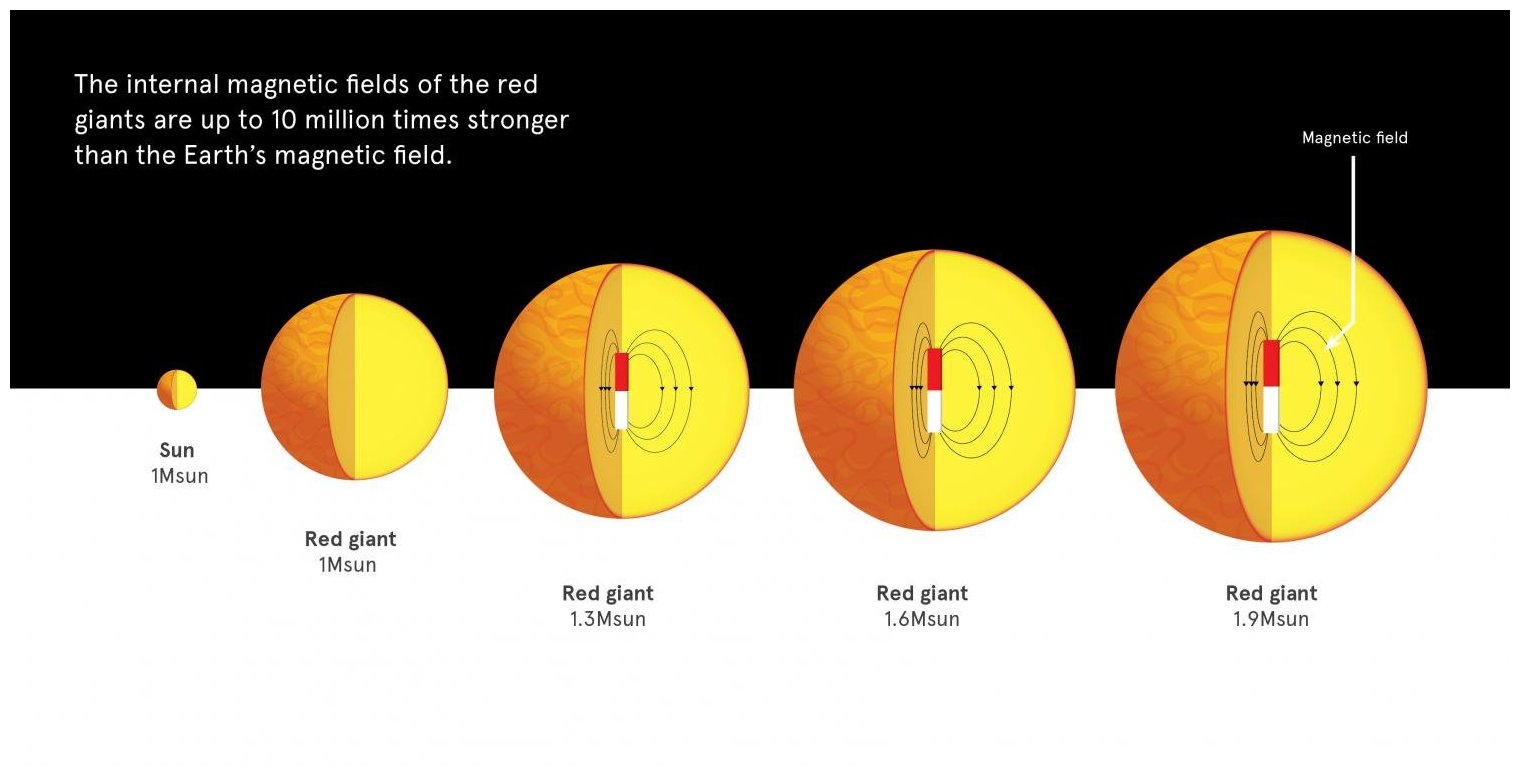
© University of Sydney Stars like the Sun puff up and become red giants towards the end of their lives. The red giants ('old' Suns) of the same mass as the Sun do not show strong magnetic fields in their interior, but for stars slightly more massive, up to 60 percent host strong magnetic fields.
An international group of astronomers led by the University of Sydney has discovered strong magnetic fields are common in stars, not rare as previously thought, which will dramatically impact our understanding of how stars evolve.

Using data from NASA's Kepler mission, the team found that stars only slightly more massive than the Sun have internal magnetic fields up to 10 million times that of the Earth, with important implications for evolution and the ultimate fate of stars.

"This is tremendously exciting, and totally unexpected," said lead researcher, astrophysicist Associate Professor Dennis Stello from the University of Sydney.

"Because only 5-0 percent of stars were previously thought to host strong magnetic fields, current models of how stars evolve lack magnetic fields as a fundamental ingredient," Associate Professor Stello said. "Such fields have simply been regarded insignificant for our general understanding of stellar evolution.

"Our result clearly shows this assumption needs to be revisited."

The findings are published today in the journal Nature.

Robot

Facebook founder Zuckerberg makes building an AI butler his New Year's resolution

Facebook founder Zuckerberg
© Stephen Lam / ReutersFacebook CEO Mark Zuckerberg
Facebook founder Mark Zuckerberg may not quite be Tony Stark, but he wants to build an artificially intelligent digital assistant modeled after Jarvis, the cyber-butler from Marvel's 'Iron Man' universe. Can the "Age of Ultron" be far behind?

The tech billionaire announced his plan on Sunday night, saying that he wants an AI assistant to help run his life more efficiently.

Comment: See more:
  • Corporate charity = Corporate power
  • Mark Zuckerberg's phony generosity


Info

4 new elements added to the periodic table

Periodic Table
© isak55/Shutterstock
Welcome to the world, elements 113, 115, 117 and 118!

Four new elements will join more than a hundred others on the periodic table of the elements, the International Union of Pure and Applied Chemistry (IUPAC) announced last week. The last time the venerable chemistry mainstay added new elements to its roster was in 2012, when elements 114 and 116 got the names flerovium and livermorium, respectively.

"The chemistry community is eager to see its most cherished table finally being completed down to the seventh row. IUPAC has now initiated the process of formalizing names and symbols for these elements," Jan Reedijk, president of the Inorganic Chemistry Division of IUPAC, said in a statement.

Robot

How far will science go in its pursuit of immortality?

brain
© shutterstock
There are a lot of outrageous claims being made within the halls of neuroscience and artificial intelligence. Whether exaggerations, wishful thinking, the dreams of the egocentric and megalomaniacal to be immortal, or just drumming up funding for a never-ending round of "scientific investigation," the year 2045 seems to always be cited as a target date.

Ray Kurzweil popularized the notion of The Singularity - the threshold when computing power would match or exceed the human brain and human biological systems - in his 2006 book The Singularity is Near: When Humans Transcend Biology. In that book, and subsequent articles, he theorized that 2045 would be the far end of when we could expect full integration of human and machine that would create immortality.

So far there have been indications that we are indeed proceeding in this direction. Beyond the gadgets we all use to augment our intelligence, each day seems to offer a new medical development that reads more like science fiction than reality. Just the other day there was an article in The Seattle Times that a new type of flexible brain implant could enable the paralyzed to walk again. We have robotic prostheses, humanoid robots, artificial human skin, and a range of nanotechnology applications used in medicine and the military that are quickly redefining life and nature itself. In fact, it's been proclaimed by scientists that the era of cyborgs has begun.

Cheeseburger

Eating at odd times can dull the memory

Clock
© Earth Times Org
Shift work and other aspects of a busy lifestyle lead to people eating at times when the body is not geared to be expecting food. New research shows "midnight eating" can dull the memory.

The finding relates to studies conducted using mice. By varying the eating times for mice, scientists have shown that internal clocks wired in different regions of the brain begin working out of step if feeding times step outside from the norm.

This leads to an alteration to the,physiology of the brain, and learning and memory are particularly affected. The function of memory is controlled by the hippocampal area of the brain. The science group say there is a reasonable chance the same effects will occur with people.

Eating at strange hours, later into the night, has previously been linked with physiological ill-health (such as pre-diabetes). Scientists from the David Geffen School of Medicine at University of California, Los Angeles were interested to explore the psychological impact.

By varying the times that mice eat at, the researchers assessed the ability of mice to recall a common object. Mice fed when they would normally be asleep saw a significant reduction in their long-term memory. Physiological examinations showed the process of memory formation, where nerve impulses are fired in the brain, were less effective with mice fed at night compared with a control group fed during the day.

X

Scientists discover two dangerous earthquake faults in California Bay Area appear to be linked together

Hayward and Rodgers Creek fault
© CBS News
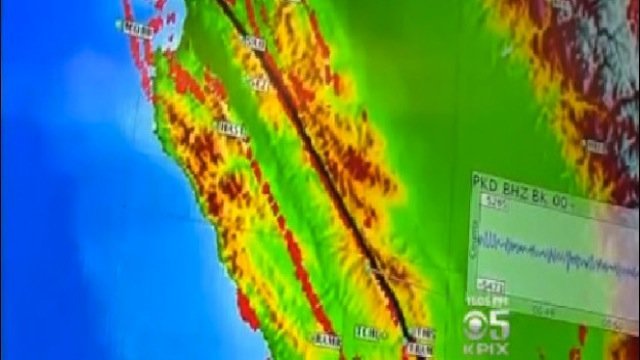
Scientists have discovered an alarming connection underwater: Two of the most dangerous earthquake faults in the Bay Area.

Experts long debated whether the Hayward Fault and the Rodgers Creek Fault connected, but now there's strong evidence they do.

US Geological geophysicist Janet Watt made the discovery in an underwater survey using an acoustic instrument over the San Pablo Bay. She says the data is clearer than ever.

"We now have direct evidence that the faults come closer together in the bay and may be directly connected," says Watt. "It would be devastating for an earthquake to rupture at both those faults — it'd be a very strong earthquake."

Two Bay Area fault lines could potentially trigger a 7.3 magnitude earthquake if they ruptured together. That's stronger than the 1989 Loma Prieta quake.

"If these two faults are connected then that means it would be easier for an earthquake to rupture from the Hayward to Rodgers or vice versa," says Watt.


Comment: Four San Francisco fault lines have built up enough seismic strain to unleash destructive earthquakes


Cassiopaea

Nova discovered on Christmas Day

New Star_1
© Slooh
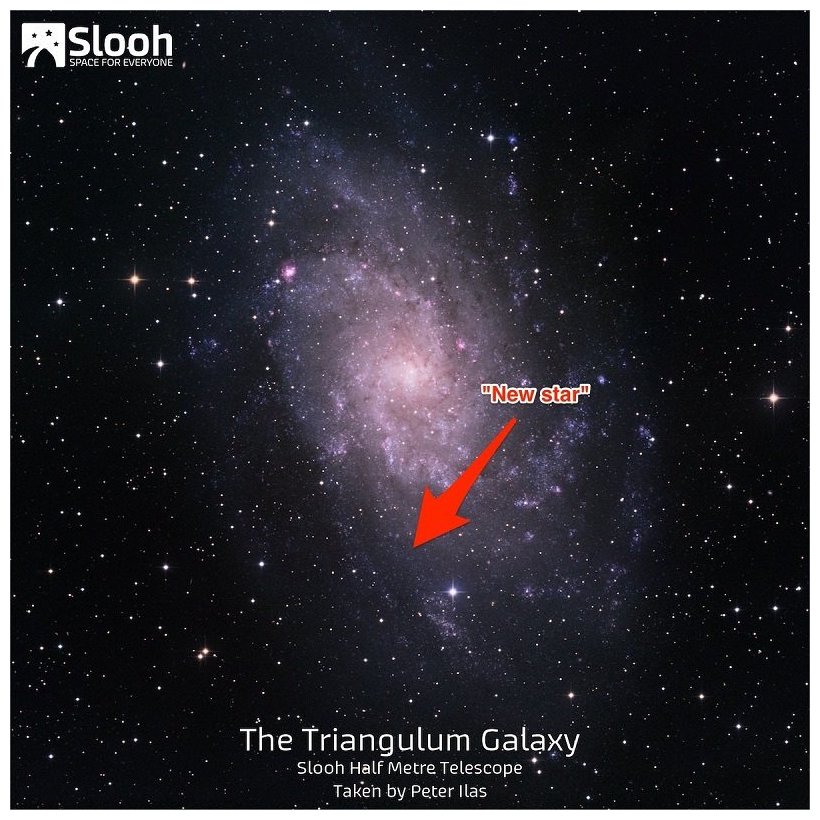
A nova discovered in the Triangulum Galaxy.

Although no three kings were present at the time, amateur astronomer Emmanuel Conseil discovered a "new star" or nova in the Triangulum Galaxy on Christmas Day.

He made the discovery using the online Slooh observatory, whose telescopes are located in the Canary Islands. It was the second time Conseil had discovered a nova this way.

Slooh did a live broadcast of the galaxy and its "new star" on its webpage Tuesday afternoon, and will host a second show next week Tuesday at 2:30 p.m. EST, when scientists will hopefully know what kind of nova it is.

"The object was there on my images on Christmas Day, but not there on the 24th. It's pretty new!" Conseil said in a statement.

Arrow Up

Victory over corrupt science and the Monsanto GMO cartel

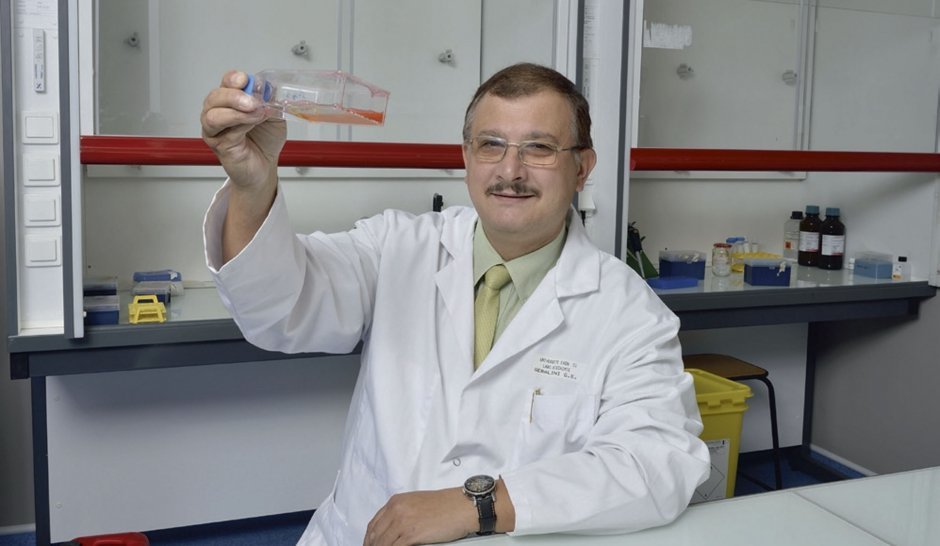
Gilles-Eric Séralini
There is very positive news coming out of Paris, a city with more than her share of bad news lately. It's a major legal victory for the voices of science and reason against the GMO Monsanto-led cabal. Its implications will be felt worldwide. If our world ever gets the will to rid the 21st Century Black Death plague masquerading under the name of Genetic Manipulation of Organisms or GMO, it will owe a huge debt of gratitude to the courageous work of Prof. Gilles-Eric Séralini and his extraordinary team of dedicated scientists at CRIIGEN, the Committee for Independent Research and Information on Genetic Engineering, in France.

In a world where industry's corruption of scientists has almost become ordinary, the existence of a non-industry-funded team of scientists dedicated to producing research and independent information on genetic engineering and its impacts in biology, environment, agriculture, food, medicine, and public health, including the short, medium and long-term effects on human health and on the health of the entire living ecosystem, is, so far as I am aware, unique. Few are aware of their tireless and largely thankless work.

For this reason it's doubly good news that the Paris High Court has just announced a verdict in favor of Seralini in a libel trial. On 6 November 2015, the High Court of Paris indicted Professor Marc Fellous, former chairman of the French Biomolecular Engineering Commission, for "forgery" and "the use of forgery," in a libel trial he lost to Prof Séralini. The penalty will be decided sometime in 2016.

Comment:


Bug

Carpenter ants social behavior reprogrammed using epigenetic drugs

carpenter ants
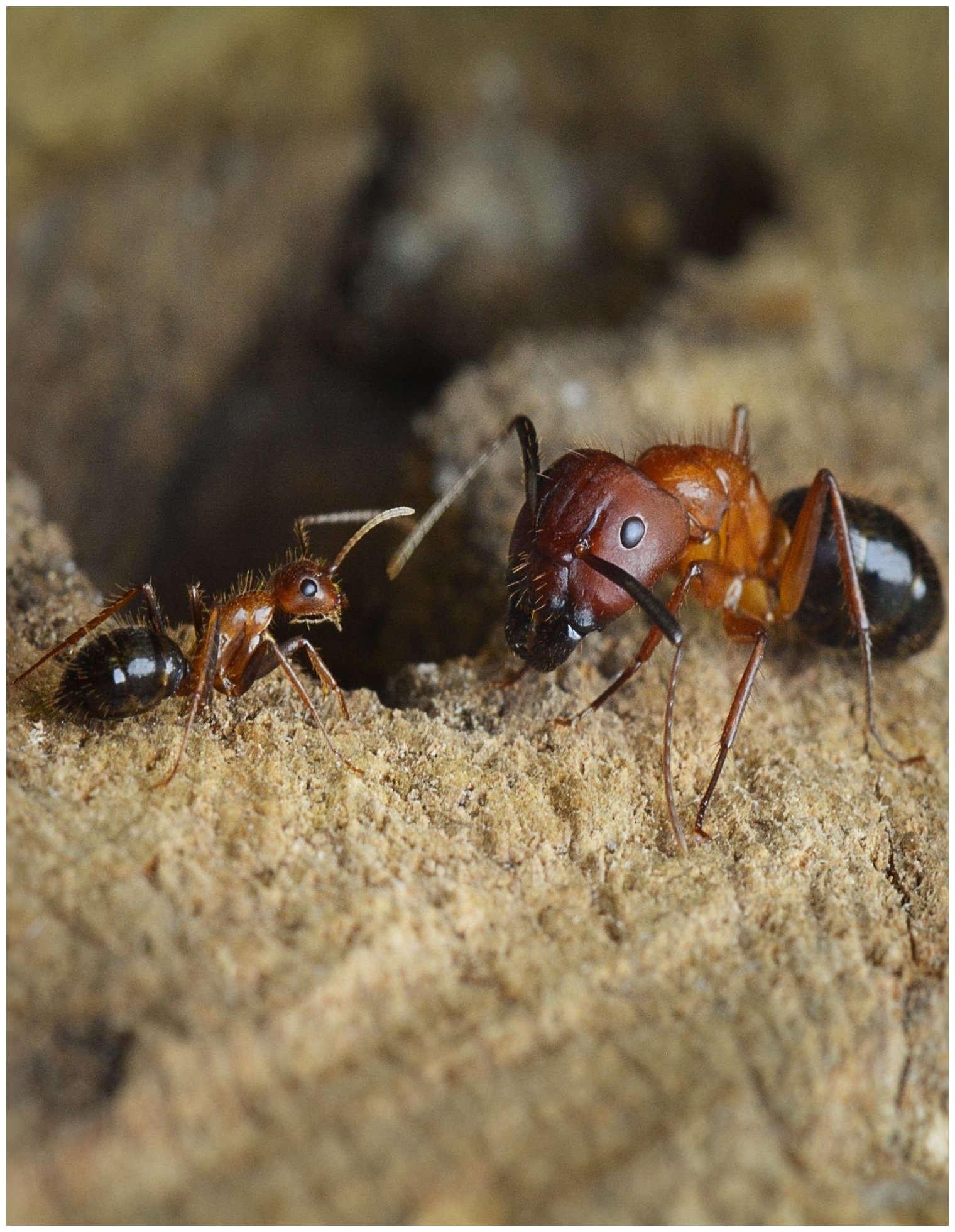
© Shelley Berger, PhD, Perelman School of Medicine, University of PennsylvaniaFlorida carpenter ants, minor caste (left) and major caste, are shown.
In Florida carpenter ant colonies, distinct worker castes called minors and majors exhibit pronounced differences in social behavior throughout their lives. In a new study published today in Science, a multi-institution team anchored at University of Pennsylvania found that these caste-specific behaviors are not set in stone. Rather, this pioneering study shows that social behavior can be reprogrammed, indicating that an individual's epigenetic, not genetic, makeup determines behavior in ant colonies.

Epigenetics is the study of stable, or persistent, changes in gene expression that occur without changes in DNA sequence. Epigenetic regulation has been observed to affect a variety of distinct traits in animals, including body size, aging, and behavior. However, there is an enormous gap in knowledge about the epigenetic mechanisms that regulate social behavior.

Ants provide ideal models to study social behavior, because each colony is comprised of thousands of individual sisters—famously, the queen and all workers are female—with nearly identical genetic makeup, much like human twins. However, these sisters possess stereotypically distinct physical traits and behaviors based on caste.

In a previous study, the authors created the first genome-wide epigenetic maps in ants. This revealed that epigenetic regulation is key to distinguishing majors as the "brawny" soldiers of carpenter ant colonies, compared to minors, their smaller, "brainier" sisters. Major ants have large heads and powerful mandibles that help to defeat enemies and process and transport large food items. Minor ants are much smaller, outnumber majors two to one, and assume the important responsibility of searching for food and recruiting other ants to help with the harvest. Compared to majors, these foraging minors have genes involved in brain development and neurotransmission that are over expressed.

Magnet

Massive G3 solar storm to hit Earth just before New Year's Eve; Northern Lights visible in northern U.S. states

Solar storm
© aia.lmsal.com
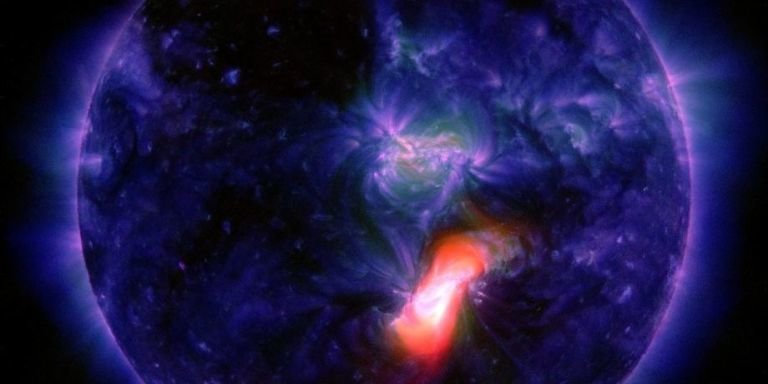
A massive solar eruption is about to hit Earth, and the resulting northern lights could be spectacular just before New Year's Eve for those in the right latitudes. NOAA forecasts the aurora borealis will dip clear down to Oregon, with a small chance of even the Bay Area seeing the northern lights.

"It's certainly possible," Terry Onsager, a physicist with the National Oceanic and Atmospheric Administration told Sfgate. "It depends entirely on the strength of the storm. If it turns out to be stronger than that, it could be seen."

On Monday, a powerful M1.9 class solar flare erupted from the sun. The solar phenomenon will hit Earth early in the morning on December 30th, and the effects could linger into New Year's Eve.

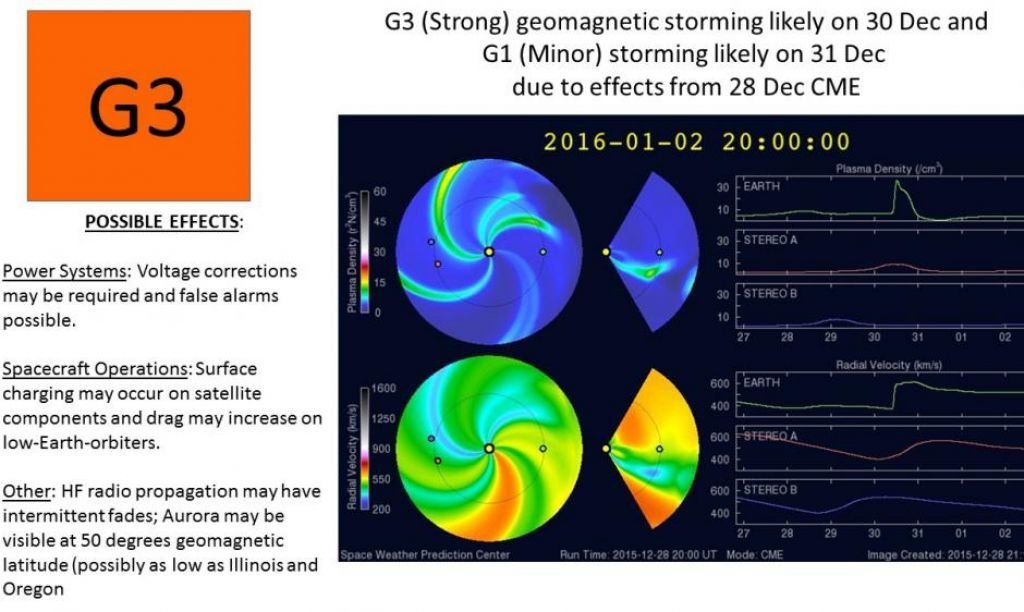
NOAA is predicting a strong "G3" class geomagnetic storm. The rating system classifies the magnetic fields created by these solar events on a scale of G1 to G5. A G3 storm like what will hit this week can create fluctuations in power grids, cause radio blackouts in the higher latitudes, and even affect GPS reception. A less common G4 storm would create northern lights visible in California.
Solar storm warning
© NOAA
Onsager describes the coronal mass ejection as, "...a chunk of the sun's atmosphere, mainly protons and electrons, that carries a magnetic field."

"The whole earth's magnetic system is embedded in this flowing 'battery,'" said Onsager, "and that is what drives the electric currents around us." When the electricity hits the upper atmosphere, it glows just like a neon light.

If you're flying early in the morning on December 30th, or live in the northern states, you're likely to see the northern lights between 2 a.m. and 6 a.m. Wednesday.