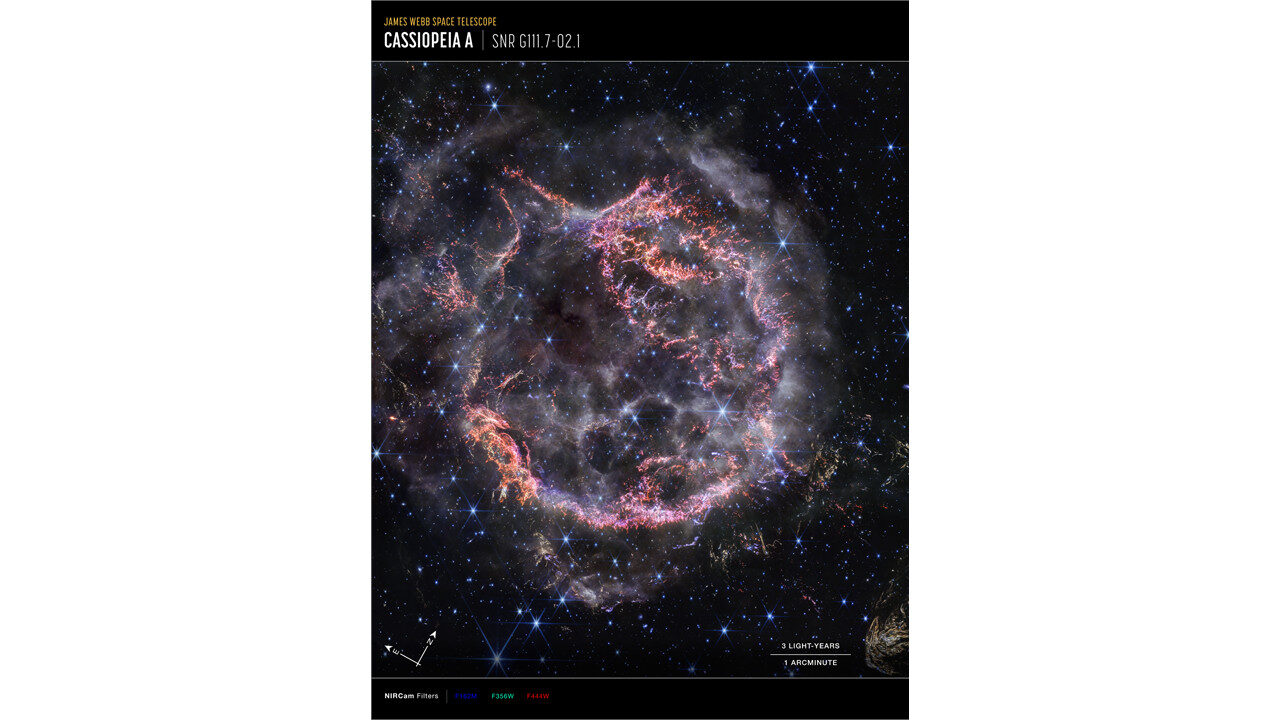
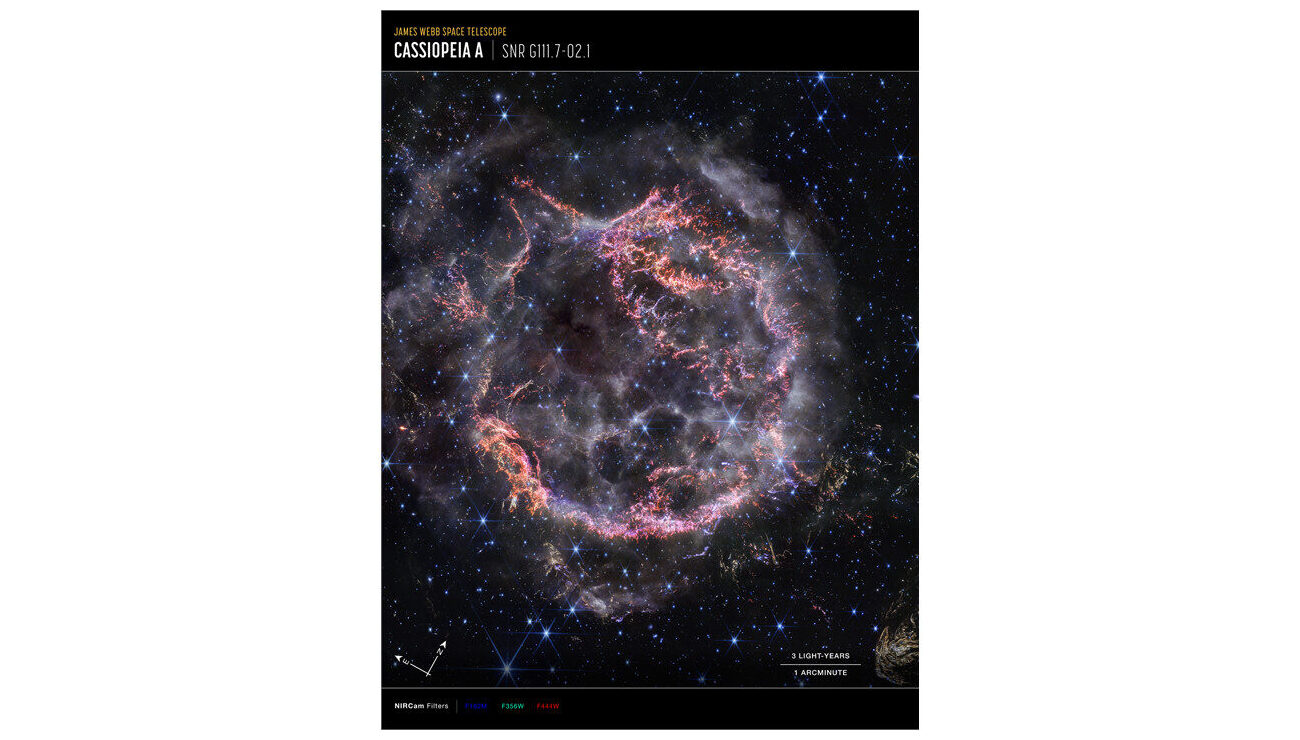
© NASA, ESA, CSA, STScI, Danny Milisavljevic (Purdue University), Ilse De Looze (UGent), Tea Temim (Princeton University)This image of the Cassiopeia A supernova remnant, captured by Webb’s NIRCam (Near-Infrared Camera) shows compass arrows, scale bar, and color key for reference.
Objects in space reveal different aspects of their composition and behavior at different wavelengths of light. Supernova remnant Cassiopeia A (Cas A) is one of the most well-studied objects in the Milky Way across the wavelength spectrum.
However, there are still secrets hidden within the star's tattered remains.The latest are being unlocked by one of the newest tools in the researchers' toolbox, NASA's James Webb Space Telescope — and Webb's recent look in the near-infrared has blown researchers away.
Like a shiny, round ornament ready to be placed in the perfect spot on a holiday tree, supernova remnant Cassiopeia A (Cas A) gleams in a new image from NASA's James Webb Space Telescope.
As part of the
2023 Holidays at the White House, First Lady of the United States Dr. Jill Biden debuted the first-ever White House Advent Calendar. To showcase the "Magic, Wonder, and Joy" of the holiday season, Dr. Biden and NASA are celebrating with this new image from Webb.
While all is bright, this scene is no proverbial silent night. Webb's NIRCam (Near-Infrared Camera) view of Cas A displays this stellar explosion at a resolution previously unreachable at these wavelengths. This high-resolution look unveils intricate details of the expanding shell of material slamming into the gas shed by the star before it exploded.
Cas A is one of the most well-studied supernova remnants in all of the cosmos. Over the years, ground-based and space-based observatories, including NASA's
Chandra X-Ray Observatory,
Hubble Space Telescope, and retired
Spitzer Space Telescope have assembled a multiwavelength picture of the object's remnant.
However, astronomers have now entered a new era in the study of Cas A. In April 2023, Webb's MIRI (Mid-Infrared Instrument)
started this chapter, revealing new and unexpected features within the inner shell of the supernova remnant. Many of those features are invisible in the new NIRCam image, and astronomers are investigating why.













Comment: See also: Scientists discovered a crucial element for life gushing out of Saturn's icy ocean moon