Science & TechnologyS


Info

World's highest and longest glass bridge closes indefinitely 2 weeks after grand opening in China

world's highest and longest glass-bottomed bridge
© Fred Dufour / AFP
A true architectural wonder - the world's longest and highest glass-bottomed bridge which provides visitors with magnificent views of China's Zhangjiajie mountains - has been closed indefinitely just two weeks after its opening.

The record-breaking structure which gives even the most robust adrenaline junkies the chills, was closed on Friday - just 13 days after its grand opening in China's Zhangjiajie Grand Canyon, authorities said.

On Thursday officials posted an announcement on the Chinese microblogging site Weibo, saying the bridge has been closed due to the "urgency to improve and update" the construction. The officials said no damage had been done to the bridge and it just needed upgrading.

Galaxy

Discovery of highly unusual planetary system finds twin stars hosting three giant exoplanets

solar twin binary system
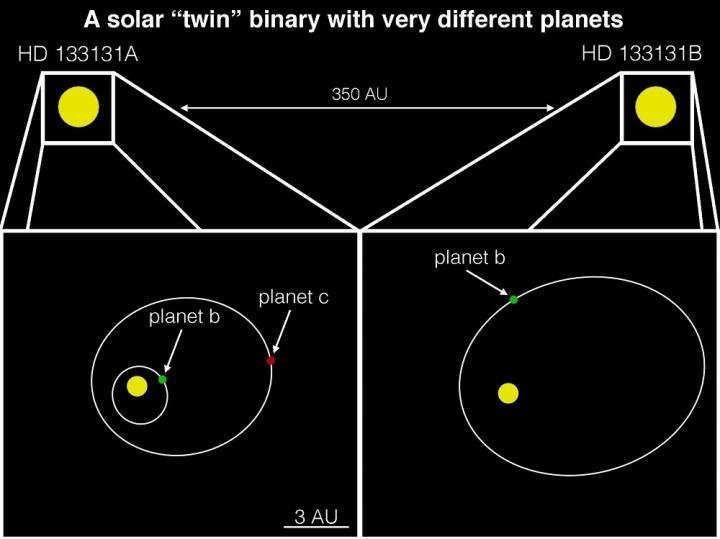
© Timothy Rodigas.This is an illustration of this highly unusual system, which features the smallest-separation binary stars that both host planets ever discovered. Only six other metal-poor binary star systems with exoplanets have ever been found.
A team of Carnegie scientists has discovered three giant planets in a binary star system composed of stellar ''twins'' that are also effectively siblings of our Sun. One star hosts two planets and the other hosts the third. The system represents the smallest-separation binary in which both stars host planets that has ever been observed. The findings, which may help explain the influence that giant planets like Jupiter have over a solar system's architecture, have been accepted for publication in The Astronomical Journal.

New discoveries coming from the study of exoplanetary systems will show us where on the continuum of ordinary to unique our own Solar System's layout falls. So far, planet hunters have revealed populations of planets that are very different from what we see in our Solar System. The most-common exoplanets detected are so-called super-Earths, which are larger than our planet but smaller than Neptune or Uranus. Given current statistics, Jupiter-sized planets seem fairly rare -- having been detected only around a small percentage of stars.

This is of interest because Jupiter's gravitational pull was likely a huge influence on our Solar System's architecture during its formative period. So the scarcity of Jupiter-like planets could explain why our home system is different from all the others found to date.

Jupiter

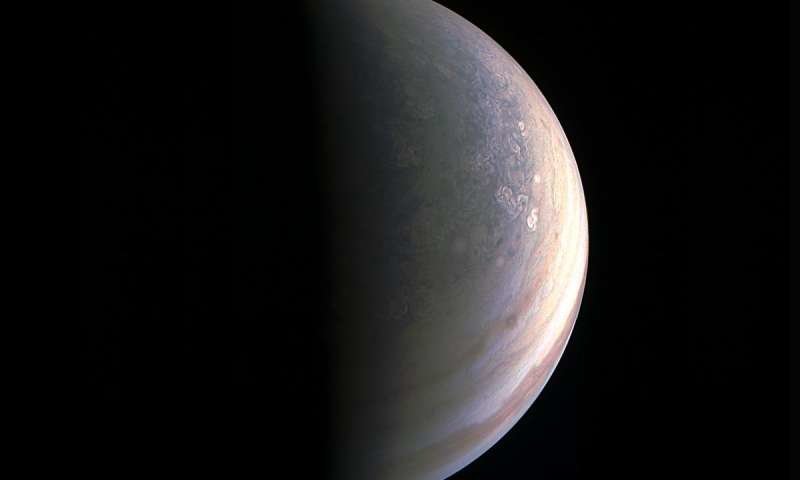
NASA's Juno probe reveals that Jupiter's north pole is 'like nothing we have seen or imagined'

Jupiter's north pole
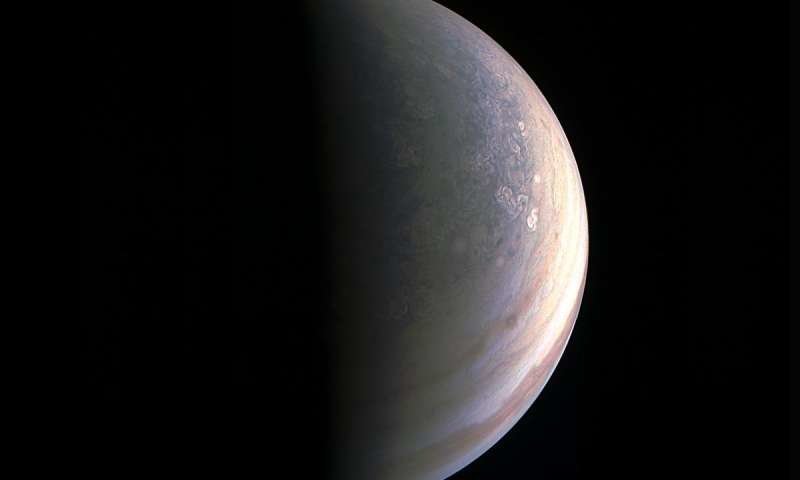
© NASA/JPL-Caltech/SwRI/MSSSNASA's Juno spacecraft captured this view as it closed in on Jupiter's north pole, about two hours before closest approach on Aug. 27, 2016.
NASA has released striking close-up images of Jupiter's north pole and its southern lights, all captured by the Juno spacecraft which is now in orbit around the gas giant.

The images show a different side of the planet, Scott Bolton, principal investigator of Juno from the Southwest Research Institute said in statement released via NASA on Friday.

"First glimpse of Jupiter's north pole, and it looks like nothing we have seen or imagined before. It's bluer in color up there than other parts of the planet, and there are a lot of storms," Bolton said.

"There is no sign of the latitudinal bands or zone and belts that we are used to - this image is hardly recognizable as Jupiter. We're seeing signs that the clouds have shadows, possibly indicating that the clouds are at a higher altitude than other features," he added.

The southern aurora of Jupiter was captured by June on August 27 along with the other data, giving what the space agency said was a unique look at the planet in detail.

The spaceship's Infrared Auroral Mapper (JIRAM) camera acquired the view at wavelengths ranging from 3.3 to 3.6 microns, which is the wavelengths of light emitted by excited hydrogen ions in the polar regions.


Question

Stratospheric deviation in wind pattern reversal observed for the first time

Earth’s stratosphere
© NASA/JSC Gateway to Astronaut Photography of EarthEarth’s stratosphere lies just above the red-orange troposphere in this photo snapped by International Space Station astronauts in 2011. Late last year, unusual wind behavior interrupted a reliable stratospheric wind pattern known as the quasi-biennial oscillation.
For the first time, scientists have observed a deviation from the typical alternating pattern of easterly and westerly winds in the equatorial stratosphere.

The weather we experience on Earth typically occurs in the troposphere, the lowest layer of the atmosphere. But the stratosphere, which envelops the planet just above the troposphere, is home to winds of its own. In a new study, Newman et al. report an anomalous interruption in an otherwise reliable stratospheric wind pattern known as the quasi-biennial oscillation.

Each cycle of the quasi-biennial oscillation begins with strong westerly winds that flow through the stratosphere in a belt around the equator. Over the course of about 1 year, these winds gradually weaken and descend in altitude to the lower stratosphere as easterly winds replace them. These easterly winds slowly sink and weaken, too, as westerly winds return. The cycle repeats roughly once every 28 months.

Since 1953, scientists have observed equatorial winds by instruments known as radiosondes, which are carried skyward by weather balloons. The quasi-biennial oscillation was discovered in the early 1960s. Although the timing of each cycle has sometimes varied by a few months, the pattern as a whole has remained uninterrupted—until now.

2 + 2 = 4

One receptor, two ligands, different responses

Host and bacterial ligands that interact with the same cell-surface receptor induce different activities in human macrophages.

Macrophage
© WIKIMEDIA, NIAIDMacrophage
Macrophages detect and kill pathogens, but also recognize and repair damage to host tissues. How the cells determine which response is required, however, is somewhat of a mystery. Now, researchers at the University of Oxford studying the macrophage toll-like receptor 4 (TLR4), which interacts with both bacterial lipopolysaccharide (LPS) and host protein tenascin-C, show that the two molecules trigger different pathways and proteins in the macrophages that govern contrasting responses. The findings were published in Science Signaling.

"This is a very interesting paper. It addresses a big overall question of how does the immune system distinguish between infection and non-infectious tissue damage," said immunologist Cynthia Leifer of Cornell University College of Veterinary Medicine in Ithaca, New York, who was not involved in the study. "The overall conclusion is that, through one innate immune receptor, with two different ligands, you can trigger two different types of outcome."

Robot

SONY to build robot with 'emotional connection' with humans

Robot and Frank
© thefilmstage.comScene from the movie "Robot and Frank'
Sony is working on a domestic robot which can form "an emotional connection" with robots [humans], it has been revealed. The firm's CEO, Kaz Hirai, said his designers are working to hard to produce a machine that humans will "bond" with.

Speaking at the IFA tech conference, he said: "I'm happy to report that we are working hard to create a robot for your home that is not only capable of assisting you with everyday needs but is really capable of forming an emotional connection with all of you. "You definitely want to stay tuned."

Of course, many humans will be unsettled by the idea of inviting a machine into their home. Science fiction is full of stories about robots which go rogue and end up killing their owner. Experts have also raised fears about the possibility of artificial intelligence becoming smarter than humans. However, Hirai told Mirror Online this "shouldn't be a concern". He said: "If Sony comes up with a robot for the house, is the AI involved in that going to be dangerous or not? Consumers ultimately decide."

Unfortunately, there's good evidence to suggest robots could make terrifying house guests. You might like the sound of a world where robots do all the work whilst you sit back and sip pina coladas. But Google staff have warned that domestic labour-saving machines could end up attacking their owners. In a research paper, three of the tech giant's top artificial intelligence experts explored what could go wrong when lazy humans let cleaning contraptions do all the hard work around their home.

Comment: So, the AI may be better emotionally adjusted than we are?!! We hardly 'live' our lives now, with all our gadgets and secondary 'real-life' experiences (computers, texting, shop online, etc.). Robots doing the work offers humans a nursing home-style existence. This development is just one more nail in the coffin of human existence in any meaningful way. Are you OK with that?


Megaphone

Science explains why it's impossible to ignore a baby's cry

crying baby
© ShutterstockThat noise is far more sophisticated than it sounds.
Have you ever been sat on a flight with a crying baby in your vicinity, wondering more and more with each successive wail how much longer you can stand the sound? Or maybe you've been a parent, barely able to resist for a second before running to soothe your precious infant's ear-piercing distress? Most of us have been there at some point in our lives. But what exactly is it about a baby's cry that makes it so hard to ignore?

First, it is important to draw a distinction between crying and tears. Many species produce cries, but we appear to be the only animals that send emotional droplets streaming down from our tear ducts. While tears often accompany cry vocalisations in older age, they are by no means a prerequisite of crying - newborns cry from birth but don't produce tears until they are two to three months in age. It also turns out that these early cries have evolutionary roots separate from the more cultural, learned "emotional crying" that we develop in later life.

Crying is a primitive behaviour shared across mammals, whose governing mechanisms are rooted in the evolutionarily ancient brain stem - infant rats, cats, and humans have all been shown to be able to cry even when the forebrain, which evolved much later, is absent. Indeed, the cries of many human and non-human mammal infants are highly similar in both acoustic structure and in the contexts in which they occur - across the mammal kingdom, infants cry primarily when they're hungry, when they're in pain, and when they're alone.

Comment: See also:


Jet1

It's about the long range: Why the F-35 could 'never in a million years' beat the RAF Typhoon or the Russian Su-35 in a dogfight

F-35 fighter jet
© Matt Cardy/Getty Images
In a recent interview with Business Insider, Justin Bronk, a research fellow specializing in combat airpower at the Royal United Services Institute, dropped a bombshell about the US's $1 trillion F-35 program:

"The F-35 cannot outdogfight a Typhoon (or a Su-35), never in a million years."

In earlier stages of the F-35's development, some bad reports came out claiming it lost in simulated dogfights to the F-16, a legacy platform the F-35 is meant to replace in the US Air Force.

The latest news coming out about the F-35's dogfighting ability has taken a visible turn to the positive, but dogfighting was never the main purpose or strong suit of the Joint Strike Fighter.

For that reason, older fighters like the Eurofighter Typhoon or the Sukhoi Su-35 could most likely outmaneuver and destroy an F-35 in a close-range confrontation.

Cloud Lightning

Lightning strikes and thunderstorms are spreading mercury pollution

thunderstorms mercury pollution
© Florida State universityThunderstorms are moving significant amounts of mercury to the ground.
In the southern United States, an afternoon thunderstorm is part of a regular summer day. But new research shows those storms might be doing more than bringing some scary thunder and lightning.

In fact, these storms are moving significant amounts of mercury to the ground.

In a new study published in the journal Environmental Science and Technology, Assistant Professor of Meteorology Christopher Holmes writes that thunderstorms have 50 percent higher concentrations of mercury than other rain events.

"The mercury is being transported into our region by winds, and tall thunderstorms are bringing it down to the earth," Holmes said.

Holmes and a team of researchers collected rain in a variety of locations in Florida, as well as Vermont, Georgia and Wisconsin. They then matched it to weather data that told them whether it was from a thunderstorm or just rain. They also used radar and satellite data to examine storm clouds.

Comment: Mercury pollution released into the environment becomes a serious threat when it settles into oceans and waterways, where it is converted to methyl mercury. This transition is particularly significant for humans, who absorb methyl mercury easily and are especially vulnerable to its effects. Instead of dissolving or breaking down, mercury accumulates at ever-increasing levels. In adults, mercury poisoning can adversely affect fertility and blood pressure regulation and can cause memory loss, tremors, vision loss and numbness of the fingers and toes. A growing body of evidence suggests that exposure to mercury may also lead to heart disease.


Archaeology

3.7-billion-year-old Greenland fossils may be the oldest signs of life on Earth

oldest fossils earth
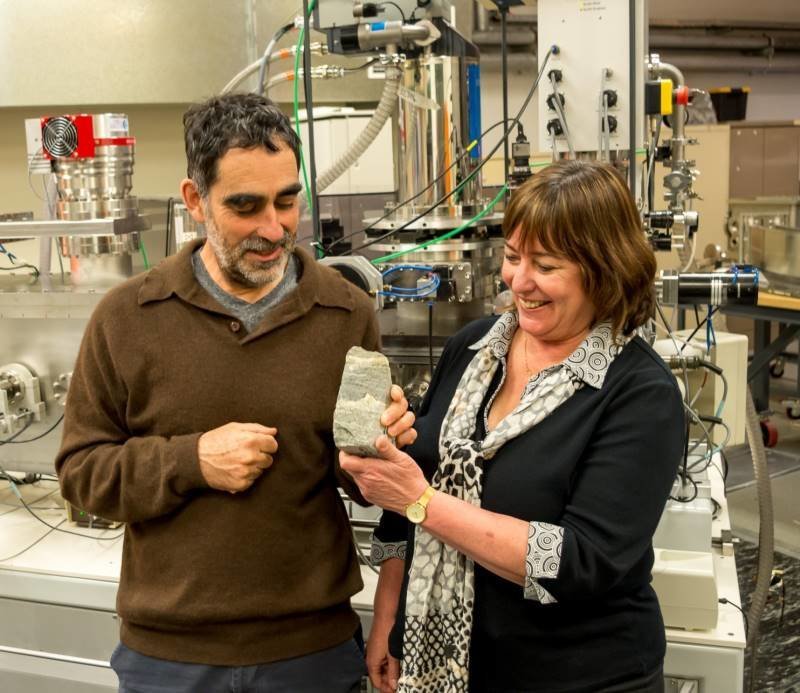
© Yuri AmelinAustralian researchers Allen Nutman and Vickie Bennett hold a 3.7-billion-year-old fossilized stromatolite from Isua, Greenland.
Scientists probing a newly exposed, formerly snow-covered outcropping in Greenland claim they have discovered the oldest fossils ever seen, the remnants of microbial mats that lived 3.7 billion years ago.

It's a stunning announcement in a scientific field that is always contentious. But if confirmed, this would push the established fossil record more than 200 million years deeper into the Earth's early history, and provide support for the view that life appeared very soon after the Earth formed and may be commonplace throughout the universe.

A team of Australian geologists announced their discovery in a paper titled "Rapid emergence of life shown by discovery of 3,700-million-year-old microbial structures," published Wednesday in Nature.

They made their find in July 2012 while doing field research in Isua, a region of Greenland so remote that they had to travel there by helicopter. The site is known for having some of the oldest rocks on Earth, in what is known as the Isua supracrustal belt. Allen Nutman, a University of Wollongong geologist who has studied the rocks there since 1980, said one day he and his colleagues were working at the site when they spied some outcroppings they'd never seen before. The formations had been exposed where the snow pack had melted — the result, Nutman said, of the global warming that is so pronounced in Greenland or of low levels of snowfall the previous winter.