Science & TechnologyS


Sun

Unexpected solar flare gives off stunning UV radiation flash

solar flare
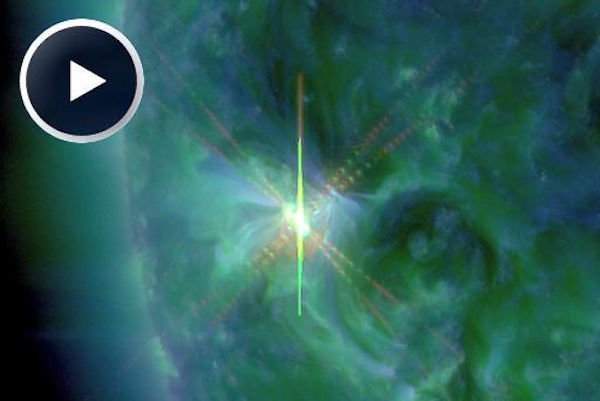
On Nov. 29th, new sunspot AR2615 erupted, producing two M-Class solar flares.

A pulse of UV and X-radiation from the explosion ionized the upper layers of Earth's atmosphere over the Pacific Ocean. This affected the normal propagation of radio waves.

Mariners and ham radio operators may have noticed brief fade-outs and/or unexpected hops at frequencies below ~10 MHz.


Comment: From Spaceweather.com:
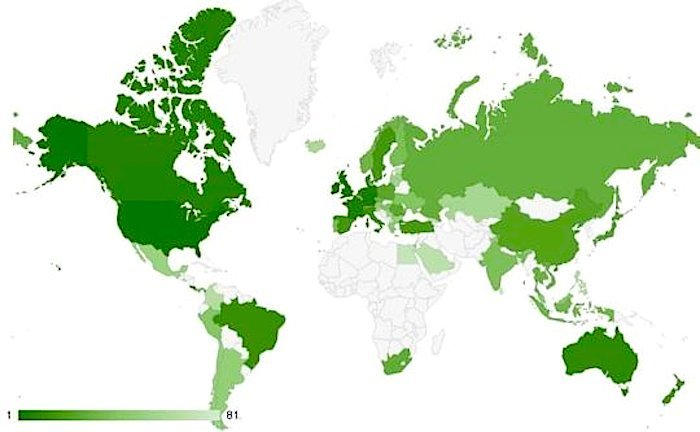
Following months of negligible solar flare activity, the sudden emergence of AR2615 and its subsequent explosion caught forecasters off guard. A pulse of UV and X-radiation from the explosion ionized the upper layers of Earth's atmosphere over the Pacific Ocean: map. This affected the normal propagation of radio waves. Mariners and ham radio operators may have noticed brief fade-outs and/or unexpected hops at frequencies below ~10 MHz.

A few hours later, it happened again. At 23:38 UT on Nov. 29th, AR2615 produced an M1.2-class flare, causing a short-lived radio blackout over Australia.

This is *not* a major space weather event, but it is a break from the sun's recent deepening quiet. NOAA forecasters estimate a 10% chance of additional M-flares on Nov. 30th.


MIB

Here's how to check if your Google account is one of the 1 million infected with malware

Google Headquarters / Android
Anyone running an older version of the Android operating system, be warned: Malware is infecting 13,000 Android devices every day, putting at risk the private details of more than 1 million Google accounts.

That's according to cybersecurity software company Check Point, which discovered a new piece of malware called "Gooligan" that's infecting Android phones and stealing email addresses.

Users who download Gooligan-infected apps or click links in phishing messages are being exposed to the malware, which allows attackers to access sensitive information from Google apps like Gmail, Drive, and Photos.

Once attackers hack into the device, they're buying apps on the Google Play store and writing reviews posing as the phone's owner, Check Point says.

Anyone who owns a device running Android 4 and 5 — that includes Android Jelly Bean, KitKat, and Lollipop — is most at risk, according to Check Point, and those devices make up nearly 75% of Android users.

Eye 1

All in the eyes: Women and men look at things differently

women see things differently
Women and men look at faces and absorb visual information in different ways, which suggests there is a gender difference in understanding visual cues, according to a team of scientists that included psychologists from Queen Mary University of London (QMUL).

The researchers used an eye tracking device on almost 500 participants at the Science Museum over a five-week period to monitor and judge how much eye contact they felt comfortable with while looking at a face on a computer screen.

They found that women looked more at the left-hand side of faces and had a strong left eye bias, but that they also explored the face much more than men. The team observed that it was possible to tell the gender of the participant based on the scanning pattern of how they looked at the face with nearly 80 per cent accuracy. Given the very large sample size the researchers suggest this is not due to chance.

Lead author Dr Antoine Coutrot from QMUL's School of Biological and Chemical Sciences said: "This study is the first demonstration of a clear gender difference in how men and women look at faces.

Microscope 1

Part human, part virus: The body's intimate relationship with viral DNA

Viral DNA
© DigitalGenetics / Fotolia
When viruses infect us, they can embed small chunks of their genetic material in our DNA. Although infrequent, the incorporation of this material into the human genome has been occurring for millions of years. As a result of this ongoing process, viral genetic material comprises nearly 10 percent of the modern human genome. Over time, the vast majority of viral invaders populating our genome have mutated to the point that they no longer lead to active infections. But, as scientists funded by the National Institutes of Health have demonstrated, they are not entirely dormant.

Sometimes, these stowaway sequences of viral genes, called "endogenous retroviruses" (ERVs), can contribute to the onset of diseases such as cancer. They can also make their hosts susceptible to infections from other viruses. However, scientists have identified numerous cases of viral hitchhikers bestowing crucial benefits to their human hosts -- from protection against disease to shaping important aspects of human evolution, such as the ability to digest starch.

Comment: See also:


Sun

Stunning NASA video reveals barren solar surface with lowest level of activity since 2011

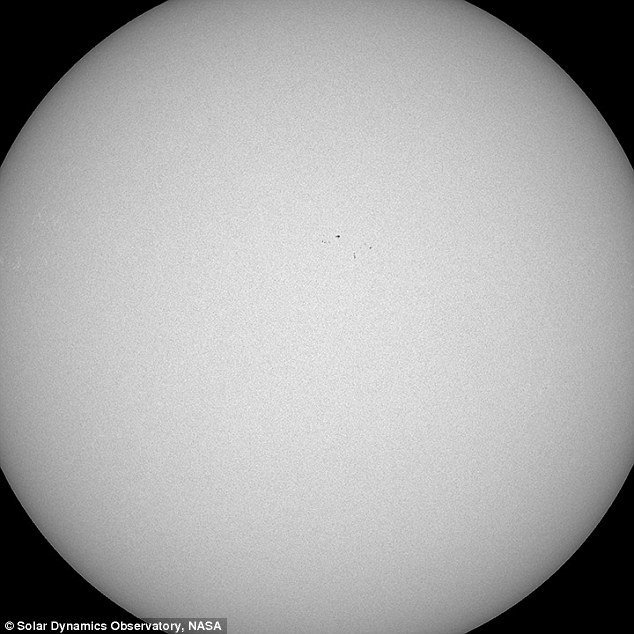
handful of barely-visible spots on the surface of the sun
© Nasa Solar Dynamics ObservatoryImages captured by Nasa’s Solar Dynamics Observatory from Nov 14-18 reveal just a handful of barely-visible spots on the surface of the sun, which is otherwise as blank as a cue ball

The face of the sun was nearly spotless this month as our star marches toward solar minimum, hitting its lowest activity level since 2011.

Images captured by Nasa's Solar Dynamics Observatory from Nov 14-18 reveal just a handful of barely-visible spots on the surface of the sun, which is otherwise as blank as a cue ball.

The sun follows a pendulum-like pattern of activity over roughly an 11-year period, and while scientists say this behaviour is not unusual, some have warned the current trend could send Earth into a 'mini ice age.'

Archaeology

Cluster of forty-nine pit caves discovered in northwest China

Pit cave in China
© PressTV
A cluster of world-class sinkholes has been discovered in northwest China. Forty-nine pit caves have also been discovered during a 4-month-survey in China's Hanzhong City located in Shaanxi Province.

The cluster includes 31 regular-sized, 17 large and 1 super-sized pit caves with the largest measuring up to 500 meters in diameter. All found caves live up to the standards of a world geological relic and are intact since they're located in places that are hard to reach.

Rare plant and animal species were also found during the survey conducted by experts from UNESCO as well as other international and local bodies.

Local governments have already started their work to utilize technical, ecological and legal methods to preserve these natural marvels. The caves are expected to contribute greatly to the study of environment and climate change in both the north and south of China.


Galaxy

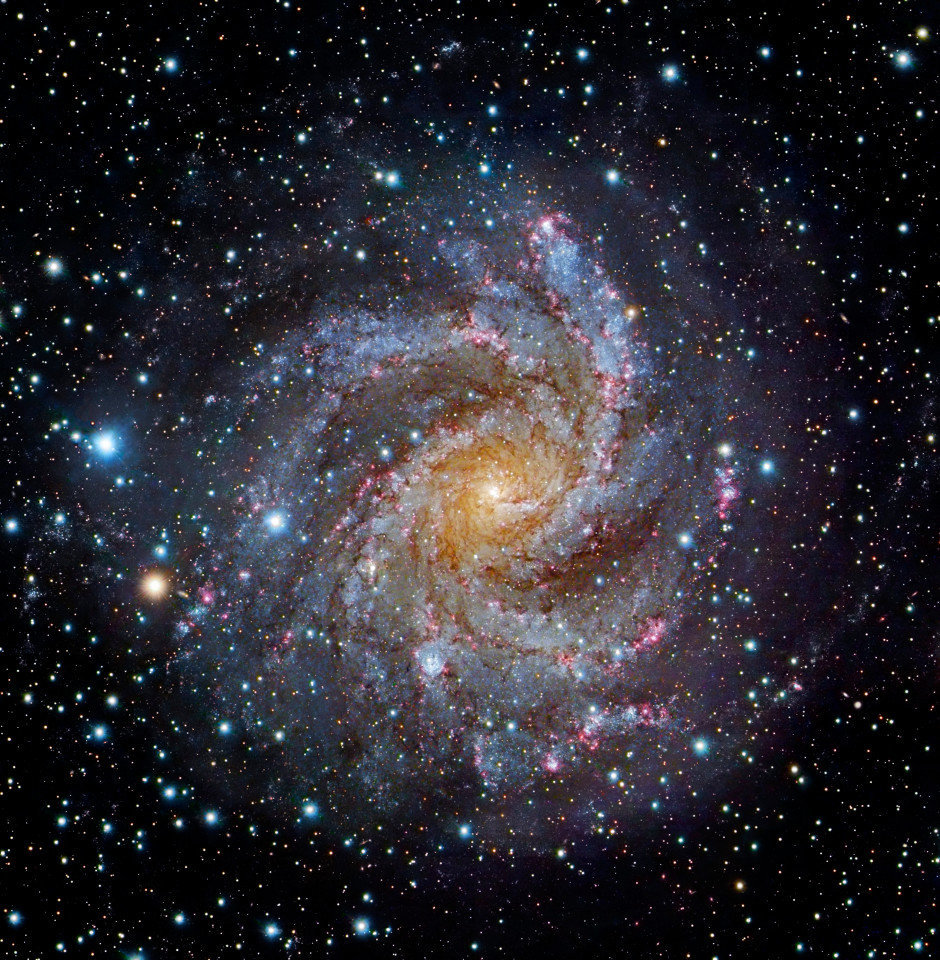
Quantum leaps: Physicists reveal sensational findings which could allow science fiction dreams to become reality

Quantum Leap
© Getty ImagesThe team of researchers claim that there are multiple, interacting universes – some very different from our own
There are multiple timelines playing out in parallel universes, according to a team of researchers.

The sensational claim was made by a team of physicists, who believe that the parallel universes can all affect one another.

Professor Howard Wiseman and Dr Michael Hall, from Griffith University's Centre for Quantum Dynamics, claim that the idea of parallel universes is more than just science fiction.

Fellow researcher Dr Dirk-Andre Deckert, from the University of California, helped further the researchers' theory, which goes against almost all conventional understanding of space and time.

If there really are multiple, interacting universes, then it would be possible for time travelers to visit Earth, and every imaginable scenario would be played out in a parallel universe at some point.

Comment: See also: Researchers claim that humans have souls which can live on after death and Pierre Lescaudron and Laura Knight-Jadczyk's Earth Changes and the Human Cosmic Connection.


UFO 2

Secretive Chinese space program gives NASA a run for its money

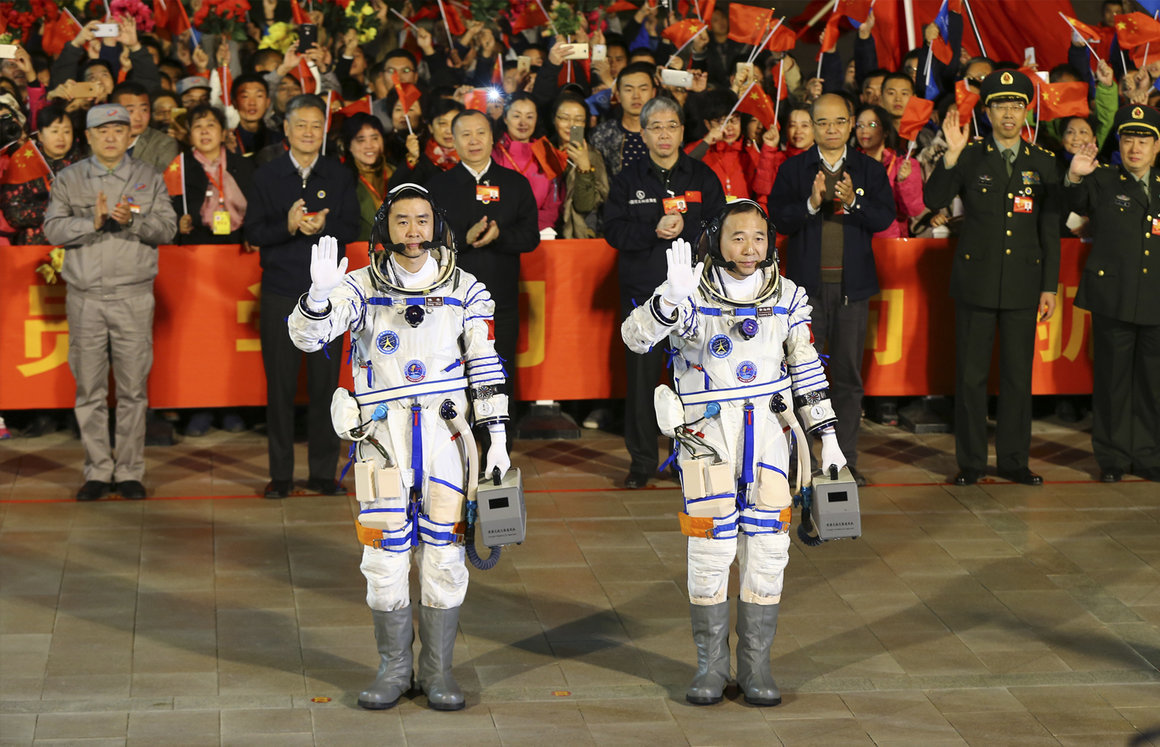
chinese astronauts
© Li Jin/VCG via Getty ImagesAstronauts Chen Dong and Jing Haipeng at a ceremony prior to the launche of the Shenzhou 11.
The launch of the Shenzhou 11 spacecraft in western China last month marked another great leap forward for the nation's space program and its ambition to send manned missions to the moon and, eventually, Mars. Yet more than national prestige is at stake: China is counting on its space program to pay huge economic dividends.

China is NASA's biggest rival in space exploration with plans to land "taikonauts" on the moon by 2036 and Mars thereafter. Along the way, President Xi Jinping hopes the space missions will spawn a wave of Chinese innovation in robotics, aviation and artificial intelligence, among other leading 21st-century technologies.

China's space program is generally shrouded in secrecy, yet Xi's government is now reviewing a proposal by top researchers to triple investments into scientific missions, according to Wu Ji, director-general of the National Space Science Center. The hope is that advancements made while building new telescopes, monitoring Earth's water cycles and improving satellite navigation will revive state-owned enterprises and inspire the startup of private ones.

"China has been relying on the knowledge discovered by others," said Wu, who's spearheading the effort to lobby for more space missions with possible economic spinoffs. "If China wants to rejuvenate the economy, it needs to put more resources into developing groundbreaking technologies."

Cloud Grey

Cloud hosting services compromised by 'lurking malice'

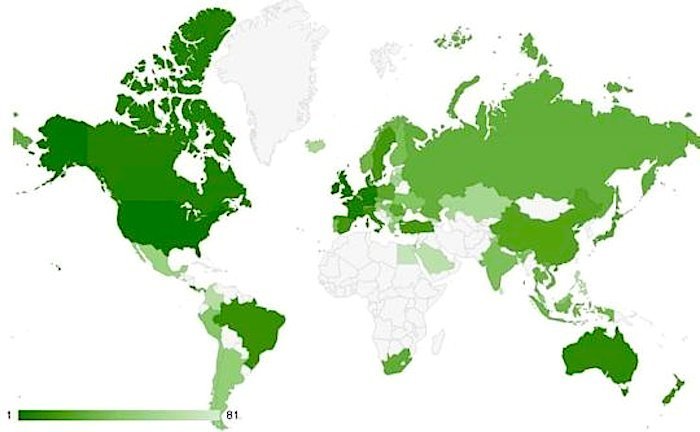
Bad repositories
© Xiaojing Liao, Georgia TechBad repositories map: This map shows locations where the impacts of bad repositories (Bars) occur.
A study of 20 major cloud hosting services has found that as many as 10 percent of the repositories hosted by them had been compromised -- with several hundred of the "buckets" actively providing malware. Such bad content could be challenging to find, however, because it can be rapidly assembled from stored components that individually may not appear to be malicious.

To identify the bad content, researchers created a scanning tool that looks for features unique to the bad repositories, known as "Bars." The features included certain types of redirection schemes and "gatekeeper" elements designed to protect the malware from scanners. Researchers from the Georgia Institute of Technology, Indiana University Bloomington and the University of California Santa Barbara conducted the study.

Believed to be the first systematic study of cloud-based malicious activity, the research will be presented October 24 at the ACM Conference on Computer and Communications Security in Vienna, Austria. The work was supported in part by the National Science Foundation.

"Bad actors have migrated to the cloud along with everybody else," said Raheem Beyah, a professor in Georgia Tech's School of Electrical and Computer Engineering. "The bad guys are using the cloud to deliver malware and other nefarious things while remaining undetected. The resources they use are compromised in a variety of ways, from traditional exploits to simply taking advantage of poor configurations."

Beyah and graduate student Xiaojing Liao found that the bad actors could hide their activities by keeping components of their malware in separate repositories that by themselves didn't trigger traditional scanners. Only when they were needed to launch an attack were the different parts of this malware assembled.

Ice Cube

Why is the surface of ice wet?

Water on ice
© Murata K. et al., PNASFigures illustrating the process in which a QLL, a thin layer of water on ice, transforms to a state of partial wetting. At the start (0.00 seconds), the surface of the ice is completely covered by the QLL. After six seconds, the layer has turned into droplets (Scale bar: 10 ?m).
A team of Hokkaido University scientists has unraveled a 150-year-old mystery surrounding the surface melting of ice crystals in subzero environments by using an advanced optical microscope. "Ice is wet on its surface": Since this phenomenon, called surface melting, was mentioned by British scientist Michael Faraday more than 150 years ago, the question of why water on the surface of ice does not freeze in a subzero environment remained unanswered.

In their search for the underlying mechanism behind surface melting, the team used a special optical microscope jointly developed with Olympus Corp. to observe how thin water layers, or quasi-liquid layers (QLLs), are born and disappear at various temperatures and vapor pressure levels. According to the researchers' findings, thin water layers do not homogeneously and completely wet the surface of ice -- a discovery that runs contrary to conventional wisdom. QLLs, therefore, are not able to stably exist at equilibrium, and thus vaporize.

Furthermore, the team discovered that QLLs form only when the surface of ice is growing or sublimating, under supersaturated or unsaturated vapor conditions. This finding strongly suggests that QLLs are a metastable transient state formed through vapor growth and sublimation of ice, but are absent at equilibrium.