Science & TechnologyS


Blue Planet

Not even wrong: Stephen Hawking says Trump's Paris Agreement stance could 'push the Earth over the brink'

Hawking and Trump
Stephen Hawking thinks President Trump's decision to pull out of the Paris Agreement and the British Brexit decision might trigger a chain of events which leads to the destruction of the world. My question - where is the evidence?
Hawking says Trump's climate stance could damage Earth

By Pallab Ghosh
Science correspondent, BBC News
2 July 2017

Stephen Hawking says that US President Donald Trump's decision to pull out of the Paris climate agreement could lead to irreversible climate change.

Prof Hawking said the action could put Earth onto a path that turns it into a hothouse planet like Venus.

He also feared aggression was "inbuilt" in humans and that our best hope of survival was to live on other planets.
...
In its Fifth Assessment Report, the IPCC authors wrote: "The precise levels of climate change sufficient to trigger tipping points (thresholds for abrupt and irreversible change) remain uncertain, but the risk associated with crossing multiple tipping points in the Earth system or in interlinked human and natural systems increases with rising temperature."
...
"We are close to the tipping point where global warming becomes irreversible. Trump's action could push the Earth over the brink, to become like Venus, with a temperature of two hundred and fifty degrees, and raining sulphuric acid," he told BBC News.

"Climate change is one of the great dangers we face, and it's one we can prevent if we act now. By denying the evidence for climate change, and pulling out of the Paris Climate Agreement, Donald Trump will cause avoidable environmental damage to our beautiful planet, endangering the natural world, for us and our children."
...
And on Brexit, he feared UK research would be irreparably damaged.

"Science is a cooperative effort, so the impact will be wholly bad, and will leave British science isolated and inward looking".
...

Satellite

Aquila: Facebook tests internet-beaming drones

Facebook drones
© Mark Zuckerberg / Facebook
Solar-powered drones could one day provide 4 billion people in poorer parts of the world access to the internet, Facebook said after a "successful" test of its drone, Aquila. The internet company intends to share the blueprints for the technology.

Facebook co-founder and CEO, Mark Zuckerberg, posted video of the drone which landed in Arizona after flying for an hour and 46 minutes over the desert. The previous test of Aquila in December resulted in a crash.

"We successfully gathered a lot of data to help us optimize Aquila's efficiency. No one has ever built an unmanned airplane that will fly for months at a time, so we need to tune every detail to get this right," wrote Zuckerberg on Facebook.

Robot

The blind leading the greedy: Big Pharma turns to artificial intelligence to find new drugs faster

robot medicine
The world's leading drug companies are turning to artificial intelligence to improve the hit-and-miss business of finding new medicines, with GlaxoSmithKline unveiling a new $43 million deal in the field on Sunday.

Other pharmaceutical giants including Merck & Co, Johnson & Johnson and Sanofi are also exploring the potential of artificial intelligence (AI) to help streamline the drug discovery process.

The aim is to harness modern supercomputers and machine learning systems to predict how molecules will behave and how likely they are to make a useful drug, thereby saving time and money on unnecessary tests.

AI systems already play a central role in other high-tech areas such as the development of driverless cars and facial recognition software.

"Many large pharma companies are starting to realise the potential of this approach and how it can help improve efficiencies," said Andrew Hopkins, chief executive of privately owned Exscientia, which announced the new tie-up with GSK.

Hopkins, who used to work at Pfizer, said Exscientia's AI system could deliver drug candidates in roughly one-quarter of the time and at one-quarter of the cost of traditional approaches.


Microscope 2

Electrical stimulation steers neural stem cells

neural stem cells
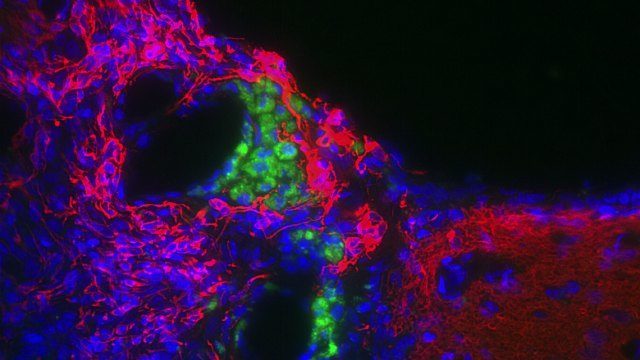
© JUNFENG FENG/UC DAVIS, SACRAMENTO AND REN JI HOSPITAL, SHANGHAIHuman neural stem cells (green) guided by electrical stimulation migrated to and colonized the subventricular zone of rats’ brains. This image was taken three weeks after stimulation.
Neural stem cells normally go with the flow of chemical guides. But with a little electrical stimulation they can be coaxed to go the other way, a new study shows.

When scientists applied electric current to human neural stem cells injected into rats' brains, the cells moved toward the animals' subventricular zone and lateral ventricle, instead of toward their olfactory bulb, the default destination. The result, published June 29 in Stem Cell Reports, suggests that electrical stimulation could one day be used to guide neural stem cells to damaged sites in the brain.
"This is the first study I've seen where stimulation is done with electrodes in the brain and has been convincing about changing the natural flow of cells so they move in the opposite direction," stem cell expert Alan Trounson of the Hudson Institute in Australia tells The Scientist. "The technique has strong possibilities for applications because the team has shown you can move cells, and you could potentially move them into seriously affected brain areas."

"I didn't expect the direction of the cells could be reversed," study coauthor Min Zhao of the University of California, Davis, tells The Scientist. The molecules that direct the flow of cells in the brain are very commanding, he says. Seeing that electrical stimulation can reverse the directions the cells travel shows the technique is "even more powerful than we thought" for guiding neural stem cells.

Comment: See also: Stem cells used for the first time to treat paralyzed man - and he regained upper body movement


Microscope 1

Ancient virus DNA gives stem cells the power to transform

embryonic stem cells
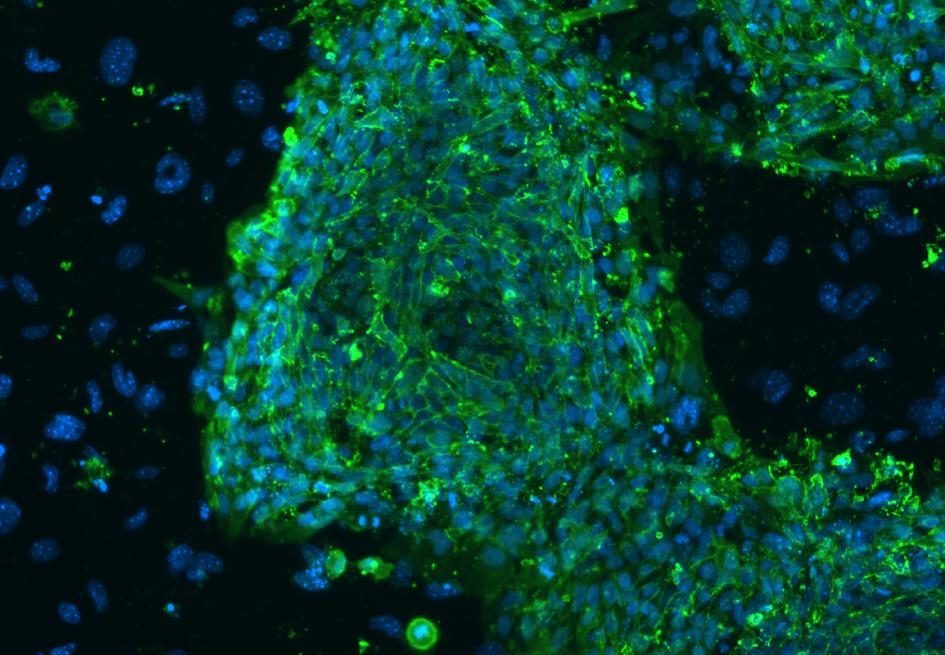
© Michael Longaker, Stanford University/Reuters via CorbisHuman embryonic stem cells display as blue and green patchwork under a fluorescent microscope.
A virus that invaded the genomes of humanity's ancestors millions of years ago now plays a critical role in the embryonic stem cells from which all cells in the human body derive, new research shows.

The discovery sheds light on the role viruses play in human evolution and could help scientists better understand how to use stem cells in advanced therapies or even how to convert normal cells into stem cells.

Embryonic stem cells are pluripotent, meaning they are capable of becoming any other kind of cell in the body. Scientists around the world hope to use this capability to help patients recover from injury and disease.

Researchers have struggled for decades to figure out how pluripotency works. These new findings reveal that "material from viruses is vital in making human embryonic stem cells what they are," said computational biologist Guillaume Bourque at McGill University in Montreal, a co-author of the study published online March 30 in Nature Structural & Molecular Biology.

Comment: More food for thought:


People 2

Gender-bender fish: Flushed contraceptive chemicals causing dramatic hormone changes in UK fish

contraceptives, the pill
© Image Point Fr/Shutterstock
A fifth of male fish are now transgender because of chemicals from the contraceptive pill being flushed down household drains, a study by has suggested.

Male river fish are displaying feminised traits and even producing eggs, the study found. Some have reduced sperm quality and display less aggressive and competitive behaviour, which makes them less likely to breed successfully.

The chemicals causing these effects include ingredients in the contraceptive pill, by-products of cleaning agents, plastics and cosmetics, according to the findings.

Professor Charles Tyler, of the University of Exeter, is to present his findings in a key-note lecture at a symposium this week. He will explain that the offspring of such "transgender" or "intersex" fish can also be more sensitive to the effects of these chemicals in subsequent exposures.

Comment: Blasphemy! Saying male fish are naturally more aggressive and competitive is just a socially constructed un-truth. Fish society must be just as patriarchal and infested with toxic masculinity.

But seriously, this should be food for thought for those who believe gender exists on a spectrum. It doesn't. But that doesn't mean that things can't go wrong with biological systems. This is a case in point: chemicals are messing with natural biology, producing effects on "gender expression" that wouldn't otherwise exist (or at the very least would be much rarer). Maybe the rise in transgenderism has more to do with our chemically toxic environment than simply a more open and accepting culture.


Wolf

Meet the rare 'sea wolves' who prey on sea animals and can swim for hours

BC wolf
Along the wild Pacific coast of British Columbia, there lives a population of the sea wolves. "We know from exhaustive DNA studies that these wolves are genetically distinct from their continental kin," says McAllister. "They are behaviourally distinct, swimming from island to island and preying on sea animals. They are also morphologically distinct — they are smaller in size and physically different from their mainland counterparts," says Ian McAllister, an award-winning photographer who has been studying these animals for almost two decades.

McAllister captured the magic of these wolves in breath-taking pictures. As he swam towards them, "the curious canines approached him so closely that he could hear them grunting into his snorkel. He took several frames, then pushed back into deeper water without daring to look up," writes the bioGraphic.

Comet 2

NASA unveils its asteroid defense plans

asteroids
Humanity could face one less doomsday scenario if NASA has its way.

On Friday, the space agency announced plans to redirect the course of a small asteroid approaching Earth, as part of the Double Asteroid Redirection Test (DART), according to a NASA press release.

The release notes that asteroids hit Earth nearly every day, but most are small enough to burn up in the atmosphere.

But the DART project -- a joint effort between NASA and the John Hopkins Applied Physics Laboratory in Maryland -- is for the asteroids that are too big to break up -- those that could have severe consequences for the Earth if they hit.
"DART would be NASA's first mission to demonstrate what's known as the kinetic impactor technique -- striking the asteroid to shift its orbit -- to defend against a potential future asteroid impact," said Lindley Johnson, NASA's planetary defense officer in Washington, in the press release.
"This approval step advances the project toward an historic test with a non-threatening small asteroid."

Arrow Up

CERN's Large Hadron Collider: Unprecedented number of particles reached in record time

CERN particle record broken
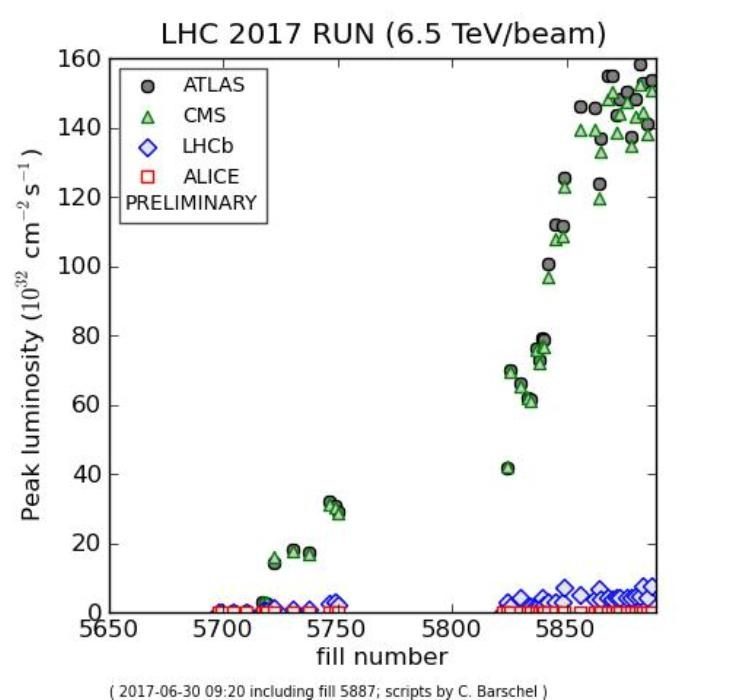
© CERNThis plot shows the values of the luminosity reached during the last few weeks by the LHC, with the record of 1.58x1034 cm-2s-1 achieved on Wednesday 28 June.
An unprecedented number of particles has been reached in record time. Just five weeks after physics resumed, the Large Hadron Collider (LHC) is already running at full throttle. On Wednesday 28 June 2017 the LHC established yet another record-breaking high, with 2556 proton bunches circulating in each direction of the accelerator.

The beams in the LHC are made up of bunches of protons, spaced seven metres (25 nanoseconds) apart, with each one containing more than 100 billion protons. 2556 is the maximum possible number of bunches that can be reached with the beam preparation method currently used.

The particle bunches that are delivered to the LHC are prepared and accelerated by a chain of four accelerators. Since last year, a new method to group and split the bunches enables the particles to be squeezed even closer together. With an equal number of protons, the beam diameter was reduced by 40 per cent. Denser bunches means a higher probability of collisions at the centre of the experiments.

Saturn

Cassini captures rare photos of Saturn's polar 'hexagon' storm

Saturn hex
© NASA
The lifespan of NASA's Cassini is coming to an end, but in one of its final acts the space probe has captured images of an incredible vortex that experts believe has been raging on Saturn for centuries.

In 1981, the US space agency's Voyager 2 spacecraft discovered a mass of clouds on the north pole of the gas giant that appeared to be permanently swirling.