Science & TechnologyS


Comet 2

Study uncovers new evidence supporting Younger Dryas impact hypothesis

Airburst
© Youtube
If you wanted evidence that a giant comet wiped out the wooly mammoth, you might look for a giant crater.

But so far, you'd be out of luck.

"Some of our critics have said, 'Where's the crater?'" says Christopher Moore, an archaeologist at the University of South Carolina. "As of now, we don't have a crater or craters."

But Moore says that by looking below the surface, you can find strong evidence for the Younger-Dryas impact hypothesis, which states that large comet fragments hit Earth or exploded in the atmosphere shortly after the last ice age, setting off cataclysmic changes in the environment, crater or not.


AK47

China shows off robot 'dogs' equipped with assault rifles

china robot dog gun
© YouTube / CCTV Video News Agency
The People's Liberation Army of China has demonstrated some of its most advanced military capabilities during joint drills with Cambodia scheduled to end on Thursday. The list of weapons employed by soldiers included several types of military robots, including a dog-like, remotely operated device equipped with an assault rifle.

"Intelligent equipment," including all sorts of robots and unmanned aerial vehicles, were the focus of the Golden Dragon 2024 drills, Chinese state broadcaster CCTV said in a video report published this week. The clip demonstrated several types of remotely controlled robots used for a wide range of tasks, including reconnaissance, target detection, and even assault operations.

Reconnaissance robot 'dogs' weighing 15 kilograms (33lbs) could operate for between two and four hours, providing real-time video transmission to troops, a device operator told CCTV. The robot was shown to be capable of rapidly lying down, of jumping and of moving in various directions on flat terrain. According to Chinese media, such devices are capable of planning their routes and of avoiding obstacles without additional input from their operators.

Volcano

Recent and extensive volcanism discovered on Venus

lava flows venus volcanic activity Sif Mons
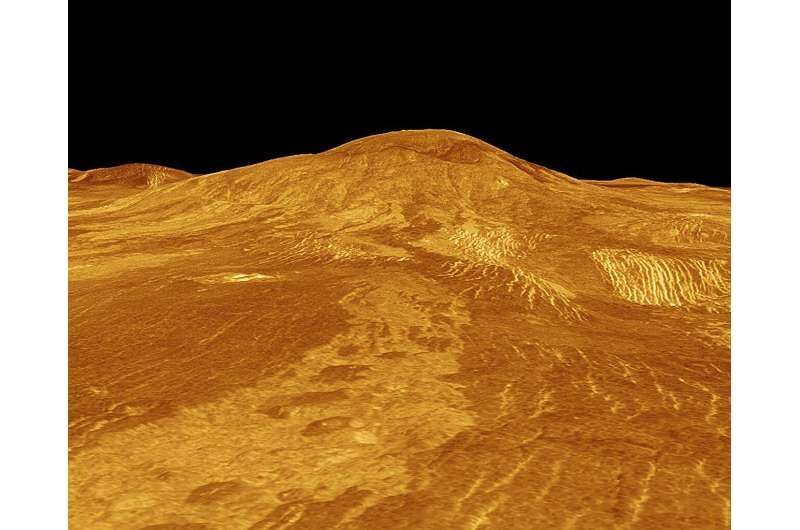
© NASA/JPLThis computer-generated 3D model of Venus’ surface shows the volcano Sif Mons, which is exhibiting signs of ongoing activity. Using data from NASA’s Magellan mission, Italian researchers detected evidence of an eruption while the spacecraft orbited the planet in the early 1990s.
A new analysis of data collected on Venus more than 30 years ago suggests the planet may currently be volcanically active.

A research group from Italy led by David Sulcanese of the Università d'Annunzio in Pescara, Italy, has used data from a radar mapping of Venus's surface taken in the early 1990s to search for volcanic lava flow, finding it in two regions.

The discovery suggests that volcanic activity may be currently active and more widespread than was previously thought, supporting previous indirect evidence that there is volcanic activity on Venus.

The work is published in the journal Nature Astronomy.

Venus is sometimes called "Earth's twin sister." Though only slightly smaller than Earth, its CO2-dominated atmosphere has a massive greenhouse effect that bakes its surface at about 465°C (870°F).

Comment: Venus is a mystery, with more than one possible origin. There must be a reason it figures so prominently in the myths of ancient peoples all over the world:


Network

Russia proposes global space monitoring system

missioncontrol
© Grigory Sysoyev/Sputnik/file photoMission Control Moscow
The early warning system would track both "natural and artificial" threats, Roscosmos boss Yuri Borisov told RT.

Russia has floated the idea of creating a global space monitoring system to provide early warning about celestial threats, Yury Borisov, the head of Russian space agency Roscosmos, has revealed.

The proposal was made during a two-day summit of the space agency chiefs of the BRICS member states in Moscow, Borisov told RT on the sidelines of the event on Friday. The proposed system would not be limited to BRICS states only, as creating it would require the joint effort of many countries around the world, Borisov suggested.
"The Russian proposal to create a global space monitoring system to determine threats, from both natural and artificial objects, has sparked genuine interest. We're talking about protection from debris, asteroids. Such a system can be built only as a global system, since a lot of sensors are needed on the ground all around the globe, as well as space components to ensure reliability for decision making in case of close encounters with any dangerous objects."
The system would involve a "joint informational environment," with participants contributing the readings from installations located in their countries and receiving in return access to the aggregated data from the whole project.

Sun

Rethinking the sun's cycles: New physical model reinforces planetary hypothesis

the Sun
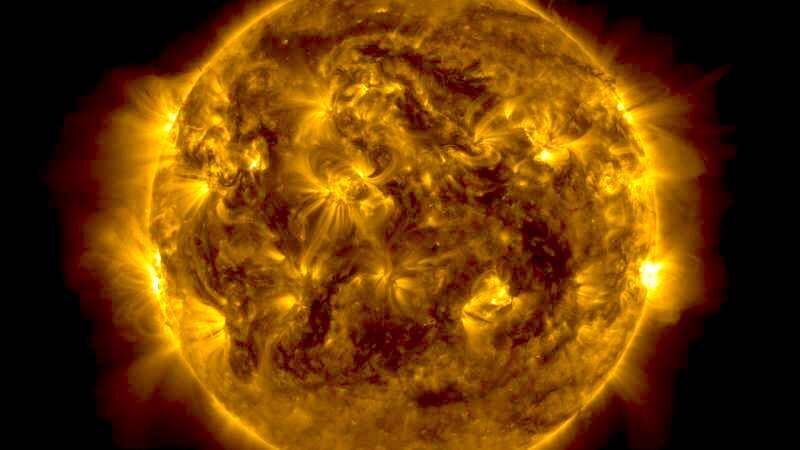
© UnknownThe Sun is currently approaching a maximum activity in the 11-year "Schwabe Cycle"
Researchers at the Helmholtz-Zentrum Dresden-Rossendorf (HZDR) and the University of Latvia have posited the first comprehensive physical explanation for the sun's various activity cycles. It identifies vortex-shaped currents on the sun, known as Rossby waves, as mediators between the tidal influences of Venus, Earth as well as Jupiter and the sun's magnetic activity.

The researchers therefore present a consistent model for solar cycles of different lengths — and another strong argument to support the previously controversial planetary hypothesis. The results have now been published in the journal Solar Physics.

Although the sun, being near to us, is the best researched star, many questions about its physics have not yet been completely answered. These include the rhythmic fluctuations in solar activity. The most famous of these is that, on average, the sun reaches a radiation maximum every eleven years — which experts refer to as the Schwabe cycle.

This cycle of activity occurs because the sun's magnetic field changes during this period and eventually reverses polarity. This, in itself, is not unusual for a star — if it weren't for the fact that the Schwabe cycle is remarkably stable.

The Schwabe cycle is overlaid by other, less obvious fluctuations in activity ranging from a few hundred days to several hundred years, each named after their discoverers. Although there have already been various attempts to explain these cycles and mathematical calculations, there is still no comprehensive physical model.

Gem

Groundbreaking new process lets scientists grow diamonds from scratch in 15 minutes

synthetic diamond new process
© Bloomberg Creative/Getty ImagesA new technique has allowed scientists to create lab-grown diamonds at ambient temperatures and pressures in just 15 minutes.
Scientists have used a new technique to synthesize diamonds at normal, atmospheric pressure and without a starter gem, which could make the precious gemstones much easier to grow in the lab.

Natural diamonds form in Earth's mantle, the molten zone buried hundreds of miles beneath the planet's surface. The process takes place under tremendous pressures of several gigapascals and scorching temperatures exceeding 2,700 degrees Fahrenheit (1,500 degrees Celsius).

Similar conditions are employed in the method currently used to synthesize 99% of all artificially created diamonds. Called high-pressure and high-temperature (HPHT) growth, this method uses these extreme settings to coax carbon dissolved in liquid metals, like iron, to convert it to diamond around a small seed, or starter diamond.

However, the high pressures and temperatures are difficult to produce and maintain. Plus, the components involved affect the diamonds' size, with the largest being about a cubic centimeter, or about as big as a blueberry. Besides, HPHT takes a fairly long time — a week or two — to produce even these tiny gems. Another method, called chemical vapor deposition, eliminates some requirements of HPHT, like high pressures. But others persist, like the need for seeds.

Info

Cosmic rays illuminate the past

site of Dispilio
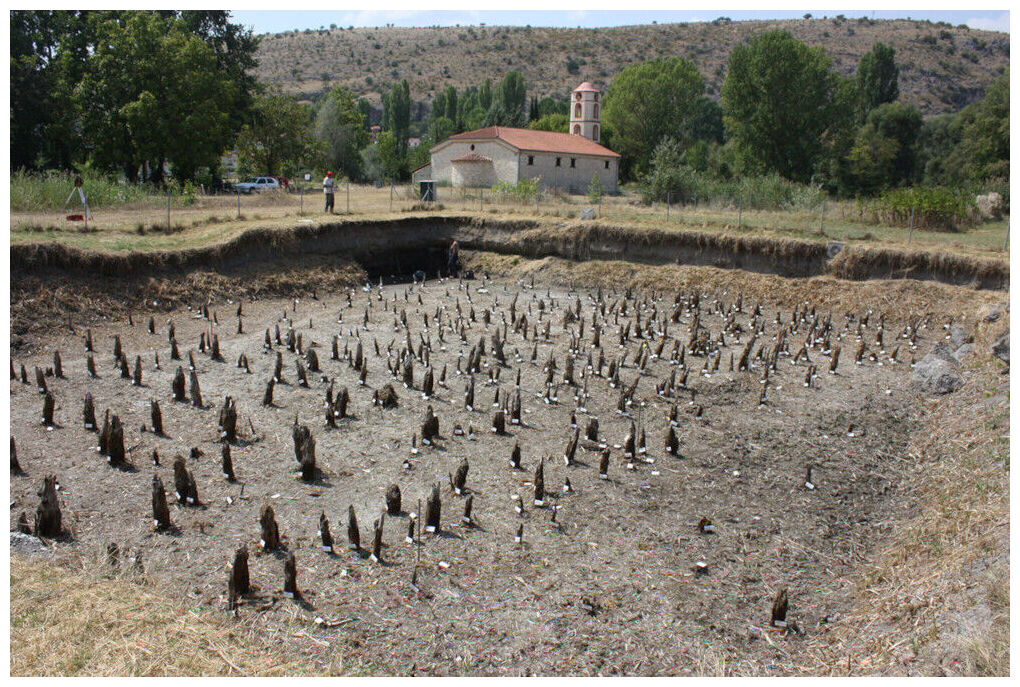
© Dispilio Excavation ArchiveThe pile field at the site of Dispilio. Almost 800 piles, mostly made of juniper and oak wood, were sampled and dendrochronologically measured. This data forms the basis for the high-precision dating of this site. Dispilio is the first archaeological site to be dated to a precise year using the Miyake event of 5259 BC.
Researchers at the University of Bern have for the first time been able to pin down a prehistoric settlement of early farmers in northern Greece dating back more than 7,000 years to the year. For this they combined annual growth ring measurements on wooden building elements with the sudden spike of cosmogenic radiocarbon in 5259 BC. This provides a reliable chronological reference point for many other archaeological sites in Southeast Europe.

Dating finds plays a key role in archaeology. It is always essential to find out how old a tomb, settlement or single object is. Determining the age of finds from prehistoric times has only been possible for a few decades. Two methods are used for this: dendrochronology, which enables dating on the basis of sequences of annual rings in trees, and radiocarbon dating, which can calculate the approximate age of the finds by the decay rate of the radioactive carbon isotope 14C contained in the tree rings.

A team led by the Institute of Archaeological Sciences at the University of Bern has now succeeded in precisely dating timber from the archaeological site of Dispilio in northern Greece, where dating to the year had previously not been possible, to different building activities between 5328 and 5140 BC. The researchers made use of high-energy particles from space, which can be reliably dated to 5259 BC. Their research has been published in the journal Nature Communications.

Info

Lost photos suggest Mars' mysterious moon Phobos may be a trapped comet in disguise

Previously unpublished photos of Mars' moon Phobos hint that the mysterious satellite may actually be a trapped comet — or perhaps just a piece of one, along with its twin moon Deimos.
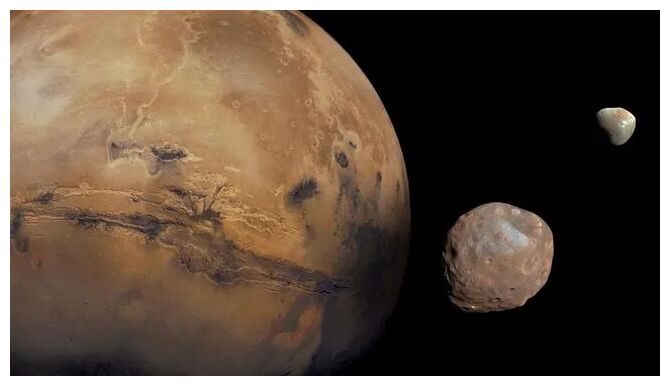
Phobos and Deimos
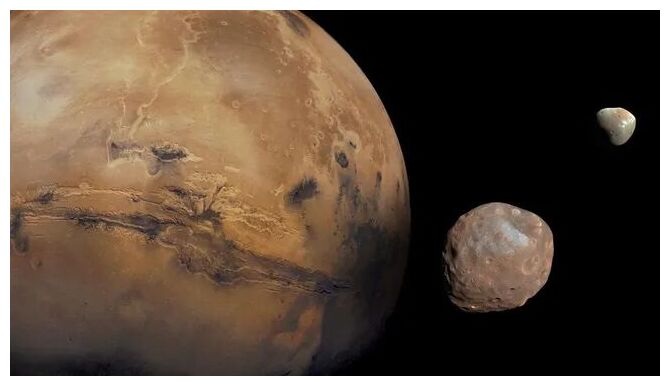
© NASA/JPL-Caltech/GSFC/Univ. of ArizonaA composite photo of Mars with its twin moons Phobos and Deimos. New research suggests the pair may in fact be two halves of an ancient comet captured by Mars long ago.
Mars' moon Phobos may actually be a comet — or at least part of one — that was gravitationally captured by the Red Planet long ago, a new preprint study based on previously unpublished photos suggests.

For years, researchers have puzzled over the origins of Phobos and its twin, Deimos. Some have theorized that the moons are former asteroids lured in by Mars' gravity, because their chemical composition is similar to that of certain rocks in the main asteroid belt between Mars and Jupiter. However, computer models simulating this capture process have not been able to replicate the pair's near-circular paths around Mars.

Another hypothesis suggests that a giant impact, like that which created our moon, gouged the duo out of the Red Planet; but Phobos has a different chemical composition from Mars, making this scenario unlikely, too.

Figuring out exactly how Phobos was born is one of the aims of the Japan Aerospace Exploration Agency's Martian Moons eXploration (MMX) mission, slated to launch in 2026. Sonia Fornasier, an astronomy professor at the Paris Cité University and lead author of the new study, is an instrument scientist for the MMX mission. While she and other scientists were analyzing images to fine-tune the spacecraft's planned path, Fornasier stumbled upon unpublished photos.


Blue Planet

Neanderthals and modern humans interbred 47,000 years ago, new analysis reveals

neanderthal
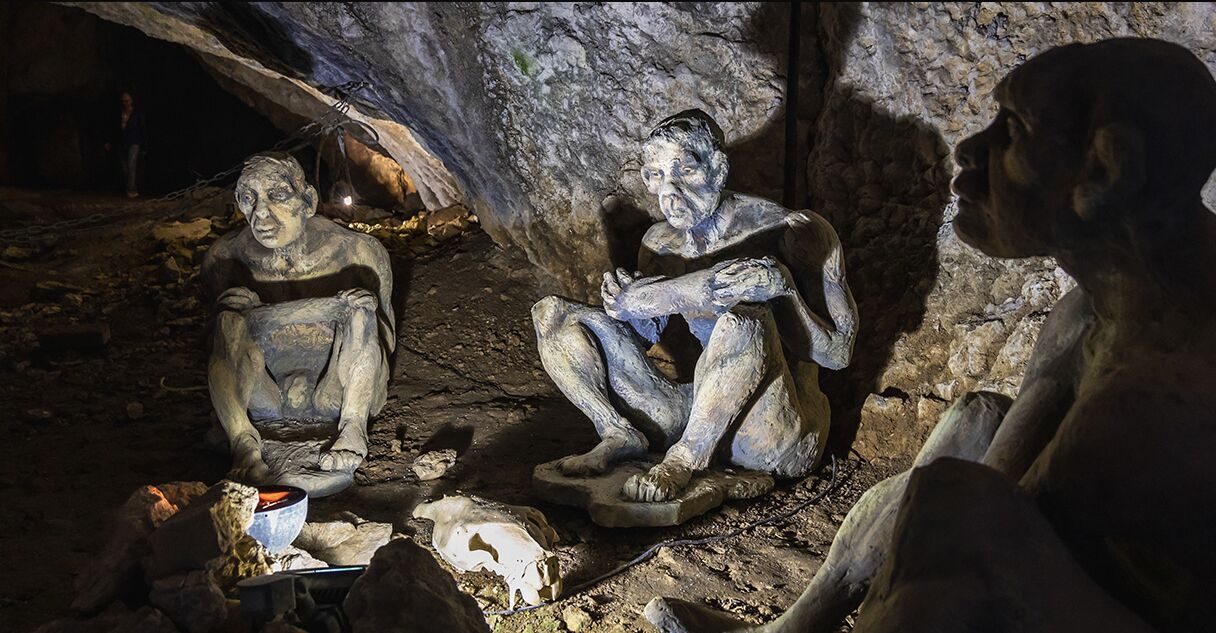
© Fotokon/ShutterstockGenome analysis genomes refines timing of critical and mysterious juncture in human history.

Some 45,000 years ago, Bulgaria's Bacho Kiro caves hosted modern humans — depicted here in sculpture — whose genomes suggest they had recent Neanderthal ancestry.
Most people alive today carry traces of genes inherited from Neanderthals — the enduring legacy of prehistoric hookups with our extinct cousins. But researchers have long debated when and where that mingling happened, and whether these were one-off romps or commonplace trysts. Now, an analysis of ancient and modern genomes suggests contemporary people's Neanderthal DNA came from a single, prolonged period of mixing some 47,000 years ago.

The findings — released last week as a bioRxiv preprint that has yet to undergo peer review — sharpen the timeline for this critical and mysterious juncture in human history. It's the first paper to use dozens of ancient Homo sapiens genomes to address this question, and it may have implications for the timing of other major events in human evolution, such as the peopling of Australia.

Comment: As noted above, the era seems to be marked by other significant events:


Bug

Fossil discovery: 308-million-year-old spider ancestor with prickly legs

Douglassarachne acanthopoda  fossil spider prickly legs
© Paul Selden/EurekaAlertFossilized Douglassarachne acanthopoda might have resemblance to modern harvestmen spiders.
Once a spider-like species that crawled through the Carboniferous coal forests of North America and Europe have now been traced back to an ancient species of arachnid named Douglassarachne acanthopoda.

A team of researchers from the University of Kansas, the Natural Museum of London, and the Museum für Naturkunde Berlin analyzed a fossil discovered by Bob Masek in the 1980s. It was later acquired by the David and Sandra Douglass Collection.

This fossil was examined recently to understand more about the diversity and evolutionary history of arachnids during the Carboniferous period.