Science & TechnologyS


Gear

Unraveling the physics of knitting

knit stitch analysis physics
© Krishma Singal, Michael S. Dimitriyev, et al.Two similar stitches (K-K or P-P) are joined by a yarn segment with even symmetry, highlighted in pink (a top). Extensional deformations cause curvature deformations of the yarn segment (a bottom). Alternating stitches (K-P) are joined by a yarn segment with odd symmetry, highlighted in cyan (b top). These segments are able to rotate to accommodate extensional deformation (b bottom). Symmetries of stitches are shown in the x-direction (c–f) and the y-direction (g–j). c, g Stockinette fabric has only even connecting yarn segments in both x- (c) and y-directions (g). d, h Garter fabric has even connecting yarn segments in x-direction (d) and odd connecting yarn segments in the y-direction (h). e, i Rib fabric has odd connecting yarn segments in the x-direction (e) and even connecting yarn segments in the y-direction (i). f, j Since seed fabric is based on a checkerboard pattern, it only has odd connecting yarn segments. The renderings in (a-j) are repeated unit cells of sample stitch-level simulation outputs
Knitting, the age-old craft of looping and stitching natural fibers into fabrics, has received renewed attention for its potential applications in advanced manufacturing. Far beyond their use for garments, knitted textiles are ideal for designing and fabricating emerging technologies like wearable electronics or soft robotics — structures that need to move and bend.

Knitting transforms one-dimensional yarn into two-dimensional fabrics that are flexible, durable, and highly customizable in shape and elasticity. But to create smart textile design techniques that engineers can use, understanding the mechanics behind knitted materials is crucial.

Physicists from the Georgia Institute of Technology have taken the technical know-how of knitting and added mathematical backing to it. In a study led by Elisabetta Matsumoto, associate professor in the School of Physics, and Krishma Singal, a graduate researcher in Matsumoto's lab, the team used experiments and simulations to quantify and predict how knit fabric response can be programmed. By establishing a mathematical theory of knitted materials, the researchers hope that knitting — and textiles in general — can be incorporated into more engineering applications.

Solar Flares

Rethinking the sun's cycles - New physical model reinforces planetary hypothesis

Researchers at the Helmholtz-Zentrum Dresden-Rossendorf (HZDR) and the University of Latvia have posited the first comprehensive physical explanation for the sun's various activity cycles. It identifies vortex-shaped currents on the sun, known as Rossby waves, as mediators between the tidal influences of Venus, Earth as well as Jupiter and the sun's magnetic activity. The researchers thus present a consistent model for solar cycles of different lengths - and another strong argument to support the previously controversial planetary hypothesis. The results have now been published in the journal Solar Physics (DOI: 10.1007/s11207-024-02295-x).
Our Sun
© ESA & NASA/Solar Orbiter/EUI TeamThe sun is currently approaching a maximum activity in the 11-year “Schwabe cycle” again, here a Solar Orbiter image from October 2023.
Although the sun, being near to us, is the best researched star, many questions about its physics have not yet been completely answered. These include the rhythmic fluctuations in solar activity. The most famous of these is that, on average, the sun reaches a radiation maximum every eleven years - which experts refer to as the Schwabe cycle. This cycle of activity occurs because the sun's magnetic field changes during this period and eventually reverses polarity. This, in itself, is not unusual for a star - if it weren't for the fact that the Schwabe cycle is remarkably stable.

The Schwabe cycle is overlaid by other, less obvious fluctuations in activity ranging from a few hundred days to several hundred years, each named after their discoverers. Although there have already been various attempts to explain these cycles and mathematical calculations, there is still no comprehensive physical model.

Microchip

Bringing transhumanism down to Earth, Part 1: Military intelligence operations cloaked in the false promise of transcendence

transhuman human
"All of our exalted technological progress, civilization for that matter, is comparable to an axe in the hand of a pathological criminal".

— Albert Einstein, in a letter to Heinrich Zangger (1917)
Abstract: With the coordinated global release of the Covid-19 narrative in late 2019 and the subsequent illogical demands of governments — allied with transnational organisations and pharmaceutical giants — many people around the world began questioning the hasty, unprecedented, and sweeping technological and technocratic changes being made to societies in the name of a highly marketed "medical emergency". Despite new policies emanating from authorities to isolate, to mask, to restrict all social contact, to accept without question unique experimental gene- and nanoparticle-based injections, and to abide by novel and absurd social norms, many people pushed back against the apparent tyranny. The more enthusiastic that governments were in deleting civil rights, suppressing freedom of speech and due process, the more that people sought to expose the story behind the mainstream Covid-19 narrative. This article, the first in a series of four, considers that story as it intersects with the trajectory of transhumanism. Here in Part 1 we examine how the current uninterrupted global push for a total top-down alteration of humanity, of human biology, of human emotions, and social relations, relates to a philosophy and history of well-funded and highly efficient business and military operations framed as necessarily rational and inevitable. We address the obfuscatory meanings of transhumanism so far propagated, and begin uncovering transhumanism's roots in the military-intelligence complex, taking NASA and its purported demand for cyborgs in space as our starting point. With a focus on primary sources and military-intelligence material, we lay the foundations for the subsequent three articles in the series, which offer an alternative possible way of understanding the current unfolding process as one aimed at transforming human beings from natural and sovereign creatures to controlled synthetic forms of life.

Fireball 2

Near Earth asteroids and the Virginid complex

Meteor Shower
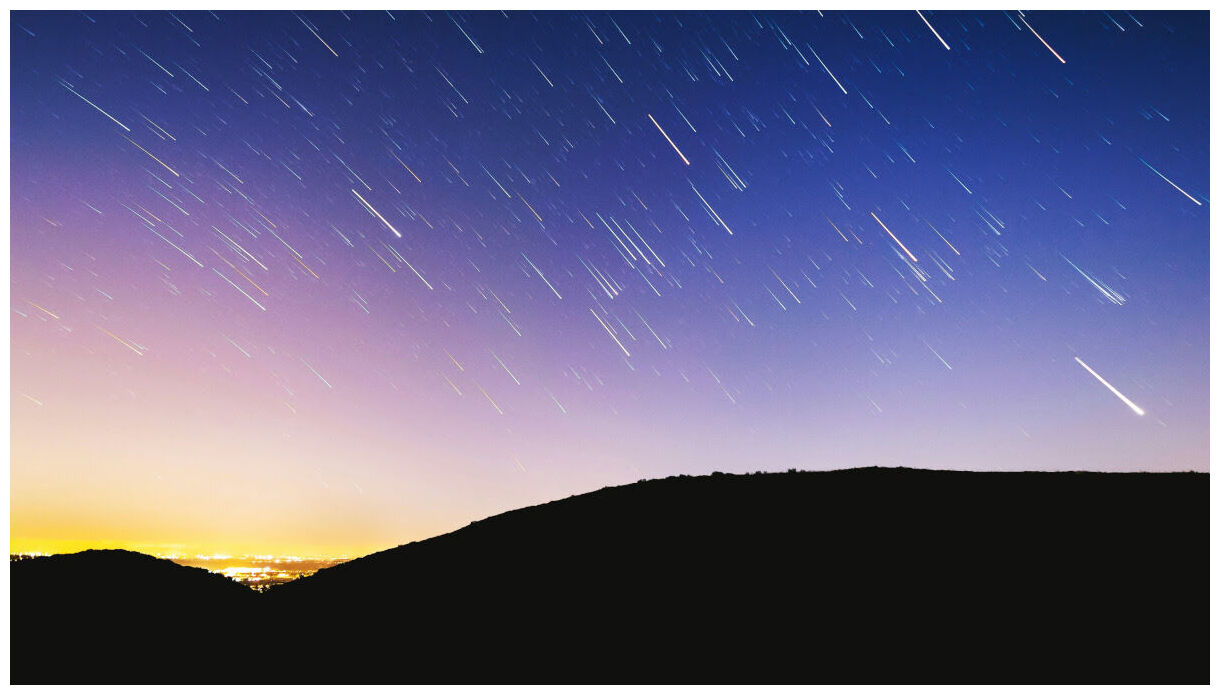
© Randall Carlson June 2024 Newsletter
In April 2024 a study was published in the journal Planetary and Space Science looking at one of the lesser-known meteor streams. In this study a team of astronomers and astrophysicists from the Institute of Astrophysics of the National Academy of Sciences of Tajikistan and the Astronomical Observatory Institute, A. M. University in Poland, examined evidence for a meteor stream whose radiant point was in the constellation Virgo, hence bearing the name the Virginid stream. The authors begin their report by establishing a context for their research. (If their wording is somewhat awkward, bear in mind that English is not their first language.) I have made minor editing and grammatical changes for clarity.

"Besides major planets a lot of smaller bodies are moving in the solar system. This population consists of comets, asteroids, and meteoroids. Comets and asteroids are parents of meteoroids. A huge number of meteoroids generated by a parent body form a meteoroid stream. The stream meteoroids are moving in interplanetary space in similar orbits close to the orbit of the parent. It is accepted that the activity of comets or their destruction are responsible for formation of meteoroid streams. Forming of a stable long-lived meteoroid stream can be provided by a periodic normal gas- and dust producing activity of comet which is observed during passage of the perihelion. (perihelion is the closest passage of the object to the Sun.) . . . A concept of the formation of meteoroid streams as a result of the cometary activity, as well the circumstances of their evolution and structure are described in a lot of papers. When the Earth crosses the meteoroid stream orbits, meteor showers occur. As was shown by Babadzhanov and Obrubov, 1992, one stream might produce from four to eight meteor showers observable on the Earth. Note, quadruple crossings are the most common among meteoroid streams. For instance, the Taurid meteoroid stream consists of four meteor showers. At the per-perihelion crossing with the Earth's orbit they are the Northern and Southern Taurids . . . which are observable on the Earth annually in September-November, as well as the Daytime beta-Taurids and Daytime zeta-Perseids observable in June-July which are occurring at the post-perihelion crossing. The well-known parent body of the Taurid stream is comet 2P/Encke; however, it turned out that more than 40 near-Earth asteroids (NEAs) relate to this family. The dynamical association of these objects was found and the family was called the Taurid asteroid-meteoroid complex. It was determined that asteroids of the Taurid complex very likely are extinct cometary nuclei or dead fragments of the larger comet-progenitor."

I would note that there is a widely held opinion that comet Encke is not the original progenitor comet of the Taurid stream, rather it is a fragment of the original nucleus which was much larger. As many enthusiasts of this work and research are aware, the Taurid meteor streams have likely played a profound role in both Earth and human history over the past 25 to 30 thousand years. It has been proposed that impact events at the lower Younger Dryas boundary were associated with the Taurid stream. It is likely that the Tunguska event of 1908 was caused by a fragment of the stream as well. It is probable that many more events involving the Taurids remain to be discovered.

Beaker

Promethium bound: Rare earth element's secrets exposed

prometheum rare earth artist illustration
© Jacquelyn DeMink, art; Thomas Dyke, photography/ORNL, U.S. Dept. of EnergyConceptual art shows the rare earth element promethium in a vial surrounded by an organic ligand. ORNL scientists have discovered hidden features of promethium, opening a pathway for research into other lanthanide elements.
Scientists have uncovered the properties of a rare earth element that was first discovered 80 years ago at the very same laboratory, opening a new pathway for the exploration of elements critical in modern technology, from medicine to space travel.

Promethium was discovered in 1945 at Clinton Laboratories, now the Department of Energy's Oak Ridge National Laboratory, and continues to be produced at ORNL in minute quantities. Some of its properties have remained elusive despite the rare earth element's use in medical studies and long-lived nuclear batteries. It is named after the mythological Titan who delivered fire to humans and whose name symbolizes human striving.

"The whole idea was to explore this very rare element to gain new knowledge," said Alex Ivanov, an ORNL scientist who co-led the research. "Once we realized it was discovered at this national lab and the place where we work, we felt an obligation to conduct this research to uphold the ORNL legacy."

Moon

Chang'e-6 lands on far side of the moon to collect unique lunar samples

MoonEarth
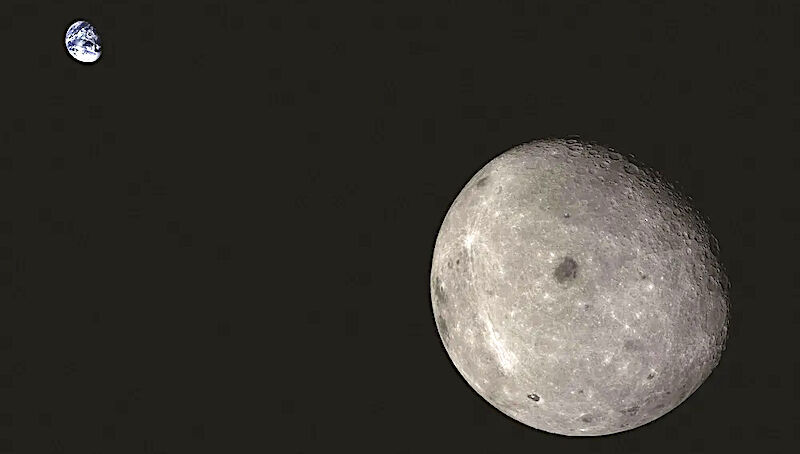
© Chinese Academy of SciencesThe far side of the moon and distant Earth, imaged by the 2014 Chang’e-5 T1 mission service module.
HELSINKI — China's Chang'e-6 mission lander made a successful soft landing on the far side of the moon late Saturday and will soon begin collecting unique lunar samples.

The Chang'e-6 lander made a soft landing at 6:23 p.m. Eastern June 1 (2223 UTC), the China National Space Administration (CNSA) announced shortly after the event. The lander targeted a southern portion of Apollo crater within the South Pole-Aitken (SPA) Basin on the lunar far side.

The landing is a critical step towards bringing unique and scientifically invaluable lunar samples to Earth for analysis. U.S. decadal surveys have highlighted an SPA sample return as a highest priority science objective.

The Chang'e-6 lander used a variable 7,500-newton-thrust engine to slow its velocity in lunar orbit and begin its descent. The lander was scheduled to make rapid positional adjustments at an altitude of around 2.5 kilometers above the lunar surface before continuing its descent. The spacecraft entered a hovering phase for fine hazard avoidance at approximately 100 meters above the surface. It used light detection and ranging (LiDAR) and optical cameras to find a safe landing spot.

Chang'e-6 is China's fourth successful lunar landing from four attempts, and the second on the far side of the moon. It is also the third lunar landing in 2024. It follows Japan's SLIM in January and Intuitive Machines' IM-1 Odysseus lander in February.

Sun

Sun's active regions make 'rare' return with more strong geomagnetic storms possible in June

sunspot regions
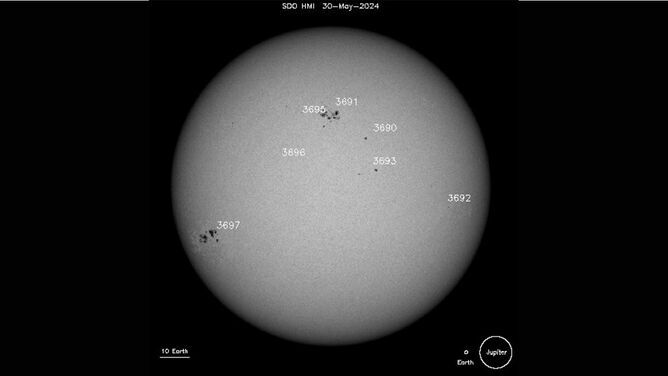
© NASAAn image of the sunspot regions taken by NASA's Solar and Heliospheric Observatory on May 30, 2024. Regions 3697 (bottom left) and 3691 (middle right) are still producing space weather events.
This month, the Sun produced the most intense geomagnetic storms in 20 years and Northern Lights as far south as the southern U.S. Now, active Sun regions are facing Earth, putting Earth in the line of fire once again.

Sunspot regions 3663 and 3664, which caused the G5-level geomagnetic storms in mid-May, are back but with new names as they emerge from the other side of the Sun. Old region 3663 is now 3691, and old region 3664 is now 3697. On the other side of the Sun, the areas were facing toward Mars, sending space weather toward the Red Planet.

NOAA's Space Weather Prediction Center has been busy tracking activity in these regions, including a long-duration strong flare and associated coronal mass ejection prompting a Geomagnetic Storm Watch through this weekend.

Brain

Evidence of surgical tumor removal in ancient Egyptian skull is 'milestone in the history of medicine'

egyptian skull ancient tumor surgery brain cancer
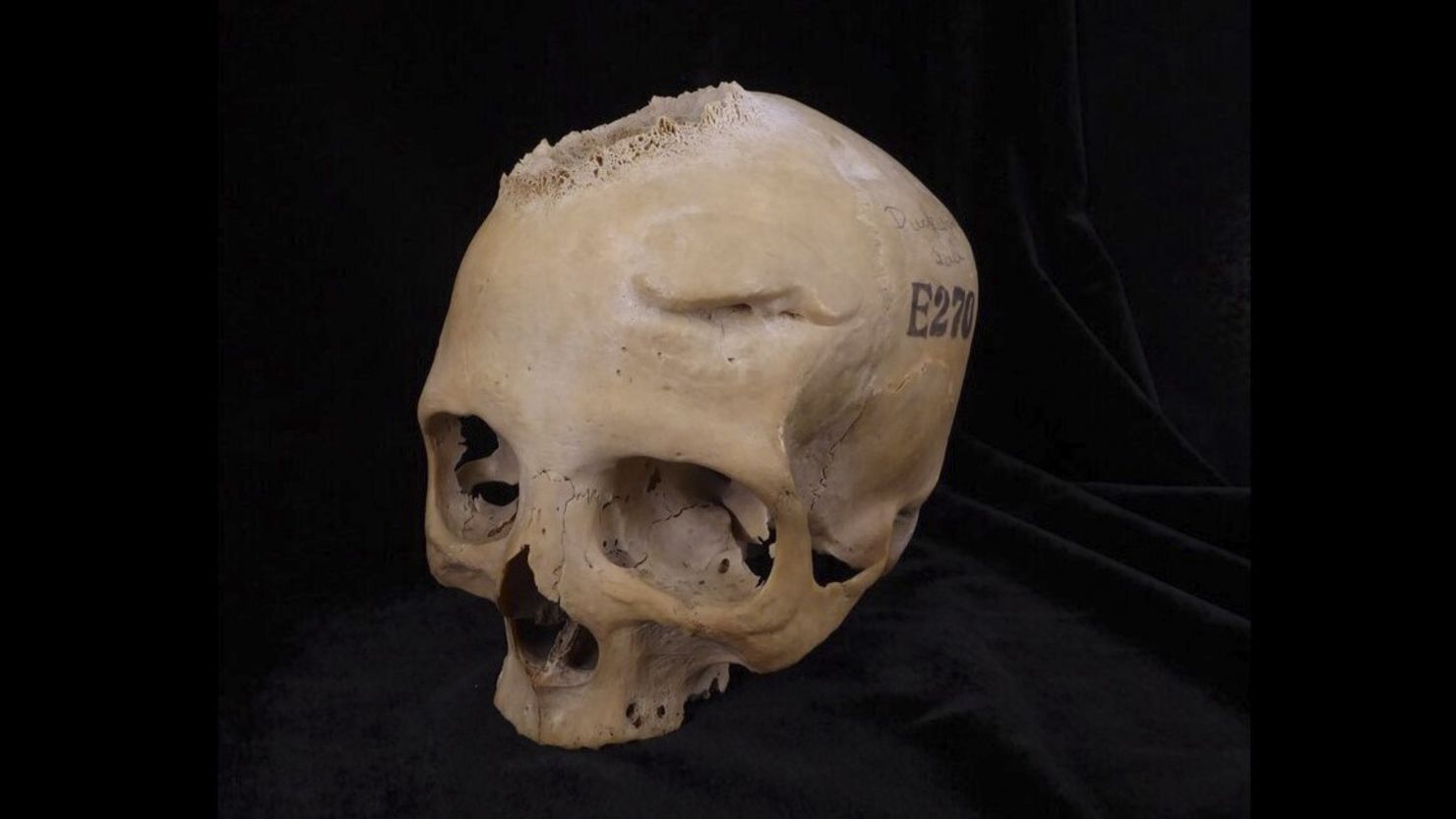
© Tondini, Isidro, CamarósSkull E270, dating from between 664 BC and 343 BC, belonged to a woman who was at least 50 years old, according to the study.
Cancer is often regarded as a disease of the modern age. However, medical texts from ancient Egypt indicate that healers of the time were aware of the condition. Now, new evidence from a skull more than 4,000 years old has revealed that ancient Egyptian physicians may have tried to treat certain cancers with surgery.

The skull belonged to a man who was about 30 to 35 years old when he died, and it resides in the Duckworth Laboratory collection at the University of Cambridge in the United Kingdom. Since the mid-19th century, scientists have studied the skull's scarred surface, including multiple lesions thought to represent bone damage from malignant tumors. Archaeologists regard the skull, labeled 236 in the collection, as one of the oldest examples of malignancy in the ancient world, dating back to between 2686 BC and 2345 BC.

But when researchers recently peered more closely at the tumor scars with a digital microscope and micro-computed tomography (CT) scans, they detected signs of cut marks around the tumors, suggesting that sharp metal instruments had been used to remove the growths. The scientists reported the findings Wednesday in the journal Frontiers in Medicine.

Beaker

A tiny fern discovered to have the largest genome of any organism on Earth

fern longest genome record holder
© Pol FernandezThe DNA of T. oblanceolata measures over 106m in length, making it taller than Elizabeth Tower in London, home to Big Ben.
In a new study published in the journal iScience, researchers from the Royal Botanic Gardens, Kew and the Institut Botànic de Barcelona (IBB-CSIC) in Spain present a new record-holder for the largest amount of DNA stored in the nucleus of any living organism on the planet.

Coming in at more than 100 meters of unraveled DNA, the New Caledonian fork fern species Tmesipteris oblanceolata was found to contain more than 50 times more DNA than humans and has dethroned the Japanese flowering plant species Paris japonica, which has held this record since 2010.

In addition, the plant has achieved three Guinness World Records titles for Largest plant genome, Largest Genome, and Largest fern genome for the amount of DNA in the nucleus.

Monkey Wrench

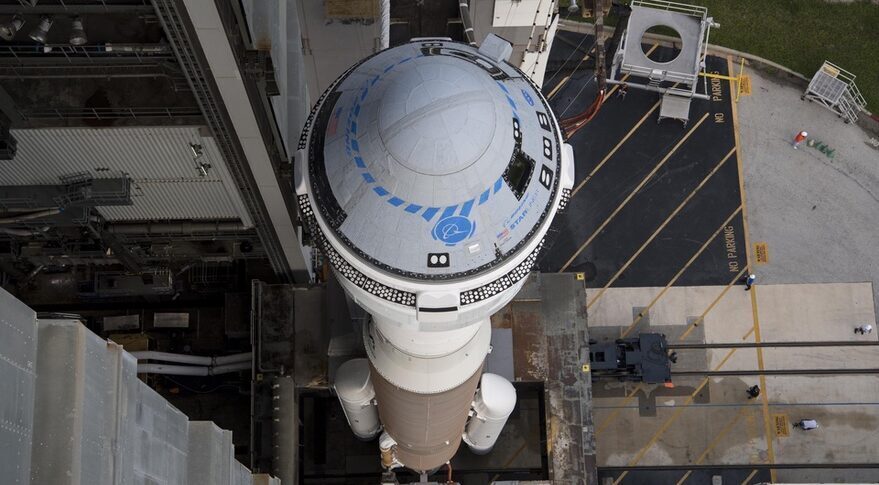
Boeing's troubled Starliner Spacecraft launch delayed AGAIN

Starliner
© NASA/Aubrey GemignaniFILE: Starliner
Update (1245ET):


Comment: Note that the article was initially reporting on the scheduled launch.


The Boeing-Lockheed Martin joint venture United Launch Alliance wrote on X, "Hold. The countdown has been stopped. Safing of the Atlas V, Starliner and launch pad systems is underway."


"The launch of Boeing's Starliner spacecraft has been delayed. Ground controllers called a hold with 3 minutes and 50 seconds left in the countdown. No reason for the delay was immediately given. There is another launch opportunity Sunday," Washington Post's Christian Davenport wrote in a blog update.

Comment: Is this yet another example of the corruption and incompetence that's overwhelming the West?