
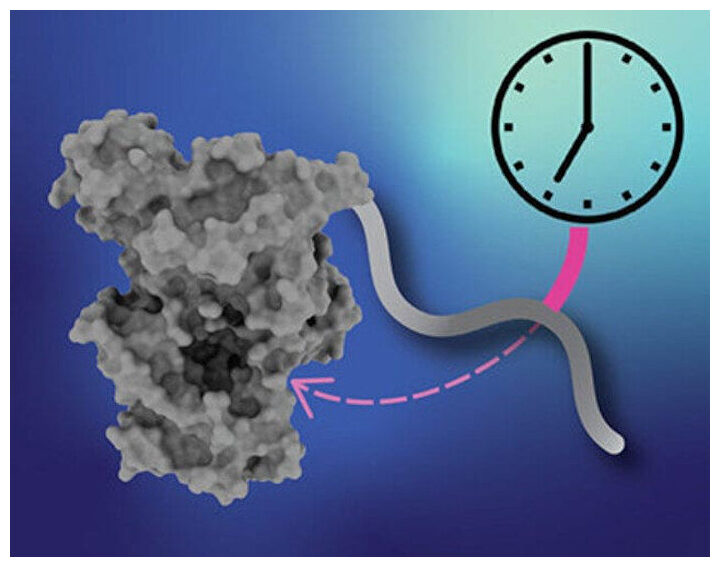
© Illustration by G. Carlo ParicoCryptochrome is one of four main clock proteins that drive daily biological rhythms. This illustration shows a “pocket” in the clock protein complex where binding of the “tail” of the cryptochrome protein helps regulate the timing of the biological clock.
People with this condition are unable to fall asleep until late at night (often after 2 a.m.) and have difficulty getting up in the morning. In 2017, scientists discovered a surprisingly common mutation that causes this sleep disorder by altering a key component of the biological clock that maintains the body's daily rhythms. The new findings, published October 26 in Proceedings of the National Academy of Sciences, reveal the molecular mechanisms involved and point the way toward potential treatments.
"This mutation has dramatic effects on people's sleep patterns, so it's exciting to identify a concrete mechanism in the biological clock that links the biochemistry of this protein to the control of human sleep behavior," said corresponding author Carrie Partch, professor of chemistry and biochemistry at UC Santa Cruz.
Daily cycles in virtually every aspect of our physiology are driven by cyclical interactions of clock proteins in our cells. Genetic variations that change the clock proteins can alter the timing of the clock and cause sleep phase disorders. A shortened clock cycle causes people to go to sleep and wake up earlier than normal (the "morning lark" effect), while a longer clock cycle makes people stay up late and sleep in (the "night owl" effect).















Comment: See also: