Science & TechnologyS


Galaxy

3I/ATLAS is 7 miles wide — the largest interstellar object ever seen — new photos from Vera C. Rubin Observatory reveal

comet w circle
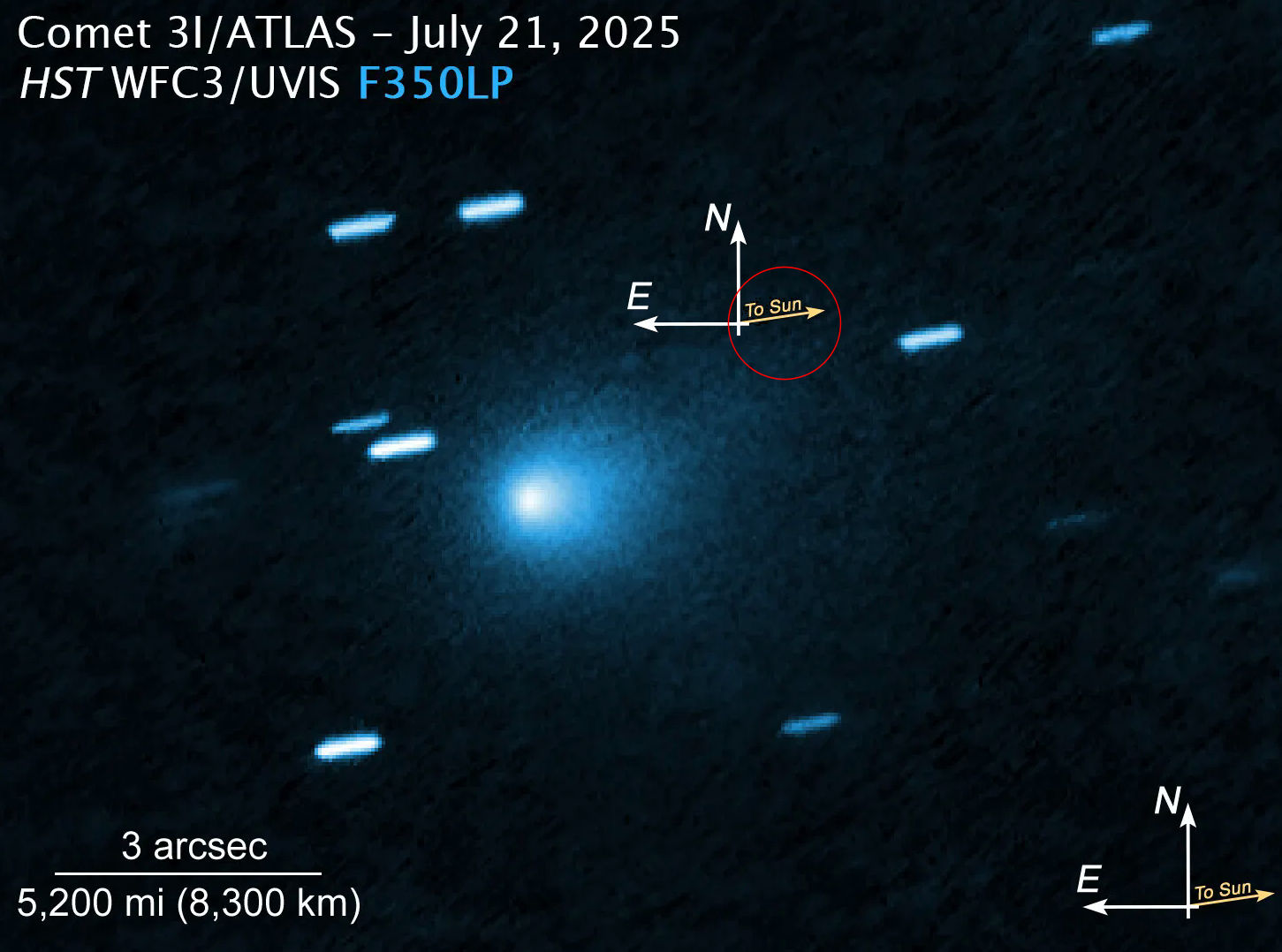
© Darryl Seligman et al.3I/ATLAS is an interstellar comet that is currently shooting toward the sun on a one-way trip through the solar system.
The alien comet 3I/ATLAS is roughly 7 miles (11.2 kilometers) wide, making it the largest interstellar object ever spotted, according to newly revealed photos from the Vera C. Rubin Observatory.

The detailed images, which were captured before the extrasolar entity was officially discovered, highlight the immense power of the record-breaking telescope and demonstrate how valuable it will be for finding future interstellar interlopers, researchers say.

3I/ATLAS was discovered on July 1, barrelling toward the sun at more than 130,000 mph (210,000 km/h). Less than 24 hours later, NASA had confirmed that it was the third known interstellar object (ISO) — an ejected piece of an alien star system that is shooting clean through our solar system. It quickly became clear that 3I/ATLAS was a comet, and computer simulations tracing back its likely region of origin hint that it could be up to 3 billion years older than Earth, potentially making it the oldest comet ever detected.

Black Cat

Physicists create hottest Schrödinger's cat ever in quantum technology breakthrough

digitally enhanced cat
© livescience/alamyA digitally-enhanced photo of a cat
Physicists have replicated the famous Schrödinger's cat experiment at hotter temperatures than ever before. The breakthrough is a small but significant step toward quantum computers that can work at normal temperatures.

Physicists have created a Schrödinger's cat state at unusually hot temperatures, and it could be a major step toward the development of practical quantum computers.

Schrödinger's cat states exist in two distinct quantum states simultaneously and take their name from Erwin Schrödinger's famous thought experiment of a cat that is both simultaneously alive and dead.

Yet to achieve these states, quantum objects usually have to be cooled to their ground states, which exist just a few fractions above absolute zero (minus 459.67 degrees Fahrenheit or minus 273.15 degrees Celsius).

But now, a team of scientists has shown that a state of quantum superposition can be achieved at significantly warmer temperatures than before. The researchers published their findings April 4 in the journal Science Advances.

Nebula

Distorted sound of the early universe suggests we we may be living in a giant void

cosmic voids distorted sound Baryon acoustic oscillations
© Gabriela Secara, Perimeter Institute, CC BY-SABaryon acoustic oscillations represent the sound of the Big Bang.
Looking up at the night sky, it may seem our cosmic neighbourhood is packed full of planets, stars and galaxies. But scientists have long suggested there may be far fewer galaxies in our cosmic surroundings than expected.

In fact, it appears we live in a giant cosmic void with roughly 20% lower than the average density of matter.

Not every physicist is convinced that this is the case. But our recent paper analysing distorted sounds from the early universe, published in the Monthly Notices of the Royal Astronomical Society, strongly backs up the idea.

Cosmology is currently in a crisis known as the Hubble tension: the local universe appears to be expanding about 10% faster than expected. The predicted rate comes from extrapolating observations of the infant universe forward to the present day using the standard model of cosmology, known as Lambda-Cold Dark Matter (ΛCDM).

Bizarro Earth

Gigantic 'mud waves' buried deep beneath the ocean floor reveal dramatic formation of Atlantic when Africa and South America finally split

mud waves
© D Duarte et al/Heriot-Watt UniversityThe 'mud waves' discovered off the coast of Africa, under the Atlantic Ocean, are hundreds of feet high and almost a mile long.
Enormous "mud waves" buried under the Atlantic seabed formed 117 million years ago as the Atlantic Ocean opened up.

The discovery of buried "mud waves" off the coast of western Africa reveals that the Atlantic Ocean was born at least 4 million years earlier than scientists previously thought.

These waves, each hundreds of feet high and over half a mile (1 kilometer) long, were caused by the mixing of extremely salty water from the southern hemisphere with less-salty water from the northern hemisphere as South America and Africa tore apart 117 million years ago, forming the Atlantic, according to new research published in the June issue of the journal Global and Planetary Change.

Previously, the Atlantic was thought to have finished opening between 113 million and perhaps 72 million years ago.

The giant waves were found in sediment cores drilled from 0.6 mile (1 km) below the seabed about 250 miles (400 km) west of Guinea-Bissau in 1975, as part of the Deep Sea Drilling Project. The ocean-drilling project confirmed that Earth's surface is broken into rafts of ever-moving tectonic plates.

Better Earth

Scientists discover long-lost giant rivers that flowed across Antarctica up to 80 million years ago

antarctic rivers
© Guy PaxmanThe rivers likely formed when the supercontinent Gondwana broke up, separating Antarctica from Australia.
Large flat surfaces carved by ancient rivers deep beneath East Antarctica are influencing how ice flows across the continent today, according to a new study.

Scientists have discovered a long-lost landscape that's been preserved beneath the Antarctic Ice Sheet for 30 million years.

Erosion by ancient rivers appears to have carved large, flat surfaces beneath the ice in East Antarctica between 80 million and 34 million years ago. Understanding how these features formed, and how they continue to affect the landscape, could help refine predictions of future ice loss, researchers reported July 11 in the journal Nature Geoscience.

Study co-author Neil Ross, a geophysicist at Newcastle University in the U.K., said in a statement:
"We've long been intrigued and puzzled about fragments of evidence for 'flat' landscapes beneath the Antarctic ice sheets. This study brings the jigsaw pieces of data together, to reveal the big picture: how these ancient surfaces formed, their role in determining the present-day flow of the ice, and their possible influence on how the East Antarctic Ice Sheet will evolve in a warming world."
If the East Antarctic Ice Sheet were to melt entirely, it could raise global sea levels by more than 160 feet (50 meters). But accurately predicting how much the ice sheet might melt in the coming years requires scientists to know its past behavior and the conditions at its base.

Brain

Just like humans, octopuses fall for the rubber hand illusion - pointing to a sense of 'body ownership'

body self-awareness experiments octopus rubber hand illusion
© Sumire Kawashima and Yuzuru IkedaFor the experiments in body self-awareness, the scientists worked with plain-body octopuses (Callistoctopus aspilosomatis).
The trick that plays with awareness of one's own limb appeared to fool all six of the cephalopods tested in a series of experiments

Octopuses, they're just like us: New research suggests the eight-armed cephalopods are also fooled by a version of the rubber hand trick.

In humans, this illusion involves covering a person's hand so they can no longer see it, then placing a realistic-looking rubber hand next to it. When both are touched simultaneously, many individuals begin to "feel" the sensations in the fake hand — and feel like the alien appendage is their own.

The illusion is more than just a fun party trick: First described in 1998, scientists say it sheds light on the interaction between vision, touch and proprioception, or the body's ability to sense its position and movement in space.

Comment: More on the "rubber hand illusion and extensions of the theory:


Laptop

Japan sets new internet speed record — it's 4 million times faster than average US broadband speeds

Blue lighted earth
© Andriy OnufriyenkoScientists developed a new form of optical fiber to send information over roughly the distance between New York and Florida.
A team of scientists in Japan shattered the record for the fastest internet speed by developing new fiber optics.

Researchers in Japan say they have set a new world record for the fastest internet speed, transmitting over 125,000 gigabytes of data per second over 1,120 miles (1,802 kilometers).

That's about 4 million times the average internet speed in the U.S. and would allow you to download the entire Internet Archive in less than four minutes, according to some rough estimates. This is also more than twice the previous world record of 50,250 GB/s, previously set by a different team of scientists in 2024.

To achieve this new speed — which has not been independently verified — the team developed a new form of optical fiber to send information at groundbreaking speeds over roughly the distance between New York and Florida.

Moon

Earth may have at least 6 'minimoons' at any given time. Where do they come from?

Minimoons
© Nazarii Neshcherenskyi/iStock/Getty ImagesA minimoon could be an object that is at least temporarily bound to Earth, makes at least one revolution of the planet, and is closer than about four times the Earth-moon distance at some point in its orbit.
Half a dozen fragments of the moon may briefly orbit Earth at any given time, before moving on to circle the sun, new research suggests — but the minimoons' small size and quick pace make them challenging to spot.

When objects collide with the moon, they send up a shower of material, some of which manages to escape into space. Although there may be an occasional large chunk, most are fast-moving and smaller than 6.5 feet (2 meters) in diameter. The bulk of the lunar material falls into orbit around the more gravitationally attractive sun. But some of the debris may occasionally be pulled into an orbit around Earth before returning to circle the sun, researchers explained in a study published in the journal Icarus.

It's "kind of like a square dance, where partners change regularly and sometimes leave the dance floor for a while," Robert Jedicke, a researcher at the University of Hawaii and lead author of the study, told Space.com by email.

Microscope 2

Best-ever map of the human genome yields new information on 'jumping genes,' 'junk DNA' and more

Junk DNA
© National Institute of Health
In a pair of papers, scientists greatly expanded our catalog of known genomic variation among humans.

Twenty-two years after the completion of the Human Genome Project, scientists have unveiled the most expansive catalog of human genetic variation ever compiled.

Across two new papers published Wednesday (July 23) in the journal Nature, scientists sequenced the DNA of 1,084 people around the world. They leveraged recent technological advancements to analyze long stretches of genetic material from each person, stitched those fragments together and compared the resulting genomes in fine detail.

The results deepen our understanding of "structural variants" within the human genome. Rather than affecting a single "letter" in DNA's code, such variations affect large chunks of the code — they may be deleted from or added to the genome, or encompass places where the DNA has been flipped around or moved to a different location.

Comment: Further reading:


Ice Cube

Changes to the polar vortex are plunging parts of US into deep freeze

changes polar vortex cold weather
© NOAA via Getty ImagesA satellite image showing a large area of low pressure, from the polar vortex, moving into the northern U.S. on Jan. 6, 2014. This weather system brought dangerously cold temperatures not seen in half of the continental United States in about 20 years.
When the polar vortex stretches, North America feels the chill. New research reveals some of the stratospheric patterns controlling these cold snaps.

Though global temperatures are warming, winters in the Northern Hemisphere are still marked by cold snaps and extreme snowfall events — sometimes to an unprecedented extent, such as the 2021 deep freeze in Texas and Oklahoma that caused over $1 billion in damage.

Now, a new study suggests that these cold extremes are due to an increasingly common pattern in the polar vortex, the zone of low pressure that usually circulates over the Arctic. Disruptions to this vortex cause it to deform and stretch, spewing cold air into Canada and the U.S. These disruptions are becoming more common as the Arctic warms.